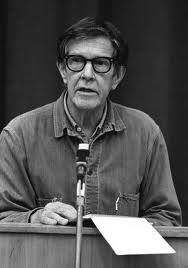
Happy Birthday John. 5 September 1912, 12 August,1992.
I CAN’T UNDERSTAND WHY PEOPLE ARE FRIGHTENED OF NEW IDEAS.
I’M FRIGHTENED OF THE OLD ONES.
John Cage
Photo and quote courtesy of Alan Zimmerman.
Happy Birthday John. 5 September 1912, 12 August,1992.
I CAN’T UNDERSTAND WHY PEOPLE ARE FRIGHTENED OF NEW IDEAS.
I’M FRIGHTENED OF THE OLD ONES.
John Cage
Photo and quote courtesy of Alan Zimmerman.
May 9, 11:10 PM
Had an 8AM bus to start the day. Our schedule, – The Great Wall, Peking duck dinner, Nexus treats our Chinese hosts.
The Great Wall – well what can I say? The bus pulls up to a parking lot near a building with a big sign in English” The Great Wall Souvenir Shop” and “Coca Cola.” Could be Niagara Falls except the crowds are mostly Chinese and the attraction is a giant wall outlining the crest of some of the most beautifully shaped hills I’ve ever seen. (Note: Today, 2014, most of the visitors to Niagara Falls could well be from China.)
Have to stop for a moment. In the hotel I hear a lot of French voices in the hall. “Les Grande Ballet Canadian” has just arrived in Beijing and are staying on our floor. Good luck kids! Perhaps I’ll be able to speak to some of them tomorrow. I want to re-meet my square dance partner from Ottawa.
May 10, 7 AM
At the wall we can turn either left or right, conditions imposed by the wall itself. We go left, left because there are less people in that direction. Less people in that direction because the client is so steep. It starts out innocently enough – just a good plodding gait. Our goal is the highest visible tower. At one point the angles are 45 to 55 degrees. There is one section where, coming down John and Russ’s heads are the only visible part of them and they are only 15 steps below us. The view is incredible – looking north and west over a vast plain to more hills and mountains in the distance. Kwang Chao stopped shortly after our assent and says she will wait for us. She knows what’s coming. Wang explains after our climb that we are now heroes. Beyond the highest point we reach, the wall has crumbled in some places. it is now a faint line against the hills. From the look of these hills and mountains I can appreciate now the graphic representations found in Chinese art. There are many hills in a chain and many shapes, some very sharp. Here there are no single massive structures as found in the Rockies. There was a twinge visualizing thousands of Mongolians and ponies moving towards that wall.
“Shawn Lay Bah!” (phonetic spelling for “get on the bus”, a command we hear often.) The Ming tombs rest with their backs against a low chain of hills and look out over a beautiful valley. No wonder so much Chinese art shows people as insignificant against the landscape. There are 12 or so tombs being excavated and only one is open. Each have Temple buildings. Their tombs were constructed so that when the doors were closed a large marble slab fell in place behind them. The workers were killed and the entrances hidden. Mao’s mausoleum is much larger.
We get back to the hotel with about 40 min. to spare for dressing and resting before Peking duck. The restaurant where we eat invented this dish during the Ming Dynasty. The meal is the best we’ve had to date. The seating is arranged in two tables. At our table is Mr. and Mrs. Rose, two young Chinese diplomats; my favorite speaker, Mr. Sung; John and Jean; a heavy from the Arts Bureau, Bill and one other Chinese cultural official. We have a few appetizers and John makes his speech in English, translated by Kwang Chao. When he thanks a whole list of people, ending with her, she finds it embarrassing to refer to herself and the officials at our table chuckle at the impossibility of her predicament.
After Mr. Sung’s speech, when small groups are conversing I compliment him on his speaking abilities. The drama of his gestures and his rich voice. He explains that he used to be an actor and singer (base). His voice is not so good now perhaps too much smoking and mai tai. The Chinese are proud of the food at our banquet and Mr. Sung mentions that Italy got its noodles from China. He says that when he was in Italy they only had one size of noodle and it was not as good as noodles in China.
I ask him the Chinese theory on 1st man. He begins a reply, is taken back, chuckles and defers to Mr. Whoever – two bodies to my right. The explanation is pure Darwinism.
I asked Mr. Sung if he ever played a musical instrument. He talked about his childhood and playing a drum during spring festivals. He then produced a short but very moving analysis of what percussion meant to him. How his heart beats to the music and how soft and loud a drum can be – “A pin dropped on the ground and thunder”. We toast each other with mai tai. While watching each other out of the corners of our eyes we throw it back draining the glass in one gulp and then show the empty glass to each other. I am reminded of the scene in “Patton” when George C Scott and the Russian general toast one another.
There was a toast after John’s speech and as we raised our glasses. Kwang Chao said “Bottoms up”. We’ve been teaching her slang but she was immediately worried that it was not serious enough for the occasion. I told her “Bottoms up” could be expressed seriously and threw back my brew. Mrs. Rose remarked with some alarm that I did indeed take “Bottoms up” seriously and I told her it was the act of a coward. That I had learned from the 1st banquet how to handle the drink. Mr. and Mrs. Rose ( David and Judith) were slightly alarmed that Nexus had been teaching slang to Kwang Chao. Kwang is very fast and remembers a great deal. She is impressed by how openly we express our opinions and state our views. Some phrases we have taught her:
” He doesn’t have a full deck” say this while pointing to your temple with your 1st finger. “You’re coming from left field” ” Grody to the max” ” Funky”, “Get down”, “ Holy cow”, “He bought the farm”, Here’s mud in your eye” “Up yours”, The shit’s hit the fan”.
Her favorite is ”Get your ass in gear.”
We explained to David and Judith that we will refine her education during the next week so that she will know when and in front of whom to make these remarks.
When we get back to the hotel, Bill wants to talk and offers to buy the warm Cokes. We stay up for about an hour. Bill didn’t want to go to the banquet and when he told, John the response was not empathetic. I admitted that I had thought about becoming sick but decided against it.
As a whole, Nexus does not function well in official situations – at least Chinese official situations. Interestingly enough, neither do the Chinese. It appeared to both Bill and me that the heavies would rather have been someplace else. There was some covert watch watching.
When we talked to Guy St. Jacques at the end, he told us that their table discussed dope. The Chinese wanted to know how marijuana, hashish, cocaine and heroin were used and to what effect. Sounds like they were at a different banquet. Obsequiousness is not our style. Perhaps we should have taken them to Donald Duck’s fast food restaurant. It is my individualism confronting this lack of individualism. But as I said earlier, you have to do what you do, let it hang out, let it all hang out. Diplomatic people are playing in shadows. Once in a while they appear, do something they thought about for a long time and then fade back into the dusk. What you’ve heard sounds okay but there is nothing to indicate flesh and blood. It is a cliché, (another favorite definition of Kwang Chao).
Our last concert was reviewed in the Chinese press. The review listed the pieces we played and said we received a warm response. That was it. Our last concert was videotaped by Beijing TV and we will receive a copy – also a tape of our 2nd concert for radio. Anton Kuerti is coming with Bob Aiken, Joel Quarrington, and Jim Campbell sometime in the near future. Tony is noted for stopping a performance and telling the audience to shut up. I would love to be here for his 1st performance. He cannot tolerate smoking and spitting and he’s a vegetarian. Good luck!
I have grown increasingly fond of Guy St. Jacques. Good sense of humor and good conversationalist, very open. I spent this morning in my room writing and admiring a book of paintings I purchased for 30 yuan at the Ming tombs. Very relaxing. We fly to Shanghai tonight at 7:40. Mrs. Rose has promised I will have a closet in my hotel room in Shanghai. I hope she’s right. David Rose described our hotel there as colorful. Ummm. I’m not losing weight – even feel as though I’m gaining. Is rice, veggies, shrimp and beef fattening? I’ve eaten no breakfast since leaving Toronto. I thought I was off to a good start when I had 2 great bowel movements in Japan. I’m plugged, no , it’s Metamucil time!
 Robin Engelman
Barbara Hannigan redux
Her Hands Lead, Her Voice Follows. Barbara Hannigan Sings and Conducts at the Lucerne Festival
By JAMES R. OESTREICHAUG. 19, 2014
In fact, barring the need for surgical removal of an appendix, the hands and arms can be an even bigger problem, since they are inescapably visible. Aspiring vocalists may take years to learn to use their hands expressively or, alternatively, to keep them out of mind, if not out of sight.
Barbara Hannigan, a superb and versatile Canadian soprano, has found another use for her hands and arms. At 43, she is developing a second career, as a conductor, and she seems to be stealing shows around Europe with some regularity, as she did here on Saturday in a late-night concert with the Mahler Chamber Orchestra at the KKL Concert Hall as part of the Lucerne Festival.
This sort of career realignment is rare among singers. Ms. Hannigan cites the parallel example of the French contralto Nathalie Stutzmann, who conducts and often sings at the same time.
The tenor and baritone Plácido Domingo is the best-known example of a classical vocalist who conducts regularly, though typically in the opera pit, where he is not singing at the same time.
But why not do both on the concert stage? Ms. Hannigan sees no reason not to, arguing that singers actually have an advantage over instrumentalist-conductors who play along with an orchestra: precisely that availability of hands and arms, otherwise idle, to lead the band.
“You sing like a conductor,” colleagues used to tell Ms. Hannigan of her musical personality and stage manner, she said in an interview on Sunday. And you can see some of that when she conducts while singing.
In three splendidly delivered Mozart arias here, her beating of time and cues to players often seemed mere amplifications of expressive gestures she might have made anyway. Since much (most?) of a conductor’s job takes place in rehearsal, she was able to leave a lot of the last-minute coordination and balancing of parts to the concertmaster.
Colleagues have also told Ms. Hannigan that her arm movements are particularly expressive, she said, and this, too, was borne out in her conducting of purely instrumental works: Rossini’s “Scala di Seta” Overture, Ligeti’s “Concerto Romanesc” and Fauré’s “Pelléas et Mélisande.” Her arms seemed fluid, elbowless entities, shoulder to wrist, evoking curvilinear waves of sound, and she did not use a baton.
This is one reason that Ms. Hannigan, unlike many other female conductors, chooses not to shroud her arms, or her femininity as a whole, in, say, a dark suit. She wore one for her conducting debut, at the Théâtre du Châtelet in Paris in 2010, and that was the last time.
“I thought, ‘I never wear a suit to sing,’ ” she said. “ ‘Never, ever. That isn’t my uniform.’ ”
She decided that from then on, she would wear “something that suited the music, suited the program,” she said.
For her concert on Saturday, she wore a glittery knee-length sheath until the grand finale, Ligeti’s “Mysteries of the Macabre,” a series of high-flying arias drawn from the composer’s nonsensical opera “Le Grand Macabre.” Ms. Hannigan, a specialist in modern and contemporary music who recently won great acclaim in productions of Berg’s “Lulu” and George Benjamin’s “Written on Skin,” has made this work — which she has sung often — her calling card.
She says she now sings it only when conducted by the English maestro Simon Rattle, a frequent and favorite collaborator, or — more often — herself. She performs it in vampy black leather, high-heeled platform boots and a wig, and inevitably brings the house down, as she did on Saturday.
Mr. Rattle has mentored Ms. Hannigan and sent her to the wizardly Finnish maestro and pedagogue Jorma Panula, who, Mr. Rattle says, came out of retirement to guide her.
“We’ve only worked together for eight or nine years,” said Mr. Rattle, who is in town to work with students of the Lucerne Festival Academy, “but it quickly became apparent that she is one of the best musicians out there. When she brought up the notion of conducting, I was surprised but not staggered. It seemed a fairly normal thing to do.”
A latecomer to conducting, Ms. Hannigan now faces the challenge of building up an orchestral repertory while maintaining a busy singing career in Europe and expanding it in North America. But Ms. Hannigan, with musicality to burn, says she is in it for the long haul.
“Conducting is now 20 percent of my schedule,” she estimated. “Eventually it will be 50-50, and then I will only conduct.”
She looks to tackle bigger orchestral works, with Mahler’s Fourth Symphony in the offing. (Ms. Hannigan will sing the soprano solo in the finale of that work in a performance here on Sept. 6, with Matthias Pintscher conducting the Lucerne Festival Academy Orchestra.)
She also looks to conduct opera, with Stravinsky’s “The Rake’s Progress” being a possible starting point.
For her and audiences alike, it promises to be quite a ride.
Posted by robinengelman on August 21, 2014 in Articles, Commentaries & Critiques, Contemporary Music
Tags: Barbara Hannigan, conducting