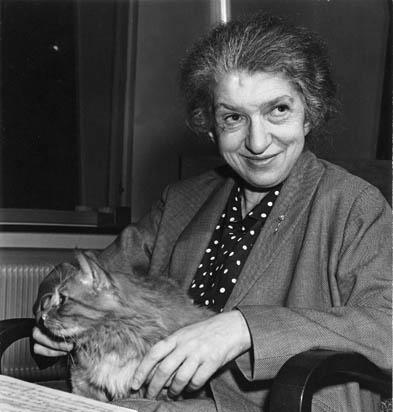
First published by Clavier® Volume 39, No. 7, September 2000, p. 25 f. (C) 2011 – Alle Rechte vorbehalten. The Perfect Clara Haskil © by Peter Feuchtwanger.
As Clara sat down “the music materialized as if from nowhere. Her arm seemed to glide over the keyboard without preparation, just as a flat stone skims across the water. This was so typical of her playing; nothing seemed to start or end, and everything became timeless.”

Admiration and international fame came late in life for Clara Haskil, in a career beset by poor health and the adversities of a world war. Dinu Lipatti described her playing as “the sum of perfection on earth,” Wilhelm Backhaus called it “the most beautiful in the world,” Tatyana Nikoleyeva burst into tears when she first heard Haskil, and Rudolf Serkin nicknamed her “the perfect Clara.” Haskil’s close friend, Nikita Magaloff wrote, “I had the great privilege of hearing her, at her home and mine, thumbing through fingering, deciphering and running over the most diverse works, and that is why the Chromatic Study by Debussy, the Etude Tableau in E flat minor by Rachmaninoff, a passage from the Totentanz of Liszt or a Rondo of Chopin rest engraved in my memory as played so inimitably by her. Never, even amongst my most illustrious colleagues, have I met with that incredible and disconcerting facility and pianistic ease, which a spontaneous, uncalculated, natural flow of the music. That which others achieve by work, research, and reflection, seems to come to Clara from heaven without problems.” (The Journal of the British Institute of Recorded Sound, July-October, 1976)
I first heard Clara Haskil’s name mentioned by Dinu Lipatti after a recital he gave in Switzerland. When I congratulated him on his Mozart playing, Lipatti said, “In two weeks’ time you must hear Clara play Mozart. Then you will realize how far the rest of us are from the truth.” I was young at the time, but the name stuck in my mind. Who was this mysterious Clara? Five years later during another visit to Switzerland, the mystery was solved. At a concert in the Tonhalle in Zurich on September 7, 1952, Clara Haskil was the soloist in Mozart’s Concerto in E flat, K. 271.
The concert was well-nigh sold out, and the only tickets available were for the cheapest seats in the annex. Mine was behind a pillar, where I could hear well but not see. The concerto begins with a question from the orchestra that is answered by the soloist in the second bar. The question repeats, prompting the soloist to emphasize the answer. Haskil’s response aroused my curiosity and made me listen. Nothing, though, prepared me for what was to com. After the ensuing tutti, the B flat trill suddenly materialized, and I heard something akin to Mary Garden’s description of Nellie Melba’s top C at the end of the fist act of La Bohème.
The note came floating over the auditorium of Covent Garden: it left Melba’s throat, it left Melba’s Body, it left everything, and came over like a star and passed us in our box, and went out into the infinite. I have never heard anything like it in my life, not from any other singer, ever. It just rolled over the hall of Covent Garden. My God, how beautiful it was! Since then I always wait for that note when I hear the first act of La Bohème. (Mary Garden’s Story, Michael Joseph)
Likewise, I now wait for that B flat trill whenever I hear this concerto. Haskil recorded K. 271, but no recording can capture the consummate musical expression or magic of a great artist, which is something ineffable. Haskil’s performances in the concert hall were often miracles, and miracles simply cannot be reproduced. Her performance that night was greeted with stormy applause, so I seized the opportunity to look around the pillar to see who was responsible for such divine sounds. Grasping the conductor’s hand as if for reassurance and with a look of disbelief on her face, Clara Haskil acknowledged the audience’s enthusiasm.
I glimpsed at the pianist who one London critic described as playing “Mozart for the Gods.” In years to come I heard her many times, both publicly and privately. For theses experiences I remain eternally grateful. As I left the hall, a friend who knew Haskil offered to take me backstage. She seemed inconsolable and unhappy, excusing her poor performance to anyone who congratulated her. When introduced, I mumbled my admiration, and she asked whether I was a pianist. After hearing such playing, I did not want to talk about my own and said I was a composer. A few weeks later I saw Clara waiting at a tram stop, looking forlorn. “Ah, the young composer,” she exclaimed, and that’s how our friendship started.
Born in Bucharest on January 7, 1895 of Sephardic Jewish parents, Haskil’s musical talent was evident in early childhood. At the age of three she could pick out any tune that an older sister played on the piano. She was not yet five when a professor at the Bucharest Academy visited her parent’s home and played a Mozart sonata. When he finished she repeated the sonata perfectly, while simultaneously transposing it into another key, all without having had any musical instruction. After her father’s death, the girl’s uncle brought her to the attention of Anton Door, a celebrated piano teacher in Vienna who had known Johannes Brahms, Clara Schumann, and Joseph Joachim.
Door described meeting the girl in the Neue Freie Presse in April 1902: Recently a doctor from Romania came to me, leading by the hand a little girl barely seven years of age. The child, whose mother is a widow, is unique. She has never had any music lessons beyond being shown the value and names of the notes. More did not seem necessary, for every piece of music that is played to her and which she can manage with her small hands she repeats by ear without mistake and in any key one asks. An easy movement from a Beethoven Sonata that I gave her she played at sight without difficulty. One is baffled, for this early maturity of a human brain strikes one as uncanny.
In 1903 Haskil began piano studies with Richard Robert, whose pupils included Rudolf Serkin and George Szell. He took a special interest in the young artist, and soon she created a stir in musical Vienna with a performance of Mozart’s Concerto in A Major, K. 488. Two years later at age ten, she gave her fist solo recital. In 1905 she entered the Paris Conservatoire, impressing the director, Gabriel Fauré, with her musical gifts. Joining Alfred Cortot’s class in 1907, she graduated at age 15 with the Premier Prix. Extensive concert tours to France, Switzerland, Italy, and Bucharest followed. In Switzerland Ferrucio Busoni, then at the height of his career, heard Haskil play his transcription of Bach’s D minor Chaconne and invited her to study with him in Berlin.
Clara’s mother declined the offer on the grounds that her daughter was too young. Instead, further concert tours were organized until the first of many severe physical setbacks brought Haskil’s concert career to an abrupt halt in 1913. In an attempt to delay the onset of scoliosis (curvature of the spine), she spent the next four years in a plaster cast. Though acclaimed in the later years as the foremost Mozart pianist of her generation, it was in such works as Islamey, The Great Gate of Kiev, Feux Follets, and the Brahms B flat Concerto – learned in two days – that she excelled in playing in those early years.
Haskil learned Feux Follets by hearing Vlado Perlemuter play the piece at a private function; then she performed the work a few days later and confessed afterwards that she had never seen the score. From early childhood Haskil was fond of the violin, especially the playing of Joseph Joachim, which nearly moved her to tears. Peter Rybar, the Swiss violinist, recalls an occasion in Winterthur in 1944 when she picked up a violin during a rehearsal break and began playing the fist movement of Mendelssohn’s Violin Concerto. Rybar could scarcely believe his ears: the playing was perfect, with impeccable phrasing and intonation, and an exquisite tone. She had hardly three years of violin study and practiced only on the day of her lesson.
Throughout her career Haskil performed with such great string players as Eugène Ysaÿe, Georges Enesco, Pablo Casals, Arthur Grumiaux, Pierre Fournier, Joseph Szigeti, Zino Francescatti, Isaac Stern, Yehudi Menuhin, Henryk Szeryng, and her sister Jeanne.
Note from R.E. I am extremely grateful to my friend and inveterate collector of important memorabilia, David Waterhouse for unearthing this inspiring article from his library of writings on music.
My introduction to the art of Clara Haskil is related in Clara Haskil and Arthur Grumiaux: The Elegance of Great Art.
 Robin Engelman
the Bradshaw Amphitheatre, an Homage
The Richard Bradshaw Amphitheatre, RBA, has achieved Most Favoured Venue status with Toronto chamber music audiences. An anonymous gift makes the RBA’s public concerts free of charge. They are the product of programme director Nina Draganic whose discriminating and eclectic tastes consistently account for line ups and full houses. A visit to Ms. Draganic’s RBA website will provide ample insight into the popularity of her concert series.
Rick Sacks was one of her presciently gratifying choices. On 24 April, he performed a concert of music for the MalletKat – two octaves of rectangular rubber pads laid out like the black and white keys of a piano keyboard and activated with, what else, mallets. A computer helps program the pads with an almost infinite number of sounds and Rick employed many of them during the concert. An hour’s worth of MalletKat music proved plenty diverse enough to hold the audience’s attention.
Rick played six works, four of his own creation. On a couple of occasions, his natural gift for whimsy struck home. In his 2009 Dragnet, a Sergeant Friday -“Just the facts Mam” tribute, Rick donned a fedora and pulled up his shirt collar to take his bow.
The program opened with a work by David Lidov, evocatively titled I Want You To Know That I Love You (An Aria). This was written in 2011 and revised in 2012. I didn’t feel loved at all and wondered if i was missing something. Perhaps. There were no programme notes.
A commission by Rick was GOLEM (2014) by Musique Concrète composer Giels Gobeil. Although to me overly long, GOLEM is the work of a professional and the first work by Gobeil involving a performer. The industrial or factory sounds were, for the most part mesmerizing. I believed Rick when he said prior to playing the work, that it was extremely difficult and he was still working on it. At concerts end, GOLEM elicited questions from the audience about its notation.
Lullaby (2010) by Sacks, is a simple construction of sampled sounds of a naturally amplified German version of an Mbira. Lullaby is a beautiful work and without the traditional buzzing of shells or bottle caps attached to Mbiras played in Africa, it was profitably adapted to the MalletKat. Tender and affecting, Lullaby created a dramatic presence.
The last work was the premier of Rick’s Andronicus, which, on a couple of occasions and much to the delight of the capacity audience, he accidently referred to as Androgynous. Dedicated to the Bradshaw Amphitheatre and the Canadian Opera Company, Andronicus is a skillfully arranged pastiche of operatic excerpts triggered by strikes on the MalletKat. Andronicus ended in parody with a much too long high soprano note allowing Rick, mouth opened wide, sanpaku eyes ablaze and a supplicant’s arms outstretched, to accept his audience’s long and grateful applause.
Rick Sacks is the artistic director of Array Music, a composer, a percussionist and conductor. In this author’s opinion, Rick’s term as Array’s Artistic Director has wrought significant changes bringing Array Music into an elite group of Canadian contemporary music educators and presenters. I look forward to Array’s Young Composers Programme in the last half of this month. (May 2014.)
R.E.
Posted by robinengelman on April 30, 2014 in Articles, Commentaries & Critiques, Contemporary Music
Tags: David Lidov, Giels Gobeil, Richard Bradshaw Amphitheatre. Nina Draganic, Rick Sacks