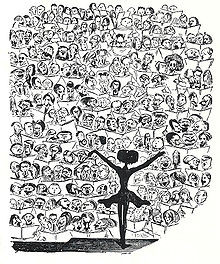
Hector Berlioz conducting a choir. Gustave Dore, 1850.
Arrogance exists for many reasons and comes in many forms. Interestingly, the bed rock of arrogance is often insecurity. In recent years I’ve been under the knives of surgeons, all of them arrogant. Though rarely more than skilled craftsmen, forever replicating the same procedure, surgeons appear convinced of their pre-eminent place in the medical profession. Their work is performed in theatres under bright lights. Only after aides have prepared the patient, does the freshly scrubbed surgeon make his entrance, arms half raised as if bestowing a blessing.
Personally I think anesthesiology is where it’s at and the anesthesiologists I’ve met have been thoughtful, interesting people. The last one to put me under, played the Saxophone in his spare time. They’re also the people that insure my survival during the cutting and hacking.
Conductors of symphony orchestras are the surgeons of the music world. They too consider themselves pre-eminent in their field. Their work is done under similar conditions, players perform the critical tasks needed to replicate the conductors’ repertoire. When everyone is attentive and quiet descends, Maestro makes his entrance, poised, with baton rampant.
A few weeks ago my wife and I attended a Toronto concert by the Mariinsky Orchestra from Petersburg, Russia. The Marviinsky Orchestra is a misnomer because four orchestras known by the same name exist in the Marviinsky Theatre complex. The orchestra we were to hear was in the midst of a tour and had prepared two programs. Ours was all music by Stravinsky. A 3 1/2 hour extravaganza with two intermissions, the works were played in the order written: the complete Firebird Ballet music, 1910; the complete Petrushka Ballet music 1911; and Le Sacre du Printemps, 1913. It was a marvelous trip hearing these three works in succession and the band could play loud as well as seat-edge soft.
The playing was uniformly good and the clarity of voices was stunning. I was disturbed by the lack of physical movement from the orchestra players, most noticably in the strings who sat motionless except for their arms and fingers. No one was swaying. There was no evidence of anyone digging into the music. Are there excuses for playing dance repertoire without moving? Go figure. There was an exception. The bass drummer, who doubled on small tambourine and gong, was the oldest member of the section and its best musician. He was into the music, always. I waited for him by the stage door, but finally gave up and reluctantly conveyed my congratulations to him via another member of the orchestra.
These were antiseptic performances with some startling affects. There was only one moment that transcended all others, totally captivating. Near the end of Petrushka there are groups of 5 eighth notes in rhythmic unison for brass and timpani. The Marviinsky voices were so exquisitely balanced, they created a bell-like sound I’d never imagined possible. Gergiev is the artistic director and principal conductor of the Mariinsky Theatre complex. He had brought the youngest musicians on this tour so they’d gain experience. Their next stop was Carnegie Hall where a stage hands’ strike would be settled just before Mariinsky‘s concert. (The average take home pay for a Carnegie Hall stage hand? – $ 400,000.00 US. New York is an expensive town.)
The other disturbance was Gergiev. He did not use a podium or baton, which created intimacy. From shoulder to wrist, his conducting motions were generally reserved, but his fingers flailed above as if defying anyone to follow him. He strode on and off stage with a “I can do anything swagger”, bowed curtly, turned and began his phalangial oscillations. Gergiev even conducted the flutist’s solo in Petrushka. An unnecessary imposition of either control, or arrogance, or both. He was showing off and if I could conduct those three works from memory, I might develope a bit of haughtiness myself.
Fortunately I met a local Deep Throat after the concert. He was one of eight Torontonians hired to fill out the Mariinsky wind section. “It was crazy. Madness”, he said, describing a one hour rehearsal given the locals for Le Sacre. That was it. Deep Throat said, “We couldn’t figure out his beat. Once I came in early, but he didn’t say anything.” Deep Throat ruefully shook his head and joined his wife for the ride home.
Oh, one thing more. Of the seven Mariinsky contra bass players, five gripped their bows German style. Two used the French grip. I didn’t hear any difference. C’est la vie.



 Robin Engelman
AUSTRA
Pleiades, a work for percussion by Greek composer Iannis Xenakis, forced me to wear ear plugs for the first time. With all respect to Dionysus, it was the loudest music I’d ever heard.
But not as loud as Austra, an electro-acoustic band formed in 2009 in Toronto. Its members are percussionist Maya Postepski, singer Katie Stelmanis and bassist Dorian Wolf. Austra, as they say in the bizz, has a buzz. Their first CD, Feel it Break (2011) was a New York Magazine Top Ten Album of the Year and received a Juno Award nomination for Electronic Album of the Year and came within a decibel of winning. (Check out Lose It). They’re beginning to make it, particularly in France, Germany and England. Austra’s been on the road for three years and If any couch potato wants to feel queazy, check out their current touring schedule:<http://www.austramusic.com>).
Maya studied music and percussion at the University of Toronto and played for 4 years in the Faculty Percussion Ensemble. At the same time, Stelmanis was a voice major in the faculty opera department. Wolf is a veteran of many bands and no mean photographer. While still in school, Maya invited me to hear their fledgling group in a local venue used primarily by young musicians. The band was too large, a bit unwieldy and the house sound system did them no favours. After that trial run, Austra pared itself down to a trio and Maya’s contributions have bloomed with the purchase of conga drums, a viberaphone, glockenspiel, some traps and a complete drum set. Austra has also acquired managers and agents and most important for the trio’s music, a full time, professional soundman.
A few weeks ago Maya and I reconnected over dinner. She invited me to Austra’s concert in Toronto’s Phoenix Concert Theatre. Besides free admission, she gave me a back stage pass for food and drinks at the after concert party. My first.
I met up with three former U of T students, two percussionists and a flutist. We had our picture taken with Maya before the concert and sat in the balcony at the back of the theatre.
Tricia Mangat, Maya Postepski, Robin, Mandy Lau, Laura Chambers. Phoenix Concert Theatre, Toronto, 27 September, 2013.
I had been told to bring earplugs. I didn’t. The first tune hit like a solid wall of sound so loud, I felt my dinner beginning to digest. I sat stone still, trying to relax. Conversation with friends was impossible. Cripes I thought, how could the kids pressed against the stage bear this Maginot line barrage?
Nearby, a tall delicate girl dressed in diaphanous white began moving her arms over head, her hips side to side, in a slow meditative choreography to the music. She kept this up for Austra’s entire set, providing me an occasional diversion. As the evening progressed, I began to hear voices moving in the walls of sound. Stuff was happening in there.
Even so, I had difficulty separating electronic from acoustic sounds. Electronic percussion cannot easily be distinguished from its “real” counterparts, especially in a sound spectrum as heavily mixed as the one I was hearing. I wanted to know for sure what Maya was playing and what was electronically pre-recorded, but my vision is not too sharp and with the flashing lights, I rarely caught more than a fleeting glimpse of Maya and some mysteries about her work remain.
The trio is growing on me. Stelmanis has a voice with a band saw vibrato, an edgy intensity that could be interpreted as anger, but overall, floats with an indefinable poignancy that draws one in. She covers a range of emotions larger than the tessitura of her songs, singing with complete control and in tune. The bed for her voice consists of a solid bass and the driving pulse of percussion. For me, Austra has been a taste worth acquiring.
Austra is paying dues, but they are doing what they love and that’s aplenty. Rumour has it they’ll soon be playing Hollywood Bowl.
Post script:
Whenever she can, Maya and a group of her friends manage to trundle percussion instruments across Eigensinn Farm, the home of Chef Michael Stadtlander’s internationally famous restaurant. Every summer Michael hosts a Wild Leek Festival. As many as 15 chefs prepare their specialties at stations around the farm and offer appropriate wines donated by Ontario wineries. The music of Maya and her friends accompany the moving feast. Stadtlander was voted one of the world’s top ten chefs and some aficionados fly into nearby Collingwood to savor his cuisine. Michael is also a leader in the use of local foods and has enrolled Ontario farmers and chefs nationwide to cultivate and use locally grown food. This past year he rallied friends, foodies, chefs, farmers and businesses to defeat plans for a mega quarry. An expansion that would have polluted the headwaters of five Ontario rivers.
Maya Postepski, 2nd from right, with chef Jamie Kennedy and Toronto percussionists during a Wild Leek Festival on chef Michael Stadtlander’s Eigensinn Farm, Singhampton, Ontario.
Posted by robinengelman on October 15, 2013 in Articles, Commentaries & Critiques, Contemporary Music
Tags: Austra, Dorian Wolf, Feel it Break, Iannnis Xenakis, Katie Stelmanis, Maya Postepski, Olympia, Phoenix Concert Theatre