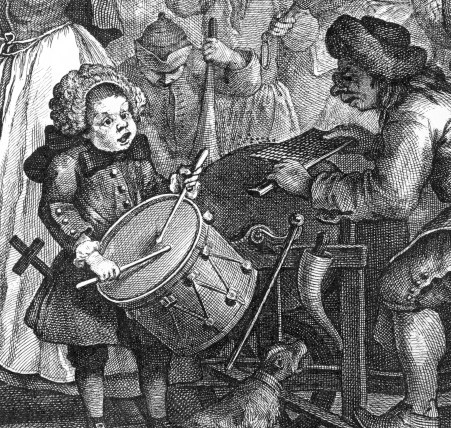
Wm. Hogarth; The Enraged Musician, 1741, detail.
THE BOOK OF JOBBING, CHAPTER IV: GOD CREATES SIDEMEN
And so the great Leader Nebulon did embark upon a search for suitable Sidemen for his orchestra, and he could find none; for in those days there were not many, and those he could find were already working. Some worked the Ark with the House of Noah, and some had the house gig at The Walls of Jericho. And many played behind the scat-singing team of Shadrach, Meshach and Abednago. So Nebulon did return to the Lord and saith, “Lord, there are many musicians, but no Sidemen!”, and he rent his clothing asunder.And the Lord did say, “Thou art a schmuck! Hast thou looked everywhere? Didst thou call the Union?”And Nebulon did say, “Lord, I have looked high and low, especially low; and only one or two could I find. What shall I do?” And the Lord did afflict Nebulon with boils, saying unto him, “Leave Me to think on this!” And just to buy some time he did also visit a plague of locusts upon Egypt.
And the Lord did summon a league of Angels, and sent them forth over the land, commanding them to find Him some Sidemen. And the Angels did go to the four corners of the earth, but the only unemployed Sideman they could find was one holy man in India who did play the horn with the slide. So with great fear the Angels did return to the Lord with the bad news, and filled with wrath He said. “How can this be? At one time the world did teem with Sidemen, as dead oxen do with maggots!” And the Angels did say, “Lord, many left the business, many have become idiots, and some have even become Leaders, and no Leader will work for another Leader.”So the Lord did cause drought for 40 days while He thought, and at last the answer came unto Him.
He did recall that there was a factory, part of his Beasts Of The Field, Inc., division, that was in disuse. For it had earlier been used to create Golems, for which there had been no great demand, and so He had closed down the operation. And He thought, ‘We can retool, and start turning out Sidemen.’ And so it was done, and it came to pass that the Sidemen started rolling off the assembly line. But somehow a remnant of the Golem program remained, and the Sidemen did come out acting unpredictably. Some stammered and stuttered, some talked to themselves under their breath, and some would not bathe. Some refused to shave their beards or to have their hair shorn, and some refused to wear the Jobbing Toga. And some wore the Toga, but left them crumpled in their chariots in between Gigs, or slept in them, or wore Togas from eons past, with ruffles.
And some did not believe in maps, and wandered the land aimlessly looking for the Gig, and some did not believe in the use of the hourglass, and arrived at the Gig whenever they chose. And some loved the wine of dates, and some loved the burning of hemp. And some were created without ears, and some with knuckles where their eyebrows should be.And some did worship the gods Trane, Jaco, Mahavishnu and Ornette, and mocked their Leaders. And some did steal food from the buffet line, yea, even before the Guests had dined.And some did try to lay with the Chick Singers, and some with the Guests, and some with the Little Sisters of these, the Chick Singers and the Guests. And some did not Read, and some could only Read, and not Blow. And some had no social skills, and some had no musical skills. And many of them were afflicted with a Dark Outlook on Life.
But every once in a while the line did produce a Perfect Sideman: One who followed orders without question; One who showed up on time; One who wore the Toga; One whose chariot always ran; One who Knew Tunes; But these Perfect Sidemen were few and far between, and besides their eyes were glazed, and they were shunned, for they were Boring, and knew not how to Hang. And soon the land teemed with Sidemen milling about, looking for Gigs, complaining and whining and arguing and occasionally stabbing each other in the back.
And the Lord looked down upon his work, and said, “It will do.”
Editor’s Note:
This was probably sent to me in the early 1980s just before synthesizers made possible composing music for orchestras without the orchestra, thus precipitating the end of the Jobber’s world and closing most recording studios. The jobber’s world did not end as abruptly as had the pit musician’s world after Talkies arrived with sound on acetate. Still many Toronto musicians used to making five to seven digit incomes plus residuals, were left scratching their heads about what to do next. My former colleague Michael Craden once exclaimed, “Pain is growth.” And growth did occur.
I never received chapters 1, 2 and 3 of the Book of Jobbing. Besides, I have no need for them. I know the life and occasionally think of it with a mix of nostalgia, mostly for the money and repugnance, mostly for the quality of music making. There is no mystery behind North American musician’s reputation for being superior sight readers. In the studios, that’s what we did. Back in the Day.










 Robin Engelman
“BRYCE” BY TORU TAKEMITSU
The players.
Bryce was written for flutist Robert Aitken, harpists Judy Loman and Erica Goodman, John Wyre and me, percussion and marimba. It was dedicated to my son Bryce. In my opinion the best performance was given in the Glenn Gould THeatre in Toronto the night of the Glenn Gould Prize award ceremony about 6 months after Takemitsu’s death. Takemitsu’s wife Asaka and daughter Maki were in attendance as well as Bryce and many of Toronto’s music elite.
The first meeting between Bryce and Takemitsu and the subsequent composing of Bryce, is documented in an earlier article on this site titled Toru Takemitsu.
I was prompted to write this article after a recent performance of Bryce in Toronto by five young women, all of whom were connected to people I’ve known for years. Flutist Sarah Moon, harpists Sophie Baird-Daniel and Angelica Hairston and marimbist Chung Ling-Lo. The percussion was played by Allison Bent, a former student in my university percussion ensemble. Allison asked me to attend one of their rehearsals. This would be my first time hearing Bryce played by people other than those for whom it was written. All the performances in my past had been, with one exception, with the original ensemble. At the rehearsal, it was clear the work had been prepared with great care and sensitivity.
The 12:00 noon, 22 January, 2013 concert was given in the Canadian Opera Company, Richard Bradshaw Amphitheatre. Over the years, I have grown to enjoy this space. It’s an open venue, two floors above the opera lobby, with raked bench seating, huge wall to wall windows rising three stories with an expansive view of University Avenue, its lanes separated in summer by colourful flower gardens now covered in still pristine snow. The Bradshaw, as I think of it, has a surprisingly good acoustic. The amphitheatre is named in honour of the man who, besides conducting the orchestra and managing the opera company, worked tirelessly for years to bring a new opera house to Toronto. Not long after achieving his dream, Richard dropped dead next to an airport carousel waiting with his wife for their baggage. The one hour Bradshaw Amphitheatre concerts are free to the public.
The programme was titled Meditations on East and West and began with Takemitsu’s Air for solo flute, his last composition, completed in 1994 in his hospital room. He died a few months later. Air is not only beautiful, it is challenging in its simplicity. Sarah Moon, a student of Toronto’s emminent flutist Susan Hoeppner, played the work with elegance and a lack of affectation. She would once again delight the audience with her performance of the extremely demanding flute part to Bryce.
The programme’s second work was titled Histoire du Tango (1956) by Astor Piazzolla, a three movement work elegantly played by violinist Rebecca MacLeod amd Sophie Baird-Daniel, one of the harpist’s in Bryce.
Bryce ended the concert. The flutist and harpist mentioned above were joined by another harpist, Angelica Hairston and marimbist Chung Ling Lo and percussionist Allison Bent playing gongs and smaller ringing sounds some floating on water. My wife Eleanor and I were seated together. The great harpistt, teacher and friend Judy Loman and Susan Hoeppner arrived and sat with us. The flute part requires multiphonics and other extended techniques. The harp parts are perfectly written, a fact noted by Judy Loman who once said, “Toru must have studied with a harpist”. Judy was one of the people for whom the work was written. We had not seen each other for many years and it was a pleasure sharing a warm reunion with her.
After the performance Judy my wife and I sat for a moment reflecting on what we had just heard. I turned to Judy and said, “It is a difficult work. They all played well.” Judy replied, “it is a work for artists.”
L. to R. Susan Hoeppner, Rebbeca MacLeod. Susan Moon, Sophie Baird-Daniel, Judy Loman, Angela Hairston,Chung Ling Lo, Allison Bent, R. E.
Percussion instruments for Bryce.
Posted by robinengelman on June 18, 2013 in Articles, Commentaries & Critiques, Composers, Contemporary Music
Tags: Bryce, Canadian Opera Company, Glenn Gould Prize, Judy Loman, Richard Bradshaw, Susuan Hoeppner, Toru Takemitsu