I drove to Rochester this past weekend to hear Michael Burritt play the premier of his Duende Concerto for Percussion and Wind Ensemble with the Eastman School of Music Wind Ensemble conducted by Mark Scatterday. On the same program Nexus was to play Rituals for Five Percussionists and Orchestra by EllenTaffe Zwilich (2005), a work written for and recorded by them. The part I had played in this work was performed by guest artist John Beck.
Michael’s performance was on the last concert of Percussion Rochester. P.R. was a two day percussion blitz organized by Burritt, Bil Cahn and Kathleen Holt with the help of numerous sponsors. It was an exhibition of percussion instruments and music – all played at various venues in Rochester by extremely gifted students and professionals.
The Eastman School of Music has been irrevocably transformed by the arrival of Michael Burritt as its head of percussion. Michael is a virtuoso percussionist, teacher, clinician and composer. His enthusiasm for and dedication to teaching and performing is so powerful it could not possibly be ignored by anyone or any department in this venerable school.
I am particularly aware of the changes Michael has wrought because I played in the Rochester Philharmonic from 1966 – 68 when the orchestra was closely associated with the school. I met the percussion instructor William (Bill) Street and heard tales of his legendary tenure at the Eastman School. I met John Beck who was the timpanist of the Rochester Philharmonic and who took over the percussion department upon Street’s retirement. If memory serves, I was only the 2nd principal percussionist of the Rochester Philharmonic who had not graduated from the Eastman School. I believe the first was Jack Moore who preceded me. This was 45 years ago, I was in the bloom of my career and in awe of Bill Street, John Beck and their students.
The Rochester Philharmonic consisted of a core of professional players numbering about 35. All the principal players were teachers at the school and great players they were. Playing next to Beck for two years is a memory that will always endure in my mind. He was a gracious and helpful colleague who always enjoyed playing. If extra were players were needed, they came from the student body, assigned by their teachers. This created the first and only conflict in two of the most productive years I’ve ever spent in an orchestra. Street assigned different students to every concert. One day I told John Beck, “I want to select the extra players and keep them all year””. And so it came to pass.
I knew this system was good for Street’s students. But it wasn’t good for me, nor I thought, for the orchestra. If only for one year, I wanted to establish a relationship, with the extras who came to play in the orchestra. I had grown comfortable with Bill Cahn and his future wife Ruth McLean. I wanted them to play with the orchestra for as long as they were in school and, in fact, both joined the orchestra immediately after I left for Toronto. Of course, Bill came to be one of my colleagues in Nexus not too many years later. But I digress.
The standard of percussion at Eastman has always been high. The school’s first percussion ensemble was formed by John Beck, Street having no interest in the percussion ensemble genre. His interest was primarily in orchestra percussion. At the time, John Cage was known by many musicians, the pathfinder percussion soloist Max Neuhaus was performing and recording and far away in Europe the Strasbourg Percussion Ensemble was commissioning works from European composers. Nexus pushed further ahead by writing its own repertoire, collecting percussion instruments from other cultures and improvising. Generally speaking however, percussion ensemble music and the level of percussion playing in academia was from todays’ perspective, just emerging from the dark ages. The Renaissance came quickly.
As I sat listening to Michael percussion concerto I could not help but be amazed. A revolution had occurred at the Eastman School of Music.
And the change was also exemplified by the students. In the afternoon of our arrival I heard a concert in Kilbourn Hall given by Eastman percussion students and simply sat slack jawed as I heard them zoom their way through a program of works with precision and flexibility unthinkable 25 or 30 years ago, all without conductor, except for the Harrison Concerto for Violin and Percussion. Speaking with former colleagues and friends, I learned that the incoming freshman auditions were, to say the least, illuminating. Kids just out of high school were playing works PhD students couldn’t have played, or have thought to play, not too many years ago. On the whole, it has been percussion composers such as Leigh Stevens, Bob Becker, Gordon Stout and Michael Burritt who have been responsible for this incredible advance. Their compositions and teaching innovations have prodded new generations of exceptionally gifted percussionists. Now the question arises in my mind, “What can they do with all their skills? ”

After the student performance we took dinner across the street at Max’s. We ordered a dozen oysters on the half shell and fillet mignons, accompanying both with two bottles of 2004 Chateau Berliquet, Grand Cru St. Emilion. So satisfying.
Michael’s Concerto must have been a kick in the ass for any composer in attendance who has dreamed their way through a composition for percussion based on some ‘concept’. Duende, a work in one movement, begins with a virtuoso fanfare of tom-toms so fast and clear as to leave no doubt in the minds of listeners as to Michael’s secure artistry. It’s a classically designed work, thoroughly professional in its orchestration and structures. A few years ago I had heard his French horn concerto with percussion orchestra, but was not prepared for the maturity of Michael’s compositional skill. Duende is much more advanced. In response to Michael’s marimba playing, there were woodwind passages of surprising originality and beauty. From the very first note I was caught up by his energy, passion and when required, delicacy of touch. Duende is a work I’d love to hear again and again.
Duende is a spirit associated most commonly with the music of Spain. El duende prompted the famous Andalusian poet Frederico Garcia Lorca to write a now famous lecture about its affects on art and artists. Duende is a complex emotion, referencing among other things death and transcendence. To Lorca, its presence evoked a heightened sense of awareness, a spiritual wholeness. [1.] In Spanish and South American mythology, Duende is also an imp, a small, mischievous devil or sprite. Both definitions of Duende are applicable to the Burritt concerto, though I like to believe the shift to hand drums at the end, bongos and conga for the soloist and mounted tom toms for the ensemble percussionists, represented the Imp while the largest part of the work dealt with more spiritual aspects.
Whatever Michael’s intentions, his solo on bongos and conga was disconcerting. To my ears, the sounds of those instruments undeniably announce a kind of pop dance music from another culture. They rang falsely against the much larger body of his European Abstract Art Music. Well, picky, picky, but I cannot deny the shiver of surprise and disappointment I felt when I heard those sounds.[2.] The feeling dissipated when Michael was joined by his students in a tight knit exciting duet more suited to the work.
Michael and his accompaniment received a long and well deserved standing ovation. In response he played a short , lovely marimba solo.
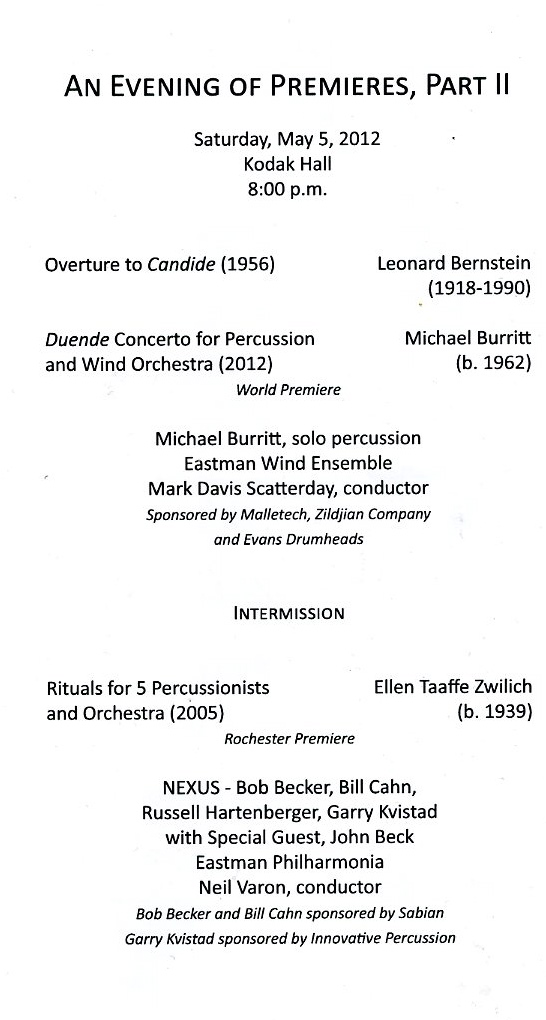
The concert ended with a performance of Rituals, the Ellen Taffe Zwilich Concerto written for and played by Nexus. I knew this work pretty well because I had played it a number of times and recorded it with Nexus. Sitting out front was a wholly different and very impressive experience. Because of the clarity of Nexus and the superb playing of the Eastman student orchestra conducted by Neil Varon, I could grasp the scope of the work in its sonorities for the first time. It’s a terrific work, particularly in its contrast to other percussion concerti. The metal percussion, symbols and gongs, combined with string and woodwind chords, create clouds of gorgeous, complex overtones. Some of the movements seem to hang over the newly renovated Eastman theater, enveloping everyone. It is not a piece without rhythm but the overall impression is amorphous. The snare drum rhythms don’t actually propel the music but are simply layered into it. Bill Cahn’s tuned gongs, Becker’s soft tom-toms stand out, but otherwise the percussion instruments are a part of the orchestration, often making it into harmonic clouds. John Beck played my old part and the chimes which open and close the 2nd movement, always my favorite moments, were beautifully played.
I came away feeling the four movement work is one movement too long. Which movement should go? The removal of one would require a reshuffling of the remaining three. Maybe the last. Its’ ending was a problem when first written and after hearing it May 5, it is still a problem.
Footnotes:
[1.] http://en.wikipedia.org/wiki/Duende_(art)
[2.]Joseph Schwantner concluded his Concerto No. 2 for Percussion Section, Timpani and Orchestra with a similar idea. His instruction for the drummers was to improvise and they didn’t know when enough was enough. With Burritt’s work, thoroughly composed, it was the device itself that troubled me.
 Robin Engelman
PRISTINE Classical – an update
Pristine Classical was a major part of my posting about the Horowitz , Tchaikovsky 1st Piano Concerto recording made in 1941 and restored by Andrew Rose. (See under Alphabetical List of Articles, Horowitz and Tchaikovsky’s First Piano Concerto.) I mentioned in my article Rose’s weekly commentaries. (pristineclassical.com) The article below is a recent example and I thought it might be of general interest and specifically, interesting to percussionists. The recording was made in 1953. Does anyone know who the snare drummer might have been?
Too loud to record properly?
Ravel’s Boléro is only one
When Maurice Ravel wrote his Boléro in the late 1920s he had no idea it would go on not only to become his most well-known work, but also one of the best-loved piece of classical music produced in the 20th century. Indeed, the composer actually predicted that most orchestras would refuse to play it!
Boléro was helped greatly in its rise to fame by its US première and adoption thereafter by Toscanini – as well as word of a famous falling out between Toscanini and the great composer over the tempo at which it should be played, with the maestro bluntly telling the composer “When I play it at your tempo it is not effective”, to which Ravel responded that he should therefore not play it at all.
Regardless of this, it went on to be played many times thereafter and to become a firm concert hall favourite. I recall as a child going to the Town Hall in Birmingham to a musical workshop with the CBSO where the work was discussed and then played. It is indeed childishly simple to explain the premise, and as a result it’s rather unique. See if you can spot it in this waveform representation of the complete Paul Paray album we’ve issued today:
Paul Paray album
Not too difficult, is it! Here it is again, in close up:
Boléro
Musically, the fundamental essence of Boléro is one very long crescendo. The same basic idea is repeated over and over again as the intensity builds up and the melody moves around different sections of the orchestra. There’s no musical “development” in the traditional sense, and as a musical experiment it leads almost nowhere, at least in the view of its composer – though further developments later on in twentieth century music in the field of endless repetition of simple figures might have come as a surprise to Ravel had he lived to hear them.
Recording a work such as this, especially in the pre-digital days of tape and disc technology, was always going to present a major problem. In fact, even with digital technology it’s not necessarily straightforward. This is the direct result of the huge dynamic range of the piece.
I was reminded when listening to it this week of my first visit as a young trainee BBC sound engineer to the corporation’s Big Band studio at the Hippodrome in Golders Green, in north London. It was the first time I’d encountered the specially designed and built large loudspeakers that were installed in but a handful of the BBC’s major recording venues back then (I’ve no idea if they’re still in use). As far as I recall, each loudspeaker was approximately the size of a stacked pair of domestic washing machines, with four large woofers surrounding a central tweeter. The speakers were mounted into the walls with a spring system allowing the entire enclosure a degree of movement forward and backward – if you pushed at them they’d “bounce” back and forth into the wall and then back towards you for a few moments.
The reason for these custom-built monsters was soon explained to me. The Big Band was individually mic’d up, the feed of these microphones going through a mammoth mixing desk with some 96 channels or so. That must have been a nightmare to get right first time! But the biggest problem they had was that of dynamic range, and above all that of the big bass drum. The drum, when whacked appropriately hard, had a dynamic range of a huge 120dB.
Even the very best digital recording systems we had at the time, which were all 16-bit back then, could only cope with a theoretical maximum dynamic range of 96dB. In order to cope with this discrepancy the BBC’s engineers decided that they needed to be able to hear the drum properly on their monitors, even if they couldn’t actually record its full range – hence the design and building of these monster speakers. (To me that sounds like a great ruse for getting hold of a pair of the most humongous loudspeakers imaginable from the BBC’s notoriously tight-fisted radio management – but it obviously worked.)
Come back to Ravel’s Boléro and we have perhaps a similar problem – it starts very, very quietly indeed, and finishes just about as loud as an orchestra can possibly play. Go back to 1953 and we have a much bigger problem that we did in 1990 – the dynamic range of a standard non-Dolby tape machine back then (and Dolby was a good decade and a half away from inventing his first noise reduction system – or as it was originally billed, his “signal-to-noise stretcher”) was perhaps somewhere in the 45-60dB range. Likewise the LP. Back in 1930, when Ravel conducted a recording with the Lamoureux Orchestra for 78rpm discs it would have been considerably less again.
So we come to a thorny compromise which was immediately audible in the original LP transfer of Paul Paray’s 1953 Detroit Symphony Orchestra Boléro, known as “gain riding”. Quite simply, as Paray slowly increased the volume of his orchestra, Mercury’s sound engineer was slowly decreasing the volume of the microphone to try and make sure that both the quiet opening and the loud ending fitted within the range and abilities of the recording equipment and media.
To the careful listener this manifests itself as a rather hissy opening to the piece. But it’s a curious kind of hiss, which gradually diminishes across the course of the work, until by the end it’s entirely inaudible. It’s been my assumption that the hiss heard at the start of the piece comes not from the tape or disc surface but from the microphone and its amplifier. Pushed to their upper limits this is what comes out of the electronics – but start to pull the faders back a little and that hiss disappears into the background noise of any analogue recording – tape hiss being the major culprit by the early 1950s.
I tried, in my remastering of Paray’s Boléro, to undo this gain-riding compensation, at least to a degree. The problem is that it’s very difficult to gauge how much of this actually took place. I began by measuring the background hiss at the start of the recording and comparing this to later in the piece. This at least gave me a starting point to work from. The problem with this approach is that I’m actually measuring two different things – the microphone hiss to start with and the residual tape hiss later on. And at the same time there’s an orchestra playing, making it difficult to take any noise measurements at all!
Anyway, I worked on this principle to begin with, and starting making my own adjustments, which first involved dropping the volume at the start by about 40% and then gradually increasing it across the entirety of the performance. But this still didn’t sound convincing. A further 30% drop at the beginning, again with an increase spread across the duration of piece back up to 100% sounded better – we were getting closer. Then I spotted that the music at the end wasn’t hitting the “end stops”, and I was able to add a further 20% to the final climax, which goes audibly into peak-overload distortion anyway on the original, suggesting even higher original levels were played than can be heard here.
The end result is something which comes, I hope, a little closer to what Paul Paray had in mind – though I retain a sneaking suspicion that there was probably an even greater contrast between the start and the finish than I’ve dared represent here.
The effect technically is to bring that opening hiss level right back down. You’ll still hear it at the beginning because we have the technology today to handle a much wider dynamic range and leaves it quietly audible when you turn the volume up on replay, but it’s much quieter than it was on the LP, as is the orchestra too at this point.
The effect musically is to make the entire performance even more startling and effective, the relentless drive of the orchestral crescendo in its slow build up is rendered more powerfully than a 1953 LP could ever hope to replicate. I do wish there was some I could do for the slight distortion at the end, but to a certain extent, just as it can in some rock music, this serves only to accentuate to the listener the intensity of the music’s conclusion. It’s an incredible piece, and Paray’s is a truly magnificent performance of it.
Scroll down the page and click on the Paray sample link and you can hear the entire performance in full.
Andrew Rose
11 May 2012
Posted by robinengelman on May 11, 2012 in Articles, Commentaries & Critiques, Composers, History