RSS

Author Archives: robinengelman

ARRAY MUSIC, RIXAX

Rick Sacks

Rick Sacks

Last September 2010 Rick Sacks became the latest director of Array music, a Toronto organization that by mandate encourages and performs works by young Canadian composers. Sacks is also a composer, a trained percussionist, and a quipster – his e-mail address begins rixax. With little provocation, Rick can slide easily into New York City hip, an endearing persona much prized by friends and acquaintances.

Rick’s solo compositions are generally quirky, sometimes slap-stick funny theater pieces suited to his upbeat temperament. But like a Charlie Chaplin film they often carry another more serious message. Rick’s Life in the Factory which he performs in a working man’s overalls behind a conveyor belt filled with found instruments is a modern  percussionist’s take on Modern Times. This is all to say that Rick’s humor should not deceive. He is a man of many parts who also has a gift for promotion. In today’s economic climate, Rick’s promotional acumen may well benefit Array Music.

About thirty years ago, Canada’s federal government established a policy of Multiculturalism. All minority ethnic groups were encouraged to dress, pray, speak and act as though they were living in their native land. These groups subsequently asked for funds from government art budgets to subsidize their community initiatives.

As the government responded to their requests, the Art’s money pie was cut and served in ever smaller pieces. Here-to-for favored music ensembles devoted to a Euro-centric music tradition found themselves under funded and sometimes, in their eyes, under appreciated. Then came the added burden of the financial crisis of 2008.

Particularly sensitive to budget cuts were ensembles specializing in contemporary music. There are a half dozen ensembles in Toronto that perform four to six concerts a year. Their audiences have always been small and to a large extent government grants have kept them afloat. Ensembles such as Array Music responded to the financial crunch by reducing the number of concerts or by programming less expensive repertoire. But one of the most artistically bothersome problems inherent in government funding is a ritualized commissioning off Canadian composers.

The cycle of funding composers is simple and politically justifiable. In order to receive government money, ensembles must demonstrate a  commitment to Canadian composers. They must also apply every year for funds to commission new works and every year a new batch of compositions is created. Last year’s works are filed away and the cycle begins anew. No music is put into repertoire, rehearsed and performed beyond their premieres.

One of Rick Sacks’ first decisions as Director of Array Music was to expand upon an idea of former Array director Bob Stevenson.  Rick is searching through Array’s library of over 300 commissioned scores, collected during its forty-year existence for worthy, though forgotten works, and bring them once more to the public. This could ameliorate to a considerable extent the artistically frustrating and financially wasteful results of yearly commissions being relegated to file drawers.

The quality of contemporary music performance is exacerbated by the jobbing musician. Every ensemble in Toronto specializing in contemporary music is made up of players who work all over town playing all kinds of music. This and the fact that they rarely play anything more than once makes them good sight readers, but poor interpreters.  If they’re part of the busy elite, they rarely have time to hone the skills that brought them this far. A sight reading mentality and lack of rehearsal time become a way of life that produces uninspired concerts.

Established in 1971, Array Music, is housed in a rather crowded second-floor room that appears to be a former factory. Stacked against its walls and hanging from its beamed ceiling are the accoutrement of a well used rehearsal space : a variety of percussion instruments, music stands, a covered baby grand piano stacked with music, filing cabinets, chairs and a desk or two.  Array rents their space to other groups when it is not otherwise busy with its own projects.

Rick’s enthusiasm and commitment are infectious. There is an esprit de corps in this year’s Array ensemble that has been lacking since the death of Michael Baker, for eight years an inspiring director  who died young. Today Array’s performers are communicating their commitment and, just as important, pleasure.

Composer Linda Smith has also had a significant part to play in Array Music. Ms. Smith is a composer of considerable standing in Canadian arts. She is a Jules Leger Prize winner. She too was a director of Array and her musical and administrative skills were exemplified by a concert given late in the 2009-10 season. Linda chose the  concert repertoire. Each work was related in some way to other works on the program.

Along with innovations in repertoire, there were noticeable personnel changes in Array’s traditional group of seven players. It was all good and a couple of months later was followed by yet another successful concert.

Array Music has turned a corner and is now headed in a refreshed and creatively rewarding direction.

Recently Rick announced Array as recipient of an unsolicited grant of US $10,000 from the Lucerne Foundation of Switzerland. The work that attracted the Swiss was Array’s month long Young Composers Workshop. After a call for scores, Array selects four fledgling composers from anywhere in the world. They are brought to Toronto to work with Array instrumentalists and a mentor who is an established Canadian composer, and this year, Christopher Butterfield.  While composing a new work, they receive feedback from the professional players of Array, the resident composer and fellow students. At the end of the month their works are performed before the public.

I attended the most recent of these once a year concerts. Rick conducted the ensemble and introduced the composers who came forward to make brief statements about their works. Of the four compositions performed that evening two of them had real promise. An extraordinary percentage of success.

Rick is something of a workaholic. Besides administrative, conducting and performing duties with Array Music, he has recently joined the board of directors of New Music Concerts of Toronto and continues his non stop composing music for theatre.

During the month of July, 2011 he will be at the Banff Centre composing music for a new dance work in collaboration with Red Sky and New Zealand’s dance company Black Grace. With Red Sky Performance he toured the 2009 Cultural Olympiad (Beijing), the  2010 Vancouver Olympics and the May 2010 World Expo (Shanghai) with TONO a dance and music piece that received a DORA award in 2010 for best new music in a dance production..  Rick will be in Beijing, Mongolia and New Zealand this fall performing TONO.

Adventures of the Smoid, a new work written and composed by Rick in collaboration with the Evergreen Club Gamelan, premiered June 2011 features shadow puppets designed by Rick in association with David and Ann Powell of Puppetmongers. I went to this performance and was as usual delighted. He was commissioned by the Evergreen Club and the plot involves an astronaut, the Smoid, rocketed into space where he avoids strange asteroids, comes back to earth, falls in love, marries and has three children.

Everything Rick attempts is done with good grace , a keen imagination and a desire to entertain and inform. I’ve thought of suggesting he slow down, but a cup of black coffee is all he seems to need, that and the next project.

 
1 Comment

Posted by on June 15, 2011 in Articles, Contemporary Music


Toru Takemitsu in The Digital Concert Hall

As a subscriber to the Berlin Philharmonic Digital concert Hall I have access to  weekly archived performances by this great orchestra conducted by some of the world’s best musicians. Each week I receive an e-mail notifying me of the next live performance, often on Thursday or Saturday afternoons at 3PM Toronto time which translates to 8PM in Berlin. For about $160 Canadian per year I can watch more than one  hundred concerts or parts of them at my leisure. Five strategically placed cameras almost unobtrusively record the musicians and conductors, often close up.  And the sound reproduction lives up to the highest standards people have come to expect from German Tonmeisters.

For the price of one decent seat in Toronto’s Roy Thomson Hall I have an ever-growing orchestral repertoire  at my fingertips. Modern technology at its best.

Sado
Sado

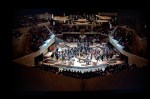
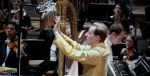
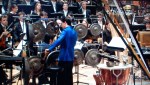
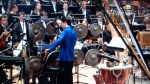
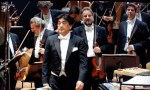
This morning I sat in front of my computer to watch and hear Toru Takemitsu’s “From me flows what you call Time” recorded live in Berliner Philharmonie just a few days ago by the Philharmoiker, five German percussionists and the Japanese conductor Yusaka Sado.

I had known for over a week that this performance was going to be broadcast. So I had a good deal of time to contemplate the experiences I might have watching other people perform a work I had played probably 100 times since Toru wrote the piece in 1991 for Carnegie Hall’s 150th anniversary, Seiji Ozawa, the Boston Symphony and Nexus. Both Toru and Seiji have been important people in my life and every time I performed “From me flows what you call Time” I was deeply touched, even when the conductor or the orchestra or both were not quite up to the challenge, or when my performance was not entirely satisfactory. So I approached this performance by strangers with feelings of ambivalence if not trepidation.

Paduh
Paduh

Things started off really well with the young French flautist Emmanuel Pahud. He has performed the  Boulez …Explosant – fixe… with Boulez conducting, and performs most of the Philhaemoiker’s contemporary works and sometimes interviews contemporary composers for its broadcasts.  He is an incredible player and his performance of the opening flute solo was superb; nothing over the top, just fluid, serene, and beautifully shaped. Pahud also conducted the concert interview with Sado.

But it was the percussionists I was most interested in. I was ready to be disappointed or dismissive, but it has been a few years since I last played the piece and as this performance progressed, my listening became more objective.

I was delighted with the way the soloists performed and the smiles on their faces at the end of the concert, the repeated calls by the audience for another bow, and the response of the orchestra and the conductor confirmed the success of their performance.

There were delightfully surprising details.  At one point in the score, Takemitsu directed some percussionists to play with their fingers, something Nexus never did, but I couldn’t hear one part and another was barely audible. No one plays the same piece of music the same way, nor should they. The soloists have all the sounds, that is to say, all the instruments with the correct pitches. I wonder if Michael Ranta provided them. I understand Michael has created a set of instruments for “From me flows .  .  .  .” The percussionists also played with artistry. I felt they were new to the work, which is probably true, and this work takes time.

The sounds from the Berlin Philharmonic are spectacular. This is an orchestra that can play anything and under their Music Director Sir Simon Rattle, they have broken free from their limited repertoire of yesteryears. (There are also a lot of young players in the band.)  The clarinets, harps, French horns, oboes, cellos and trumpets play particularly important roles in this work, but the entire orchestra has to play together and there’s no better orchestra in the world for doing this.

Never-the-less, I have to single out that great string bass section. The way they finished off the 5/8 bar crescendo just before the end and held the low C until the decay of the final wind chime note, was perfectly, if accidentally timed. The wind chimes did not ring excessively long and so the music stopped at exactly the right time to balance the work’s form.

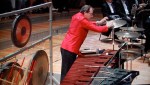
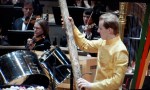
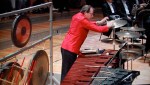
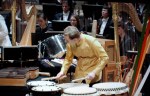
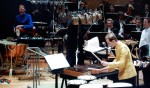
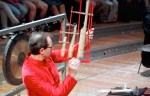
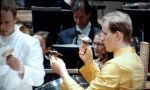
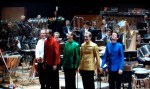
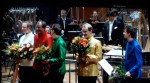
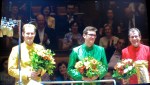
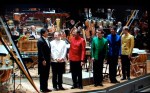
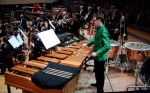
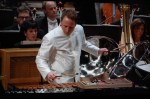
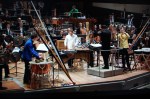
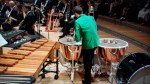
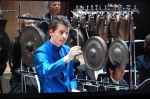
The percussionists colored  jackets, representing earth, wind, fire, water and everything or nothingness were a nice touch. The percussionists were Raphael Haeger (blue/water), Simon Rössler yellow/earth, Franz Schindlbeck (red/fire), Jan Schlichte (green/wind), and Wieland Welzel (white/nothingness). Excepting Simon Rössler, they are members of the Berliner percussion section. Watching them play was a bit eerie. So many of the sounds they produced and the gestures they made reminded me of Nexus. The body language they displayed when they came on stage for their bows was also similar. They are all good players. Bravo.

As the last sounds of this magnificent work disappeared, I was convinced, as I was in 1990, that Takemitsu has created for percussionists their first major  and popular concerto.  Though it must be said that Takemitsu did not think of this work as a concerto. He said it was a work for orchestra with percussion.  Nevertheless “From me flows what you call Time” is an astounding work which affords opportunities for percussionists  and audiences to experience aspects of the percussion world beyond the bombast typically associated with drumming.

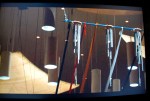
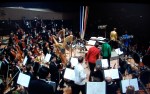
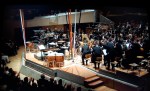
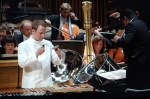
To subscribe to the Berlin Digital concert Hall, go to: http://www.digitalconcerthall.com. The photo gallery below  mostly consists of photos of the percussionists and their set ups.  This was purposeful as I had in mind a readership primarily of percussionists. They loosely follow the music’s progression.

 
Leave a comment

Posted by on May 31, 2011 in Articles, Composers


JAZZ as America’s Premier Art Form 
By Ratzo B. Harris

ODJB

ODJB

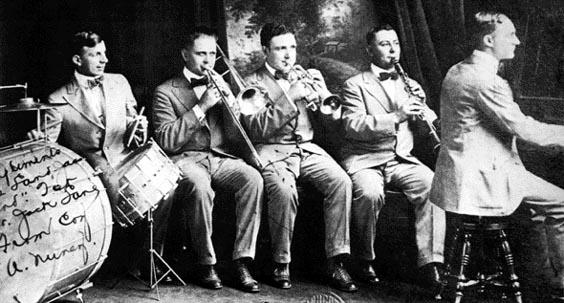
I had read the article below and had put it aside intending to reference it at sometime in the future. In fact I forgot about it until I received an e-mail a few days ago from my friend, pianist, composer and percussionist Bill Brennan. He was referring me to a website where I could hear recordings by the Original Dixie Land Jazz Band, known to aficionados as simply the O D J B.  It was this reference that reminded me of Mr. Harris’s article. My brother collected recordings of Dixieland bands and he was particularly fond of the O D J B.  Therefore, from an early age I had heard this group and Louis Armstrong’s Hot Five, Hot Seven and other noteworthy Dixie Land bands of the 20s.

Mr. Harris’s article also mentions Pauline Oliveros. I first met Pauline at the New Hampshire Music Festival in 1962. She introduced me to “structured improvisations” and we had a grand time arguing about the credibility of this-and-that. Years later Pauline  conceived a work for Nexus and she and I kept in touch sporadically for many years.

For these reasons and the fact that I agree with most of Harris’s points, I’ve decided to post his article as Food for Thought. To hear ODJB’s famous 1917 recording of  Livery Stable Blues, click here http://en.wikipedia.org/wiki/Original_Dixieland_Jass_Band

R.E.

Jazz as America’s Premier Art Form 
By Ratzo B. Harris

Friday, April 22, 2011, 10:07:58 AM

Who generally began to say, JAZZ is “America’s Premier Art Form”?
This question was posted to a jazz research message board I subscribe to on April 19, the day after this year’s annual extortion to Aunt Iris was due. I remembered that part of the hard-earned cash my wife and I had to pay this year goes to the salary of Representative John Conyers, who authored a Congressional bill (HR 57) in 1987 which designated jazz “a rare and valuable national American treasure to which we should devote our attention, support and resources to make certain it is preserved, understood and promulgated.” (I’m just doing my civic duty as a good citizen.) But I also remembered that Conyers’s good friend, Dr. Billy Taylor, called jazz “America’s classical music” long before HR 57.

According to the sources on the message board Dizzy Gillespie said jazz is “our native art form” (although he didn’t specify any nationality in the term “our”) in 1957, an unnamed contributor to Harper’s described “talk of jazz as a native art-form” in 1950, and a 1946 issue of the New Republic calls jazz “the only original American art form.” Another magazine, Art Hodes’s The Jazz Record, insists that jazz is “America’s first wholly native art form” (ca. 1943) and in 1944 RCA Victor issued a set of records claiming to be “presenting jazz music as an American art form worthy of study.” Earlier citations are included: “Naturally, there have clustered together little groups of serious European thinkers to make the same discovery that Americans have made, that Jazz is a great art form” (Paul Whiteman, Time, 1926); “as far as America is concerned it (jazz) is actually our characteristic expression” (Gilbert Seldes, The Seven Lively Arts, 1924); and a mention of a book written by Japanese author, Kamesuke Shioiri, in 1929 (the book is untranslated, but the person posting has offered to supply a PDF copy of it to anyone who contacts him through the message board).

The quotes from the earlier dates are significant in that this was a minority opinion among the cultural elite at the time. There was much heated debate about whether or not jazz was even music, much less art. Some, and mostly classical conductors, saw jazz as having artistic merit, but most saw it as an abomination that would lead to the corruption of society, probably because of its purported origins in African American culture. But that was the dilemma, if Dvořák were to be taken seriously (and enough time and money had been invested in his residency at The National Conservatory that he had to be taken seriously), then any truly original American music had to be steeped in African American musical aesthetics (as well as Native American ones). My point is that by the time the music being called jazz was being accepted by the masses, it was played by an elite group of ethnically diverse performers. Why the work of Scott Joplin isn’t considered an original American art form while the drivel that Paul Whiteman was calling jazz is, escapes me (unless one takes into account the tastes of most American highbrow music lovers, then it all comes into perspective). It seems that as long as there has been a music called jazz, someone has been trying to call it an American art form and someone else has poo-poohed the attempt.

But improvisation (and I am blogging about improvised music) wasn’t the main thrust of jazz of the ’10s, ’20s, or even the ’30s. It really wasn’t until the late 1940s and ’50s that this became considered an indispensable salient feature. It seems that as improvisation became more important to jazz performance, the musical result became more questionable in terms of authenticity. I almost want to thank Ken Burns for his arbitrary demarcation that essentially launched the 2nd New Orleans School in New York City and took jazz away from the improvisers and performing musicians and put it into the hands of corporate-friendly composers and academicians.

Except that a lot of really great music is marginalized so as not to question certain ideological and political forces that lean toward global hegemony and must, by their tenets and methodology, stifle improvisation. For example, the salient feature of early jazz, more so than improvisation, was the use of extended techniques, especially those resulting in unorthodox timbres. When James Reese Europe brought his African American military ragtime band to France in 1918, the local musicians couldn’t believe the sounds that the Harlem Hellfighters were producing with their instruments. Trumpets growled and wah-ed, trombones slided and belched, saxophones bent notes and played without vibrato.

The first “official” jazz recording in 1917 of the Original Dixieland Jass Band included “Livery Stable Blues,” where the instruments imitated the sounds of barnyard animals. Over the decades, an indispensable aspect of the artistry of jazz performance was mastery of a set of extended techniques that could become part of one’s “voice.” Johnny Hodges’s swooping melodies, Roy Eldridge’s growls, Walter Page’s slap bass. Listen to John Coltrane and ask yourself if his sound and technique would have any place in the classical saxophone world, and then ask yourself who was the better saxophonist, Marcel Mule or John Coltrane. Without answering that directly, one thing is clear, Coltrane was original—and he was original in a field of original saxophonists. It doesn’t take a very discerning ear to hear the difference between Coltrane, Wayne Shorter, Dewey Redman, Warne Marsh, Stan Getz, or Dexter Gordon. Each took an unorthodox way of playing and milked it into a personal voice.

With the advent of the jazz repertory orchestra and ensembles, that is becoming lost. More and more, the “big names” of jazz sound less and less original in their use of extended techniques. The soprano saxophone playing of multi-instrumentalist Joe McPhee is like nothing anyone else does, but you rarely hear of him outside of Trio X or his work with Pauline Oliveros. The others who were breaking ground in the late ’70s and ’80s as part of the “Downtown Sound” are pretty much left out of the new jazz paradigm, although Jazz At Lincoln Center owes their souls to them. They continue to be the real carriers of the flame and, as such, will probably have to self-produce and play door gigs in small venues in Brooklyn or Harlem or the Lower East Side between an every dwindling amount of European tours to keep their vital, important, and original music going. Which is good for me, since I can’t afford the charge on San Juan Hill!

 
Leave a comment

Posted by on May 21, 2011 in Articles, History