I grew up listening to the NBC Symphony Orchestra. Led by the charasmatic Toscanini (1867-1957), they sold recordings of classical music in large, previously unimagined numbers. Toscanini was known for his explosive temper and quest for perfection. The covers of his RCA Victor Beethoven Symphony LPs were decorated with 20 snapshots of Toscanini conducting, all depicting him as the quintessential Maestro, no smiles, this was serious business no matter how you looked at it. Toscanini rode a Hi Fidelity sales wave as CBS, Columbia Broadcasting System, tried to catch up with the more subdued and introspective Bruno Walter. [1.] Using Toscanini as a marketing model, record companies planted the maestro mantle on other conductors, Bernstein the great home-grown communicator, Szell the meticulous teacher, Reiner the beady eyed dictator and Ormandy the curator of Philadelphia’s lush sound.
During my college days, I’d gather with a few friends for listening sessions. One of us would put on an LP and with no hints allowed, the others, in a kind of blind aural tasting if you will, had to name the orchestra. Back-in-the-day, major orchestras had their own distinctive sound. They could also be recognized by their conductor’s style, the suave sound Karajan achieved with the Berlin Philharmonic, its choice of recording venue, the super dry studio H of the NBC Symphony, and in some cases, its principal players – Voison’s trumpet in Boston, Kincaid’s flute in Philadelphia, Goodman’s timpani playing with the New York Philharmonic and the Brass section in Chicago. French wood wind sound was thin and reedy, German brass was warm and round particularly the horns and the Russians were still playing post revolution Boosey and Hawkes instruments in desperate need of up-dating. Hearing one or more of these ‘tells’, our answers were correct more often then not. These distinctions are almost impossible to make today. When asked in a NewYork Times interview why today’s orchestras sounded alike, Seiji Ozawa said Mahler was what mattered, not the orchestra. Though oblique, even evasive, Ozawa’s answer confirmed the question’s premise. It also beggared another. How did it happen?
I believe recording technology and record companies’ desire to control the results of the final product was and is at the heart of this phenomenon. Almost overnight compact digital discs replaced LP records. The effects of this revolution influenced recording companies, musicians and the public in ways unimaginable at the time, unalterably changing their attitude towards each other and the music. Working with CD technology was a far cry from the good ole direct-to-disc days of yore when performers had to play each movement straight through, no stops. If a mistake was made, a new vinyl replaced the old and another complete performance was attempted. Thus, early 78 rpm recordings were ‘live’ performances. After the invention of recording tape, mistakes could be cut out, literally. An offending passage or note was removed with a razor blade. A correction was inserted and the gap closed with Scotch Tape.
Whereas traditional recording studios are grounded, digital studios are compact and transportable. With digital technology, studio quality recordings can be made anywhere on earth. After the Cold War, former Eastern bloc orchestras and soloists, now in possession of quality instruments and eager for hard currency, willingly provided their services for fees dramatically lower than their western counterparts. In a few years, hither-to unknown performers began to flood the world’s art music market with solo, chamber and symphonic recordings. Sales of American made recordings plummeted. Critically, digital recordings allowed producers to manipulate sounds of lesser orchestras enough to satisfy a public more interested in The Great Gate of Kiev’s sonic splendors than which orchestra and conductor recorded it. For many record buyers, the sound of an orchestra and the subtleties of a maestro’s interpretation became almost irrelevant.
Some North American recording companies went out of business and many large orchestras lost their recording contracts. Solists and ensembles tried to energize ther careers by crossing over into the burgeoning pop music market. Recording companies tried hyping up performances of classic favourites such as Vivaldi’s Four Seasons and marketed Mozart for babies, for lovers, for fine dining and for working out.[2.]
Today the death of the CD seems imminent and mp3 downloads may well be the heir apparent. The sound quality of an mp3 is inferior to the CD, but will that matter to the public? Anyway, I have a large collection of LPs and too many CDs. Most of my recordings, made in the last 30 years, are sonically indistinguishable. They offer me no fresh insights into the music I often enjoy. I do not need another technically dazzling Rachmaninoff Piano Concerto #3 when the 1951 Horowitz, Reiner collaboration with the RCA Victor Symphony Orchestra trancends performances by all pianists, past or present [3.]
So, I’ve been listening to early Twentieth century recordings of symphonic repertoire conducted by the likes of Beecham, Klemperer, Mengelberg, Bletch, Furtwangler and Stokowski, all judiciously digitalized by Andrew Rose at Pristine Classical. Aided by the latest audio equipment, Rose discovers instrumental voices present, but hidden or diminished by early recording equipment and makes them audible. Along with balances, Rose may have to justify pitch, tempo and overtone fluctuations as well as reducing or eliminating surface noises and the thin metallic sound common to many old 78 recordings. He is acutely aware of the dangers in taking his remasterings too far and assiduously maintains relationships indicated by the recordings, his ears and technology. Rose often leaves surface and audience noises in order to maintain the life of an especially significant recording.
The orchestra players of this era were superb and with their conductors, created performances technically comparable to their modern counterparts while differing substantially, in some cases dramatically, to readings by almost all of today’s conductors. These interpretations changed or enhance aspects of a work in ways not always indicated by the composer, especially phrasing, accents, dynamics and tempi. Toscanini railed against conductors he considered guilty of these transgressions. And yet, leaving an NBC Symphony concert at intermission, Wilhelm Furtwangler said of Toscanini, “He’s just a time beater”.
Are you old enough to recall the admonition, “Don’t just play what’s on the page”? Many conductors of yesteryear were not bound by the page and were unafraid to trust their feelings, allowing works to take them spontaneously wherever their spirit’s willed. They are an elite compared to the replicators who constitute today’s majority. Below are some examples from a bygone era. I suspect most of you know the works from which the samples are taken. Like them or not, they demonstrate a time when conductors knew from common practice that scores were not written in granite. They knew the music had to speak differently to different people. [4.]
I chose the last movement of Beethoven’s Ninth Symphony because it is a series of contrasting events which Mengelberg realized beautifully. His pacing and tempi bring the messages of Schiller’s poem to life in ways unmatched by contemporary recordings. To my ears, modern singers, often heavy handed opera stars, are here, sensitive masters of the oratorio style and have time to listen and give each other space. As well, each section of the movement is allowed its own space, this sometimes by simple means such as a significant dimenuendo or extended fermata. For the first time I understood what Beethoven disciples meant when they spoke of this work as monumental. The bass drum, cymbals and triangle verge on inaudible, but the penultimate timpani bar makes up for those failings and provides a monumental ending. All excerpts are products of Pristine Classical digital recordings.
NOTE: These audio samples cannot be heard from e-mail. They can only be accessed from my web site, robinengelman.com.
Opening and Recitative, 4th movement of Beethoven’s Ninth Symphony. Mengelberg and the Concertgebouw Orchestra, Live recording in Amsterdam,1940.
First vocal quartet, 4th movement of Beethoven’s Ninth Symphony. Op Cid.
March, 4th movement of Beethoven’s Ninth Symphony. Op Cid.
Last quartet, 4th movement of Beethoven’s Ninth Symphony. Op Cid.
Last measures from the last movement to Beethoven’s Ninth Symphony. Op Cid.
And finally, some opening bars from Mozart’s Overture to The Marriage of Figaro, The Thomas Beecham Orchestra,1916.
Though the great string bass player and teacher Oscar Zimmerman was first to mention Thomas Beecham to me 50 years ago, I have just recently begun listening to his recordings. Beecham is the first to make me hear the inherent character of individual Mozart symphonic movements. After years of ho hum listening, a revelation.
Postlude: Please see my article Listening to the Past: An Addendum.
Foot notes:
[1.] But according to Norman Lebrecht,Toscanini’s charisma and recordings did not increase attendance at classical music concerts. Ironically, Columbia invented the Long Playing record.
[2.] The CD has always had its detractors. Its sound is dry and extreme dynamics are truncated, simply rejected by a predetermined electronic limit. As of this writing, 2014, the LP has made a limited comeback. A large Toronto audio retailer has reintroduced high end turntables and a limited number of LP records.
[3.] Serge Rachmaninoff said of Horowitz’ playing his Concerto No. 3, “He swallowed it whole. He had the courage, the intensity, the daring.”. (Wikipedia) Rachmaninoff, one of the century’s great virtuosos, made this comment while on tour in the United States playing the same concerto.
[4.] “If you want to play Schubert well, you need to know the atmosphere in Vienna, especially during the night, to know the literature, to breathe what is Vienna. It’s not just the notes you see in the score. Culture is translated in phrasing, timbre, all that makes the sound that expresses what you know about a composer, the spirit beyond forte and piano (loud and soft).” Ricardo Muhti as quoted by Nancy Malitz, Chicago in the Aisle, 3 November, 2014.
Her Hands Lead, Her Voice Follows. Barbara Hannigan Sings and Conducts at the Lucerne Festival
Barbara Hannigan predicts that conducting will eventually take up half of her work schedule.
LUCERNE, Switzerland — For a singer on a classical concert stage, hands and arms can often seem mere awkward protuberances, as useless as the human appendix.
In fact, barring the need for surgical removal of an appendix, the hands and arms can be an even bigger problem, since they are inescapably visible. Aspiring vocalists may take years to learn to use their hands expressively or, alternatively, to keep them out of mind, if not out of sight.
Barbara Hannigan, a superb and versatile Canadian soprano, has found another use for her hands and arms. At 43, she is developing a second career, as a conductor, and she seems to be stealing shows around Europe with some regularity, as she did here on Saturday in a late-night concert with the Mahler Chamber Orchestra at the KKL Concert Hall as part of the Lucerne Festival.
This sort of career realignment is rare among singers. Ms. Hannigan cites the parallel example of the French contralto Nathalie Stutzmann, who conducts and often sings at the same time.
The tenor and baritone Plácido Domingo is the best-known example of a classical vocalist who conducts regularly, though typically in the opera pit, where he is not singing at the same time.
But why not do both on the concert stage? Ms. Hannigan sees no reason not to, arguing that singers actually have an advantage over instrumentalist-conductors who play along with an orchestra: precisely that availability of hands and arms, otherwise idle, to lead the band.
“You sing like a conductor,” colleagues used to tell Ms. Hannigan of her musical personality and stage manner, she said in an interview on Sunday. And you can see some of that when she conducts while singing.
In three splendidly delivered Mozart arias here, her beating of time and cues to players often seemed mere amplifications of expressive gestures she might have made anyway. Since much (most?) of a conductor’s job takes place in rehearsal, she was able to leave a lot of the last-minute coordination and balancing of parts to the concertmaster.
Colleagues have also told Ms. Hannigan that her arm movements are particularly expressive, she said, and this, too, was borne out in her conducting of purely instrumental works: Rossini’s “Scala di Seta” Overture, Ligeti’s “Concerto Romanesc” and Fauré’s “Pelléas et Mélisande.” Her arms seemed fluid, elbowless entities, shoulder to wrist, evoking curvilinear waves of sound, and she did not use a baton.
This is one reason that Ms. Hannigan, unlike many other female conductors, chooses not to shroud her arms, or her femininity as a whole, in, say, a dark suit. She wore one for her conducting debut, at the Théâtre du Châtelet in Paris in 2010, and that was the last time.
“I thought, ‘I never wear a suit to sing,’ ” she said. “ ‘Never, ever. That isn’t my uniform.’ ”
She decided that from then on, she would wear “something that suited the music, suited the program,” she said.
For her concert on Saturday, she wore a glittery knee-length sheath until the grand finale, Ligeti’s “Mysteries of the Macabre,” a series of high-flying arias drawn from the composer’s nonsensical opera “Le Grand Macabre.” Ms. Hannigan, a specialist in modern and contemporary music who recently won great acclaim in productions of Berg’s “Lulu” and George Benjamin’s “Written on Skin,” has made this work — which she has sung often — her calling card.
She says she now sings it only when conducted by the English maestro Simon Rattle, a frequent and favorite collaborator, or — more often — herself. She performs it in vampy black leather, high-heeled platform boots and a wig, and inevitably brings the house down, as she did on Saturday.
Mr. Rattle has mentored Ms. Hannigan and sent her to the wizardly Finnish maestro and pedagogue Jorma Panula, who, Mr. Rattle says, came out of retirement to guide her.
“We’ve only worked together for eight or nine years,” said Mr. Rattle, who is in town to work with students of the Lucerne Festival Academy, “but it quickly became apparent that she is one of the best musicians out there. When she brought up the notion of conducting, I was surprised but not staggered. It seemed a fairly normal thing to do.”
A latecomer to conducting, Ms. Hannigan now faces the challenge of building up an orchestral repertory while maintaining a busy singing career in Europe and expanding it in North America. But Ms. Hannigan, with musicality to burn, says she is in it for the long haul.
“Conducting is now 20 percent of my schedule,” she estimated. “Eventually it will be 50-50, and then I will only conduct.”
She looks to tackle bigger orchestral works, with Mahler’s Fourth Symphony in the offing. (Ms. Hannigan will sing the soprano solo in the finale of that work in a performance here on Sept. 6, with Matthias Pintscher conducting the Lucerne Festival Academy Orchestra.)
She also looks to conduct opera, with Stravinsky’s “The Rake’s Progress” being a possible starting point.
For her and audiences alike, it promises to be quite a ride.
Barbara Hannigan studied singing at the Music Faculty of the University of Toronto with Mary Morrison. She then moved to London, England for studies at the Guild Hall School. Her next big decision was to live in Amsterdam and her career took off. A spectacular New Year’s Eve concert ended with Barbara resplendent in flowing white, standing high above thousands of revellers in Amsterdam’s city square, singing a melismatic accompaniment to a popular rock and roll song. Written especially for her extremely high tessatura, it was a tour de force that can be seen on YouTube.
Barbara has appeared more often with the Berliner Philharmoniker then any other soprano. Specializing in new music, she has premiered operas and chamber music throughout Europe and Scandinavia. Barbara has also toured with chamber ensembles and has become involved as an artistic director of festivals.
Her recent portrayal of Alban Berg’s Lulu caused a sensation in Europe. In the first act, Barbara, as Lulu, lay spread eagle in bright blue panties while a man, his cheek resting on a bare inner thigh, gazes at her crotch and strokes her clitoris. Later in scene 3, Barbara in a tutu dances on pointe while singing. Ballerinas are traditionally employed in this scene, but Barbara wanted to dance as Lulu, as a dancer in the opera would have done. Another tour de force.
As a student, Barbara began singing sentimental songs from the early 20th c. on Nexus concerts. I also had the pleasure of conducting her when she performed Oliver Knussen’s Hums and Songs of Winnie the Pooh in Toronto.
Encouraged by Simon Rattle, she began conducting as well as singing her concerts. Below I have attached a partial review of the recent Lucerne Festival by James R. Oestreich, from 17 August New York Times.
A late-night concert on Saturday proved a tour de force for the Canadian soprano Barbara Hannigan, who is taking up a second career as a conductor. Singing maestros are a rarity. The tenor Plácido Domingo conducts some, as did the baritone Dietrich Fischer-Dieskau late in his career, both typically sticking to either conducting or singing.
But Ms. Hannigan is intent on combining the two, as she did here with the Mahler Chamber Orchestra, which forms the basis of the festival orchestra, in the KKL. She conducted orchestral works by Rossini, Fauré and Ligeti fluidly and more than capably. She sang three Mozart arias beautifully, facing the audience and using slightly exaggerated expressive gestures to cue the players, but she also knew when to leave well enough alone or to the concertmaster.
She inevitably made her biggest splash with her calling card, “Mysteries of the Macabre,” three arias from Ligeti’s zany opera “Le Grand Macabre,” sung in kinky black leather or a semblance thereof. (New Yorkers may recall Ms. Hannigan’s brilliant performance in the opera with Alan Gilbert and the New York Philharmonic in 2010.) Here, in character (the head of the secret police), Ms. Hannigan’s conductorial gestures became more assertive and aggressive.
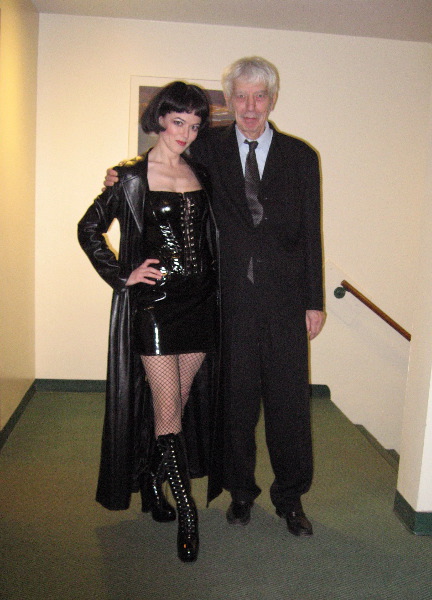
Barbara Hannigan in costume backstage with conductor Reinbert de Leeuw after a performance of Ligett’s “Mysteries of the Macabre” in Lincoln Center, New York.
The conductor Simon Rattle, in town for work with the academy and Ms. Hannigan, made a brief cameo appearance, stalking down the aisle to take the stage and interrupt the performance with the immortal spoken line “What the hell is going on here?” It was all in good fun, as was Ms. Hannigan’s performance, though no one tried to answer that question.
How far will — or can — Ms. Hannigan take this new venture as she maintains a busy singing career? To opera? To Mahler symphonies?
That remains to be seen. But to the extent that sheer musicality and personality can do the trick, she seems to have it all, and you probably wouldn’t be wise to bet against her.

 Robin Engelman
LISTENING to the PAST
I grew up listening to the NBC Symphony Orchestra. Led by the charasmatic Toscanini (1867-1957), they sold recordings of classical music in large, previously unimagined numbers. Toscanini was known for his explosive temper and quest for perfection. The covers of his RCA Victor Beethoven Symphony LPs were decorated with 20 snapshots of Toscanini conducting, all depicting him as the quintessential Maestro, no smiles, this was serious business no matter how you looked at it. Toscanini rode a Hi Fidelity sales wave as CBS, Columbia Broadcasting System, tried to catch up with the more subdued and introspective Bruno Walter. [1.] Using Toscanini as a marketing model, record companies planted the maestro mantle on other conductors, Bernstein the great home-grown communicator, Szell the meticulous teacher, Reiner the beady eyed dictator and Ormandy the curator of Philadelphia’s lush sound.
During my college days, I’d gather with a few friends for listening sessions. One of us would put on an LP and with no hints allowed, the others, in a kind of blind aural tasting if you will, had to name the orchestra. Back-in-the-day, major orchestras had their own distinctive sound. They could also be recognized by their conductor’s style, the suave sound Karajan achieved with the Berlin Philharmonic, its choice of recording venue, the super dry studio H of the NBC Symphony, and in some cases, its principal players – Voison’s trumpet in Boston, Kincaid’s flute in Philadelphia, Goodman’s timpani playing with the New York Philharmonic and the Brass section in Chicago. French wood wind sound was thin and reedy, German brass was warm and round particularly the horns and the Russians were still playing post revolution Boosey and Hawkes instruments in desperate need of up-dating. Hearing one or more of these ‘tells’, our answers were correct more often then not. These distinctions are almost impossible to make today. When asked in a NewYork Times interview why today’s orchestras sounded alike, Seiji Ozawa said Mahler was what mattered, not the orchestra. Though oblique, even evasive, Ozawa’s answer confirmed the question’s premise. It also beggared another. How did it happen?
I believe recording technology and record companies’ desire to control the results of the final product was and is at the heart of this phenomenon. Almost overnight compact digital discs replaced LP records. The effects of this revolution influenced recording companies, musicians and the public in ways unimaginable at the time, unalterably changing their attitude towards each other and the music. Working with CD technology was a far cry from the good ole direct-to-disc days of yore when performers had to play each movement straight through, no stops. If a mistake was made, a new vinyl replaced the old and another complete performance was attempted. Thus, early 78 rpm recordings were ‘live’ performances. After the invention of recording tape, mistakes could be cut out, literally. An offending passage or note was removed with a razor blade. A correction was inserted and the gap closed with Scotch Tape.
Whereas traditional recording studios are grounded, digital studios are compact and transportable. With digital technology, studio quality recordings can be made anywhere on earth. After the Cold War, former Eastern bloc orchestras and soloists, now in possession of quality instruments and eager for hard currency, willingly provided their services for fees dramatically lower than their western counterparts. In a few years, hither-to unknown performers began to flood the world’s art music market with solo, chamber and symphonic recordings. Sales of American made recordings plummeted. Critically, digital recordings allowed producers to manipulate sounds of lesser orchestras enough to satisfy a public more interested in The Great Gate of Kiev’s sonic splendors than which orchestra and conductor recorded it. For many record buyers, the sound of an orchestra and the subtleties of a maestro’s interpretation became almost irrelevant.
Some North American recording companies went out of business and many large orchestras lost their recording contracts. Solists and ensembles tried to energize ther careers by crossing over into the burgeoning pop music market. Recording companies tried hyping up performances of classic favourites such as Vivaldi’s Four Seasons and marketed Mozart for babies, for lovers, for fine dining and for working out.[2.]
Today the death of the CD seems imminent and mp3 downloads may well be the heir apparent. The sound quality of an mp3 is inferior to the CD, but will that matter to the public? Anyway, I have a large collection of LPs and too many CDs. Most of my recordings, made in the last 30 years, are sonically indistinguishable. They offer me no fresh insights into the music I often enjoy. I do not need another technically dazzling Rachmaninoff Piano Concerto #3 when the 1951 Horowitz, Reiner collaboration with the RCA Victor Symphony Orchestra trancends performances by all pianists, past or present [3.]
So, I’ve been listening to early Twentieth century recordings of symphonic repertoire conducted by the likes of Beecham, Klemperer, Mengelberg, Bletch, Furtwangler and Stokowski, all judiciously digitalized by Andrew Rose at Pristine Classical. Aided by the latest audio equipment, Rose discovers instrumental voices present, but hidden or diminished by early recording equipment and makes them audible. Along with balances, Rose may have to justify pitch, tempo and overtone fluctuations as well as reducing or eliminating surface noises and the thin metallic sound common to many old 78 recordings. He is acutely aware of the dangers in taking his remasterings too far and assiduously maintains relationships indicated by the recordings, his ears and technology. Rose often leaves surface and audience noises in order to maintain the life of an especially significant recording.
The orchestra players of this era were superb and with their conductors, created performances technically comparable to their modern counterparts while differing substantially, in some cases dramatically, to readings by almost all of today’s conductors. These interpretations changed or enhance aspects of a work in ways not always indicated by the composer, especially phrasing, accents, dynamics and tempi. Toscanini railed against conductors he considered guilty of these transgressions. And yet, leaving an NBC Symphony concert at intermission, Wilhelm Furtwangler said of Toscanini, “He’s just a time beater”.
Are you old enough to recall the admonition, “Don’t just play what’s on the page”? Many conductors of yesteryear were not bound by the page and were unafraid to trust their feelings, allowing works to take them spontaneously wherever their spirit’s willed. They are an elite compared to the replicators who constitute today’s majority. Below are some examples from a bygone era. I suspect most of you know the works from which the samples are taken. Like them or not, they demonstrate a time when conductors knew from common practice that scores were not written in granite. They knew the music had to speak differently to different people. [4.]
I chose the last movement of Beethoven’s Ninth Symphony because it is a series of contrasting events which Mengelberg realized beautifully. His pacing and tempi bring the messages of Schiller’s poem to life in ways unmatched by contemporary recordings. To my ears, modern singers, often heavy handed opera stars, are here, sensitive masters of the oratorio style and have time to listen and give each other space. As well, each section of the movement is allowed its own space, this sometimes by simple means such as a significant dimenuendo or extended fermata. For the first time I understood what Beethoven disciples meant when they spoke of this work as monumental. The bass drum, cymbals and triangle verge on inaudible, but the penultimate timpani bar makes up for those failings and provides a monumental ending. All excerpts are products of Pristine Classical digital recordings.
NOTE: These audio samples cannot be heard from e-mail. They can only be accessed from my web site, robinengelman.com.
Opening and Recitative, 4th movement of Beethoven’s Ninth Symphony. Mengelberg and the Concertgebouw Orchestra, Live recording in Amsterdam,1940.
First vocal quartet, 4th movement of Beethoven’s Ninth Symphony. Op Cid.
March, 4th movement of Beethoven’s Ninth Symphony. Op Cid.
Last quartet, 4th movement of Beethoven’s Ninth Symphony. Op Cid.
Last measures from the last movement to Beethoven’s Ninth Symphony. Op Cid.
And finally, some opening bars from Mozart’s Overture to The Marriage of Figaro, The Thomas Beecham Orchestra,1916.
Though the great string bass player and teacher Oscar Zimmerman was first to mention Thomas Beecham to me 50 years ago, I have just recently begun listening to his recordings. Beecham is the first to make me hear the inherent character of individual Mozart symphonic movements. After years of ho hum listening, a revelation.
Postlude: Please see my article Listening to the Past: An Addendum.
Foot notes:
[1.] But according to Norman Lebrecht,Toscanini’s charisma and recordings did not increase attendance at classical music concerts. Ironically, Columbia invented the Long Playing record.
[2.] The CD has always had its detractors. Its sound is dry and extreme dynamics are truncated, simply rejected by a predetermined electronic limit. As of this writing, 2014, the LP has made a limited comeback. A large Toronto audio retailer has reintroduced high end turntables and a limited number of LP records.
[3.] Serge Rachmaninoff said of Horowitz’ playing his Concerto No. 3, “He swallowed it whole. He had the courage, the intensity, the daring.”. (Wikipedia) Rachmaninoff, one of the century’s great virtuosos, made this comment while on tour in the United States playing the same concerto.
[4.] “If you want to play Schubert well, you need to know the atmosphere in Vienna, especially during the night, to know the literature, to breathe what is Vienna. It’s not just the notes you see in the score. Culture is translated in phrasing, timbre, all that makes the sound that expresses what you know about a composer, the spirit beyond forte and piano (loud and soft).” Ricardo Muhti as quoted by Nancy Malitz, Chicago in the Aisle, 3 November, 2014.
Posted by robinengelman on October 4, 2014 in Articles, Commentaries & Critiques, History
Tags: Beecham, Bernstein, CD, Columbia LP, Furtwangler, Karajan, Klemperer, Mengelberg, Norman Lebrecht, Ormandy, Oscar Zimmerman, Ozawa, Pristine Classical, RCA Victor, Reiner, Ricardo Muhti, Roger Voison, Saul Goodman, Stowkowski, Szell, Toscanini, William Kincaid