‘Hoylake, blown upon by mighty winds, breeder of mighty champions’
Bernard Darwin
Tiger Woods survived back surgery and a 109 day layoff. He’s rejoined the PGA tour to get himself competitively fit for the Open, The British Open that is, scheduled 17-20 July, Royal Liverpool Golf Club aka Hoylake (1869). This past week Tiger was playing in the Quicken Loans National, a terrible handle to lay on the majestic Congressional Country Club. (Sooner or later, someone will offer the PGA tons of money to name a contest the “Venetian Gold Sequin Jock Strap Open”, and they’ll accept.) Tiger missed the Quicken Loans cut. Even so, whether from respect, curiosity or schadenfreude, his two rounds attracted by far the largest galleries of any golfer in the field and his picture takes pride of place on the web sites of both the British Open and the PGA. The number of television viewers and tournament ticket purchases fell dramatically after Tiger announced his hiatus from golf. Irrespective of his score, Tiger’s name on a tournament list attracts countless millions of viewers and dollars. That’s fame.
Before his death, the great comedian George Carlin suggested turning all the golf courses in America into housing sites for the homeless. Carlin hated golf saying, “It’s elitist and as boring as watching flys fuck”. I understood this point of view, but some of the acreage set aside for this fascinating and ancient game should be preserved. Golf courses such as Augusta National, Pine Valley and too, Wentworth and Hoylake, should always be with us. I used to play a lot of golf. Couldn’t get enough of it. I’m partial to Hoylake because I played there on 5 consecutive days.
The day of my 1st round, I walked onto the 1st tee and couldn’t determine where to hit my ball. Seriously, this was flat open land with almost no distinguishing features. As I saw it, I could not hit to the left, that was the club house, and the three remaining choices provided me no clues. I put my driver against my golf bag and walked towards what looked to be a caddie shack. Nothing there, so on to the club house whose door was wide open. No one was about, not a soul. My God, I thought, I’ve come all this way to be met by silence and nary a clue about where to go. God dammit, I’m hanging about one of the most venerable courses in golf history, and I don’t even know where to aim my first shot! After looking around for a bit, Allen appeared, no last name, and asked if I wanted a caddie. Allen showed me in which direction to hit and off we went.
In those days I liked to play fast. At Carrying Place Golf Course just a couple of miles north of my old country home outside Toronto, I could carry my bag and play 18 holes in an hour and a half. Those were the days before golf became popular, really popular. On this day at Hoylake there was no one around to slow us up or to see how badly I played. My goodness, seaside or links golf is truly different from the upscale courses in America that Jack Nicklaus characterized as “Better Homes & Gardens golf”. Besides not knowing the direction of the next hole, the seemingly featureless landscape also demanded a caddie who knew what club to hit.
This was golf as I’d only suspected it to be. A feast for the senses. To stroll idly among freshets of sea air, dip among ageless dunes clothed in wild grass and shadows, emerge on an elevated sun washed green almost touching the sea, negates thoughts of score. Retrieving my golf ball was only an excuse for continuing my journey. I felt as a child again. The sound of my spikes crunching into Hoylake’s sandy soil, a wind whipped flag or a crisply struck ball were excitingly new. Everything new and everything possible. Allen and I agreed to meet the next day at 10 AM. And so it went.
Despite its name, the Royal Liverpool Golf Club is located in the small town of Hoylake, at the northwest corner of the Wirral Peninsula, which is separated from the city of Liverpool by the estuary of the River Mersey. The golf course extends between Hoylake and the neighbouring town of West Kirby. Consequently, the course is often referred to as Hoylake, after the town. Hoylake hosted the first Walker Cup between the top amateurs from the United States, Great Britan and Ireland in 1920 and Hoylake was the course where in 1930, Bobby Jones won the second of his four victories earning him the “Grand Slam” of Golf, the US and British amateur, and the US and British Opens. Jones is the only golfer to win all four in the same year.
At the time I played Hoylake, the course was most easily accessible from Liverpool by train. After a couple of rounds Allen began carrying my bag to the train station. The station was just a short walk from the course and Allen and I use those walks to get to know each other a bit better. Allen played organ in a local pub in the evenings and would occasionally caddie during the day. Our fortuitous meeting proved my golfing boon. Alan knew the course intimately, spoke very little and thus proved to be a perfect golfing companion. He also complimented me on the speed of my play.
Very seldom has Hoylake been a part of the Open Championship rota. The town could not accommodate the ever-growing numbers of people interested in attending a great championship. When I visited, Liverpool’s waterfront was being modernized. One of its reformations was the Liverpool International Garden Festival. This festival had brought me and Nexus to England’s west coast in 1984. Today, I remember my golf more readily than our music.
After one of our rounds, Allen told me about an Open at Hoylake when the wind off the sea was so strong, golfers could not control the ball. Players complained, but were met with resistance by Royal and Ancient officials. The Brits take pride in the fact that no Open Championship had ever been postponed or even delayed because of wind. “Nay wind, Nay golf” is the heroic homily that has come down through the years. So, the golfers took the R & A officials to the practice ground where a 9 iron was snapped directly into the wind. The ball was driven backwards over everyone’s head and the round postponed.
This year, 2014, golf will begin on Royal Liverpool’s 17th hole and finish on 16. 2006 was the last time the Open was played at Hoylake and the Champion Golfer of the Year was awarded to Eldrick Tiger Woods.. Dear Mr. Carlin, with respect, I’ll watch all four rounds of this year’s Open. Unless I’m dead.
Post script: Tiger played well, but Rory Mcilroy from Hollywood, Northern Ireland was the Champion Golfer of the year. A week later he won the World Championship tournament at Firestone Country Club and Tiger had to withdraw after straining his back. At age 25 he is the new kid on the block. This week, August 7 through 10, the PGA Tournament will be played on Valhalla Golf Course in Louisville, Kentucky. It’s the last major of the year. If Mcilroy wins this and next year’s Masters, he’ll complete a Grand Slam, whatever that means, joining Sarazen, Hogan, Player, Nicklaus and Woods. Due to scheduling, Bobby Jone’s feat can no longer be duplicated.

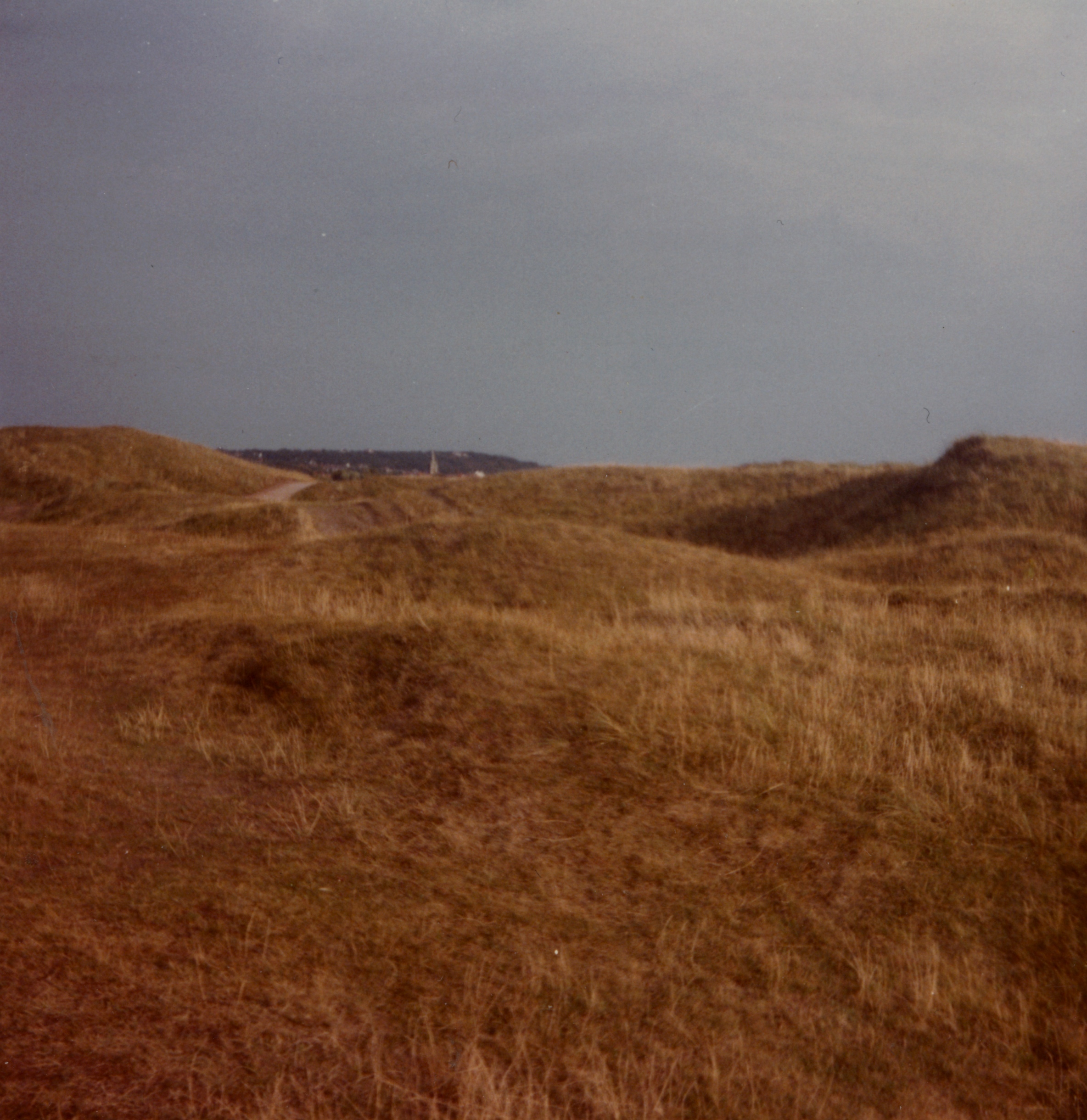
View from the par 4, 9th tee with Allen and me in the distance. This is the beginning of the five sea side holes, 9 through 13. Hoylake, 1984. Photo by William Cahn
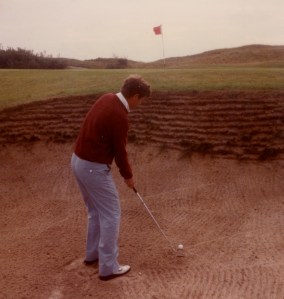
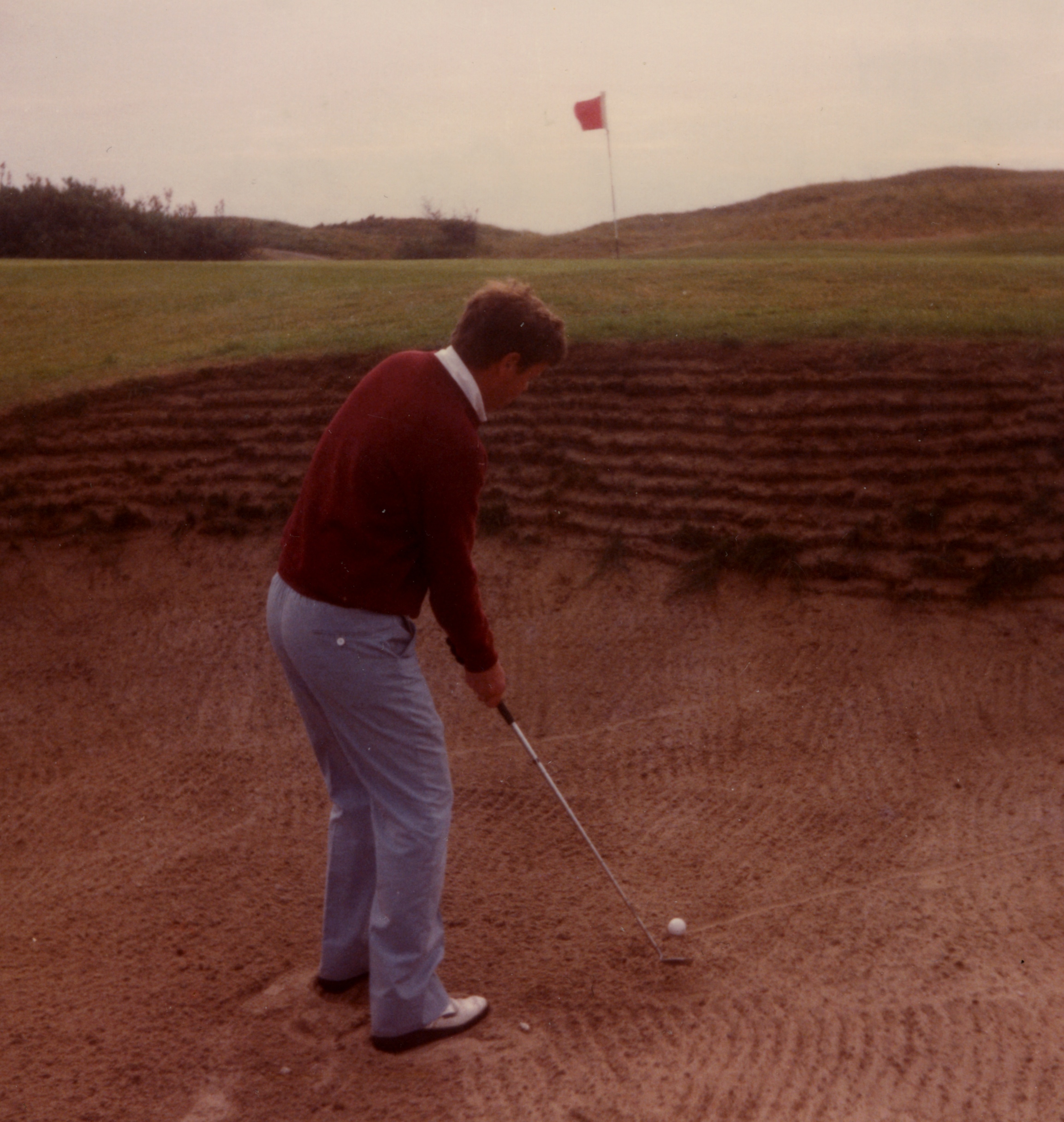
Right bunker on the par 3, 11th hole. Beyond the flag is death. Photo by William Cahn

Allen and me on the par 3, 13th hole. Photo by William Cahn
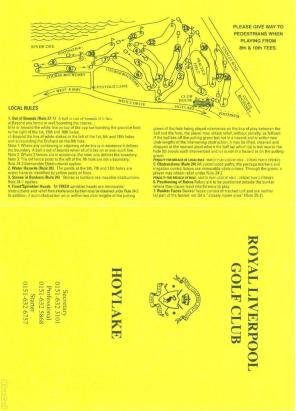
Royal Livrpool Golf Clup score card. The links truly begin at the 9th hole
http://www.pga.com/openchampionship/course/2014/tour/18


 Robin Engelman
ISIS
The Islamic State in Iraq and Syria-Levant
I’ve been wondering why a militant Arab organization chose an English acronym to advertise its jihadist movement. After all, if it feels obligated to occasionally kill co-religionists, shouldn’t it do so under a banner written in its own language: Al-Dawlah al-Islāmīyah fī al-ʻIrāq wa-al-Shām.?
Maybe ISIS thought its Arab name would not trip so lightly off the tongues of Englsh language television commentators, nor prove to be a memorable catch phrase with western audiences. Tis indeed a mouthful for non-believers.
Regardless, I have for too long been subjected to the shenanigans of Hamas, Mossad,Taliban, Israel, Palestine, Iran, Syria and all the Arabs and Jews who perennially kill each other, without regard for collateral damage. ISIS is only the latest and most virulent of the lot. As George Orwell predicted, war, in this case terror, has become a constant presence, distracting us from the unquenchable greed and insufferable stupidity of those who find chaos politicallyuseful and profitable. Religion, politics and money are fracking civilians. War has become boring and death mundane.
Which brings me to our own shenanigans. We are as militant as Jihadists and Jews. Rather than kick our bloviating politicians in their asses, the dictators of our publicly owned airwaves are allowed to maintain a 24 hour middle-east Jamboree. So screw our fellow citizens, those who lost their homes and dignity in New Orleans, our young students and their parents strung too tightly by usurious fees and our middle-class wealth subsumed in the maw of Wall Street. These are too depressing for western television and, methinks, too dangerous. Our media provide suicide bombers, rockets and amputees as diversions from our home land casualties.
So, what’s to be done? In his book The Limits of Power, the End of American Exceptionalism , Andrew J. Bacevich [1.] suggests, among other things, the United States dissengage itself from the middle east and allow them to get themselves sorted out without any intervention from us or anybody else, Much like the Russians and the Chinese have done and Christianity did during its Reformation.
Bacevich’s strategy reminds me of the New York City policeman who, when asked if he was concerned about a spate of mob killings, said, “As long as they’re killing each other I don’t see any reason to interfere.”
Apologists for imperialism stress a need to bring freedom to millions of people oppressed by malevolent dictators. Their impetus is merely a version of The White Man’s Burden (1899), subtitled The United States and the Philippine Islands, a poem by Rudyard Kipling in which he expresses a vision of men like himself civilizing the world. Today our burden has been updated to favour oil companies and armorers, otherwise the goal remains unchanged. Take all the natural resources we can use. That’s what the Brits did and it’s what we’re doing now. A profit motivated aggression hidden behind obfuscation, disambiguation and a war on terror.
An intense loathing by much of the world has been our reward. Now the world’s un-washed are fighting back and the only answer we can muster is, “Let’s drop the big one now. They don’t like us anyhow”. [2.]
“It should, it seems to me, be our pleasure and duty to make those people free, and let them deal with their own domestic questions in their own way. And so I am an anti-imperialist. I am opposed to having the eagle put its talons on any other land.”
-Samuel Langhorne Clemens aka Mark Twain, on US policy viz a viz the Philippine Islands, New York Herald, October 15,1900. [3.]
[1.] Henry Holt & Co. – 2008. Andrew J. Bacevich, Jr.(1947-) is an American political scientist specializing in international relations, security studies, American foreign policy, and American diplomatic and military history. He studied at West Point Military Academy and Princeton University and is a retired U.S. Army Colonel. He teaches International Relations and History at Boston University. His son, also an officer in the U.S. Army, was killed in 2007 in Iraq.
[2.] From the Song, “Political Science” © 1969 by Randy Newman, BMI.
[3.] The 1898 Treaty of Paris, surrendered control of Cuba and ceded Puerto Rico, parts of the Spanish West Indies, the island of Guam, and the Philippines to the United States.
Posted by robinengelman on July 16, 2014 in Commentaries & Critiques, History
Tags: Andrew J. Bacevich, George Orwell, ISIS, Jihadist, Mark Twain, New Orleans, New York Herald, Randy Newman, Rudyard Kipling, Student debt, The Islamic State in Iraq and Syria, The White Man's Burden, treaties of Paris, United States imperialism, Wall Street