Andrew Wyeth
1917, Chadds Ford, PA. – 2009 Chadds Ford, PA.
My first encounter with Andrew Wyeth was in1968 after Houghton-Mifflin published a sumptious, oversized book with reproductions of his paintings on heavy rag paper titled “Andrew Wyeth”. Later, as part of a War for Independence road trip that included Valley Forge and Brandywine Battlefield, my wife and I visited Chadds Ford.[1.] It was there I began to understand the love Wyeth had expressed for his mysterious, tucked-away-world. Wyeth’s subtle, almost invisible egg tempera colours and textures were fascinating. I’d never followed his career and I learned of his death long after his passing. However, something in the spiritual ambience of his work, if not yet quite grasped, remained with me.
That missing something was finally revealed in May 2014 when we visited a large and conprehensive Wyeth exhibit in the National Gallery, Washington, DC called Looking Out, Looking In. The exhibit began with numerous watercolours, all new to me and they wove themselves seamlessly into his sketches and paintings. I discovered a nowness that Wyeth had captured – those incredibly timeless moments, the hallmark of a great artist. Many years ago Toru Takemitsu said,”Vermeer is not about colour”. And indeed colour is not what he was about. Nor was Wyeth.
In Wyeth as in Vermeer, there is more, a most important more. As I meandered from room to room, Wyeth’s paintings evolved into a private world of my own and became abstractions

Seed Corn, 1948, Private Collection.

Cellar Fireplace, 1955, Oklahoma City Museum of Art.
In 1965, Wyeth said that although he was thought of as a realist, he thought of himself as an abstractionist: “My people, my objects breathe in a different way: there’s another core — an excitement that’s definitely abstract. My God, when you really begin to peer into something, a simple object, and realize the profound meaning of that thing — if you have an emotion about it, there’s no end”.
Howard Pyle was to my mind a superb illustrator and painter. Pyle painted a great and recently stolen picture of English Grenadier drummers pushing their colleagues up Breed’s (Bunker) Hill towards their second repulse by the “Colonial rabble”. Pyle lived in Chadds Ford as did N.C. Wyeth, Andrew Wyeth’s father, who studied with him. Andrew Wyeth said that illustrators like Howard Pyle painted pictures.

Battle of Bunker Hill, Howard Pyle, 1889.
Below is one of my favorite pictures. I took it after a long day on the Capital Mall. My wife and I had a marvelous bottle of Vouvray as an accompaniment to these even more marvelous Chesapeake Bay bivalves. (Eat your hearts out, ye denizins of P.E.I. or anywhere else for that matter.)
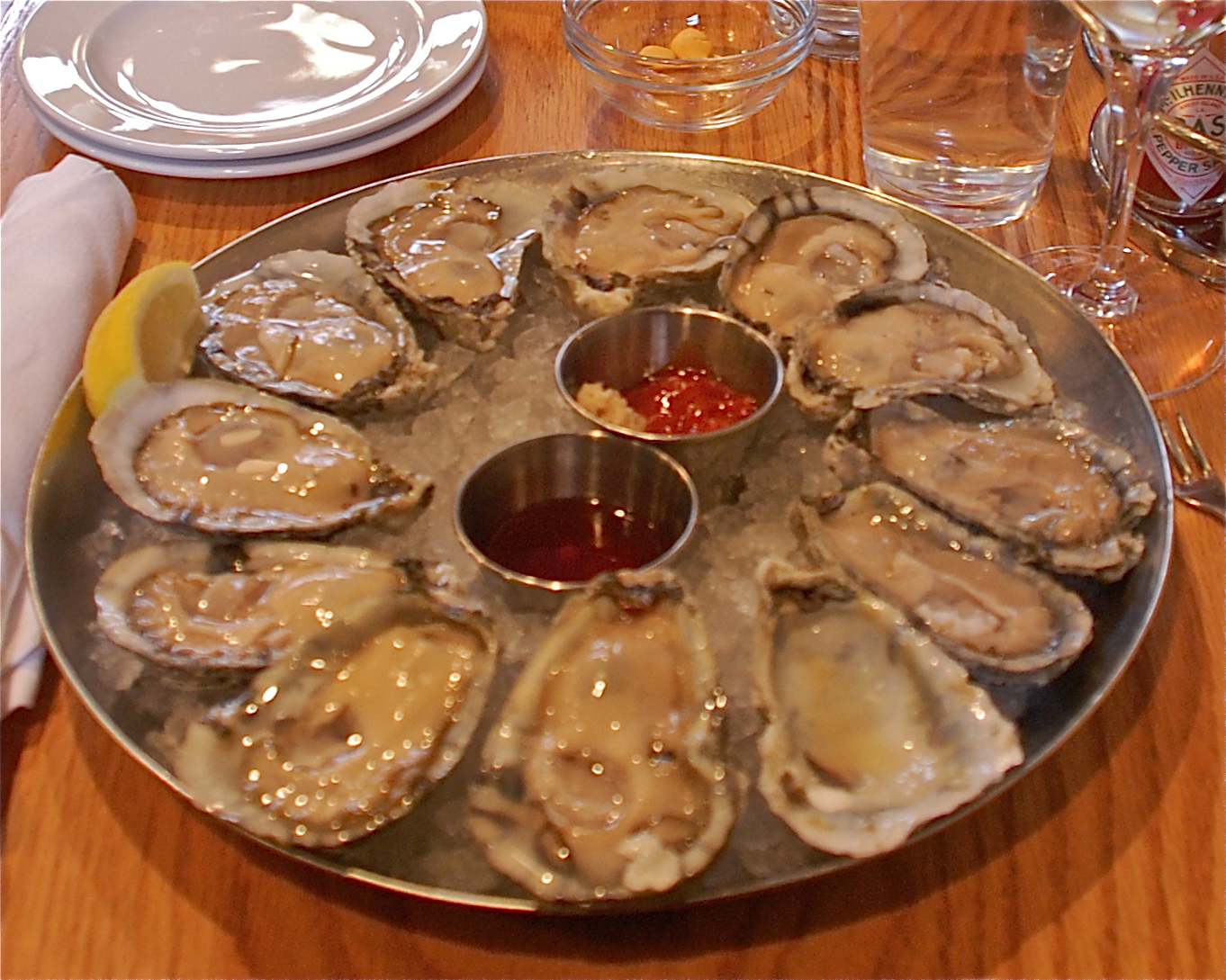
Starters, a Plate of 12 at Hank’s Oyster Bar. Washington, D.C. photograph by R.E., 2009.
[1.] Chadds Ford was the major crossing of Brandywine Creek by the road from Baltimore to Philadelphia. The battle was fought 11 September 1777 between approximately 14,000 troops under General George Washington and 15,000 under General Sir William Howe. Though occupying a strong position, Washington failed to send out scouts and his right flank was turned. The defeat led to Howe capturing Philadelphia and Washington establishing winter quarters at Valley Forge.
 Robin Engelman
A Ruff Death, (1634-2008, Requiescat in pace)
During the winter of 1778, as George Washington’s infantry rehearsed the manoeuvers of Baron von Steuben,[1.] it was the sound of an English drumming tradition that filled the parade ground of Valley Forge.
Over time the hand to hand beats played by English drummers had been grouped into short rhythmic patterns, given names, codified and passed on to colonial drummers. Some of the patterns signaled soldiers to perform camp duties such as getting fire wood or water, whilst other patterns directed their movements in battle.
In the hands of creative drummers, these patterns could be combined to enliven popular melodies which eased a soldier’s weariness or emboldened fighting men in the face of an enemy. Drummers were required to practice these patterns assiduously.
Eventually they were known as the Rudiments of drumming and the drumming style, Rudimental.
The word rudiments first appeard in a drum book in 1812. On page 3 of A New Useful and Complete System of Drum Beating, Charles Stewart Ashworth wrote, Rudiments for Drum Beating in General. Under this heading he inscribed and named 26 patterns required of drummers by contemporary British and American armies and militias. The word Rudiment was not used again in US drum manuals until 1862. George B. Bruce began page 4 of Bruce and Emmett’s Drummers and Fifers Guide with the words Rudimental Principles.
Beginning with the long roll, Bruce listed 35 patterns concluding with a paragraph titled Recapitulation of the Preceeding Rolls and Beats. On page 7 of his 1869 Drum and Fife Instructor, Gardiner A. Strube wrote, The Rudimental Principles of Drum – Beating, and followed with 25 examples, each named Lesson.
The National Association of Rudimental Drummers (“N.A.R.D.”) was organized in 1933-34. The men of the N.A.R.D. were well known teachers, performers and composers. Some of them had studied drumming with Civil War veterans, whom they referred to as The Ancients. The N.A.R.D. was formed to enhance, preserve and disseminate what in their minds was an endangered style of drumming.
They combined Gardiner Strube’s 25 lessons, added the long roll and perhaps for the first time in history, unambiguously declared each heretofore lesson, pattern, beat, or principle, a Rudiment. They called the first 13 rudiments “Essential”. These were used to test applicants seeking membership in the Thirteen Club.
Another list of snare drum rudiments was compiled in 2008 by a group of drummers from the Percussive Arts Society (P.A.S.) Marching Percussion Committee. Their compilation contained 38 rudiments of unspecified origin including 24 of the “Hybrid” variety, and the 26 N.A.R.D. rudiments, making a grand total of 64 rudiments.
Drummers can become attached to a rudiment. Its appeal can be historic, or the feeling in the hands when its played. Even the onomatopoetic nature of its name may endear it. The Paradiddle and Ratamacue are examples of the latter. If one repeats these names, one can imagine how they’d sound played on a drum. [2.]
Along side the Flam, my favourites have always been the Ruff and its relative, the four stroke Ruff. These rudiments are to my mind, the most elegant and useful beats in a drummer’s repertoire.
The Ruff’s soft R suggests a variety of nuances. The four stroke Ruff, played as a roll can substitute for the five stroke roll. However, the Drag’s consonant D, limits expressions. Even so, the P.A.S. committee changed the name of the Ruff to Drag.
Had the N.A.R.D. made their list to read Ruff, Ruff tap and double Ruff Tap, the P.A.S. committee may have followed suit, allowing a continuance to the life of Ruffs.
In May of 2011, a group of very good drummers began a contentious and sometimes humorous exchange of e-mails after one of them was criticized for using the word Drag rather than Ruff. If the statute of limitations runs out before I die, I may publish their correspondence.
Perhaps all this Tea pot tempest could be ameliorated by shifting the conversation to Strokes. As the inimitable John S. (Jack) Pratt said,
“Drum rudiments are exercises. The rudiments of drumming are strokes”. [3,]
Without preamble I asked a group of friends, all prominent teachers and performers, how many strokes were used in snare drumming. Their answers ranged in number from 1 to 11, and one person replied, “Is this a trick question?”
If no agreement exists among some of the best drummers in North America about the number of strokes needed to play a snare drum, might not arguments about Ruffs and Drags be considered akin to bickering?
Today, within the ranks of Fife and Drum corps drummers, the Ruff’s proud name, it’s romantic evocation of history and onomatopoetic pedigree survive, but outside that cozy womb of nostalgia, in the brittle, frenetic world of Kevlar heads and carpal tunnel syndromes, the Ruff is only a memory, if that.
Now, after its first appearance in print 370 years ago, the Ruff is no longer a part of an academic drummer’s lexicon.
The Ruff is dead, Viva la Ruff!!
N.A.R.D. rudiments 8, 9, and 10.
PAS Rudiments 31, 32 and 33
Notes:
[1.] Baron Friedrich Wilhelm Ludolf Gerhard Augustin von Steuben was of Prussian birth and a soldier, though he seems to have awarded himself the title. He knew19th century infantry tactics, taught them to the Colonial Army and authored an illustrated compendium of his military learning, popularly known as the Blue Book because of its cover’s colour, but officialy entitled Baron von Steuben and His Regulations.
[2.] In fact, the verbal repetition of onomatopoeia was sometimes used to teach musically illiterate young drummer boys. Today it is still used as a kind of verbal short hand.
[3,] Jack Pratt used the English language carefully. He took a Master’s degree in English with a thesis about poet John Keats. He was a published member of the New Jersey Society of Poets and taught English in a local New Jersey high school until his retirement. Jack is also a virtuoso performer and prolific composer of drum solos in the so called Rudimental or military style. His carefully drawn manuscripts bear witness to his meticulous nature. Jack’s lengthy and detailed Percussive Arts Society Hall of Fame acceptance speech is the stuff of legends.
Posted by robinengelman on June 26, 2014 in Articles, Commentaries & Critiques, Fifes & Drums, History
Tags: Baron von Steuben, Bruce and Emmett's Drummers and Fifers Guide, Charles Stewart Ashworth, Drag, Gardiner A. Strube, George Washington, John S. (Jack) Pratt, National Association of Rudimental Drummers (“N.A.R.D.”), onomatopoetic, Percussive Arts Society (P.A.S.), Rudiments, Ruff, the Thirteen Club, Valley Forge