RSS

Category Archives: Commentaries & Critiques

Going Aloft

Greetings Land lubbers. My grand-daughter Lucie is now in Cadiz, Spain having left Collingwood, Ontario on 26 August aboard the tall ship S.S. Sorlandet. She and 40 fellow students sailed up the St. Lawrence River to the Atlantic Ocean, arriving at their first port of call, Horta in the Azores. From Horta they finished crossing the Atlantic and sailed up the Tagus River to Lisbon Portugal, a total of 11,685 nautical miles in 51 days, with 24 of those days at sea.

The Sorlandet entered dry dock in Lisbon to remove a fishing net intagled in its rudder, causing a small oil leak.. The entire vessel was visible to the students for the first time.

S.S. Sorlandet in  dry dock. Lisbon, Portugal. 20 October, 2013.

S.S. Sorlandet in dry dock. Lisbon, Portugal. 20 October, 2013.

During the Atlantic crossing, Sorlandet experienced 25 foot waves and winds which produced speeds up to 10 knots per hour. In the midst of this weather Jannik Rathke, an adventurous student decided to film his climb up rope ladders to the highest point on the ship. It’s an incredible journey worth seeing. Congratulations Janniik. His mother broadcast this uTube posting. I must write to ask her what she felt while viewing her son’s film for the first time.

http://www.youtube.com/watch?v=IprZEi-yaDo&feature=youtu.be


Tags: , , , , , ,

AUSTRA

Pleiades, a work for percussion by Greek composer Iannis Xenakis, forced me to wear ear plugs for the first time. With all respect to Dionysus, it was the loudest music I’d ever heard.

But not as loud as Austra, an electro-acoustic band formed in 2009 in Toronto. Its members are percussionist Maya Postepski, singer Katie Stelmanis and bassist Dorian Wolf. Austra, as they say in the bizz, has a buzz. Their first CD, Feel it Break (2011) was a New York Magazine Top Ten Album of the Year and received a Juno Award nomination for Electronic Album of the Year and came within a decibel of winning. (Check out Lose It). They’re beginning to make it, particularly in France, Germany and England. Austra’s been on the road for three years and If any couch potato wants to feel queazy, check out their current touring schedule:<http://www.austramusic.com>).

Maya studied music and percussion at the University of Toronto and played for 4 years in the Faculty Percussion Ensemble. At the same time, Stelmanis was a voice major in the faculty opera department. Wolf is a veteran of many bands and no mean photographer. While still in school, Maya invited me to hear their fledgling group in a local venue used primarily by young musicians. The band was too large, a bit unwieldy and the house sound system did them no favours. After that trial run, Austra pared itself down to a trio and Maya’s contributions have bloomed with the purchase of conga drums, a viberaphone, glockenspiel, some traps and a complete drum set. Austra has also acquired managers and agents and most important for the trio’s music, a full time, professional soundman.

A few weeks ago Maya and I reconnected over dinner. She invited me to Austra’s concert in Toronto’s Phoenix Concert Theatre. Besides free admission, she gave me a back stage pass for food and drinks at the after concert party. My first.

I met up with three former U of T students, two percussionists and a flutist. We had our picture taken with Maya before the concert and sat in the balcony at the back of the theatre.

Tricia Mangat, Maya Postepski, Robin, Mandy Lau, Laura Chambers. Phoenix Concert Theatre, Toronto, 27 September, 2013.

Tricia Mangat, Maya Postepski, Robin, Mandy Lau, Laura Chambers. Phoenix Concert Theatre, Toronto, 27 September, 2013.

I had been told to bring earplugs. I didn’t. The first tune hit like a solid wall of sound so loud, I felt my dinner beginning to digest. I sat stone still, trying to relax. Conversation with friends was impossible. Cripes I thought, how could the kids pressed against the stage bear this Maginot line barrage?

Nearby, a tall delicate girl dressed in diaphanous white began moving her arms over head, her hips side to side, in a slow meditative choreography to the music. She kept this up for Austra’s entire set, providing me an occasional diversion. As the evening progressed, I began to hear voices moving in the walls of sound. Stuff was happening in there.

Even so, I had difficulty separating electronic from acoustic sounds. Electronic percussion cannot easily be distinguished from its “real” counterparts, especially in a sound spectrum as heavily mixed as the one I was hearing. I wanted to know for sure what Maya was playing and what was electronically pre-recorded, but my vision is not too sharp and with the flashing lights, I rarely caught more than a fleeting glimpse of Maya and some mysteries about her work remain.

The trio is growing on me. Stelmanis has a voice with a band saw vibrato, an edgy intensity that could be interpreted as anger, but overall, floats with an indefinable poignancy that draws one in. She covers a range of emotions larger than the tessitura of her songs, singing with complete control and in tune. The bed for her voice consists of a solid bass and the driving pulse of percussion. For me, Austra has been a taste worth acquiring.

Austra is paying dues, but they are doing what they love and that’s aplenty. Rumour has it they’ll soon be playing Hollywood Bowl.

Post script:

Whenever she can, Maya and a group of her friends manage to trundle percussion instruments across Eigensinn Farm, the home of Chef Michael Stadtlander’s internationally famous restaurant. Every summer Michael hosts a Wild Leek Festival. As many as 15 chefs prepare their specialties at stations around the farm and offer appropriate wines donated by Ontario wineries. The music of Maya and her friends accompany the moving feast. Stadtlander was voted one of the world’s top ten chefs and some aficionados fly into nearby Collingwood to savor his cuisine. Michael is also a leader in the use of local foods and has enrolled Ontario farmers and chefs nationwide to cultivate and use locally grown food. This past year he rallied friends, foodies, chefs, farmers and businesses to defeat plans for a mega quarry. An expansion that would have polluted the headwaters of five Ontario rivers.

Maya Postepski, 2nd from right, with chef Jamie Kennedy and  Toronto percussionists during a Wild Leek Festival on chef Michael Stadtlander's Eigensinn Farm, Singhamptn, Ontario.

Maya Postepski, 2nd from right, with chef Jamie Kennedy and Toronto percussionists during a Wild Leek Festival on chef Michael Stadtlander’s Eigensinn Farm, Singhampton, Ontario.
 

Tags: , , , , , , ,

A Paean to Librarians and a Nod to General Gage.

Librarians are cool. They are a part of my personal pantheon of professional problem solvers who, with all respect, dwell along side auto mechanics, stage hands and family doctors.

My auto mechanic for the past 30 years can sometimes diagnose a car’s problem simply by listening to it. He never over charges and doesn’t charge at all for minor adjustments or checking things out. Stage hands the world over, guard their territories like pride lions, but can relish opportunities to improvise solutions for unexpected requests. Any touring group worth its jet lag will cotton up to their venue’s stage Meisters. My family doctor brings relief just by entering  the room and a librarian behind a reference desk is an invitation to the thrills of exploration and discovery.  Hanging out with these pros is always a win win situation.

Not too long ago I gave a lift to Kathleen McMorrow, then head librarian of the Universty of Toronto Faculty of Music and her husband John Beckwith, composer and scholar. During the ride, Kathleen and I began discussing her library, one of the very best in North America and her librarians, some of the most knowledgeable and helpful people I’ve had the privilege to know. My opinion of them is based on the abstruse subjects I had asked them to ferret out and their quests which never seemed to fail. “Yes”, Kathleen answered. “We like to be asked difficult questions. The more difficult the better.

My first meeting with a librarian did not go well. I was in my second-year of college when a drab PhD student from a large Ivy League university near by, showed me her thesis and asked if I could make manuscript copies of 125 examples of cadential dissonances in the music of Josquin des Prez. [1.]  I was broke and she was going to pay. So naturally I accepted the challenge without giving any thought to the amount of time this would take. I was slow in getting the job done and she was frantic. In her mind, the success of her Magnum Opus was threatened by a recalcitrant under-grad.

Many years later, in a city far away, I visited a public library seeking pocket scores to orchestral repertoire. There, behind the music desk, was my unhappy PhD candidate. She was still unhappy and seemed embarrassed to meet me again. I didn’t ask about her thesis or where the library kept its  pocket scores.  No matter, neither of us had anything to say to the other. I found the scores on my own and left.

Things turned around when I visited Kathleen’s library. There, I discovered a new world and began to learn how to do research. Staff  were interested in my questions. Questions about obscure songs from revolutions 200 years ago, composer unknown and perhaps with 2 or 3 different titles. When and where was it first mentioned? Where, when and how was it first performed and by whom? If a first printing exists, where is it?  If in a foreign library, how can some one with no scholarly research credentials, me, gain access to the materials? [2.]

I was a neophyte, a real know nothing, but with patience and words a civilian could understand, I was led into their realm, every step an adventure of discovery.

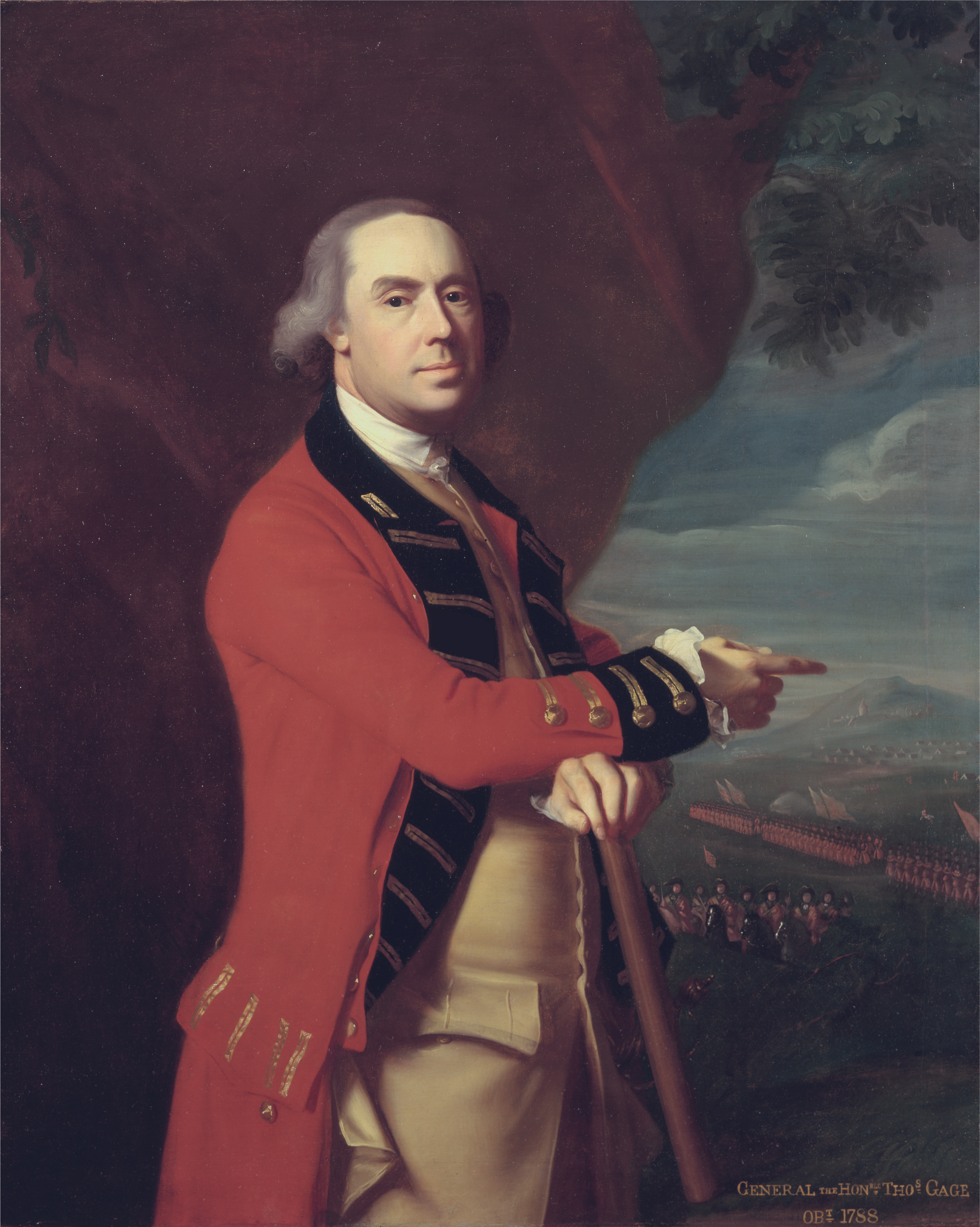
Recently I wrote a To Whom it May Concern e-mail to the Yale University Art Gallery, American Paintings and Sculpture Department. My e-mail was prompted by the Gen. Thomas Gage portrait below by John Singleton Copley. [3.] I asked to what battle or event was Gen. Gage pointing. A few days later came this reply:

Dear Robin,

We have received your request for information regarding the portrait by John Singleton Copley.  This portrait of Gen. Thomas Gage is not specific to any battle, perhaps Copley thought he was being politically circumspect by representing Gage as a gentleman in the portrait; though he showed the general in a political environment, on a military field , and dressed in full British military regalia, his approach is nonpolemical: he takes no partisan position, neither making references n support of nor alluding to the benefits of British occupation.  But the very image of General Gage, even though portrayed neutrally, was politically charged.  This painting was done ca. 1768-69 and the Battles of Lexington and Concord didn’t happen until 1775.  Copley and Gage met when the commander came to Boston in 1768 on orders from the king to still the unrest caused by British soldiers in the town.  Gage was not entirely successful in his efforts and, indeed, met the opposition of patriots such as Samuel Adams.  But his presence was appreciated by many colonists, especially members of the Massachusetts elite.  Copley’s portrait betrays no hint of the strife that surrounded his sitter but presents an authoritative picture of a distinguished an affable officer pointing out troops performing orderly drills and equestrian maneuvers.  It is an archetypal image of a military man, the composition of which Copley may have derived from any number of similar portraits of British officers that he would have known through mezzotints.

Hope this information is helpful.

Best,

Janet

Janet M.  Miller
Museum Assistant
American Paintings and Sculpture Dept.
Yale University Art Gallery

This is good stuff. I encourage anyone with a really difficult question to visit your local librarian. You may be surprised by what you learn.

Gen. Thomas Gage, Governor of the Province of Massachusetts Bay In office 13 May 1774 – 11 October 1775.  Portrait by John Singleton Copley, circa 1768

Gen. Thomas Gage, Governor of the Province of Massachusetts Bay
In office
13 May 1774 – 11 October 1775.
Portrait by John Singleton Copley, circa 1768

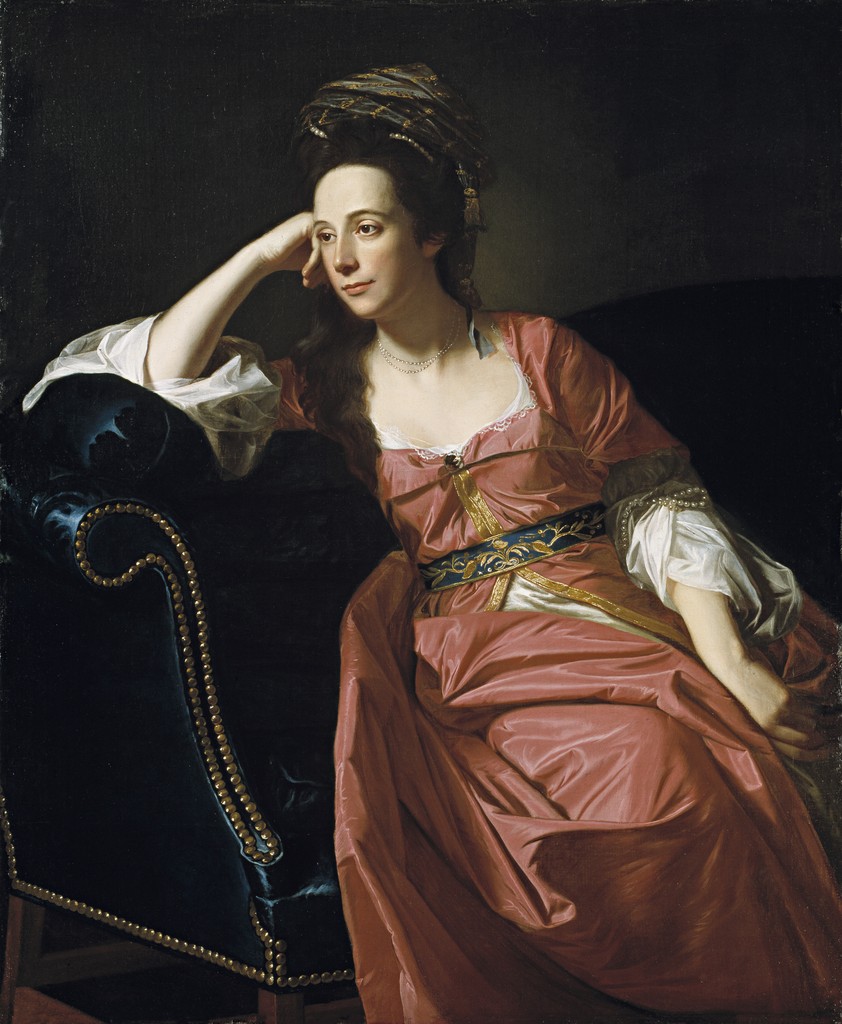
Margaret Kemble Gage (1734-1824) wife of Gen. Thomas Gage commander of British North American forces during the War for Independence.

Margaret Kemble Gage (1734-1824) by John Singleton Copley, 1771. Born in New Jersey, Wife of Gen. Thomas Gage commander of British North American forces. During the War for Independence, she was suspected of passing military information to colonists.

John SingletonCopley, self portrait, 1784, national Portrait Gallery, London.

John SingletonCopley, self portrait, 1784, National Portrait Gallery, London.

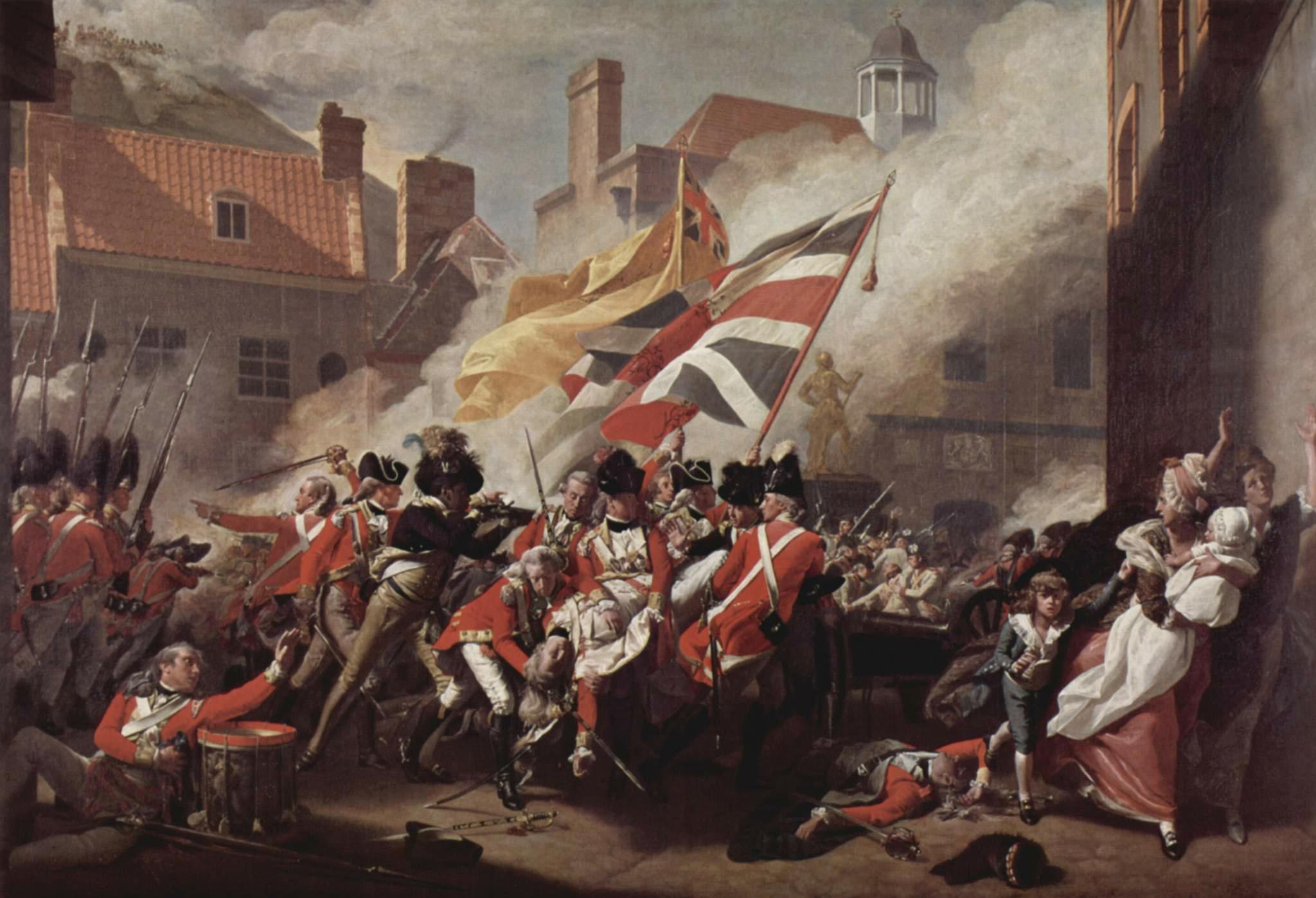
The Death of Major Peirson, in the Battle of Jersey in 1781, by John Singleton Copely, 1782-84.

The Death of Major Peirson, in the Battle of Jersey in 1781, by John Singleton Copley, 1782-84.

Footnotes:

[1.] Josquin des Prez (c. 1450-1521)

[2.] See my article Le Carillon National, Ah! ça ira and the Downfall of Paris|,The opening credits give an idea of the services librarians provide for their patrons.

[3.] Copley (1738-1815) was self taught. I am amazed by this fact when I view his skill with fabric in Margaret Kemble Gage’s portrait and his handling of the complexities of a military mêlee in his Battle of Jersey painting. He was extremely successful and moved to England during the War for Independence. The painting above, titled The Death of Major Peirson, in the Battle of Jersey, 1781, painted between 1782 – 84, made copley famous in Britain. It is yet another military Death of painting with the ubiquitous drum, shown here supporting an arm of a wounded combatant.


Tags: , , , , , ,