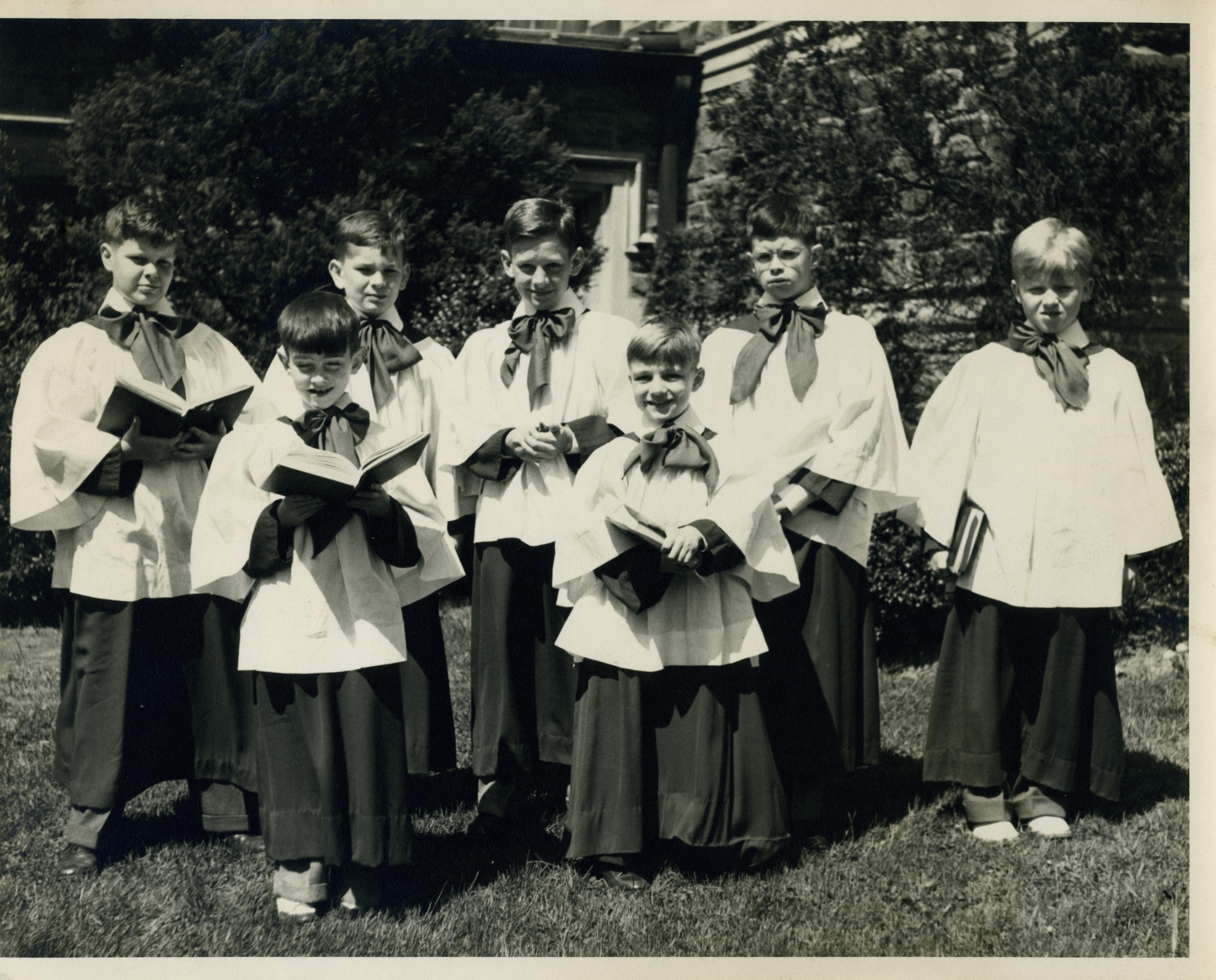
Boys choir, Saint Marks Methodist Church, Baltimore, Maryland, ca. 1947.
While discussing over drinks the subtleties of triangle playing, Seiji Ozawa remarked, “Percussionists have to sing”.
My first experience with music was probably singing. Whether it was me singing in a choir or hearing vocal music, I’m no longer sure. I do remember an LP recording arriving in the mail. It was created by Fred Waring and his Pennsylvanians. (People from my generation will remember this group.)
Waring’s arrangers had set words to the music of Tchaikovsky’s ballet “Nutcracker”. “Hark to the sound of the balalaikas, Hark to the shouts of the merry crowd, etc.”
I played that vinyl recording over and over and over until I had memorized the entire set of songs. The recording was still in pretty good shape until one day I left it sitting on a windowsill without its sleeve. Returning home from school, I found the sun had shaped the vinyl into a wave band.
I was crushed. But luckily the weight of the old tone arms was enough to keep its needle in the grooves, at least until it got close to the centre. All this took place either just before or just after I joined my neighbourhood church choir.
I couldn’t read music, but I had a quick ear and in a short time grasped the fact that the distance between notes on a staff was related to the distance up or down in pitch. Using this visual crib, I became a pretty good sight reader and the boy soprano soloist. According to my Mother, I regularly made the older women in our congregation cry, but I was not aware of my powers at the time.
The highlight of every season was a gigantic Christmas Eve service. Our organist and music director Edward Choate O’Dell [1.] always hired a string quartet, a brass quintet, two harpists and Timpanist Dr. William Sebastian Hart – all instrumentalists from the Baltimore Symphony Orchestra.
There were of course the adult choirs and a choir of 30 song flutes. Two huge Christmas trees decorated entirely in white stood guard on either side of the chancel. A professional soprano raised our souls, but nothing could compare with “Hark the Herald Angels Sing” performed en mass, a trumpet soaring in a descant worthy of “Lucy in the Sky With Diamonds”, a thousand voices singing what they knew, Timpani a roar, and then Odell’s final gut crushing cadence with 30 foot bass stops akimbo. “Oh Lord, I give up!”
I had a few good years. However, after an altercation with a new minister, I walked across the street and began singing in another church choir. That choir was directed by a man who also directed a choir in a high Episcopalian church in downtown Baltimore. He asked me to sing in the choir and just a few months after leaving one church I found myself in another.
But the buzz was gone. Now through occasional fogs of incense I was singing Latin instead of Luther. I hadn’t a clue about the meaning of the words and somehow monody just didn’t do it for me.
However, all these vocal experiences stood me in good stead. The first time I played the orchestral suite to the Nutcracker ballet, Fred Waring and his Pennsylvanians were in my head. As I played the wonderful tambourine part to Trepak, I was singing “Hark to the sound of the balalaikas, Hark to the shouts of the merry crowd, who dance and sing till the rafters ring and click their feet to the pounding beat.”
Making music couldn’t be much easier.
[1.] Edward Odell gave a large party at his home just prior to one of our Christmas services and I attended with my mother. He owned one of the famous Baltimore brownstones, houses more thin than wide, but very deep and tall. O’Dell’s living and dining room displayed glass cases filled with precious objects of Art. I can only imagine now what they were worth. But at the back of the 1st floor was his bedroom and it was this bedroom I’ll never forget. Odell had purchased the Chinese teak bedroom set of Robert Ripley the creator of “Believe it or Not”. Not too long after posting this article I was contacted b the director of the Chinese Snuff Bottle Society. The Society was started by O’Dell and the cabinets I had noticed in his home had been filled with snuff bottles. A 3″ tall baottle recently sold in England for 2 million Euros.
In preparation for this article I researched Dr. Odell and found a very interesting website, “The International Chinese Snuff Bottle Society”. There in splendor was a book, “The Edward Choate O’ Dell Snuff Bottle Collection,by John Gilmore Ford with an essay by Emily Byrne Curtis, ICSBS, Baltimore, 1982. 200 high quality color photographs from the collection of Edward Choate O’Dell, founder of the society, with catalogue entries by our current president, John Ford.”
All my life Dr. Edward Choate O’Dell has been a hero to me. I remember very little about him, in fact I can’t visualize him today. But I remember how quiet he was during my audition for the boys choir, how carefully he went through the tunes as I sang. How kind he was at the end when he turned to me and said, “You have a good ear”. At a time when I could have been crushed, perhaps turned forever away from music, he did one of those rare things that provides one with an anchor for life and the self confidence to excel. He was a great teacher.
After a 20 year absence, I had to return to Baltimore to attend a relative’s funeral. My first Pastor at Saint Marks, the Rev. Dr. E. Cranston Riggin attended the viewing as did Dr. Odell. I had not seen them since I was 13 years old. I was humbled by their thoughtfulness.

 Robin Engelman
He Who Hesitates Can.
Alfons Grieder.
John S. (Jack) Pratt.
After the 2002 Drummers’ Heritage Concert my wife and I invited a few of the participants to our hotel room for some R & R. Besides the pleasure of their company, I had an ulterior motive for gathering these gurus of field drumming. For many years a question had rankled my brain and now this assemblage offered a chance, perhaps my only one, for my question to be definitively answered.
Among others our invitees included Alfons Grieder, world renowned Swiss Basel drummer; Dennis DeLucia. our concert moderator and himself a famous rudimental player and teacher; John S. (Jack) Pratt, legendary player and composer of “14 Modern Contest Solos”; and Doug Stronach, renowned teacher, and Scots drumming master. The majority of these artists had never before met though most had heard of each other.
After we all settled down and smiled a bit self consciously someone, I think it was Doug Stronach, asked why the Swiss drummers play the way they do – the strange wobble at the end of every measure? Jack Pratt was first to jump in with an answer. “I’ve heard this is the result of drummers growing up in a mountainous country. One foot is always lower than the other and so they developed this style from hobbling around the mountains while trying to play drums”. There were a few giggles and then Alfons Grieder spoke.
“I’ve always been told and always believed we play this way because beginning students hesitate before going over the bar line into the next measure”. Alfons was obviously serious. No giggles in the room this time. It seems one of our most honored drum traditions had developed because of student insecurities.
Everything was quiet for awhile so I decided this was the time to ask my question. “Why do many North American military field drummers hesitate before starting a 7 stroke roll that ends on a downbeat?” To demonstrate, I whistled the Yellow Rose of Texas, and accompanied myself by playing sevens on my knee.
Jack Pratt was again first to speak. “We do it because we can”. And again the room was quiet. No rebuttals. Another master had spoken and I let the matter drop. Perhaps we dig to deeply, Sometimes answers are simple.
A few years later Jack and I had the pleasure of playing “Gingersnap” one of his greatest solos. We warmed up together in an Eastman school of music practice room. During our session I complained to Jack about his 7 stroke rolls. “Am I being a bad boy?” Jack asked. “Yes” I said. “ It’s not that you’re hesitating on the sevens, it’s that you’re hesitating more and more as the piece goes on and I don’t know how to follow”. “I’ll be a good boy” Jack said.
At concert time he was better then good. I doubt if I contributed much to the performance, but I managed to keep up with him. Playing with Jack that day is one of my fondest memories. Looking over our shoulders were members of the United States Military Academy Field Music Unit “Hellcats”, a group Jack had led more than 30 years earlier. One of the “Hellcats” was David Smith (the younger) a former student of mine.
For those of you who may not be familiar with the hesitating style of playing 7 stroke rolls, click on the audio file below to hear the Lancraft Fife and Drum Corp of North Haven, Connecticut.
Posted by robinengelman on December 16, 2011 in Commentaries & Critiques, History, Unassigned
Tags: Alfons Grieder, John S. (Jack) Pratt, Military drumming