Somehow, I’d always managed to miss the opening scenes of Alexander Korda’s 1934 film, The Scarlet Pimpernel: “London 1792” which shows a British band on parade, and “Paris”, with “Madame Guillotine” dropping her blade on the necks of aristocrats whilst Madame Defarge and her cronies ne’er drop a stitch.
Turner Classic Movies recently televised this wonderful film, starring Merle Oberon, Leslie Howard and Raymond Massey. This time I saw the very beginning, and was delighted that Korda had referenced perhaps the most famous print in the history of western art music, at least for percussionists; a British band on parade in the courtyard of St. James Palace, London, England, c.1790. Korda had arranged his band precisely as it appears in that print. Leading the parade is a group of musicians playing conventional band instruments of the period. Then, two young boys. One playing a small kettle drum, which became the Tenor drum of today, and the other, a Triangle. Behind them are Moors playing Cymbals, Bass drum, and Tambourine. In the 1700s, these instruments were new to western music, and known as Janissary instruments in Britain. Behind the Moors, a traditional British fife and drum Corps completes the ensemble. The film’s composer, Author Benjamin, wisely chosen Mozart’s “Turkish March” for this scene.
Then, we jump to Madame Defarge knitting and cackling with glee as each noble head falls into the wicker basket. Here again, Korda relied upon a contemporary print to depict the scene. The guillotine is the proper height, the background buildings are accurately portrayed, and the drum corps, with Drum Major, are properly placed to the right of the scaffold
Soon after, however, the film devolves into the author’s fanciful imaginings. None of its characters actually existed, at least not as author/playright Baroness Orckzy (1865-1947) portrays them. Leslie Howard plays Pimpernel, an utterly fictional British gentleman who organizes an English posse to rescue French aristocratic friends from the wrath of Les Sans Culottes. However, Raymond Massey’s villainous Citizen Chauvelin, actually lived to serve during Napoleon’s era.
Leslie Howard plays an irrepressible fop, whose wife, played by Merle Oberon, is completely unaware of his bravery until the end. Pimpernel’s doggerel poem has become a film classic:
We seek him here, we seek him there,
Those Frenchies seek him everywhere.
Is he in Heaven?-is he in Hell?
That damned elusive Pimpernel.
-

- British Band in the courtyard of St James Palace-c1790.
-
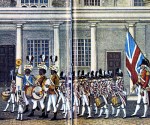
- Janissary Component leading Fifes and Drums-detail.
-

- Ah! Ca Ira, the revolution’s most famous song-first edition, Paris, 1792.
-

- Louis XVI at “Madame Guillotine”, January 20. 1793.
-
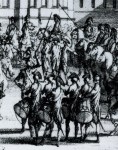
- Drum Major and Drum Corps attending execution of Louis XVI-1793.
-
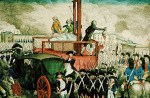
- Displaying the Head of Louis XVI-1793.

 Robin Engelman
Evelyn and Ewazen: Percussion in Buffalo, New York
Saturday, April 17, 2010.
The trip from Toronto Ontario to Buffalo New York by automobile takes only about two hours and usually includes a visit to the Albright Knox Gallery, which houses one of North America’s finest collections of contemporary Art. But the schedule this day wouldn’t allow for side trips. I was headed for Kleinhans Music Hall to hear Evelyn Glennie, Dame Glennie if you wish, play the world premiere of “Songs to the Banks of Ayr” a concerto for solo percussionist and symphony orchestra by Cleveland, Ohio native Eric Ewazen (b.1954). joAnn Falletta, the Buffalo Philharmonic’s Music Director was conducting.
I wanted to hear this new work by Eric because he had agreed to make an orchestral arrangement of “The Eternal Dance of Life”, a work he had recently completed for Nexus and wind ensemble.
Ms. Glennie’s performance was met with a spontaneous and enthusiastic standing ovation which lasted long enough for her to take three curtain calls. “Songs to the Banks of Ayr” is a well orchestrated, Romantic work in four movements each of which is based upon the poetry of Robert Burns. Eric has a distinct voice and much of the music in this premiere reminded me of the work he had written for Nexus.
Interspersed with brief percussion solos on crotales, Marimba, glockenspiel, vibraphone, xylophone, tom-toms, snare drums and cymbals, were a brilliant Scottish Jig for xylophone and violin which Ms. Glennie performed with the concertmaster of the Buffalo Philharmonic. The day before the premier Ms. Glnnie prerecorded the poetry in her mellifluous Scottish burr; and this was inserted into the performances
It was a pleasure speaking with Evelyn again. The last time we had a chance to converse was after a concert in Toronto when I took her to dinner with James Wilson her former road manager. Evelyn is a gracious woman deserving the appellation Dame. She is also a captivating performer; a charismatic virtuoso musician.
The second half of the concert was devoted to a work I had never heard and was very keen to hear “La Noce de los Mayas”, (The Night of the Mayas) by Silvestre Revueltas (1899-1940). This work requires about 10 percussionists and it must be noted here that the contracted percussionists for the Buffalo Philharmonic all studied in Cleveland at one time or another. The extra percussionists for the Revueltas work were all students of Cleveland Orchestra percussionist Tom Freer.
Earlier in the day there had been a “Day of Percussion”. My friend and colleague from the Rochester Philharmonic, eminent percussionist and educator John Beck and Dr. Kay Stonefelt, percussion instructor at the New York State University of Fredonia whose percussion ensemble had performed, were in attendance and it was a delight to see them both again. Beverly Johnston, one of the percussion instructors at the Faculty of Music in Toronto had performed some marimba solos earlier in the afternoon.
The pleasures were not over. Backstage I heard voices calling my name, and there was Tom Freer and Keith Aleo; Tom proudly taking photographs of his students with conductor Falletta. I had last seen Keith in Atlanta where we were judges for Tom Sherwood’s Atlanta Symphony Orchestra Contemporary Snare drum Competition. I also met Allison Bent who was studying with Freer at the Cleveland Institute and that night had played quiro in “La Noce de los Mayas”. Allison had played in my percussion ensemble at the University of Toronto and for the last two years has been working towards a masters degree at the Cleveland Institute.
A small reception with an open bar followed the concert. Lauren Vogel Weiss and her husband Ron Weiss had flown in from Dallas and through Ms. Glennie’s assistant had arranged our complimentary tickets to the concert. Eric’s mother, uncle, nephews and other relatives attended the premiere. A couple from Louisville, Kentucky had driven to Buffalo at the suggestion of joAnn Falletta. My wife and I spent some time reminiscing with them about our days in Louisville when I played with the Philharmonic. Surprisingly, we had known and remembered some of the same orchestra members. I thanked joAnn Falletta for her programming and performances. She, in turn, spoke enthusiastically about the quality of the evening’s percussion playing. “La Noce de los Mayas” is a great work, and was superbly played. I must search out a recording.
The next day, Sunday, the program was repeated.
Posted by robinengelman on April 19, 2010 in Articles, Commentaries & Critiques
Tags: "La Noce de los Mayas", "Songs to the Banks of Ayr", Albright Knox Gallery, Allison Bent, Beverly Johnston, Buffalo Philharmonic, Dr. Kay Stonefelt, Eric Ewazen, Evelyn Glennie, joAnn Falletta, John Beck, Keith Aleo, Kleinhans Music Hall, Lauren Vogel Weiss, Louisville Philharmonic, Robert Burns, Rochester Philharmonic, Ron Weiss, Silvestre Revueltas, Tom Freer