Cidelo Ihos-The Sound of Iron
New York City, July 5-8, 1988, Lila Acheson Wallace Auditorium, Japan Society, Toru Takemitsu and Sound Space ARK: Hiroshi Koizumi, flute; Ayako Shinozaki, harp; Yoshiaki Suzuki, clarinet; Aki Takahashi, piano; Yasunori Yamaguchi, percussion.

Guest Artists: Ani Kavafian, violin; Ida Kavafian, violin; Fred Sherry, cello; Bunita Marcus, composer/conductor.
Music by, Yoritsune Matsudaira, Yuasa, Yoriaki Matsudaira, Ichiyanagi, Mohri, Takemitsu, Takahashi, Hachimura, Ishii, Kitazume, Satoh, Kondo, Kai, Yamaguchi, Tenney, Marcus, Cage.
Artistic Director Toru Takemitsu had chosen the performers and repertoire for Sound Space ARK’s four concerts in New York City, but he did not conduct. The players, including a trio from the U.S., were some of the most experienced in contemporary music and perennial colleagues of Takemitsu.1 The fifteen Japanese composers and their work, illuminated a history of western influenced music in Japan:2 Yoritsune Matsudaira was born in 1907 and Krod Mohri in 1950. Cage Marcus and Tenney were three ‘captain’s choices’ representing U.S. composers.
These concerts would indeed, be concerts of ‘contemporary’ music. All the composers, save two-Sesshu Kai (d.1978) and Yoshio Hachimura (d.1985)-were still living. Twenty of the twenty nine compositions were written in the 1980s, including two from 1988. Eight works were from the 1970s, and the oldest work, Takemitsu’s Munari by Munari, was written in 1960.
One of the two most recent works was Time of Celestial (1988), written and played by Sound Space ARK percussionist Yasunori Yamguchi. Yasunori also played Munari by Munari, and these twoperformances elicited the first “bravos” and the most sustained applause of the concert series.
Yamaguchi is a master of sound-and silence: the how, when. where and why of it. His sensibilities are as refined as Japanese silk. and his playing casts a spell.3
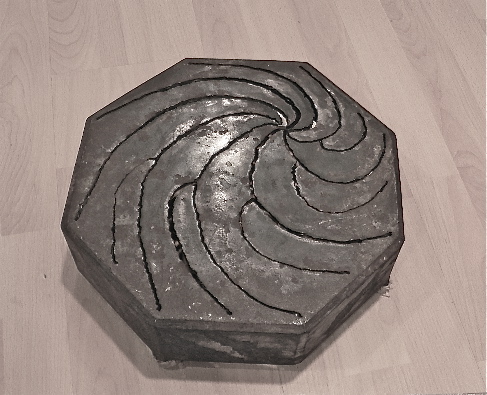
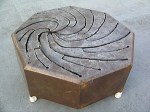
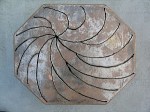
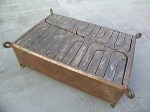
During Yasunori’s Time of Celestial performance, I was taken by the sounds he drew from two instruments in particular. Resonated by a kettledrum, they produced uniquely ethereal sounds.4 Afterwards, he showed them to me. They were welded metal octagons with tongues cut for playing. Their maker, sculptor Kazuo Harada, called them Cidelo Ihos (Greek-ΣΙΔΕΡΟ ΗΧΟΣ).
Percussionists are drawn to new sounds as was Willy Wonka to chocolate. Yasunori, diagnosing my symptoms, invited me to play and I immediately understood his reference to the Cosmos in his program note for Time of Celestial. When I had finished, he said, “They are heavy and difficult for me to take back to Japan on the plane. If you would like, please take them.” This was as unexpected as it was generous. I wanted to pay the sculptor and, after Yasunori gave me his name and address, I accepted. But, more’s the pity, I took only one!
I sent Harada a money order for what I considered to be a reasonable sum. I didn’t receive a reply, so, during the next year or two, I sent him a couple of letters. Still no word, and I began hearing vague rumors that he had disappeared or, perhaps, died. Thus, Cidelo Ihos gradually became another memorable part of a very memorable visit to New York.5 I used it for improvising and featured it in a work I wrote later that year.6
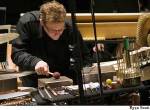
Fast forward to 2009. Out of the blue, if you will, Ryan Scott, a Toronto percussionist and friend, telephones to ask if I know anything about Cidelo Ihos! This was a dèjá vu moment and I was delighted to tell him I owned one. Ryan was preparing the solo percussion part to MakI Ishii’s concerto, Saidoki,7and needed Cidelo Ihos in quantity. Saidoki was written for and premiered by Yasunori Yamaguchi in 1989 with Maki Ishii conducting. I gave Ryan contact numbers for Yamaguchi and Alan Zimmerman.8
In a short time, Ryan had contacted Alan, Yasunori, Mannheimer Verlag-publisher of Saidoki, and Maki Ishii’s son, Kei Ishii, who lives in Berlin and owns a set of Cidelo Ihos.9 Through Ryan’s efforts, a bridge of history was being formed between 1988 and the present, but there was still no definitive word on Kazuo Harada or his where-abouts.
Today there’s the ubiquitous Google, and Google is where I found him. At least an on-line promo for his 2006 one man show/concert in Japan. The promo includes a photo-gallery showing sculptures in metal: four Cidelo Ihos-three atop tubes that look to be resonating chambers, a metal sign with Cidelo Ihos in Greek letters-ΣΙΔΕΡΟ ΗΧΟΣ, a giant ‘waterphone’, and the artist with other musicians playing instruments. Unfortunately, the promo gives no contact numbers for the artist.10
I went to the concert when Ryan played Saidoki. The hall’s size and acoustic proved too small for Saidoki’s extended orchestra and large solo percussion set-up. Two rows of audience seats had been removed to accommodate orchestra players. A brass choir situated mid audience, wholly or partially blocked some views of the stage. At times, the volume of sound overpowered the music’s details. A year before, in this hall, with the same orchestra and conductor, Ryan had played Toronto composer Erik Ross’ Concerto for Marimba and Orchestra (2006). That experience was a model of clarity, and superb musicianship. Thus, the Saidoki performance was frustrating. Ryan’s a great player, but I mostly heard the sound of iron, not the Cidelo Ihos I knew. I’m sure the Canadian Broadcasting Corporation recording from the stage will take care of the balance issues and I look forward to hearing Saidoki from that perspective.11
Footnotes:
1. I knew these players and some of the composers, from my trips to Japan in the 70s. In Tokyo, I had conducted John Cage’s First Construction in Metal with Jo Kondo & Toshi Ichyanagi, piano, Yamaguchi and Nexus, percussion, and had performed Bryce with Hiroshi Koizumi, flute, Ayako Shinozaki, harp and John Wyre.
2. For an interesting history of western music in Japan, well written and concise, see: Burt, Peter, The Music of Toru Takemitsu, p. 4-20, Cambridge University Press, 2001.
3. For issues related directly to Yamaguchi as a player, see: Takemitsu, Toru, Confronting Silence, p. 51-57, Fallen Leaf Press, Berkeley, California, 1995. The pages cited, contain Takemitsu’s thoughts on the Japanese concept of Ma. Also see below,, the program note for Munari By Munari.
4. By manipulating the kettledrum pedal, sounds from the sculpture were raised or lowered, or given vibrato.
5. Two days before my wife and I left Toronto to attend these Sound Space ARK concerts, we were told that Toru Takemitsu had received a commission from Carnegie Hall to write a work for its 100 anniversary. That commission became “From me flows what you call Time”. It would be dedicated to Carnegie Hall, Seiji Ozawa, the Boston Symphony Orchestra and Nexus. Subsequently, Nexus has played the work over 90 times with orchestras around the world.
6. Remembrance for five percussionists with Optional Brass Trio, (Score and parts available from the author). Recorded on: Nexus Now, Nexus records 10295.
7. Saidōki (Demon)(Floating Wind part.III), for percussion and orchestra, Op. 86, 1989-92. (Japanese: 砕動鬼(浮游する風 _ 第III曲)Published by Mannheimer Verlag. There are two other “Floating Wind pieces from 1989: Fu Shi (Shape of the Wind) and Garei (The Spiritual Power of Gagaku).
8. Alan Zimmerman is a percussionist who studied marimba in Japan with Keiko Abe and has performed for Percussive Arts Society International Conventions. The August-September issue of The Percussive Arts Society magazine, Percussive Notes will publish Alan’s article on the Fujii family of marimba players who will appear at the PASIC in Indianapolis this November, 2009. He is also a real estate executive with a company that owns the prestigious Lowell Hotel in New York City. The Lowell provided accommodations for Takemitsu during his 1988 visit.
9. Kei Ishii has been very helpful with my preparations for this article. He put me in touch with the artist Hiroshi Tanabe, (www.hiroshitababe.com) who made a portrait of his father, and gave me permission to use photographs from the Ishii web site. Kei Ishii’s collection of Cidelo Ihos, the portrait of his father and information about his father’s life and work, can be accessed at: http://ishii.de/maki/en.
10. Go to- http://www.catnet.ne.jp/surge/rec6/060508/060508_e.html.
11. A recording featuring Ryan Scott with the Esprit Orchestra, titled Maki Ishii Live, is in preparation and will contain Concertante, South-Fire-Summer Concertos and Saidoki. For information, Contact:
A recording featuring Ryan Scott with the Esprit Orchestra, titled Maki Ishii Live, is in preparation and will contain Concertante, South-Fire-Summer Concertos and Saidoki. For information, Contact: http://www.innova.mu/albums/ryan-scott/maki-ishii-live
( 25 July 2010: Ryan Scott’s CD Maki Ishii Livearrived in the mail this morning. The CD art work is elegant, the booklet is clearly laid out with comprehensive notes and photos on Maki IIshii, Ryan Scott and Alex Pauk conductor of the Esprit Orchestra, a Toronto’s symphony orchestra devoted exclusively to new music. These live performances were beautifully recorded by David Jeager for the Canadian Broadcasting Corporation, clearly separating the disparate instruments while capturing their complex sonorities. Most satisfying for lovers of uniqueness are the sounds of the Cidelo Ihos, particularly during soft moments when their evocations of other-worldliness are allowed to float in the air. This occurs in Saidoki, the most frenetic and in some aspects, the most virtuosic.
Concertante for Marimba Solo and Six Percussionists is an altogether different atmosphere. A marimba solo accompanied by six percussionists, one might expect this to be a riotous affair. However the drums, cymbals and bells of accompaniment are well balanced and played and excepting a brief but furious few seconds at the very end, Concertante is a rather quiet and contemplative work; so quiet one hears a couple of coughs from the audience. The marimba’s complete range is clear, even the lowest notes ‘hum’.
Percussion Concerto, South-Fire-Summer (1992) is a work of art. and of the three works on this disc, the most interesting orchestration and musically the most satisfying, with its mixture of contemplation, angst, joy and Fire. There are moments where orchestra members are featured and the piano solos bear special mention.)
-
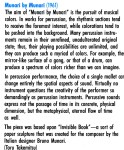
- Munari By Munari, program note.
-

- The Authors “Cideo Ihos”
-
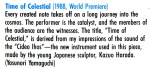
- “Time of Celestial” program note
-
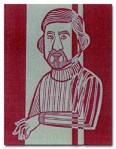
- Maki Ishii (1936-2003), Hiroshe Tanabe
-
- Ryan Scott performing “Saidoki”-photograph by Stanley Fetterman
-
- Eguilateral octagonal
-
- Octagonal
-
- Rectangular
-
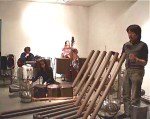
- Kazuo Harada performing, 2006
-
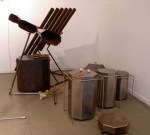
- Harada Sculptures, 2006 exhibition
 Robin Engelman
A Princely Dinner in Ontario Wine Country
His Royal Highness Prince Philip, Duke of Edinburg, established the Duke of Edinburg’s Awards in 1956.1 Subsequently, his son Prince Edward, Earl of Wessex has taken on some of the Duke’s duties and, near the end of a July, 2008 tour in Canada, he accepted an invitation to attend a fund raiser for the Awards at Stratus, a winery near Niagara-on-the-Lake in the heart of Ontario’s wine producing region.
In line with many new wineries, Stratus is eco-friendly, producing limited quantities of wine based on the true gravity-flow system. Since its founding in 2000, Stratus has acquired a reputation for high-end wines created under the direction of Loire Valley native, J-l Groux.2
Thirty people paid $10,000.00 a plate for the pleasure of dining with Prince Edward and Chef Michael Stadtlander was asked to prepare a ‘princely dinner’.
A few years ago Stadtlander was named the world’s ninth best chef by a panel of British culinary experts. A wonderful honor indeed, particularly for a chef whose restaurant, Eigensinn Farm, is in an old farm house almost three hours by car north of Toronto. Eigensinn Farm has a global reputation and its patrons care not a whit for its isolation. Michael decorated his dining room with as much care as he prepares pork, but still, it surprises new customers who arrive with images of posh French country inns in mind. Michael’s kitchen, a culinary landmark, rivals the decor of his dining room.3
Stadtlander, a good friend, had recommended me for the event’s purveyor of music. When the call came, I was delighted and ambivalent; a drummer providing music for a $10,000.00 a plate royal dinner? But Stratus evidently trusted Michael and suggested I set up in the vineyard, a few discreet yards from the patio dining table, far enough to be heard, but not close enough to intrude. (Any wedding harpist understands the role.)
I asked my friend, recording engineer and percussionist, Ray Dillard to join me. We would play quietly and sparsely on bells and gongs, but add occasional drum beats for frisson. It was fun, all of it, even with the intrusion of the worst storm I’d ever experienced. A tornado from some ring of Dante swooped in, but was avoided, thanks to the Stratus early warning weather radar. Michael’s apprentices carried our instrument ladened racks through the loading dock door into the winery Press Alley. I lived on a farm north of Toronto for twenty years, and had never experienced winds and pitch black skies such as these. Within minutes, the fund raiser switched to plan B.
The Prince arrived, met and spoke with the dinner party.4 With the help of servers from restaurants in the area, the meal was a spectacular success. During the amuse-bouche, the winds howled and the rains really did beat a tattoo. But the storm’s fury was matched by its brevity and when singers from the Shaw Festival began their dessert selections, all was calm. (They opened with Sondheim’s “Send in the Clowns”. From my distant perch, I smiled ruefully for my Nexus colleague William Cahn, who declares this his most disliked song.)
Ray and I heard the Prince of Wessex’s friendly voice signaling the evening’s close, but, given the Press Alley’s cavernous acoustic, we understood nary a word. We continued to play until the only sounds were ours. Then I went forward, past the kitchen where the ‘help’ was cleaning up, and onto the patio where Michael was relaxing, alone with a glass of Stratus white. I joined him for a few moments and then returned to pack up. I had not met or seen the Prince, nor had I drunk a glass of wine or eaten anything Michael had prepared. Oh well. With visions of frocked Esterházy musicians in our heads, Ray and I drove back to Toronto.
Footnotes:
1. See: WWW.dofe.org
2. See: WWW.stratuswines.com
3. See: www.nytimes.com/1997/11/12/dining/the-chef-who-got-away.html
www.torontolife.com/guide/restaurants/out-of-town/eigensinn-farm
4. Prince Edward, the third son and fourth child of Queen Elizabeth II and the Duke of Edinburg, is now seventh in line of succession to the throne of England.
Unless otherwise credited, all photos are by the author.
Posted by robinengelman on August 23, 2009 in Articles, Commentaries & Critiques