RSS

Category Archives: Composers

MUSIC APPRECIATION 101

Janis Joplin

Janis Joplin 

I purchased PEARL in 1971. When I heard drummer Clark Pierson’s  opening kicks and Ms. Joplin sing, “You say that its over baby, you say that its over now”  I gulped and was willingly dragged into the magic that was her voice. Today whenever I hear the opening cut to PEARL I begin the smile in anticipation of a listening experience of the first water. Of course the original recording was pressed on LP and once in a while I still listen to this vinyl version, but dammit, CDs are more convenient. I own the so-called Legacy Edition. CD or vinyl, be sure to turn your volume to 11.

11 was one notch above her contemporary rock rivals. That’s the way Joplin seems to have lived her life and that is the way she sang, even in the most tender moments of Cry Baby. I can’t think of another song with such a cry or in A Woman Left Lonely, or in the hot Half Moon.  She did have a great band, thank heavens for Full Tilt Boogie: Clark Pierson, drums; Ken Pearson, organ; John Till, guitar and Richard Bell, piano. I challenge anyone to name a better rendition of Me and Bobby McGee. It doesn’t exist, It can’t exist. And listen to Get it While You Can. She did. Admittedly, it cost her dearly, but I’ll be forever thankful for her commitment to every note. Her ability to express what she felt. Sometimes I’ve tried, but I drew a line Janis Joplin did not. At least her testament to emotional honesty remains for others, singers or not.

Jacques Loussier

Jacques Loussier

Today I would not think of myself as a big jazz fan. I once was. For the 1st fourteen years of my life I listened to the original Dixieland Jazz Band, Sydney Bechet, Lizzy Miles, Bessie Smith, and Louis Armstrong’s Hot 5 and 7. Armstrong’s recording of W.C. Handy’s music and the great recording Anbassador Satch were favourites. What a band. Trummy Young on trombone, Arvell Shaw on bass, Barney Bigard on clarinet, Billy Kyle on piano and Barrett (“the fastest drummer in the world”) Deems on drums .

I then became interested in music with less formal structure. After college I played 12 years in symphony orchestras and reveled in the sound. In the 60s I listened to the Beatles (how many did not?) and Ravi Shankar. But jazz didn’t come back into my life again with any kind of seriousness until I hooked up with clarinetist Phil Nimmons, purchased a new release of his amazing early big-band compositions and did some improvising with him while I was in Nexus.

And then on my most recent trip to Germany, a friend  of mine played a Jacques Loussier (b.1934) Play Bach Trio recording, bassist Pierre Michelot, percussionist Christian Ganos. Formed in 1959, they were together for 15 years and sold more than 6,000,000 recordings of Jazz based on the music of Bach before disbanding in 1974. I felt old. I graduated from high school in 1957 and it took me 55 years to discover them.

I’ve never liked arrangements of Bach’s music. Especially arrangements for marimba, glass harmonica, synthesizers, pop vocal groups, cats and dogs and, well, you get the idea. But Mr. Loussier is an artist of great sensitivity and taste, as well, he is in possession of a great technique, fluid and precise. Loussier, himself a composer, obviously understands Bach’s music. He does not use it as a vehicle for self-indulgence. His escapades never fail to convince me of his or Bach’s artistry.

During the last few weeks I have listened to this recording many times and it continues to delight. Bach was known as an improviser in the classical style. I think a concert of Bach and Loussier would have been a  sell-out.


Tags: ,

Morris Palter and Ensemble 64.8. University of Alaska, Fairbanks.

Dr. Morris Palter, graduate of the University of Toronto School of Music, disciple of Steven Schick and currently Assistant Professor of Music at the University of Alaska, Fairbanks flew into Toronto with 3 of his graduate students and presented a concert of music for percussion at the Music Gallery Monday night, 7th of May.
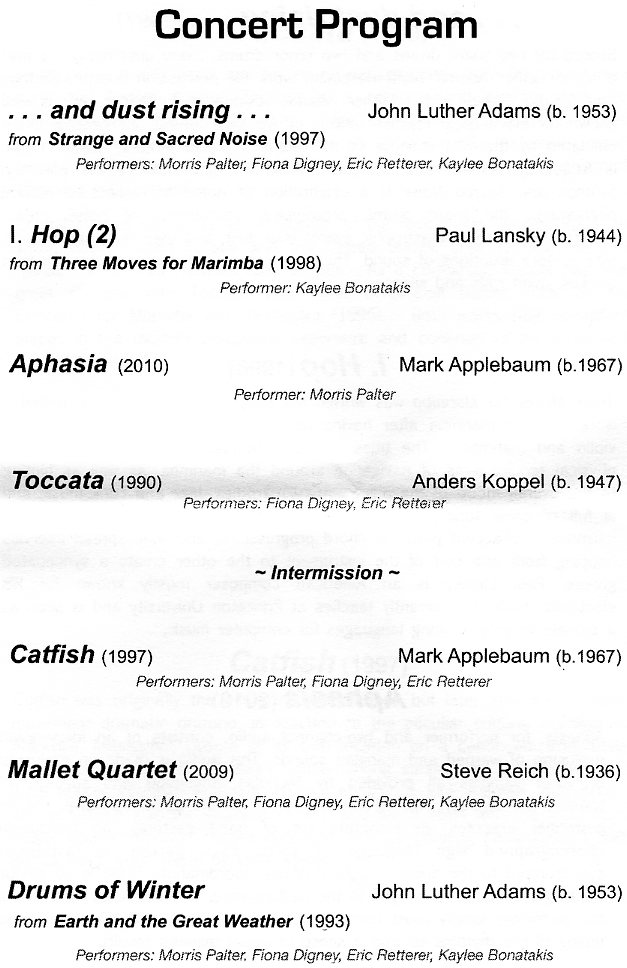
I’m not a great fan of music by John Luther Adams (b.1953), but he’s hot now and I suppose I should be happy for him. He has labored in the wilderness, literally, for many years and besides, is a good guy. Years ago I visited him in his rustic, but comfortable cabin in the Bush outside Fairbanks. There are no doubts in my mind about his dedication and honest approach to his music.

Adams’.  .  . and dust rising  .  .  . (1997), a work for four snare drums, needed better orchestration. Morris’ group had little choice here. All the instruments were rented from a local shop and in such cases, one must accept what’s delivered. To my ears, the piece was no more than an exercise in counting. It pales in comparison to James Tenny’s (1935-2006) Crystal Canon from Three Pieces for Drum Quartet (1974).

The hit of the show for me was Aphasia (2010) by Mark Applebaum (b.1967).   It was performed by Dr. Palter, who from past experience seems to thrive on and enlarge theater pieces. I cannot imagine a better performance of Aphasia. I was enchanted from beginning to end.

The audience was small and as usual, no percussion students from the University of Toronto were in attendance. I say as usual because the percussion students at the University of Toronto by tradition don’t attend concerts, even  Nexus concerts.  I can’t imagine what keeps them away. They are missing opportunities to hear percussion repertoire currently being played throughout North America. As future educators and performers, one would naturally assume an interest, indeed a need, to expand their music minds. The habit carries through beyond graduation. Rarely does one see any Toronto percussionist at percussion music concerts.

However, Dan Morphy member of the Torq Percussion Quartet and one of Toronto’s best musicians did attend and we sat together. We hadn’t seen each other in quite some time and it was a pleasure sharing the concert experience with him.

The Steve Reich (b.1936) Mallet Quartet was written for Nexus and two other groups in 2009 and given its Canadian premiere in Koerner Hall by Nexus.  I attended this performance and came away thinking about Picasso. Towards the end of his life Picasso would hand out favors to almost anyone. He’d scroll something on a restaurant napkin, sign Picasso, and the lucky recipient would go away feeling they’d just inherited a masterpiece.  I wondered if Reich was up to the same game. Years ago, Nexus paid quite a bit of money to copy the music of a piece Steve was “writing for us”.  This turned out to be Sextet, a work Nexus could never play again at least on the road because it required two extra musicians playing pianos and synthesizers. Now, the Mallet Quartet, a work instantly recognizable as being from the pen of Reich, but from all other points of view, a “toss–off”. A friend told me the middle section was “original”. Yes, but original does not equate with good. One does not always get what one pays for.

Nevertheless Ensemble 64.8 played the work with clarity and they’re set up, two marimbas at the back and two vibraphones facing each other at the front worked better in the music Gallery then it did for Nexus at Koerner Hall.

I’ll comment on only one more work, l. Hop (2) from Three Moves for Marimba (1998) by Paul Lansky (b. 1944) and performed by Kaylee Bonatakis. I liked this  work. I asked Kaylee how long she’d been playing it because I thought she needed more time with it. Still, everything was there, and, propelled by an occasional bass note, the piece has an infectious swing.

After the concert I went to a pub with Ensemble 64.8, Dr. Palter’s sister, mother, father, aunt, and Dan Morphy. This made getting up the next morning a bit difficult, but I had to meet 64.8 for lunch. It was good to hang out with them in the relative quiet of a West Queen Street restaurant. One of the students is from Florida, another from Australia and the third from Fairbanks. Then, they were off to see The Avengers. They are staying around for the Friday and Saturday drumming event in Guelph and will fly home Sunday. I enjoyed their music. Keeping up with Morris is fun. From all indicators, he’s doing good things in Fairbanks, Alaska.
 

PRISTINE Classical – an update

Pristine Classical was a major part of my posting about the Horowitz , Tchaikovsky 1st Piano Concerto recording made in 1941 and restored by Andrew Rose. (See under Alphabetical List of Articles, Horowitz and Tchaikovsky’s First Piano Concerto.) I mentioned in my article Rose’s weekly commentaries. (pristineclassical.com) The article below is a recent example and I thought it might be of general interest and specifically, interesting to percussionists. The recording was made in 1953. Does anyone know who the snare drummer might have been?

Too loud to record properly?
Ravel’s Boléro is only one

When Maurice Ravel wrote his Boléro in the late 1920s he had no idea it would go on not only to become his most well-known work, but also one of the best-loved piece of classical music produced in the 20th century. Indeed, the composer actually predicted that most orchestras would refuse to play it!

Boléro was helped greatly in its rise to fame by its US première and adoption thereafter by Toscanini – as well as word of a famous falling out between Toscanini and the great composer over the tempo at which it should be played, with the maestro bluntly telling the composer “When I play it at your tempo it is not effective”, to which Ravel responded that he should therefore not play it at all.

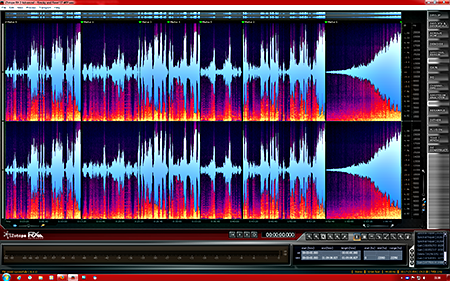
Regardless of this, it went on to be played many times thereafter and to become a firm concert hall favourite. I recall as a child going to the Town Hall in Birmingham to a musical workshop with the CBSO where the work was discussed and then played. It is indeed childishly simple to explain the premise, and as a result it’s rather unique. See if you can spot it in this waveform representation of the complete Paul Paray album we’ve issued today:

Paul Paray album

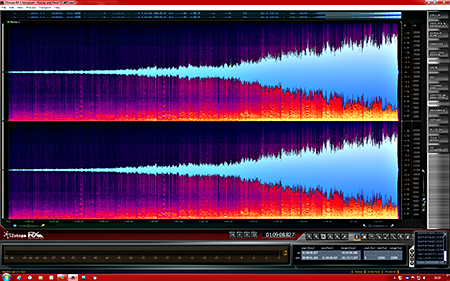
Not too difficult, is it! Here it is again, in close up:

Boléro

Musically, the fundamental essence of Boléro is one very long crescendo. The same basic idea is repeated over and over again as the intensity builds up and the melody moves around different sections of the orchestra. There’s no musical “development” in the traditional sense, and as a musical experiment it leads almost nowhere, at least in the view of its composer – though further developments later on in twentieth century music in the field of endless repetition of simple figures might have come as a surprise to Ravel had he lived to hear them.

Recording a work such as this, especially in the pre-digital days of tape and disc technology, was always going to present a major problem. In fact, even with digital technology it’s not necessarily straightforward. This is the direct result of the huge dynamic range of the piece.

I was reminded when listening to it this week of my first visit as a young trainee BBC sound engineer to the corporation’s Big Band studio at the Hippodrome in Golders Green, in north London. It was the first time I’d encountered the specially designed and built large loudspeakers that were installed in but a handful of the BBC’s major recording venues back then (I’ve no idea if they’re still in use). As far as I recall, each loudspeaker was approximately the size of a stacked pair of domestic washing machines, with four large woofers surrounding a central tweeter. The speakers were mounted into the walls with a spring system allowing the entire enclosure a degree of movement forward and backward – if you pushed at them they’d “bounce” back and forth into the wall and then back towards you for a few moments.

The reason for these custom-built monsters was soon explained to me. The Big Band was individually mic’d up, the feed of these microphones going through a mammoth mixing desk with some 96 channels or so. That must have been a nightmare to get right first time! But the biggest problem they had was that of dynamic range, and above all that of the big bass drum. The drum, when whacked appropriately hard, had a dynamic range of a huge 120dB.

Even the very best digital recording systems we had at the time, which were all 16-bit back then, could only cope with a theoretical maximum dynamic range of 96dB. In order to cope with this discrepancy the BBC’s engineers decided that they needed to be able to hear the drum properly on their monitors, even if they couldn’t actually record its full range – hence the design and building of these monster speakers. (To me that sounds like a great ruse for getting hold of a pair of the most humongous loudspeakers imaginable from the BBC’s notoriously tight-fisted radio management – but it obviously worked.)

Come back to Ravel’s Boléro and we have perhaps a similar problem – it starts very, very quietly indeed, and finishes just about as loud as an orchestra can possibly play. Go back to 1953 and we have a much bigger problem that we did in 1990 – the dynamic range of a standard non-Dolby tape machine back then (and Dolby was a good decade and a half away from inventing his first noise reduction system – or as it was originally billed, his “signal-to-noise stretcher”) was perhaps somewhere in the 45-60dB range. Likewise the LP. Back in 1930, when Ravel conducted a recording with the Lamoureux Orchestra for 78rpm discs it would have been considerably less again.

So we come to a thorny compromise which was immediately audible in the original LP transfer of Paul Paray’s 1953 Detroit Symphony Orchestra Boléro, known as “gain riding”. Quite simply, as Paray slowly increased the volume of his orchestra, Mercury’s sound engineer was slowly decreasing the volume of the microphone to try and make sure that both the quiet opening and the loud ending fitted within the range and abilities of the recording equipment and media.

To the careful listener this manifests itself as a rather hissy opening to the piece. But it’s a curious kind of hiss, which gradually diminishes across the course of the work, until by the end it’s entirely inaudible. It’s been my assumption that the hiss heard at the start of the piece comes not from the tape or disc surface but from the microphone and its amplifier. Pushed to their upper limits this is what comes out of the electronics – but start to pull the faders back a little and that hiss disappears into the background noise of any analogue recording – tape hiss being the major culprit by the early 1950s.

I tried, in my remastering of Paray’s Boléro, to undo this gain-riding compensation, at least to a degree. The problem is that it’s very difficult to gauge how much of this actually took place. I began by measuring the background hiss at the start of the recording and comparing this to later in the piece. This at least gave me a starting point to work from. The problem with this approach is that I’m actually measuring two different things – the microphone hiss to start with and the residual tape hiss later on. And at the same time there’s an orchestra playing, making it difficult to take any noise measurements at all!

Anyway, I worked on this principle to begin with, and starting making my own adjustments, which first involved dropping the volume at the start by about 40% and then gradually increasing it across the entirety of the performance. But this still didn’t sound convincing. A further 30% drop at the beginning, again with an increase spread across the duration of piece back up to 100% sounded better – we were getting closer. Then I spotted that the music at the end wasn’t hitting the “end stops”, and I was able to add a further 20% to the final climax, which goes audibly into peak-overload distortion anyway on the original, suggesting even higher original levels were played than can be heard here.

The end result is something which comes, I hope, a little closer to what Paul Paray had in mind – though I retain a sneaking suspicion that there was probably an even greater contrast between the start and the finish than I’ve dared represent here.

The effect technically is to bring that opening hiss level right back down. You’ll still hear it at the beginning because we have the technology today to handle a much wider dynamic range and leaves it quietly audible when you turn the volume up on replay, but it’s much quieter than it was on the LP, as is the orchestra too at this point.

The effect musically is to make the entire performance even more startling and effective, the relentless drive of the orchestral crescendo in its slow build up is rendered more powerfully than a 1953 LP could ever hope to replicate. I do wish there was some I could do for the slight distortion at the end, but to a certain extent, just as it can in some rock music, this serves only to accentuate to the listener the intensity of the music’s conclusion. It’s an incredible piece, and Paray’s is a truly magnificent performance of it.

Scroll down the page and click on the Paray sample link and you can hear the entire performance in full.

Andrew Rose
11 May 2012