RSS

Category Archives: Composers

Heinrich Ignaz Franz Biber von Bibern

This is the second article in a series devoted to aspects of  composers works and lives not generally known by average concert goers. Perhaps these sketches will encourage readers to dig further into the life and times of other composers.

Who was the first Western composer to write col legno for strings, the first to write in multiple keys simultaneously, the first to employ what is known today as a “Bartok pizzicato” and which composer first thought of weaving paper among the strings of a bass viol?

Not too long ago I would have answered in order, Hector Berlioz, Charles Ives, Bela Bartok and maybe Henry Cowell.  Now that I’ve discovered the works of Heinrich Biber , a man music historian Charles Burney named as the best violin composer of the 17th century, I know better.1 The discovery wasn’t my personal Olduvai Gorge, but it was an Ah Ha moment that made me re-evaluate aspects of my music school education.

The music of Heinrich Ignaz Franz Biber von Bibern expunged a trove of old ideas from my mind and led me on a delightful voyage of discovery through music of the late 17th century hitherto unknown to me.

Heinrich Biber is regarded by violinists, particularly aficionados of early music, as one of the most important composers for the violin in the history of the instrument. His technique allowed him to employ multiple stops in intricate polyphonic passages, and explore the various possibilities of scordatura or retuning.2 He also wrote one of the earliest known pieces for solo violin, the astonishing “Passacaglia”.3Paul Hindemith (1895-1963) proclaimed Biber the best Baroque composer prior to J.S. Bach.  As Biber’s other works had not as yet been discovered or printed, Hindemith’s evaluation was made solely on the strength of the “Rosary” or “Mystery Sonatas” (1676) which were unknown until their publication in 1905.

After first hearing Biber’s “Passacaglia”.4 I began to explore his music further. Therein I discovered his “Battalia” or Battle music and the 17th century infatuation composers had with war and the sounds of battle. All this more than100 years before the most famous, or infamous work in this genre, Beethoven’s “Wellington’s Victory” wherein Beethoven employed antiphonal bass drums, snare drums and wooden ratchets which simulated the cannonade, the march of soldiers and the rapid fire of muskets.

If Biber was not the first to hit strings with the wood of a bow or compose a work in eight simultaneous tonalities, or ask for pizzicatos forceful enough to snap the finger boards or weave paper around bass strings, he was way ahead of the guys my teachers had credited with first doing these things.
And all of those sounds Biber put in one work, “Battalia à 10” written in 1673.  Having the sound of musket and canon imitated by stringed instruments alone, Biber creates a battle experience more stimulating to one’s imagination then the literalism of Beethoven’s “Wellington’s Victory”, a television versus radio comparison if you will.

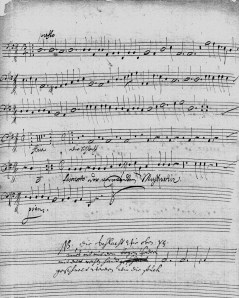
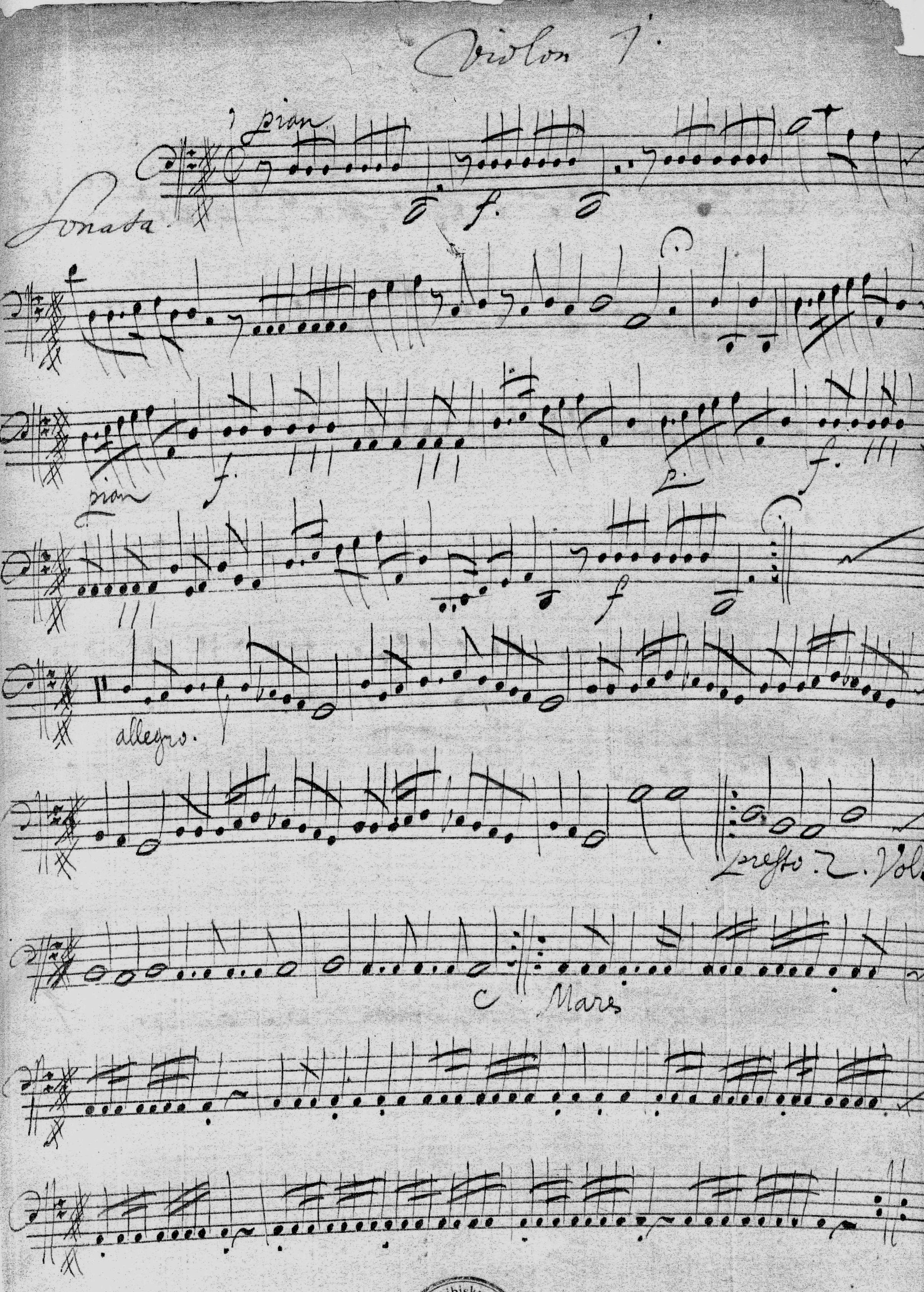
Biber’s “Battalia à 10” contains the following eight movements:   “Sonata” (col legno), “Die liederliche Gesellschaft von allerley Humor” (in eight tonalities), “Presto”, “Der Mars” (violin solo and bass viol prepared with paper and played col legno), “Aria”, “Presto” (Bartok pizzicatos), “Der Schlacht”, “Lamento der Verwundten Musquetierer” (lament for the dead soldiers).

As suggested earlier, Biber was not the only composer to delve into the 17th century’s infatuation with the Art of War. In fact, the genre appears to have begun in Italy during the 16th century. A more immediate predecessor of Biber was Carlo Farina (ca 1600-39), who in his “Capriccio stravagante” (1627) presages some of Biber’s compositional devices, with the use of folk tunes, short movements  alternating fast and slow tempi, drones ala bagpipes, sudden extremely discordant outbursts, simultaneous glissandi in various keys and col legno.

One commercial CD I highly recommend for those interested in exploring the military genre of the 16th and 17th century is ‘batailles”, with La Bande Montreal Baroque and Concerto Palatino. This disc includes eleven works devoted to battle music written between 1557 and 1673.  The performances are superb. (Also of interest is the sound and fluidity of Baroque trumpets played by Concerto Palatino.) This recording includes the Biber “Battalia à 10”.  A Jordi Savall CD is titled “Biber,Battalia à 10” also contains Biber’s “Requiem à 15 in Concerto”.

There are also two other  CDs of distinction. Both Biber’s fifteen “Rosary” or “Mystery Sonatas” 5 and eight other violin sonatas and “Romanesca” were recorded by Andrew Manza. Both two CD sets deserve a hearing, or two or three. When one hears these works one cannot help but compare them to Bach’s Sonatas and Partitas written a half century later.

Bach was a ‘systematic’ composer, that is, he was interested in form and harmony and his works could often be played on any combination of solo or ensemble instruments, whereas Biber to my ears was most interested in sound and advancing violin technique and expression.  (Listen to Sonata 10 of the Sonata CD.)

Heinrich Ignaz Franz Biber von Bibern, baptised, Wartenberg (Stráž pod Ralskem) 12 August 1644 – died Salzburg, 3 May 1704.

What has been will be again,

what has been done will be done again;

there is nothing new under the sun.

Ecclesiastes 1:9

1.  Charles Burney, (1726-1814)

2. The tunings used by Biber in his “Rosary”” or “Mystery Sonatas”.

With these tunings, a violinist fingers the passages as normally, but other notes sound.

3. Biber’s unaccompanied Passacaglia concludes the Rosary Sonatas and was written in 1676.  The three sonatas and partitas for solo violin by Bach were completed in 1720.

4.  The name “Passacaglia” is derived from two Spanish words Pasar ( to walk) and calle (street). In the first quarter of the 16th century Giroloma Frescobaldi refined the form. Later he invented the Chacconne.  A triple metre and bass ostinato are now considered two characteristics of both.

5.  Biber’s  sixteen “Rosary Sonatas”, each with its own name, are in three contiguous groups of five sonatas called Mysteries: “The Five Joyful Mysteries”, “The Five Soulful Mysteries”, “The Five Glorious Mysteries”  and end with “Passacaglia for Unaccompanied Violin”. The entire set is titled “The Rosary Sonatas”.  The first Sonata is called “The Annunciation” and the fifteenth, “The Beatification of the Virgin”.
A comparison of the Biber and Bach sonatas is enlightening. It is also worth noting that Leopold Mozart (1718-87)  published his famous “Violin School” in 1756,  83 years after the “Rosary Sonatas” and 52 years after Biber’s death.

Following up on Leopold and programatic music, in the next century Leopold was much concerned with a naturalistic feel to his compositions, his “Jagsinfonie” (or “Sinfonia da Caccia for four horns and strings”) calls for dogs and shotguns, and his “Bauernhochzeit” (Peasant Wedding) includes bagpipes, Hurdy Gurdy, dulcimer, pistol shots and whoops and whistles, ad. lib.)
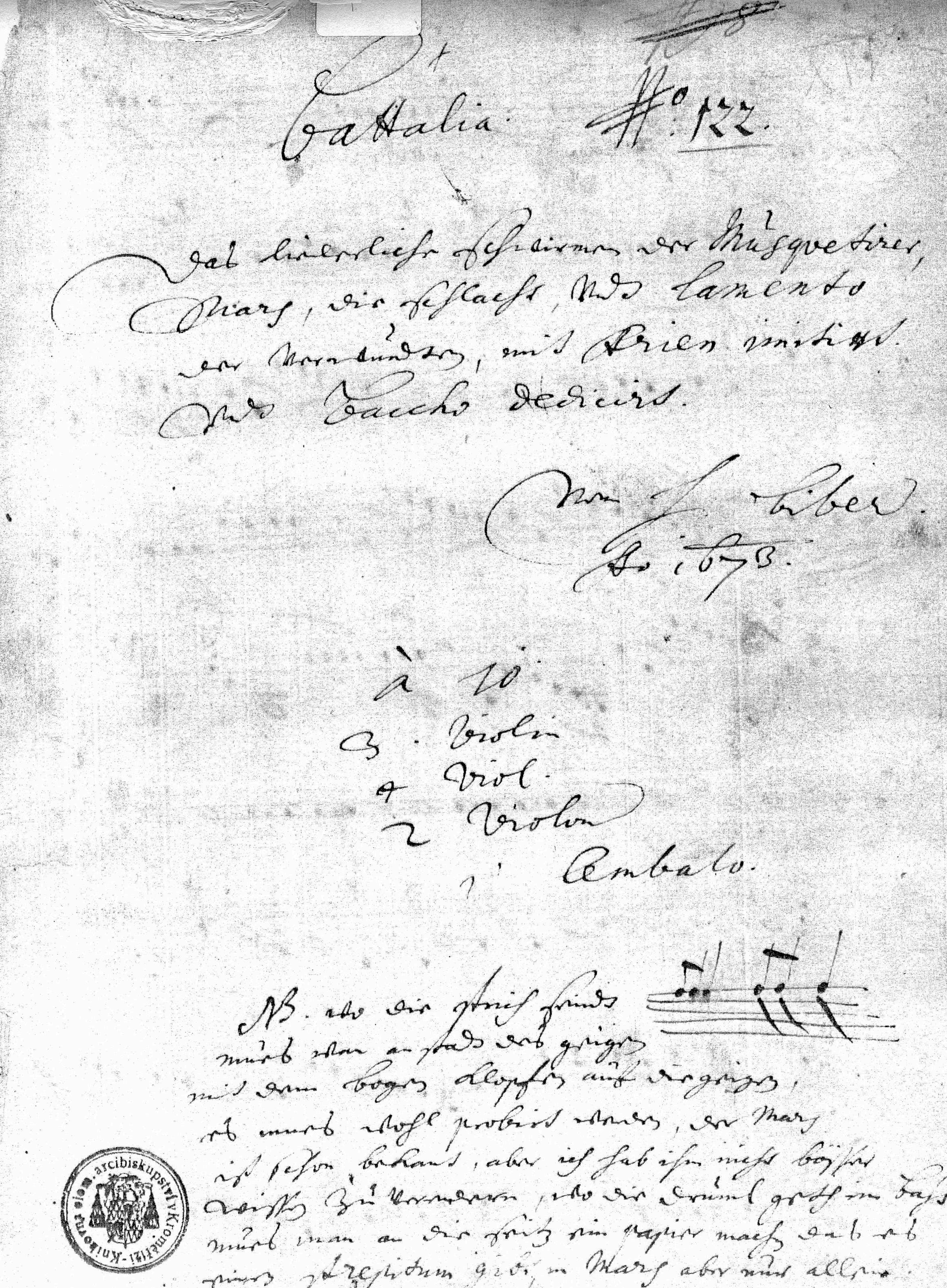
Cover to Batallia a 10

Cover to Batallia a 1

Bass violon part to Mars, page 2.

Bass violon part to Mars, page 1.

Bass violon part to Mars, page 1.

 
Leave a comment

Posted by on September 4, 2011 in Articles, Composers


Tags: ,

Toru Takemitsu in The Digital Concert Hall

As a subscriber to the Berlin Philharmonic Digital concert Hall I have access to  weekly archived performances by this great orchestra conducted by some of the world’s best musicians. Each week I receive an e-mail notifying me of the next live performance, often on Thursday or Saturday afternoons at 3PM Toronto time which translates to 8PM in Berlin. For about $160 Canadian per year I can watch more than one  hundred concerts or parts of them at my leisure. Five strategically placed cameras almost unobtrusively record the musicians and conductors, often close up.  And the sound reproduction lives up to the highest standards people have come to expect from German Tonmeisters.

For the price of one decent seat in Toronto’s Roy Thomson Hall I have an ever-growing orchestral repertoire  at my fingertips. Modern technology at its best.

Sado
Sado

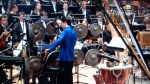
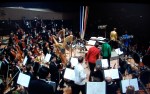
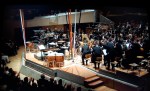
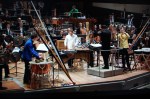
This morning I sat in front of my computer to watch and hear Toru Takemitsu’s “From me flows what you call Time” recorded live in Berliner Philharmonie just a few days ago by the Philharmoiker, five German percussionists and the Japanese conductor Yusaka Sado.

I had known for over a week that this performance was going to be broadcast. So I had a good deal of time to contemplate the experiences I might have watching other people perform a work I had played probably 100 times since Toru wrote the piece in 1991 for Carnegie Hall’s 150th anniversary, Seiji Ozawa, the Boston Symphony and Nexus. Both Toru and Seiji have been important people in my life and every time I performed “From me flows what you call Time” I was deeply touched, even when the conductor or the orchestra or both were not quite up to the challenge, or when my performance was not entirely satisfactory. So I approached this performance by strangers with feelings of ambivalence if not trepidation.

Paduh
Paduh

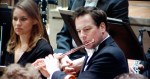
Things started off really well with the young French flautist Emmanuel Pahud. He has performed the  Boulez …Explosant – fixe… with Boulez conducting, and performs most of the Philhaemoiker’s contemporary works and sometimes interviews contemporary composers for its broadcasts.  He is an incredible player and his performance of the opening flute solo was superb; nothing over the top, just fluid, serene, and beautifully shaped. Pahud also conducted the concert interview with Sado.

But it was the percussionists I was most interested in. I was ready to be disappointed or dismissive, but it has been a few years since I last played the piece and as this performance progressed, my listening became more objective.

I was delighted with the way the soloists performed and the smiles on their faces at the end of the concert, the repeated calls by the audience for another bow, and the response of the orchestra and the conductor confirmed the success of their performance.

There were delightfully surprising details.  At one point in the score, Takemitsu directed some percussionists to play with their fingers, something Nexus never did, but I couldn’t hear one part and another was barely audible. No one plays the same piece of music the same way, nor should they. The soloists have all the sounds, that is to say, all the instruments with the correct pitches. I wonder if Michael Ranta provided them. I understand Michael has created a set of instruments for “From me flows .  .  .  .” The percussionists also played with artistry. I felt they were new to the work, which is probably true, and this work takes time.

The sounds from the Berlin Philharmonic are spectacular. This is an orchestra that can play anything and under their Music Director Sir Simon Rattle, they have broken free from their limited repertoire of yesteryears. (There are also a lot of young players in the band.)  The clarinets, harps, French horns, oboes, cellos and trumpets play particularly important roles in this work, but the entire orchestra has to play together and there’s no better orchestra in the world for doing this.

Never-the-less, I have to single out that great string bass section. The way they finished off the 5/8 bar crescendo just before the end and held the low C until the decay of the final wind chime note, was perfectly, if accidentally timed. The wind chimes did not ring excessively long and so the music stopped at exactly the right time to balance the work’s form.

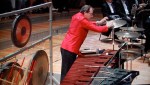
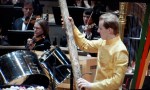
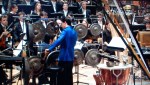
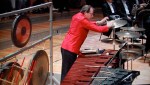
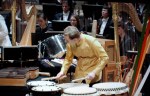
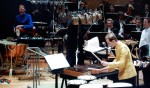
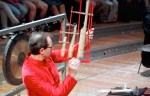
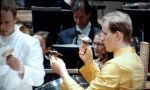
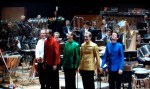
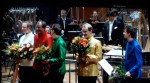
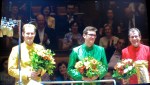
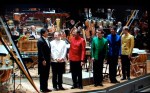
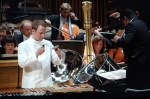
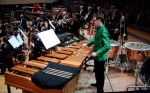
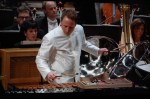
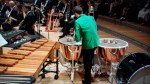
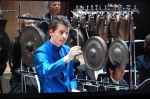
The percussionists colored  jackets, representing earth, wind, fire, water and everything or nothingness were a nice touch. The percussionists were Raphael Haeger (blue/water), Simon Rössler yellow/earth, Franz Schindlbeck (red/fire), Jan Schlichte (green/wind), and Wieland Welzel (white/nothingness). Excepting Simon Rössler, they are members of the Berliner percussion section. Watching them play was a bit eerie. So many of the sounds they produced and the gestures they made reminded me of Nexus. The body language they displayed when they came on stage for their bows was also similar. They are all good players. Bravo.

As the last sounds of this magnificent work disappeared, I was convinced, as I was in 1990, that Takemitsu has created for percussionists their first major  and popular concerto.  Though it must be said that Takemitsu did not think of this work as a concerto. He said it was a work for orchestra with percussion.  Nevertheless “From me flows what you call Time” is an astounding work which affords opportunities for percussionists  and audiences to experience aspects of the percussion world beyond the bombast typically associated with drumming.

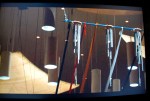
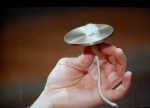
To subscribe to the Berlin Digital concert Hall, go to: http://www.digitalconcerthall.com. The photo gallery below  mostly consists of photos of the percussionists and their set ups.  This was purposeful as I had in mind a readership primarily of percussionists. They loosely follow the music’s progression.

 
Leave a comment

Posted by on May 31, 2011 in Articles, Composers


THE DIVINE PURCELL

This is the first article in a series devoted to aspects of  composers works and lives not generally known by average concert goers. Purcell’s genius, rated by some music critics as being superior to that of Bach, is known by only a mere fraction of his oeuvre. Yet once explored in depth, his music, most admirably his vocal music impresses upon the listener a world far removed from the more systematic works of Baroque and Classical composers. Perhaps these articles will encourage readers to dig further into the life and times of other composers.

My high school band director asked me to conduct Henry Purcell’s Trumpet Voluntary on one of our band concerts. I enjoyed the experience and later, whenever I heard the tune, I would recall my conducting debut. Years later I learned musicologists had attributed the voluntary to another British composer and contemporary of Purcell, Jeremiah Clarke who called the work Prince of Denmark March.

About 20 years ago I heard Barbara Hannigan sing Purcell’s The Blessed Virgin’s Expostulation.  I was taken by an incredible change in the song which after the concert I described to Barbara as madness. Barbara replied,“That’s exactly what happens to her. She is coming to terms with the fact that she is going to be the mother of Jesus Christ”.

I purchased a CD of Purcell’s vocal music  with a version of that incredible song. The singer, though very good, did not take the dramatic plunge into madness. Nevertheless those songs introduced me to a Henry Purcell I had never known. For sure he has a way with words, but his ear for melodic lines and inventive use of simple materials continue for me as an ever fresh bouquet of musical delights.

I then purchased one of the finest books on Purcell,titled simply Purcell, by J. A. Westrup. Though out-of-print, it is still available from rare and used book sellers. It was my reading of this book that led me to Purcell’s operas or as they were called in the 17th century, Masques or semi-operas. In these operas one can hear irresistibly fresh and young vocal writing alongside humor in goodly measure.

The first masque I listened to was King Arthur written in 1691 to a text by Dryden. King Arthur is one  of Purcell’s greatest works. In Arthur one can hear the hallmarks of Purcell’s orchestral and vocal prowess.

Purcell was born in either 1658 or 1659 in the city of Westminster, London.  During his later years he was referred to as Purcell the divine and he is buried next to the organ in Westminster Abbey. The music played at his funeral was the music he had  composed eleven months earlier for the funeral of Queen Mary, 1662-94.

One of the shortest works in the Music for Queen Mary’s Funeral is the March for brass and kettledrums. It is also profoundly moving music. I never tire of hearing it and am always touched by the mood it creates and Purcell’s genius.

The recorded performance below is by The Early Music Consort of London conducted by David Munrow, EMI Classics, 7243 5 69270 2 5. Munrow was a brilliant musician and linguist who created a public  interest in Early Music. He employed Christopher Hogwood among others. He recorded 50 albums of early music and in 1976 at the age of thirty-two, committed suicide by hanging.

https://robinengelman.com/wp-content/uploads/2011/03/05-march.mp3

 
Leave a comment

Posted by on March 29, 2011 in Articles, Composers


Tags: , , , , , , , , , , , , , ,