Duke Ellington (1899-1974) gave a lecture at the Stratford Shakespeare Festival in Stratford, Ontario, during the summer of 1966. He was asked by an audience member to “Improvise something”.
Ellington replied, “I can’t”, and immediately itemized the decisions he had to make before he could play: choose the instrument, choose a tonal language, choose a character or mood, decide where to position his hands, how many fingers to use, and how loud and fast to play. He then proceeded to play what he called a ‘composition’.
In 1971 I accepted a teaching position at York University in Toronto conditional upon me being able to do “whatever I wanted to do”. I chose to oversee, a course in improvisation. The students were majors in music, dance, visual arts and liberal studies.
In my studio I hung bells, drums, gongs, cymbals, temple bowls and other exotic percussion instruments from around the world. No specialized skills are required to play these instruments-one has only to hit them, and their sound possibilities are almost limitless. I did not include a melodic instrument. The students, about 8 of them, met with me two hours, two days a week for one semester.
I asked them to play these instruments, but gave them no instructions on how. I wanted to find out what would happen if they could “do whatever they wanted to do.” I had some practical knowledge of improvisation, but was as new to this studio experience as were they. The prospect of hearing their music excited me and I wanted them to discover sounds without being influenced by me. I hoped they’d be captivated by their explorations. They were eager; delighted by the instruments and thrilled with the idea of no rules.
After a few sessions, even the most enthusiastic students had exhausted their ideas and for the most part, sat self-consciously mute. At that point I began playing with them, individually and groups of two or three. For a while the students were rejuvenated. But these collaborations, as well, lost their spirit. During one session a student began to sing and this reminder of melody encouraged one or two other students to bring melodic instruments to class. But their playing and singing was too timid and rather than broadening the scope of their improvisations, the inclusion of pitch made the music more awkward. Aware of their quandary, the students suggested ideas for guiding their improvisations and I gave them some instructions from compositions I was playing as a professional.
Nothing worked for long. The students were frustrated and perplexed by their inability to understand why they could not make a meaningful music alone or with others. Our sessions had not even given them a repertoire of ideas and techniques to help them launch new explorations. (They were familiar with Pop music, but couldn’t isolate its elements and apply them.) Their music was almost expressionless, though occasionally enlivened by sparks of energy. We finished the semester listening to recordings of contemporary music and discussing our studio experiences. The classes went on for three more semesters, but even with fresh blood, the music continued “dribbling-to-a-tacit”.
The novelty of the course had quickly evaporated. For youngsters with little or no background in music, four hours a week of free improvisation were too much, and too much even with rules to guide them. They lacked experience with the basic elements of music: rhythm, tempo and dynamics. And, though we discussed and experimented with duration, silence, form and structure, they could not comfortably apply these ideas to their playing.1
Vinko Globokar (b. 1934), former director of IRCAM (Institute for Research and Coordination of Acoustics and Music) in Paris, virtuoso trombonist, composer and improviser, wrote that improvisers “must have a similar reservoir of possibilities-aesthetic points of view. . .” 2
NEXUS:
It was this reservoir of possibilities – aesthetic points of view that brought Nexus together in 1971.3 Though our educations differed in some details, we shared the gestures and techniques of trained Western percussionists. We had been exposed to and played Jazz, Rock and Roll, Blues, Country, Folk, Classical, Contemporary and military music. We were flexible in our music making and had a profound interest in sound. We were also close friends.
Nexus was part of a burgeoning interest in foreign ethnic music and our conscious decision to collect and play instruments from other cultures was both technically and musically liberating. The study of western percussion had made us, as some wag put it, “overeducated and underemployed”. Unlike my university students,the sounds of these “new” instruments refreshed our ears and inspired our first informal collaborations. These improvisations had a joie de vivre.
The spirit and communicative skills of Nexus were the inspiration for composer Warren Benson(1924-2005) to produce Nexus’ first concert at the Eastman School of Music in Kilbourn Hall.4 He wrote a poem for the program:
“. . . instruments from all the world
Musicians from two countries
and four private universes
Coming together
to celebrate being together. . .”
Lukas Foss (1922-2007), the successor to Arnold Schoenberg at UCLA and founder in 1953 of the UCLA Improvisation Chamber Ensemble, told me he’d given up on improvisation because the performers had quickly developed a repertoire of gestures and techniques that, by repetition, made all the performances sound pretty much the same. To Foss, this “reliance on the comfort of the familiar”, as he put it, did not produce improvisation, or, if you will, interesting music.
Nexus formulated no rules to govern its improvisations, but over time, we developed a Foss-like “reliance on the familiar” and absorbed other conventions – Foss’ “repertoire of gestures and techniques”. Particular sounds became signals for change, i.e., a low gong would change loud, fast and dense to soft, slow and sparse. A sudden sharp attach might precipitate a frenzy. Our improvisations tended to be in A-B-A form – fast, slow, fast or loud, soft, loud etc. We gradually quelled our tendency to “vamp until ready”, and our improvisations became shorter, more compact. We learned the values of less-is-more.
To maintain the freshness of our improvisations, we sometimes change our instrumentation completely. We also invite guests who have a “repertoire of gestures and techniques”. In a spirit of collegiality, Nexus usually lets our guests lead, thereby creating a “concerto” experience.
For me, Nexus’ most successful improvisational moments were achieved when everyone did “What they want to do”, without regard for homogeneity. This rare occurrence created a fantasy of concurrent, individual expressions in exquisite balance, and the music floated over us and the audience.
I sent a cassette tape of a Nexus improvisation to Globokar and his response was typically direct (I paraphrase): “You play beautifully together, but it is North American. It is totally rhythmical, pleasant and traditionally structured. It doesn’t interest me. When our percussionist comes to an improvisation concert or recording session, he brings at most three instruments and never repeats a sound.” Globokar’s rule for improvisation was, “always search for something new, never repeat a sound”.5
Nexus’ early free improvisation era has been credited, at least in part, with spawning new professional percussion ensembles. Yet today, all the younger percussion ensembles play written music and, to my knowledge, none of them improvise in public. As my colleague Bob Becker said, “People were more interested in how we played than what we played”. Nexus was an unanalyzable anomaly.
During the last century, composers involved performers in the creation of their works. I experienced this first hand, often under the personal direction of the composer, while performing with New Music Concerts of Toronto, Ontario. These works, in whole or part, were Aleatoric; 6 “ music in which elements traditionally determined by the composer were determined either by a process of random selection or chance operations chosen by the composer, or through the exercise of choice by the performer.” 7 Usually, there was one or more of six principal directives present in these compositions: “Imitate”; “Integrate”; “Hesitate”; “Do the Opposite”; “Do Something Different” and “Improvise”. Improvise was the least effective as it meant to classically trained musicians, “do whatever you want”.8 The results,intentional or not, were often at variance with the composer’s (unstated) intentions.
SOME REALITIES OF IMPROVISATION:
In group improvisations, players have complete freedom of expression, yet cannot with certainty control the beginning or end of the music; the beginning or end of a diminuendo or crescendo; they cannot determine dynamics; instrumentation; range (gamut); timbre; tempo; or, for that matter, any occurrence of sound or silence other than those which they create individually. And even those sounds and silences can be, and often are, rendered inaudible by a colleague. (A tutti silence, cessation of playing, one of composed music’s most gratifying experiences, has practically no chance of occurring in a group improvisation.)
After a Nexus concert in Japan that included a free improvisation, the composer, Toru Takemitsu (1930-96) said to me, “Nexus should not improvise”.
In order to achieve consistently high levels of communication, group improvisers must be guided by rules. These rules may be pre-ordained or, as in the case of Nexus, gradually assimilated during performances over time. The experience of improvising without rules can be fun, but rarely produces memorable music. Memorable is the work of composers. However, free improvisations by certain individuals, alone in a room with their instrument(s), can be an invaluable learning tool. Percussionists by nature “noodle”, and this kind of habitual improvising helps marry them to their instruments.
The most captivating improvisation I ever heard was performed by the great Japanese percussionist Yasunori Yamaguchi. Yasunori’s playing of his “Time in Celestial”(1988) took place during a series of Japanese music concerts in New York City.9 During the four days of concerts, his performance received the loudest and most prolonged applause from the sold out audiences. When I asked him about his piece, he showed me some brief notes he’d written on a piece of paper, reminders, or, if you will, rules.
Acknowledgements:
I wish to thank the students of York University who participated in my improvisation course,1972-75, my colleagues in Nexus whose improvisations have always amazed me and Austin Clarkson, Professor emeritus of music, York University, Stepan Wolpe and John Cage scholar, who arranged Nexus’ first university residency at York University in 1973 and whose questions and editorial skills greatly improved my initial efforts with this article.
Discography:
For examples of Nexus improvisations with guests, see: out of the blue, Nexus and Fritz Hauser, Nexus records-10814 and Garden of Sounds with Richard Stoltzman, BIS records-CD1108.
Spontaneous Nexus improvisations can be heard on: ORIGINS, Nexus records 10295. .
Footnotes:
1 For other pedagogical approaches to free improvisation, see Cahn, William L., (2005). Creative Music Making (Four Simple Steps to Cultivating the Inner Musician), (New York/London: Routledge, Taylor & Francis Books, Inc.)
2 Globokar, Vinko, (1970). Reacting (Musique en Jeu), trans. by Carl Bergstroem-Nielsen.
3 Wagner, Alan D. (2005). A Bio-Bibliography of Composer Warren Benson. (Lewiston, NY: Edward Mellen Press), p. 63. The original Nexus was John Wyre, Bob Becker, Bill Cahn and the author, but we had yet to choose our name.
4 May 21, 1971. Soon after the Kilbourn Hall concert, Russell Hartenberger (b.1944) and Michael Craden (1941-1982) had become members.
5 I first encountered “Globokar’s Rule” in Japan in 1970 when we improvised a duet based on an idea by Lukas Foss. We wore hospital wristbands with various symbols that told us when and how to play. I used a Javanese cowbell, a marimba mallet and a contra-bass bow, Vinko, his trombone. I hit and bowed he cowbell for a while and was pretty much finished. Vinko played sounds I’d never imagined and then dismantled his trombone; playing the mouthpiece and tubing. He then took my bow and as I sat spellbound, he bowed everything “bowable”. When the piece finally ended, Vinko had performed a veritable trombone concerto.
6 From Latin, from Aleator, ‘dice player’, from alea ‘die’, (The New Oxford Dictionary of English, (1998)
7 This is a composite definition drawn from The Harvard Dictionary of Music (1986), Wikipedia, The Free Encyclopedia and The New Oxford Dictionary of English (1998)
8 Globokar, Vinko, (1970).
9 Toru Takemitsu and Sound Space Ark, Japan Society, New York City, July 5-8, 1988. The first ‘Bravos’ of these concerts occurred after a performance by Yamaguchi of Takemitsu’s “Munari by Munari”(1961). Essentially an improvisation directed by a book of colored pages, through-cut with geometric designs. The colors and designs determined the player’s response.
-
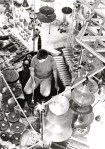
- Robin improvising
-

- 1973 Nexus set-up, Burton Auditorium, York University
-

- Bill Cahn conducting “Maestroke”. We dont do this any more.
-

- Warren Benson & poet Earle Birney
-

- cellist David Darling-a frequent guest
-
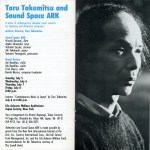
- Japan Society program schedule
-
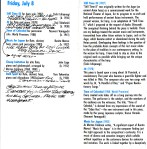
- Program page w/ Time in Celestial
Copyright © 2009, Robin Engelman


 Robin Engelman
Cidelo Ihos, “The Sound of Iron”
Cidelo Ihos-The Sound of Iron
New York City, July 5-8, 1988, Lila Acheson Wallace Auditorium, Japan Society, Toru Takemitsu and Sound Space ARK: Hiroshi Koizumi, flute; Ayako Shinozaki, harp; Yoshiaki Suzuki, clarinet; Aki Takahashi, piano; Yasunori Yamaguchi, percussion.
Guest Artists: Ani Kavafian, violin; Ida Kavafian, violin; Fred Sherry, cello; Bunita Marcus, composer/conductor.
Music by, Yoritsune Matsudaira, Yuasa, Yoriaki Matsudaira, Ichiyanagi, Mohri, Takemitsu, Takahashi, Hachimura, Ishii, Kitazume, Satoh, Kondo, Kai, Yamaguchi, Tenney, Marcus, Cage.
Artistic Director Toru Takemitsu had chosen the performers and repertoire for Sound Space ARK’s four concerts in New York City, but he did not conduct. The players, including a trio from the U.S., were some of the most experienced in contemporary music and perennial colleagues of Takemitsu.1 The fifteen Japanese composers and their work, illuminated a history of western influenced music in Japan:2 Yoritsune Matsudaira was born in 1907 and Krod Mohri in 1950. Cage Marcus and Tenney were three ‘captain’s choices’ representing U.S. composers.
These concerts would indeed, be concerts of ‘contemporary’ music. All the composers, save two-Sesshu Kai (d.1978) and Yoshio Hachimura (d.1985)-were still living. Twenty of the twenty nine compositions were written in the 1980s, including two from 1988. Eight works were from the 1970s, and the oldest work, Takemitsu’s Munari by Munari, was written in 1960.
One of the two most recent works was Time of Celestial (1988), written and played by Sound Space ARK percussionist Yasunori Yamguchi. Yasunori also played Munari by Munari, and these twoperformances elicited the first “bravos” and the most sustained applause of the concert series.
Yamaguchi is a master of sound-and silence: the how, when. where and why of it. His sensibilities are as refined as Japanese silk. and his playing casts a spell.3
During Yasunori’s Time of Celestial performance, I was taken by the sounds he drew from two instruments in particular. Resonated by a kettledrum, they produced uniquely ethereal sounds.4 Afterwards, he showed them to me. They were welded metal octagons with tongues cut for playing. Their maker, sculptor Kazuo Harada, called them Cidelo Ihos (Greek-ΣΙΔΕΡΟ ΗΧΟΣ).
Percussionists are drawn to new sounds as was Willy Wonka to chocolate. Yasunori, diagnosing my symptoms, invited me to play and I immediately understood his reference to the Cosmos in his program note for Time of Celestial. When I had finished, he said, “They are heavy and difficult for me to take back to Japan on the plane. If you would like, please take them.” This was as unexpected as it was generous. I wanted to pay the sculptor and, after Yasunori gave me his name and address, I accepted. But, more’s the pity, I took only one!
I sent Harada a money order for what I considered to be a reasonable sum. I didn’t receive a reply, so, during the next year or two, I sent him a couple of letters. Still no word, and I began hearing vague rumors that he had disappeared or, perhaps, died. Thus, Cidelo Ihos gradually became another memorable part of a very memorable visit to New York.5 I used it for improvising and featured it in a work I wrote later that year.6
Fast forward to 2009. Out of the blue, if you will, Ryan Scott, a Toronto percussionist and friend, telephones to ask if I know anything about Cidelo Ihos! This was a dèjá vu moment and I was delighted to tell him I owned one. Ryan was preparing the solo percussion part to MakI Ishii’s concerto, Saidoki,7and needed Cidelo Ihos in quantity. Saidoki was written for and premiered by Yasunori Yamaguchi in 1989 with Maki Ishii conducting. I gave Ryan contact numbers for Yamaguchi and Alan Zimmerman.8
In a short time, Ryan had contacted Alan, Yasunori, Mannheimer Verlag-publisher of Saidoki, and Maki Ishii’s son, Kei Ishii, who lives in Berlin and owns a set of Cidelo Ihos.9 Through Ryan’s efforts, a bridge of history was being formed between 1988 and the present, but there was still no definitive word on Kazuo Harada or his where-abouts.
Today there’s the ubiquitous Google, and Google is where I found him. At least an on-line promo for his 2006 one man show/concert in Japan. The promo includes a photo-gallery showing sculptures in metal: four Cidelo Ihos-three atop tubes that look to be resonating chambers, a metal sign with Cidelo Ihos in Greek letters-ΣΙΔΕΡΟ ΗΧΟΣ, a giant ‘waterphone’, and the artist with other musicians playing instruments. Unfortunately, the promo gives no contact numbers for the artist.10
I went to the concert when Ryan played Saidoki. The hall’s size and acoustic proved too small for Saidoki’s extended orchestra and large solo percussion set-up. Two rows of audience seats had been removed to accommodate orchestra players. A brass choir situated mid audience, wholly or partially blocked some views of the stage. At times, the volume of sound overpowered the music’s details. A year before, in this hall, with the same orchestra and conductor, Ryan had played Toronto composer Erik Ross’ Concerto for Marimba and Orchestra (2006). That experience was a model of clarity, and superb musicianship. Thus, the Saidoki performance was frustrating. Ryan’s a great player, but I mostly heard the sound of iron, not the Cidelo Ihos I knew. I’m sure the Canadian Broadcasting Corporation recording from the stage will take care of the balance issues and I look forward to hearing Saidoki from that perspective.11
Footnotes:
1. I knew these players and some of the composers, from my trips to Japan in the 70s. In Tokyo, I had conducted John Cage’s First Construction in Metal with Jo Kondo & Toshi Ichyanagi, piano, Yamaguchi and Nexus, percussion, and had performed Bryce with Hiroshi Koizumi, flute, Ayako Shinozaki, harp and John Wyre.
2. For an interesting history of western music in Japan, well written and concise, see: Burt, Peter, The Music of Toru Takemitsu, p. 4-20, Cambridge University Press, 2001.
3. For issues related directly to Yamaguchi as a player, see: Takemitsu, Toru, Confronting Silence, p. 51-57, Fallen Leaf Press, Berkeley, California, 1995. The pages cited, contain Takemitsu’s thoughts on the Japanese concept of Ma. Also see below,, the program note for Munari By Munari.
4. By manipulating the kettledrum pedal, sounds from the sculpture were raised or lowered, or given vibrato.
5. Two days before my wife and I left Toronto to attend these Sound Space ARK concerts, we were told that Toru Takemitsu had received a commission from Carnegie Hall to write a work for its 100 anniversary. That commission became “From me flows what you call Time”. It would be dedicated to Carnegie Hall, Seiji Ozawa, the Boston Symphony Orchestra and Nexus. Subsequently, Nexus has played the work over 90 times with orchestras around the world.
6. Remembrance for five percussionists with Optional Brass Trio, (Score and parts available from the author). Recorded on: Nexus Now, Nexus records 10295.
7. Saidōki (Demon)(Floating Wind part.III), for percussion and orchestra, Op. 86, 1989-92. (Japanese: 砕動鬼(浮游する風 _ 第III曲)Published by Mannheimer Verlag. There are two other “Floating Wind pieces from 1989: Fu Shi (Shape of the Wind) and Garei (The Spiritual Power of Gagaku).
8. Alan Zimmerman is a percussionist who studied marimba in Japan with Keiko Abe and has performed for Percussive Arts Society International Conventions. The August-September issue of The Percussive Arts Society magazine, Percussive Notes will publish Alan’s article on the Fujii family of marimba players who will appear at the PASIC in Indianapolis this November, 2009. He is also a real estate executive with a company that owns the prestigious Lowell Hotel in New York City. The Lowell provided accommodations for Takemitsu during his 1988 visit.
9. Kei Ishii has been very helpful with my preparations for this article. He put me in touch with the artist Hiroshi Tanabe, (www.hiroshitababe.com) who made a portrait of his father, and gave me permission to use photographs from the Ishii web site. Kei Ishii’s collection of Cidelo Ihos, the portrait of his father and information about his father’s life and work, can be accessed at: http://ishii.de/maki/en.
10. Go to- http://www.catnet.ne.jp/surge/rec6/060508/060508_e.html.
11. A recording featuring Ryan Scott with the Esprit Orchestra, titled Maki Ishii Live, is in preparation and will contain Concertante, South-Fire-Summer Concertos and Saidoki. For information, Contact:
A recording featuring Ryan Scott with the Esprit Orchestra, titled Maki Ishii Live, is in preparation and will contain Concertante, South-Fire-Summer Concertos and Saidoki. For information, Contact: http://www.innova.mu/albums/ryan-scott/maki-ishii-live
( 25 July 2010: Ryan Scott’s CD Maki Ishii Livearrived in the mail this morning. The CD art work is elegant, the booklet is clearly laid out with comprehensive notes and photos on Maki IIshii, Ryan Scott and Alex Pauk conductor of the Esprit Orchestra, a Toronto’s symphony orchestra devoted exclusively to new music. These live performances were beautifully recorded by David Jeager for the Canadian Broadcasting Corporation, clearly separating the disparate instruments while capturing their complex sonorities. Most satisfying for lovers of uniqueness are the sounds of the Cidelo Ihos, particularly during soft moments when their evocations of other-worldliness are allowed to float in the air. This occurs in Saidoki, the most frenetic and in some aspects, the most virtuosic.
Concertante for Marimba Solo and Six Percussionists is an altogether different atmosphere. A marimba solo accompanied by six percussionists, one might expect this to be a riotous affair. However the drums, cymbals and bells of accompaniment are well balanced and played and excepting a brief but furious few seconds at the very end, Concertante is a rather quiet and contemplative work; so quiet one hears a couple of coughs from the audience. The marimba’s complete range is clear, even the lowest notes ‘hum’.
Percussion Concerto, South-Fire-Summer (1992) is a work of art. and of the three works on this disc, the most interesting orchestration and musically the most satisfying, with its mixture of contemplation, angst, joy and Fire. There are moments where orchestra members are featured and the piano solos bear special mention.)
Posted by robinengelman on August 6, 2009 in Articles, Commentaries & Critiques, Contemporary Music