Scene I, 15 December 2013.
The televised concert specials from New York City are predictable. They feature everyone I’ve heard before and didn’t want to hear again. Over and over, the same pastiche of music hall tripe, broadway warbles and symphonic war horses featuring the only pianist, cellist and singer in the world.
On the Toronto home front, creators of concerts besides being more modest, have considerably fewer formulaic thoughts and produce resoundingly successful entertainments of high artistic merit without Big Apple budgets, celebrity hype and hyperbole.
Case in point, the recent Array Music Benefit, 15 December www.arraymusic.com. My ticket to ride included dinner! All delicious and all prepared by Array Music supporters and staff. The best chicken wings I’ve tasted in this hockey, wing and beer society and that’s saying a lot. Array space was set up cabaret style with tall round tables and scattered seating. The entertainment was in three short, but riveting parts, each followed by ample time for drinks, eats and schmoozing.
Though Marie Joseé Chartier is known for her choreography, dancing and leading her own dance company, http://www.chartierdanse.com, she is also no mean chanteuse. Marie Joseé sang two a cappella songs. The first one, during which she flirted with me, was by Rogers and Hart, Everything I’ve Got, made famous by Blossom Dearie. The second was La Vie en Rose, the Edith Piaf hallmark. Moving with ease through and around her audience in a wispy white floor length dress, Ms Chartier made both songs memorable with enchanting, unaffected performances.
Patricia O’Callaghan, www.patricia-ocallaghan.com, sang Zu-Potsdam Unter Den Eichen by Kurt Weill and Wonderful Widow of Eighteen Springs by John Cage. Reading Wikipedia I learned O’Callaghan was an exchange student in Mexico when she decided that rather than becoming “either a rockstar or a nun” she would combine both these ambitions by becoming an opera singer. This non sequitur in and of itself endeared her to me. She studied opera singing at the University of Toronto and became infatuated with cabaret music. I think her voice is lovely and she is a fine musician. Wonderful Widow of Eighteen Springs was the best of many I’ve heard over the years- true to the score with no vibrato and rendered in time, the closed piano accompaniment played clearly and with delicate authority by percussionist David Schotzko. A beautiful taste of Cage and an example of impeccable ensemble performance. Schotzko also played drumkit on the Weill and Gregory Oh played piano normally.
In the midst of the evening Array Music Artistic Director, percussionist and composer Rick Sacks sang his Rap styled song I Does Art , written in response to a long forgotten uproar over some art censorship in Toronto during the early 1980s. Rick continues to surprise me. I love this song and its performance was reality itself, both poignant and humorous. I learned he had at least three more songs in his oeuvre and if they are anywhere near as good as I Does Art, he needs to record them.
Three delightful songs by Allen Cole were next: Falling in Love with You and the Clam Song, both from an Array Music commission titledThe Wrong Son; and The Girl in the Picture from The Girl in the Picture, another Array Music commission. Patricia O’Callaghan sang Falling in Love with You and The Girl in the Picture accompanied by Greg Oh at the piano. The Clam Song was sung by Rick Sacks with accompanyment by David Schotzko on bongos and wood block.
The entire evening was a culinary, social and musical success. Sacks has plans for the Array Music space infrastructure, including among other things, HD audio and visual recordings of concerts and an elevator. Array Music is just three blocks from my home so it is taxi and TTC free. A boon by any standard. It is becoming the venue of choice for some of Toronto’s most interesting and talented performers.
My wife and I joined two friends for an early dinner at Boland’s Open Kitchen on New Year’s Eve. Our easy patter lighted upon art galleries in Toronto and I admitted to being an infrequent visitor, knowing little about today’s artists and their output. One of our dining companions, Joanne Tod, is a well established and successful Canadian artist presently specializing in portraiture though during her long career, she has created work in many mediums. Joanne is a regular art gallery visitor, but opined that many young artists latch onto the latest fad and stay there, unable or unwilling to take risks. Assuming the role of music critic, I offered pretty much the same opinions about some keyboard percussion music.
Scene II, 9 December, 2013.
The concert given in Array Music by Dan Morphy, his duet partner Ed Squires and TorQ colleague Adam Canpbell, www.torqpercussion.ca began with Eric Richards’ The Unravelling of the Field arranged by Dan Morphy for two vibraphones from the original score for one pianist playing from two grand staves in four simultaneous, but different tempi. This work has been performed with many combinations of resonant percussion instruments, all, including Morphy’s rendition, engaging and musically satisfying in every respect.
Following the Eric Richards work were the four keyboard percussion pieces that prompted my comments to Joanne Tod, . For the most part, they were based on patterns as if influenced by the music of Steve Reich. Reich himself was influenced by percussion music and percussion technique, so the composers of these works, all trained percussionists, are condemned to comparison with the more famous works of Reich, whether or not he had any influence at all upon them.
It’s the patterns that plug my ears. Pattern music is aggravating because of their forms, usually A-B-A with no attempt at transitioning. The rhythms, though sometimes complex, are laid out like dictionary entries, one riff after another, often without any discernable relationship and interminably long. The harmonies are simplistic, without any frisson to tweak one’s ears. No more than a measure goes by before I sigh, slide a bit in my seat, get comfortable and wait for the end. A sort of trans Pacific flight mentality.
There is a sub text to the foregoing. Years ago I visited the emminent percussionist John Beck in his studio at the Eastman School of Music. John was working on a Henry Cowell trio I had recently played that contained a prominent xylophone part. John said the part was difficult to learn because it contained no patterns. I held my tongue because its lack of patterns was precicely why I had found it easy to learn. I had the same experience with the xylophone part in Messiaen’s Oiseaux exotiques. Seiji Ozawa once turned to me and asked, “Is the xylophone part to Oiseaux exotiques difficult?” I knew he had scheduled the work for his orchestra on an up coming concert and knowing patterns to be every drummer’s raison d’etre, I had to hesitate before answering “No”.
After intermission came the music of Ken Shorley www.kenshorley.com. Ken Shorley, a percussionist and composer new to me, is a former student of Trichy Sankaran, a master of Karnatik music who teaches at York University in Toronto. As Shorley announced, his compositions are influenced by the classical music of South India. He incorporates the vamps or brief motifes used by mridagam players in extended solos, but only as starting points. His works are not arrangements. They are fresh, inventive creations which to a great degree, conceal their heritage. There were moments of surprise, delightful quirks. I never had the sense that Shorley was padding his music. This was clean and lean music trimmed of fat and artifice. And they were all played from memory by Shorley, Adam Campnell and Dan Morphy.
Music of Ken Shorley:
About Time (tambourine trio) – 2011
Helix (darabuka, frame drum, caxixi/tala bells) – 2012
Three Into Five (frame drum trio) – 2002 (rev. 2012)
Cobra (gongs, bells, frame drum) – 2012
Sarvalaghu (solkattu, jawharp) – 2011
Root Cellar (wastebasket, triangles, tin cans, shakers) – 2011
The Bright Side (darabuka, riq, cajon/caxixi) – 2010
Monk’s Drum (darabuka trio) – 2011


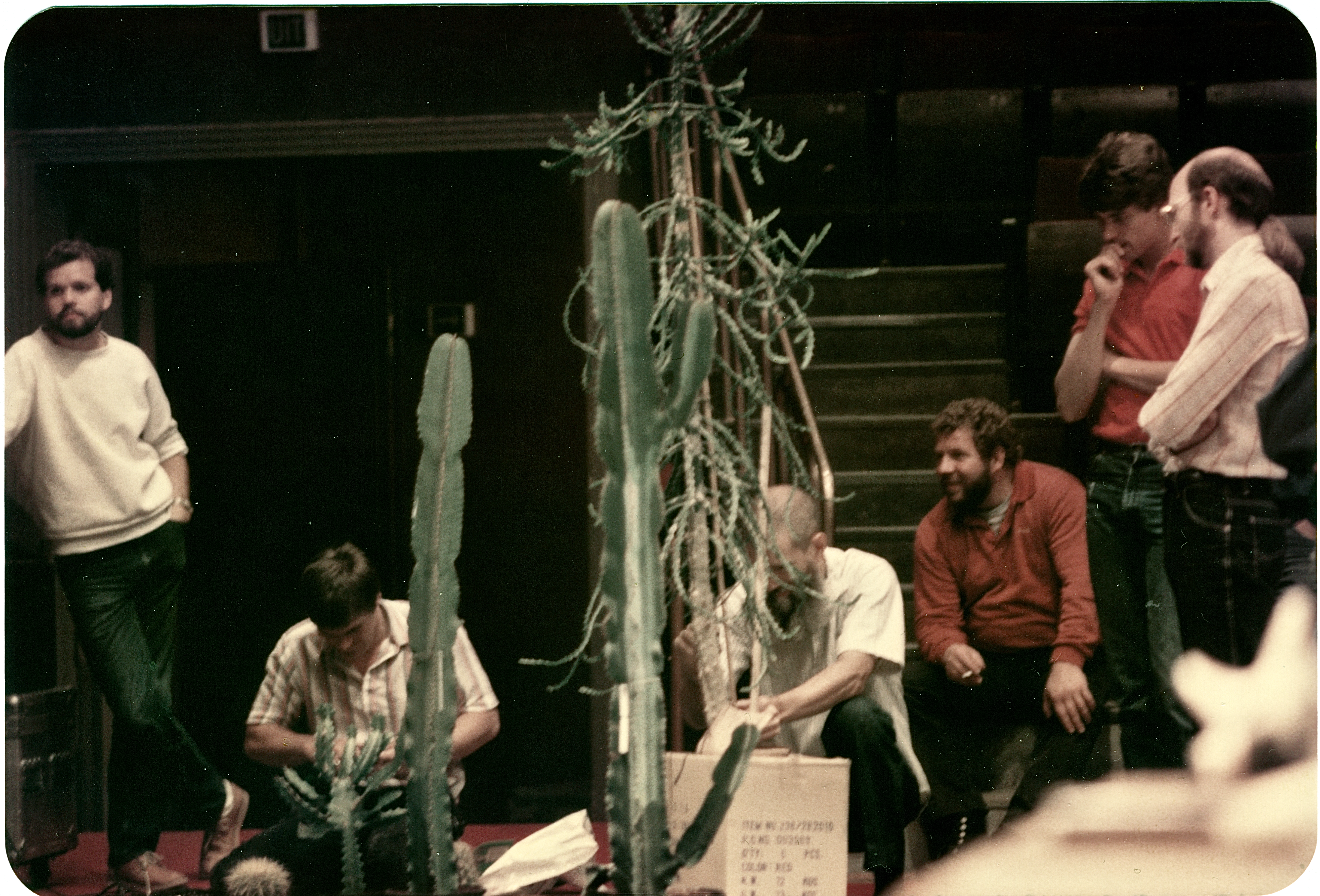
 Robin Engelman
Reflections on the Nature of Marimba Music.
Prelude:
After the defeat of China’s army by the British in the first Opium War, (1839-42) Japan, concerned with the possibility of a foreign invasion, adopted Dutch military music for fifes, drums and trumpets to discipline and train their Samurai warriors in western infantry tactics. This was the first western music sanctioned by Japan since the expulsion of foreigners in 1640. In 1875, Japan’s government introduced a nation wide public school music program based on an American model. By 1965, only 90 years after this official embrace of western music, the influence of Japanese composers began to be felt in western avant-garde art music circles [1.].
The Marimba in Japan:
The programme above is from Ryan Scott’s first DMA recital, played in Toronto, Ontario on 22 January, 2014. Ryan’s DMA thesis will probe Japanese art music for marimba. His work on this project has been facilitated in part by New York City resident and former Keiko Abe student Alan Zimmerman. Alan gave Ryan access to his encyclopedic knowledge and massive library of Japanese compositions for marimba, dating from its inception as art music in the 1960s, to the present.
Ryan anounced from the stage that prior to 1965, Japanese marimbists played arrangements of traditional folk songs and western classical music. Marimba virtuoso Keiko Abe (b.1937) convinced prominent Japanese composers to write art music for marimba and manufacturers to upgrade the quality of their instruments.[2.] Between 1965 and1985, more than 500 works of art music were written for marimba by Japanese composers and many of them are still performed today.
I had thought to write a critique of Ryan’s performance, but instead,found myself musing over his announcement regarding Keiko Abe and Japanese composers. I began thinking about the marimba in North America. What follows is almost entirely anecdotal, but during a lengthy telephone conversation, Ruth Cahn, who has been in the middle of most things percussive for many years, confirmed most of my remembrances. Thank you Ruth. Nevertheless, I take responsibility for all errors and the opinions expressed.
The Marimba in America:
Clair Omar Musser, (1901-98) a marimba virtuoso, composer, arranger and conductor, organized concerts for marimba orchestras. One of the first of such groups was a 25 piece, all-girl marimba ensemble for a Paramount Pictures event in Chicago. In 1933, Musser presented a concert with 100 marimbas and in 1950, a concert with 500 players for a Chicago railroad fair. His repertoire consisted mainly of arrangements of popular classics along with compositions of his own. Musser was also an engineer. The marimbas he designed for the J.C. Deagan Company are considered today the finest of their kind ever made. [3.]
The Percussive Arts Society:
Founded in 1961, the Percussive Arts Society (PAS) today has a membership that includes percussionists from almost every university, college and conservatory in North America. Administered primarily by and for university percussionists, the PAS acts as a nexus for students, teachers, composers, performers and manufacturers, providing them access to school programs, pedagogic trends, new instruments and music.
Leigh Howard Stevens:
By 1980, a nascent group of educators and performers began to champion the marimba as a solo instrument and the popularity of marimba playing grew exponentially. Arguably the most influential marimbists was Leigh Howard Stevens (b. 1953). Stevens studied with Vida Chenoweth [4.] and later created an entire system for marimba playing. He devised a new grip, new mallets and a new marimba design, all complimensts to his vision. Stevens also wrote hundreds of etudes, and a vade mecum to disseminate his ideas. His work has influenced marimba composition and performance and has been adopted and adapted by marimba players throughout the world.
Marimbas in the United States:
A marimba provides melodic and harmonic components often lacking in all but a few percussion programmes of the past. In most major music schools, marimba studies have become the backbone of its percussion department. Importantly, this helps validate percussion studies within academia. Post graduate degrees, often unavailable to percussionists prior to the marimba’s ascendency, are today, the norm, even for students who eschew traditional instruments and specialize in solo marimba performance.
Marimba Music in the United States:
Two major concertos for marimba were written before 1960: Paul Creston,1940 and Robert Kurka,1956. From 1969 forward, most concertos were being written by foreign composers. [5.] In 1987, John Serry completed a marimba concerto commissioned by Leigh Howard Stevens and other marimba soloists followed suit with commissions of their own. Unlike Japan however, only a small amount of solo music for marimba has been written by America’s art music composers. One of these, by Jacob Druckman (1928-96), is Reflections on the Nature of Water (1986) a masterwork, now almost thirty years old. Aside from the Druckman work, practically all pedagogic, ensemble and solo recital music has been and is being written by percussionists. A recent national marimba competition provided applicants a repertoire containing 15 compositionds, 13 of them written by percussion teachers.
Their music has failed to make an impact on audiences outside percussion circles. It is commonly based on classical forms and structures and is heavily influenced by basic marimba technique or the latest fad. Their music also demonstrates the American percussionist’s preference for loud, fast, continuous and repetitious music. [6.] For example, soon after the appearance of Steve Reich’s Music for Pieces of Wood, in 1973, percussion students and teachers began writing pattern music and continue doing so. In the words of a professional musician and friend, “Most composers are arrangers”.
Conclusions:
Note: The works on Scott’s program above by Yoshio Hachimura, particularly Ahania II, and Tokuhide Niimi, differed in substantive ways from many American compositions for marimba. They were mesmerizing, rhythmically and harmonically ambiguous and occasionally weightless. Remarkable too were their sudden, surprising silences and absence of expectation. [7.] The latter, best described by John Cage who said of his close friend, “I love Takemitsu’s music because it doesn’t lead me anywhere”.1
I was impressed by Ryan’s lack of histrionics, all too common among players today, and the concentration of his mature artistry which allowed the music’s unique qualities to appear without his intervention. Michio Kiazume’s Side by Side is a congenial and equally virtuosic substitute for Xenakis’ Rebonds and was played with clarity and panache. I was delighted.
Ryan is commissioning a select group of composers. One being a marimba concerto by Erik Ross (2007). On the program above, the work by Oesterle for marimba and koto is a welcomed addition to the repertoire.
Ryan Scott has two more recitals and as rumour has it, he plans to present both by May of this year. I look forward to hearing another half dozen works from Japan, all new to me and I thank Ryan for instigating these ruminations.(Ryan’s last two recitals will now be played in the Fall of 2014.)
Foot Notes:
[1.] See Burt, Peter: The Music of Toru Takemitsu, Cambridge University Press, 2001.
[2.] Many percussionists including myself, were familiar with the works of Keiko Abe before her first visit to North America in November,1977. Though impossible to quantify, her presence inspired many students to play modern music and encouraged marimba soloists to write their own original compositions.
A detailed comparison of the grips, mallets and styles of Abe and Stevens and their effects on marimba performance would make interesting reading and a beneficial companion to Scott’s thesis.
[3.] If one wishes to hear a large marimba orchestra playing typical Musser repertoire, one can purtchase the CD The Marimba Festival Orchestra conducted by Frederick Fennell and recorded in the Eisenhower Theater of the United States Military Academy in West Point, New York. The orchestra was assembled by Lee Howard Stevens and featured soloists Gordon Stout and Bob Becker. Resonator Records by Marimba Productions, Inc. 1999.
[4.] The importance of Vida Chenoweth and her teacher, Clair Omar Musser, are worthy of attention.
Vida Chenoweth ( b.1929), one of Musser’s students at Northwestern, played her first solo recital in Chicago in 1956. She performed concerts world wide until an accident prevented her from playing at her former level. She is a member of the Percussive Arts Society Hall of Fame.
[5.] See: Conklin, M. Christine: An Annotated Catalog of Marimba Concertos Published in the United States Between 1940 – 2000. Marimba Concertos listed, chrinologically, alphabetically by composer, with orchestration, marimba size, date of composition, an interview and reviews, DMA thesis, University of Oklahoma, Norman, 2004. UM number 3134393.
[6.] I sent trombonist/composer Vinko Globokar an ensemble improvisation recording. His reply, paraphrased, was, ” This is typical of American music. Continuous, repititious. For the trio improvisations, our percussionist brings only two or three small instruments. Our idea is to never repeat. Always search for new ways to make sound”.
[7.] See Takemitsu, Toru: Confronting Silence, Fallen Leaf Press, Berkeley, California, 1995. Pgs. 51-57 contain Takemitsu’s thoughts on his use of silence and the concept of Ma.
Posted by robinengelman on February 23, 2014 in Articles, Commentaries & Critiques, Composers, Compositions, Contemporary Music, History
Tags: aesthetics, Alan Zimmerman, Bob Becker, Erik Ross, Frederick Fennell, Gordon Stout, Japanese Marimba Music, Keiko Abe, Leigh Howard Stevens, Maeimba Music, Marimba Concerti, Michael Oesterle, Ruth Cahn, Ryan Scott, Tokuhide Niimi, Vida Chenoweth, Winko Globokar, Yoshio Hachimura