TorQ
Years ago, I read a National Geographic article about a newly discovered tribe in the wilds of South America. The tribe had no predators, their children were raised communally, abundent supplies of food were always within arms reach, they did not work and the men spent much of their time lazing in hammocks. Their average lifespan was 30 years. Scientists reporting on tribe’s seemingly idyllic existence, speculated their early deaths were due to boredom. The tribe had no music or dance. None at all.
Beyond this cultural anomaly, music and dance are universal, historically percussion being the prominent music purveyor. From the single rhythm Inuit and native American Indian frame drums, to the complex percussion ensembles of Africa; from Turkish hand drums and Korean Samulnori ensembles, to Brazilian Samba clubs; from Indonesian Gamalans and Caribbean Voodoo drums, percussion instruments provide the heart and impetus to dancers.
Composer John Cage comes first to mind when I think of percussion and dance in North America. A prime emxaple is Cage’s CREDO IN US (1942), a work for percussion whose original choreography is not extant. Throughout the United States and Canada, Cage’s music and populal misconceptions about his ideas on improvisation, have led to a multitude of annual collaborations between university dance and percussion departments.
I’ve participated in my share of these collaborations, some of them free-for-all wastes of time. The best were choreographed by professional teacher dancers, but in recent years I’d not been aware of professional percussion ensembles pursuing this creative medium. Until now.
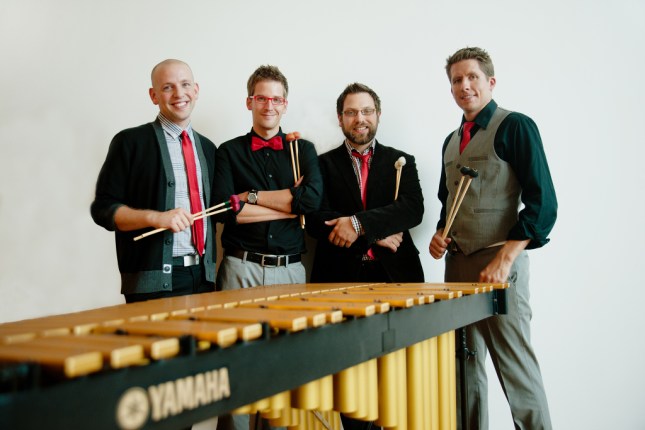
On May 3 and 4, 2013, TorQ percussion quartet gave three sold out concerts under the name New Manoeuvers in the Dancemakers facility of the Distillery District of Toronto. TorQ had asked Jacob Niedzwiecky, Louis Laberge-Côté, Lauren Van Gijn and Linda Garneau to choreograph works for their student dancers by Janes Rolfe, a TorQ commission, a recent work by Steve Reich, a new work byTorQ member Daniel Morphy, and a classic John Cage quartet dating from 1942.
Dancemakers performance space is a rectangle. The audience and performers are separated by a long, wide area covered by a dancer’s floor. There are about 70 bleacher seats for the audience and across the way, there seemed to be adequate space for TorQ. The acoustic was altogether satisfying and percussion sounds rang true.
The program began with the premier of Janes Rolfe’s, Why You. Jacob Niedzwiecky named his choreography Meek, Bent and MIld. Rolfe intended his music to be one continuous movement, but the choreography, employing ropes, required pauses, which to my ears, hindered not at all the music’s effectiveness. The music is ebulliant, well orchestrated and constructed. It is reminiscent of moments in John Cage’s early percussion works and his Sonata’s and Interludes for prepared Piano. But only reminiscent. This is a unique work and was delightfully danced. TorQ should keep Why You in its quartet concert repertoire.
Steve Reich’s Mallet Quartet is just a couple of years old, but I’ve had the opportunity to hear it a number of times. It doesn’t appeal to me as, say, his Music for Pieces of Wood. His quartet sounds to me like a “Toss-off”. But one problem is how its been played. It seems Reich’s music for percussion is always played mechanically and loud. These interpretations aggravate me and after a short time I’m compelled to say, “Enough already. I get it”. Still, as music for dance, Mallet Quartet worked. The vibraphones were played with a lilting swing which, though loud enough, was a human touch. I still think this work is of little significance, but TorQ’s interpretation made listening tolerable. The dancers were Michael Caldwell and Jordana Deveau. Michael Caldwell was the star of the duo, self assured, polished and thoroughly musical. Jordana was a great partner if just a touch less compelling. I had not expected to see student dancing of this calibre. Their performance of the Louis Laberge-Côté choreography Three Times Two, gave the Reich work its raison d’etre.
For me and I think the audience, the work that stole the show was Daniel Morphy’s Dance Cycles # 1 having the choreographed name of Restless / Reverie. Morphy’s music and the dance were seamlessly blended into a time stopping bouquet of sound and movement. As the music begins, dancers enter stage left and right with small hand-held tuned gongs, each stroke timed to the dancers personal count. The effec of their slow swirls creates magic. At the end of the work Morphy plays on small resonant metal percussion, a long diminuendo that carries the ear and the performance to rest. A gem.
Percussionists have an important relationship with John Cage and his music. Cage’s early works, all written for percussion, is the core repertoire for North American percussion ensembles. Of those works, Third Construction is generally considered to be his finest creation and I was very interested to hear it with dance. Linda Garneau named her choreography Reconstructions: an architectural study and was satisfyingly danced by Mia Delina. I was infatuated by TorQ’s performance. There’s a wooden tongue drum solo mid way that is very soft. It was played softly, but at half tempo. A startling effect, something akin to a reverse “Warp Speed, Scotty”. From that point to the end, TorQ was passionate and exciting. TorQ has recorded this work on BEDOINT RECORDS.
TorQ’s programme was refreshing, musically satisfying and exciting. All in all, a significant evening of memorable entertainment. In the case of New Manoeuvers, collaboration between percussion and dance created an artistic success. One that could bear exploration.


 Robin Engelman
AUSTRA
Pleiades, a work for percussion by Greek composer Iannis Xenakis, forced me to wear ear plugs for the first time. With all respect to Dionysus, it was the loudest music I’d ever heard.
But not as loud as Austra, an electro-acoustic band formed in 2009 in Toronto. Its members are percussionist Maya Postepski, singer Katie Stelmanis and bassist Dorian Wolf. Austra, as they say in the bizz, has a buzz. Their first CD, Feel it Break (2011) was a New York Magazine Top Ten Album of the Year and received a Juno Award nomination for Electronic Album of the Year and came within a decibel of winning. (Check out Lose It). They’re beginning to make it, particularly in France, Germany and England. Austra’s been on the road for three years and If any couch potato wants to feel queazy, check out their current touring schedule:<http://www.austramusic.com>).
Maya studied music and percussion at the University of Toronto and played for 4 years in the Faculty Percussion Ensemble. At the same time, Stelmanis was a voice major in the faculty opera department. Wolf is a veteran of many bands and no mean photographer. While still in school, Maya invited me to hear their fledgling group in a local venue used primarily by young musicians. The band was too large, a bit unwieldy and the house sound system did them no favours. After that trial run, Austra pared itself down to a trio and Maya’s contributions have bloomed with the purchase of conga drums, a viberaphone, glockenspiel, some traps and a complete drum set. Austra has also acquired managers and agents and most important for the trio’s music, a full time, professional soundman.
A few weeks ago Maya and I reconnected over dinner. She invited me to Austra’s concert in Toronto’s Phoenix Concert Theatre. Besides free admission, she gave me a back stage pass for food and drinks at the after concert party. My first.
I met up with three former U of T students, two percussionists and a flutist. We had our picture taken with Maya before the concert and sat in the balcony at the back of the theatre.
Tricia Mangat, Maya Postepski, Robin, Mandy Lau, Laura Chambers. Phoenix Concert Theatre, Toronto, 27 September, 2013.
I had been told to bring earplugs. I didn’t. The first tune hit like a solid wall of sound so loud, I felt my dinner beginning to digest. I sat stone still, trying to relax. Conversation with friends was impossible. Cripes I thought, how could the kids pressed against the stage bear this Maginot line barrage?
Nearby, a tall delicate girl dressed in diaphanous white began moving her arms over head, her hips side to side, in a slow meditative choreography to the music. She kept this up for Austra’s entire set, providing me an occasional diversion. As the evening progressed, I began to hear voices moving in the walls of sound. Stuff was happening in there.
Even so, I had difficulty separating electronic from acoustic sounds. Electronic percussion cannot easily be distinguished from its “real” counterparts, especially in a sound spectrum as heavily mixed as the one I was hearing. I wanted to know for sure what Maya was playing and what was electronically pre-recorded, but my vision is not too sharp and with the flashing lights, I rarely caught more than a fleeting glimpse of Maya and some mysteries about her work remain.
The trio is growing on me. Stelmanis has a voice with a band saw vibrato, an edgy intensity that could be interpreted as anger, but overall, floats with an indefinable poignancy that draws one in. She covers a range of emotions larger than the tessitura of her songs, singing with complete control and in tune. The bed for her voice consists of a solid bass and the driving pulse of percussion. For me, Austra has been a taste worth acquiring.
Austra is paying dues, but they are doing what they love and that’s aplenty. Rumour has it they’ll soon be playing Hollywood Bowl.
Post script:
Whenever she can, Maya and a group of her friends manage to trundle percussion instruments across Eigensinn Farm, the home of Chef Michael Stadtlander’s internationally famous restaurant. Every summer Michael hosts a Wild Leek Festival. As many as 15 chefs prepare their specialties at stations around the farm and offer appropriate wines donated by Ontario wineries. The music of Maya and her friends accompany the moving feast. Stadtlander was voted one of the world’s top ten chefs and some aficionados fly into nearby Collingwood to savor his cuisine. Michael is also a leader in the use of local foods and has enrolled Ontario farmers and chefs nationwide to cultivate and use locally grown food. This past year he rallied friends, foodies, chefs, farmers and businesses to defeat plans for a mega quarry. An expansion that would have polluted the headwaters of five Ontario rivers.
Maya Postepski, 2nd from right, with chef Jamie Kennedy and Toronto percussionists during a Wild Leek Festival on chef Michael Stadtlander’s Eigensinn Farm, Singhampton, Ontario.
Posted by robinengelman on October 15, 2013 in Articles, Commentaries & Critiques, Contemporary Music
Tags: Austra, Dorian Wolf, Feel it Break, Iannnis Xenakis, Katie Stelmanis, Maya Postepski, Olympia, Phoenix Concert Theatre