RSS

Category Archives: Fifes & Drums

Examples of Snare Drum Notation, Part 2: 1809-20.

As an independent nation, the United States Congress in 1783 authorized the formation of America’s first Army. The army was directed to secure the western borders and the Great Lakes and protect the settlers of the North West territories.1 The new government was responsible for providing the army’s music instruments. Thus a tradition of military music begun during the War for Independence was continued into the next century and survives today in amateur and military fife and drum corps.2

The Militia tradition in the United States is too complex to explore fully within the context of this article, but it is important to understand something of its origins in order to explain the abundance of snare drum and fife books published  In the United States during the 19th century.

Village militias  were established prior to the war for Independence because there were not enough British soldiers in North America to protect the burgeoning colonies. They elected their officers, armed and trained themselves in the British military tradition in order to protect their communities and played important roles in the French and Indian War. When the struggles for independence began, these local militia served with varying success along side the Continental Army regulars under Gen. George Washington.

With Great Britain’s defeat came other cantankerous issues. The iconic images of self-reliant Militiamen, their deeds at Lexington, Concord and Bunker Hill, clashed with more pragmatic ideas espoused by some powerful politicians  and former Continental Army officers who wanted to replace local militias with a standing army and arguments arose about the  Second Amendment. However, in the north eastern United States particularly, the militia idea and ideal held firm.  Thus the raison d’être for most if not all of the Fife and drum books published in the United States in the 19th century.

1809. Over Het Tromslaan. This twenty-four page book published in Amsterdam contains military drum signals and marches. It includes for example, De Kerk-Parade (Church), De Brand-Allarm (Fire), Taptoe (Tattoo), De Grenadier Marsch and De Flanke Marsch.3 In the Reveille below, the 13 and 9 stroke rolls appear to be alternating single strokes, but on an earlier page, this notation is clearly meant to indicate closed double stroke rolls. This Reveille beating is almost identical to George L. Winter, 1772 which appears in Part 1 of this posting. In Winters, however, four beams (64th notes) are used for each roll.

For technical reasons, I do not interpret the eighth notes with two stems as flams, either here or in Winters (1777, Part 1.)  Flams do not appear in the modern Swedish Army Reveille – Revelj – which is identical in all substantive aspects to Winters and this  Reveille.4 As in Winters, a small vertical line appears above each of these notes and may be a symbol for an accent or meant to designate the first and second beats of the measure. (In the mid 19th c. Dutch military music for fifes and drums profoundly influence the transformation of Japan’s Samurai military tradition.)5)
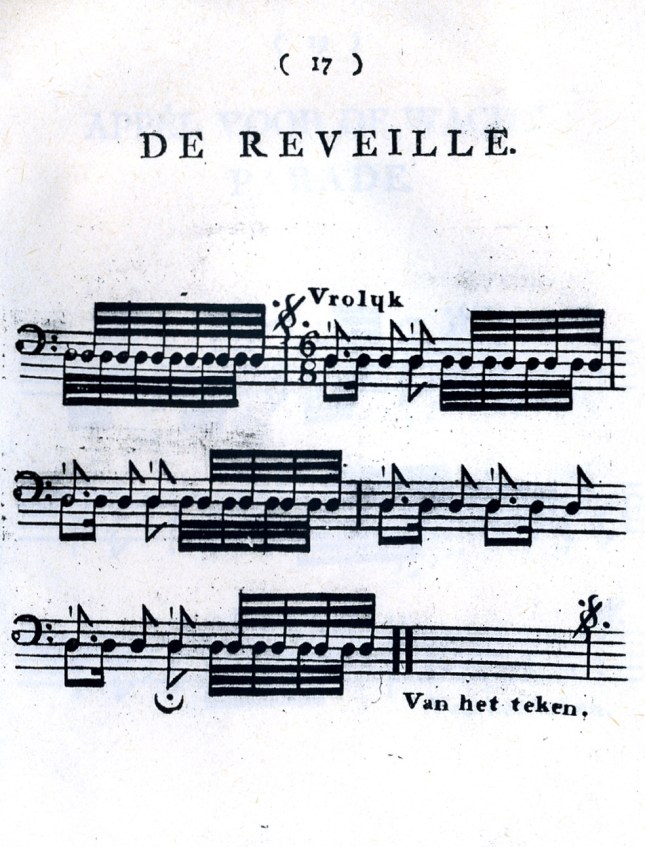
1809-De Reveille, Over Het Tromslaan, Amsterdam.

1810. David Hazeltine published his Instructor in Martial Music: containing Rules and Descriptions for the Drum and Fife, in Exeter, New Hampshire. Though I was surprised when I first saw this book, I was not completely taken aback for it brought to mind the early drum signals from England which exist only as words and which begin Part 1 of these examples. The book contains nary a note for the drum and all instructions are in English.

Reproduced below is one half page from the 9 and one half pages devoted to the drum. This begins with the Drummers Call, then the Single Drag and the drumbeating for the Irish Brigade. The Single Drag  is a rudiment, but also, as described here, a beating for tunes with dotted rhythms. For examples of single drag tunes see page 94 of Bruce and Emmett’s The Drummer’s and Fifer’s Guide where the accompanying Note reads: “For the beat of a Single Drag, refer to the “Breakfast Call” (p. 37).

Hazeltine’s book contains 21 Lessons (rudiments) including the Poing Stroke.
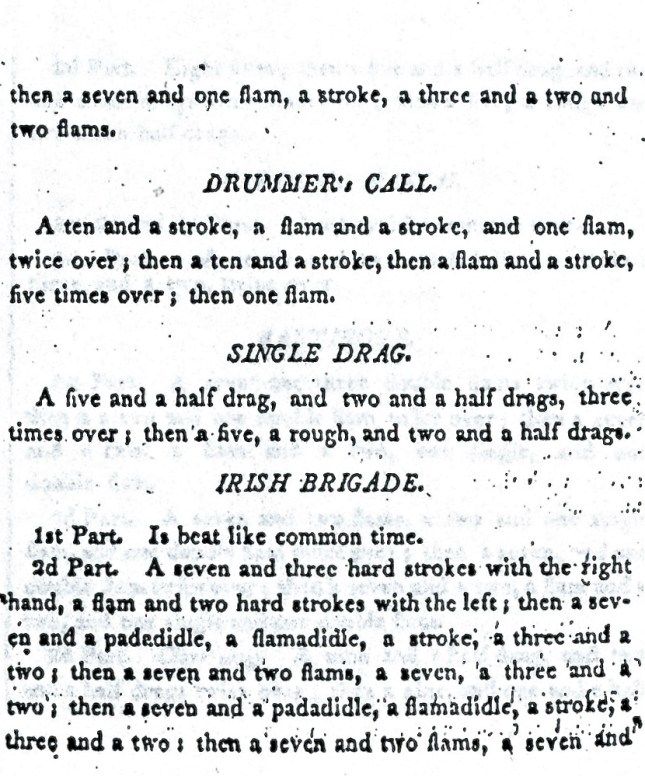
1810-David Hazelti, Exexeterm, New Hampshire.

NOTE: Shortly after finishing this article, I contacted Edmund Boyle, Lancraft, CT. Fife & Drum Corps fifer concerning a question I  intend to address at the end of the third and final article in this series. Mr. Boyle was gracious enough to give me his opinion and spread the word among core members. Soon I found myself in correspondence with Lancraft Corps members and my education in traditional and contemporary rudimental drumming and drum notation took a great leap forward.

And so I quote just a small part of my correspondence with Mr. Boyle and include part of the music to which it refers.

“The mnemonic method was used by Hazeltine, Robinson and others. The name of the rudiment sounded much like the beating itself:  e.g.”A nine and a half drag, and two and a half drags; then a nine, a rough, and two and a half drags” (First Part to Roast Beef).6

1861- Roast Beef or Dinner Call from Keach, Burditt & Cassidy.

1861- Roast Beef or Dinner Call from Keach, Burditt & Cassidy.

Apparently, somewhere along the line, the mnemonic method became too wordy and cumbersome for Connecticut drummers (speculation on my part), and a shorthand was developed by someone.”

1812. Charles Stewart Ashworth.7 “After carefully examining all the Drum books that have been published during the past 25 years, the author finds none to compare with “Ashworth’s Rudimental School .  .  .”  George Barrett Bruce, 1852.

Page 3 of Ashworth shown below is, as pointed out to me by music historian George Carroll,the first time the word Rudiments appears in a drum instruction book. The notation is by now familiar; the upper notes with stems up indicate they are to be played by the left-hand and the lower notes with stems down are to be played by the right hand.26 rudiments are listed in Ashworth including the “Mother or 5 S. Roll”.

The text reads: “It is necessary that the learner should first practice the Long Roll until he can close it handsomely, then go on with the lessons, One by One, as they are here placed, and by no means undertake the Second till he can with ease Close the first. –– He will find that by getting these Lessons perfect, —– every Beat he undertakes will become easy and familiar to him” —-
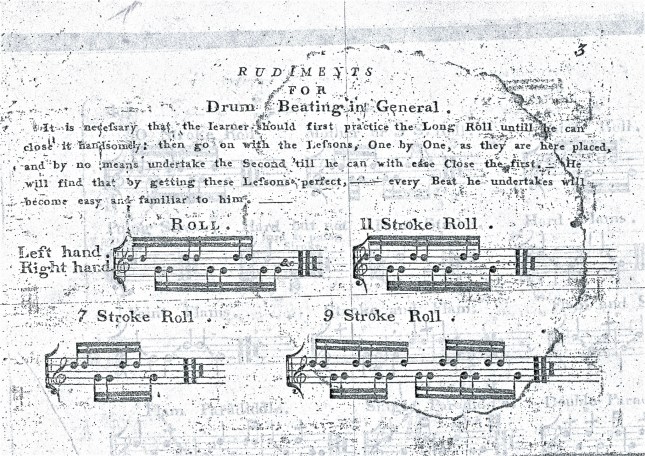
1812-Charles Stewart Ashworth,Boston, MA.

1812. The Robbins book is mainly concerned with the Fife, but in the illustration below the drum notation is familiar; two staves, top for the left-hand, bottom for the right-hand, and it is seen in the Revolutionary  War Drummer’s Book, Part 1. and in Levi Lovering, below.  Robins maintain is the use of the European designation for note values as Minums, Crotchets etc. and interestingly writes the drum parts in the treble clef. He stresses the long roll, the five, the seven, the nine, and 11 stroke rolls and then he notates five methods of common time for the drum. The 10 pages Robbins devotes to the drum  conclude  withsingle and double drags set to musical examples.. From page 17 to 61 are fife tunes and signals.
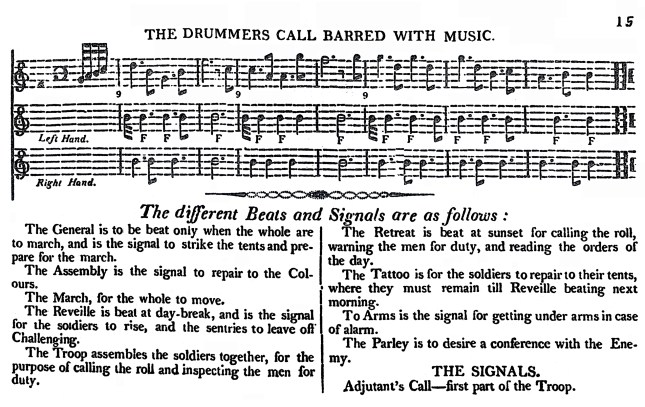
1812-Charles Robbins, Exeter, NH.

This book as Haseltine above and Robinson below was written for local militia. This is of historival importance and therefore I reproduve here the Preface to Robbins:
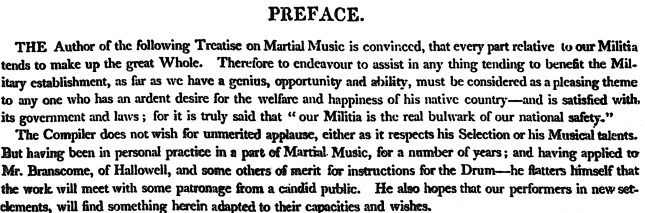
1812-Excerpt from Preface by Robbins.

The Charles Robbins Drum and Fife Instructor was new to me until I contacted Ed Boyle, mentioned above.  I purchased a copy of Robbins and learned that Mr. Boyle has spent hundreds of hours digitally enhancing historic Fife and drum books. the fruits of his great labors can be seen and purchased at http://www.beafifer.com.

1815. Samuel Potter Drum Major in the Coldstream Regiment of Foot Guards. According to Maurice Byrne (Part 1), The Retreat illustrated below is the one English drumbeating from the early 17th c. to survive to the 19th c. In fact, the Samuel Potter version continues to be used by the British Army to this day, the only difference being an additional bass drum part. Potter, in line with George Winters (Part 1.) and the Dutch manuscript above, wrote his drum parts with a bass clef designation, a device some composers continue to use today when writing for non-pitched percussion instruments.

Potter wrote his book as an instructional manual for boys. The first sentence of his introduction reads, “The first thing previous to a boy practicing on the Drum is to place him perfectly upright, and placed his left Heel in the hollow of the right Foot”.  Potter does not mention the word Rudiment, or even Lesson, but simply introduces each exercise by saying, “The next thing to learn is .  .  .”  There are 21 of these “next things to learn”.

Because this book is in modern notation, it is useful for sorting out many arcane drum notations and descriptions from the same era.

1815-Samuel Potter, London.

Potter’s preface to The Art of Beating the Drum is relevant to this presentation.

“For a length of time I have been studying in what manner to write the duty for the Side Drum by Note, as that part of Drum Beating is very intricate: And had I not made use of Appogiaturas for Flams, Drags etc. could not have accomplish’d it, but as an Appogiatura does not partake of any part of the time in such Bar  –––  it may be used only as an embellishment.  –––  At the same time that with the use of the Shake for rolls and Staccato Marks to distinguish which Hand to strike . . .”

1817-Rumrille and Holton. The Drummer’s Instructor or Martial Musician. Containing the Rudiments of Drum–Beating, on a new and improved System; the Rules for Common, Quick and Compound Time, with beats in each Mode; and the whole of the Camp Duties, consisting of the Reveille, Troop, Retreat, Tattoo, Parley, Officers calls, signals, salutes, etc. as practiced at Head Quarters of the Army and Navy, U.S.A. together with Instructions For The Base Drum, intended particularly for the militia.” from the cover of Rumrille and Holton.

This is one of the “new and improved notation” books mentioned in the prologue and there is much to recommend it to percussionists. To my knowledge, it is the first book to not only mention, but include instructions and beats for the bass drum. Though not properly a part of this presentation, I could not resist including the text on page 30 concerning the bass drum:  “The Base Drum must be tuned to chord with the Music with which it plays–The right hand Stick must not exceed 10 inches in length, with a ball at the end 6 inches in circumference, composed of sponge properly–wound–with woolen yarn and covered with Cloth of Wash–Leather.– The left hand Stick may be of the length and size of a common beating Drum Stick”.8 These instructions will be familiar to musicians having  knowledge of Janissary music performance traditions.
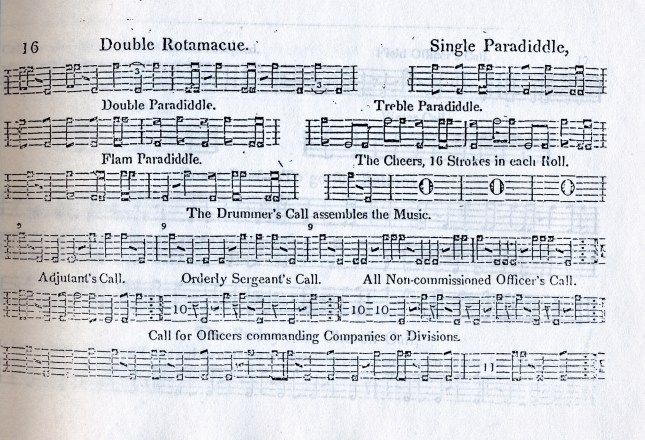
1817-Rumrille & Holton, Albany, N.Y.

1817-Rumrille & Holton, Albany, N.Y.

The examples of Common and Quick time are clear and are reminiscent of Thoinot Arbeau’s explanations off how the distance covered by soldiers can be determined by tempo and the length of their stride.(“Common Time-75 Steps of 2 Feet each in a minute & Quick Time-120 steps of 2 feet each in a minute.”)  The notation devised by Rumrille and Holton is elusive, but there are some wonderful fife tunes in traditional notation, which I’ve found in no other books. Rumrille & Holton present 29 “Lessons” (Rudiments) including the Paying Stroke, a name I’ve not found elsewhere.

1818. Drummer’s Assistant or The Art of Drumming Made Easy by Levi Lovering. In his introduction, Mr. Lovering makes it clear that this book is intended as a tutor, a self instructor, for Fife and Drum Corps and militia drummers, or, as he says, “Marshall Musicians”, and not strictly, like the four books immediately above, as compendiums of camp and field duty signals and calls suitable for military duty though these are included and easily interpreted. Lovering uses a two-stave system and also employs the onomatoopoeia Tou & Pou for strokes, a device we first encountered in Arbeau’s Orchesography (1589) as Tan-Tere-Fre, then in Pistofilo (1621) as Ta-Pa, and  most recently in the King Charles I Warrant (1630) as Tou-Pou-Pong. One must wonder how Lovering came to use the same two sounds -Tou-Pou – which appeared in a Monarch’s warrant written almost 200 years before he set pen to paper.
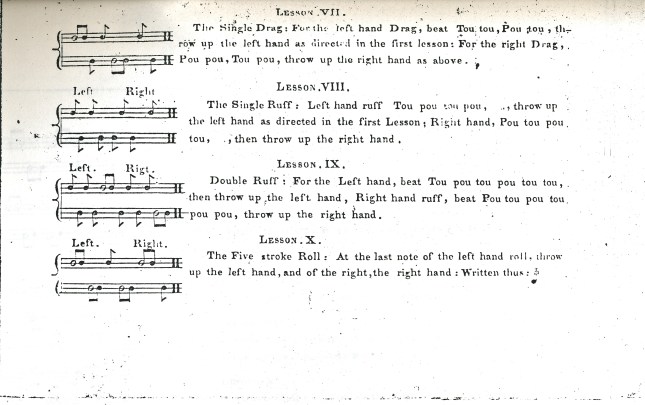
1818-Levi Lovering, Philadelphia, PA.

1818-Levi Lovering, Philadelphia, PA.

There are 17 “Lessons” (Rudiments) in Lovering, among them the  8 and 12 stroke rolls.

1820-Alvin Robinson, Massachusetts Collection of Martial Musick. Published in Exeter, New Hampshire. Only 10 years after Hazeltine, above, this book has the same look and layout and was written for the same constituency, the home militia. Below in its entirety is page 6. The last entry in the left-hand column is the single drag, this time, described as the rudiment.  Robinson describes the  Camp Duty Beats and Signals, and important for historians of the period, he describes in some detail the duties of the Musicians, Orderly Drummer, a Right Hand Corporal Drummer, the  Drum Major, the Fife Major, etc.
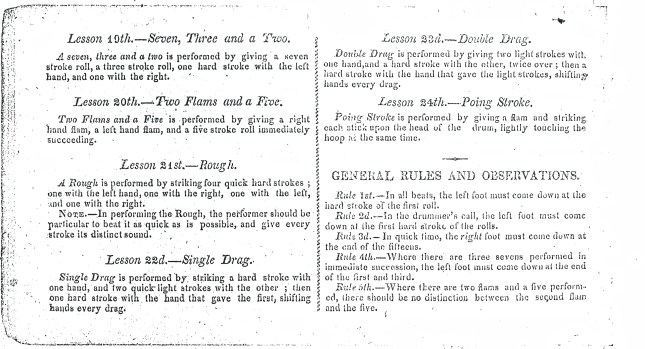
1820-Alvan Robinsonjr, Exeter, MA.

Robinson contains 24 “Lessons” (Rudiments).

Footnotes to Part II:

1. In 1791, General Arthur St.Clair (pronounced Sinclair) led this army into the Northwest Territories – now the state of Ohio – and on the banks of the Wabash River near present day Fort Recovery was attacked by a confederation of Indian nations led by the Miami tribe’s Little Turtle and Blue Jacket of the Shawnees. In the ensuing battle, the United States army, numbering 1200, was massacred, losing 900 men and 100 camp followers. General Sinclair escaped and his defeat provoked the first Congressional investigation in U.S. history. When the investigation began to probe the men closest to President Washington, it was disbanded. Gen. Sinclair, disgraced, lived to be 82 years old and died in 1818 when he was thrown from his pony cart.

2. Shortly after the War for Independence began, General George Washington ordered the construction of a field drum manufacturing plant in Carlyle, Pennsylvania. Carlyle was an important staging area for traders heading west over the  Allegheny Mountains. As President, Washington wanted a military academy built in Carlyle, but lost a political battle to New York State and Carlyle Barracks became the second oldest army training center after West Point Military Academy (1802).

3. I wish to thank Jan Pustjens, Principal percussionist of the Concergebouworkest, Amsterdam, for translating some of the book’s written instructions. Unfortunately, the book’s Dutch is archaic and much of the text defied his efforts to translate.

4. I am indebted to David Lindberg, principal percussionist with the Swedish Army Band, Stockholm, for providing me with the music and history of the Swedish Army Reveille, and other important information about Swedish Military Music. According to Mr. Lindberg, the Swedish Reveille was composed by German court musician Johann Heinrich Walch (1776-1855) and published around 1834. It was accepted as the Swedish Army Reveille-march in 1846 by King Oscar I.

Walch was a composer of quadrilles, quicksteps, marches and other military music. The War of 1812 ended, with the allies of Austria, Prussia and Russia marching into Paris on March 31, 1814 to the tune of “Pariser Einzugsmarsch”. This tune was also used during the climactic Victory parade of the Germans through Paris in 1940. Although attributed initially to Beethoven, Walch is the composer.

Walch visited the United States for a time during the 1830s.  Daniel Decatur Emmett used one of Walch’s compositions, Waterman Quickstep, published in Boston, Massachusetts in 1837, as a “Tag” for a version of his famous Dixie published in New York City in 1862.  In the same book The Drummers and Fifer’s Guide, Drum Major George B. Bruce and Dan Emmett include five other tunes by Walch.

5. See my article Western Military Music in Japan.

6.Roast Beef/Dinner Call does not contain a dotted rhythm in the Bruce and Emmett version.

7. During a visit to the United States Military Academy, friend and Hellcat drummer Warren Howe introduced me to the librarian in charge of the Academy’s rare books and manuscripts. Warren and I  were seated in his office and the conversation drifted among various subjects. For some reason, we lighted upon John Bell Hood’s campaign in central Tennessee – a campaign historian Wiley Sword called The Confederacy’s Last Hurrah. I mentioned an oft overlooked detail which had significantly undermined Hood’s campaign and our host, obviously impressed, immediately stood up and gestured for Warren and me to follow him. We entered the library and the librarian opened a glass case from which he took a rare original copy of the Charles Stewart Ashworth System of Drum Beating. He made a photo copy of the book and presented it to me. The reproduction above is from that original copy.

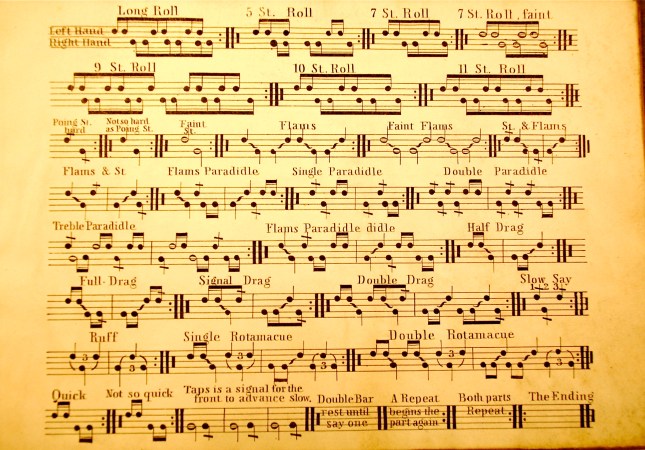
8. See: The Marching Drummers Companion, a collection of marches and quick steps for the drum containing all of the earliest American march drumbeats together with instructions for the Base Drum, and five original beatings. Rendered into notation suitable for modern drummers, from original manuscripts of 1810–1820, by George Kusel. To which is added the original descriptions of the rudiments of drumming; published by the author, Williams Grove, PA, 1970.

This small compact book (50 pages measuring 5 1/2″x8 1/2″) contains in modern notation all the rudiments and beatings harvested from all the drum manuals of the early 19th century.  Along with the work of Maurice Byrne, Raoul Camus and Henry George Farmer, this  book, now out of print, has proven most useful in providing me with an understanding of early 19th c. drumming notation and technique.
 
Leave a comment

Posted by on June 25, 2010 in Articles, Fifes & Drums


Examples of Snare Drum Notation, Part 3: 1853 to 1869

1853. George D. Klinehanse, The Manual of Instruction For Drummers, On An Improved Plan. Containing The Rudiments Of Drum — Beating; with rules for Common, Quick, and Compound Time: together with The Whole Of The Camp Duties Etc. prepared under the direction of the adjutant General of the United States Army, approved of by the commander-in-Chief And Adopted For The Use Of The Army Of The United States. 27 rudiments.

Until it was replaced by the Gardiner A. Strube Instructor in 1869, the Klinehanse manual was the only drum book officially approved for military duty by the U.S. Army.  The copy which I was allowed to photograph, resides in the Library of Congress in Washington DC. It contains 27 rudiments. The Poing Stroke appears below in the first measure of stave three and in The Rules To Be Observed By The Pupil, a brief one page introduction to his book, the author gives instructions for its use in the camp duty, to my knowledge the first and only such instructions regarding the Poing Stroke to appear in print.

Those Rules also direct the drummer to place the heel of the right foot into the hollow of the left foot, exactly opposite to Potter’s instructions (see Part 2.).  Klinehanse’s notation, left-hander above, right hand below and both on one stave is clear and reminiscent of The Young Drummers Assistant (see Part 1.) and Bruce and Emmett, Drummers and Fifer’s Guide, see below.

1853-George D. Klinehanse,Washington,DC.

According to US Department of Defense records, a George H. Klinehanse of Washington DC served in the Navy/Marine Corps during the Civil War in the United States (1861-65).  The Klinehanse family appears to have been large, moderately well to do and involved in their community. At least two Klinehanse men served as trustees on local boards of education.

1860. Swiss.1 This notation is of interest to me because the bottom or more modern parts resemble in some respects the notation that concludes this article, a shorthand device now in use particularly in Connecticut, which has come to be called “The Code”,

1860 ca.- Swiss,with modern notation below.

1860 ca.- Swiss,with modern notation below.

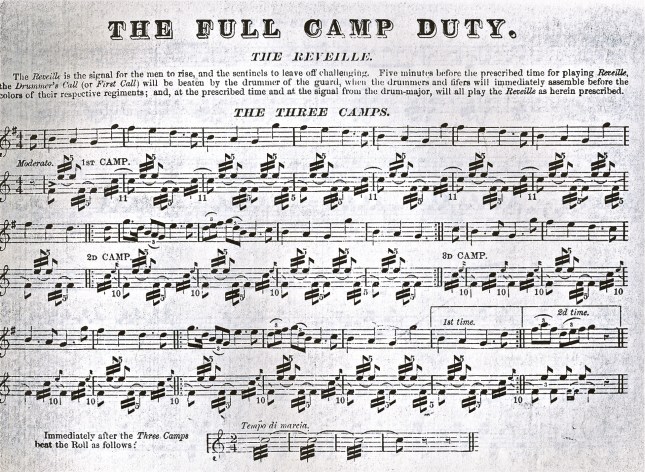
1861. Keach, Burditt and Cassidy, The Army Drum And Fife Book containing Full Illustrations, the Reveille, the Tattoo the various calls and beats used in the service and a choice collection of music to which is added the buglers call book, containing all the infantry general calls and calls for skirmishers, used in the U.S. 18 rudiments.

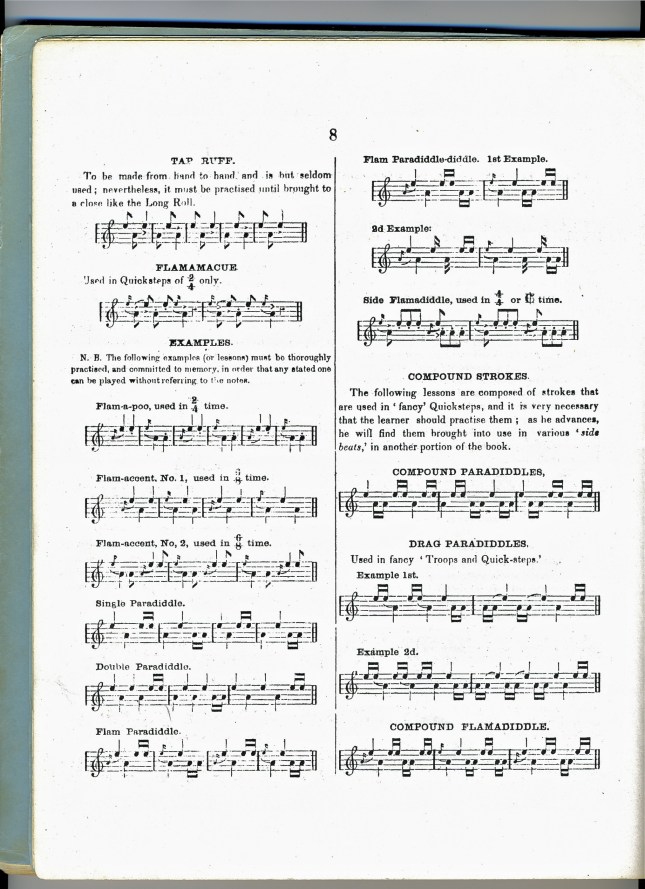
This is the first book to appear with dual drum notation: that is, a separate space for the left and right hand and then below on another stave the same beat replicated in modern notation. Keach contains 18 rudiments, including the single stroke roll, an eight stroke roll, and a side Flamadidle, but no Poing Stroke.

In the Preface to the drum section, this appears, “Hitherto, books intended to give instruction in Drum beating, were almost useless, owing to the unintelligible manner or system of instruction. In the Modern School, the System of Professor Keach, (recommended by Edward Kendall2, the greatest of Drummers as well as of Buglers), is used as being the best, imparting to the pupil, who faithfully adheres to the rules and practice, all that is needful to make a good Drummer.”

Modesty aside, Keach’s contribution to this book is one of the clearest expositions of the rudiments of drumming ever written.

1861-Keach, Burditt & Cassidy Boston, MA.

1861-Keach, Burditt & Cassidy Boston, MA.

1861-1Keach, Burditt and Cassidy, Boston.

1861-1Keach, Burditt and Cassidy, Boston.

This page from Keach may convey a seriousness of purpose more than precise details for drumming technique, but to my knowledge it is the first attempt to illustrate grip and stance in a drum book. Notice the heel of the right foot against the heel of the left.

1862.  George. Barrett Bruce and Daniel Decatur EmmettThe Drummers’ and Fifers’  Guide or Self  Instructor. 36 rudiments.

On page four appears Rudimental Principles, containing paragraphs devoted to putting on drum heads, holding the drum and holding drumsticks. Then follows instructions for the long roll and 35 other rudiments in left-hand right-hand notation, each on one stave as seen in the example below.  Bruce then repeats all the rudiments in modern notation.

Fred Johnson the founder of the Canadian rudimental drum organization  Canadian Associates  Drumming Rudimental Excellence (C.A.D.R.E.) and a distinguished teacher of many fine field drum players suggested some years ago that the reason Bruce and Emmett’s “Guide” was never officially adopted by the United States Army was because too many of the drum beatings and fife tunes were simply beyond the capabilities of the average military musician of the era.

True or not, the Guide is full of some of the most glorious music ever written for Fife and drum. The wedding of the two voices is beyond reproach and having played some of those tunes for over 50 years I can confidently say they will remain as meaningful to future generations as to those of the present and past.3

1862-Geo. Bruce & Dan. Emmett, Drummer's & Fifer's Guide, New Yor

1862-Geo. Bruce & Dan. Emmett, Drummer’s & Fifer’s Guide, New Yor

1862. Col. H. C. Hart, New York. New and Improved Instructor for the Drum with Original Notation, Containing all calls of the camp and field, for Drum, Fife and Bugle. Signals of the Drum Major; Position and Duties of Drum Corps at Guard Mounting, Parades, Reviews and Escorts. 27 Rudiments

1862-Col. H. C. Hart, New York, NY. Ex.2.

1862-Col. H. C. Hart, New York, NY. Ex.2.

1862-Col H. D. Hart, New York, NY. Ex.1.

1862-Col H. D. Hart, New York, NY. Ex.1.

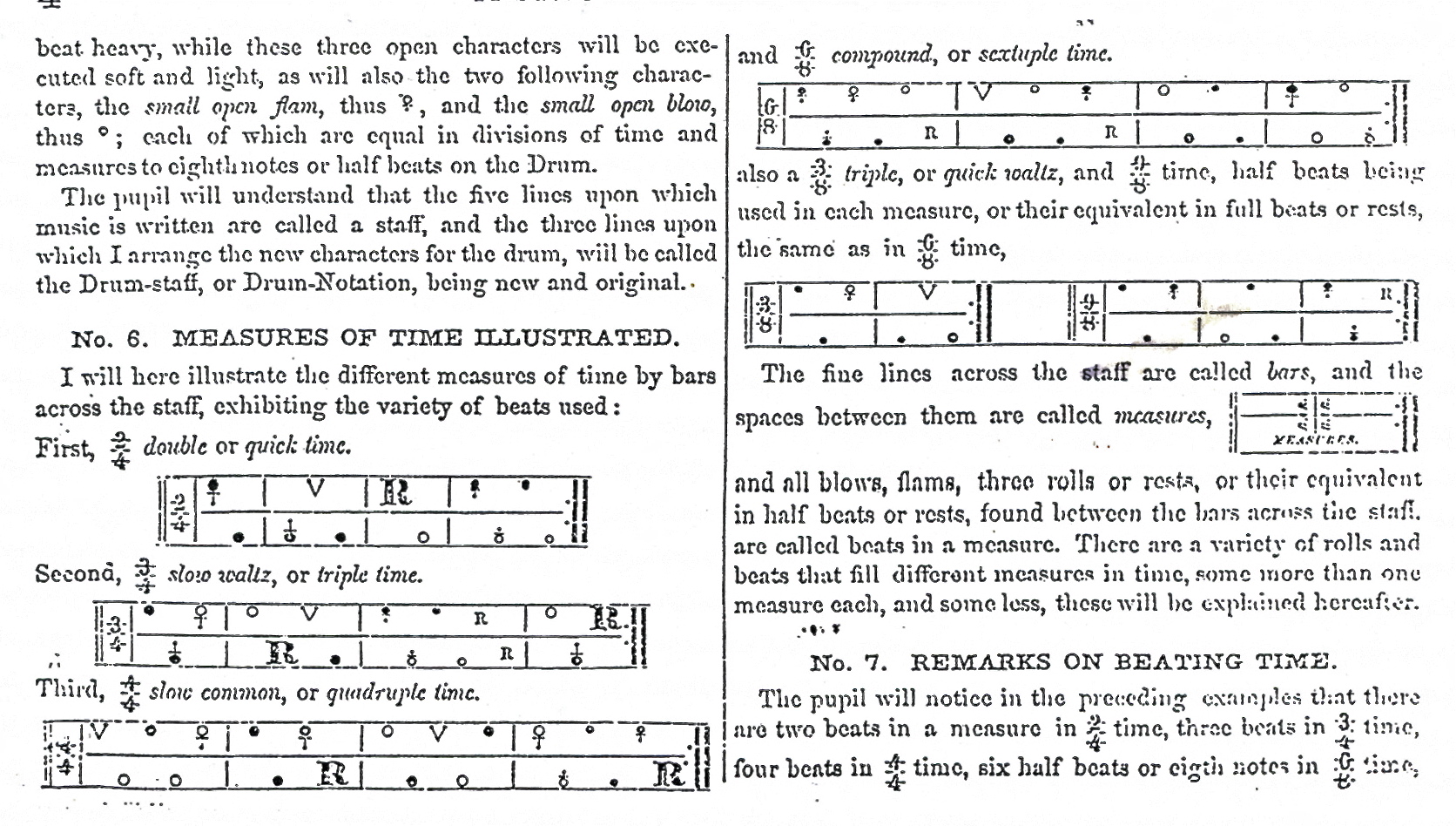
I have looked through his book on numerous occasions and am always discouraged, probably because I have been thoroughly trained in traditional Western music notation and the idea of learning a new system is simply too daunting. Still, I’m impressed by Hart’s effort.4 Also, there is much information in this book to interest music and military historians which goes beyond the subject of these articles

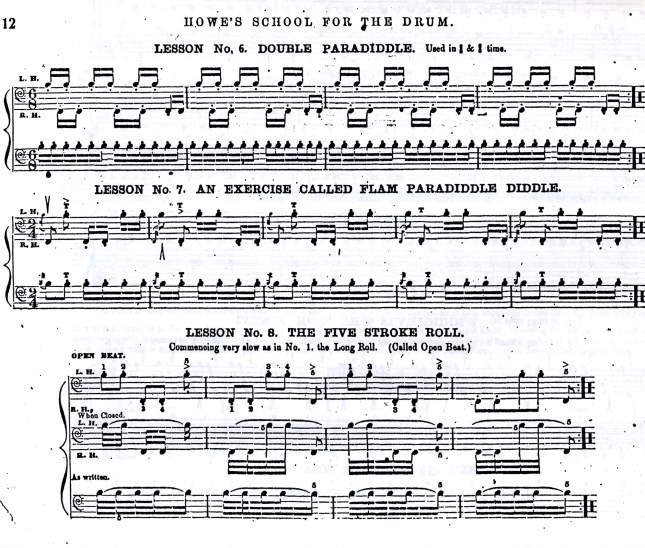
1862, Elias Howe, Boston. United States Regulation Drum and Fife Instructor, for the use of the Army and Navy consisting of full rules and exercises, the duties of musicians on all occasions, Full Camp Duty, Signals, Calls, etc. also the complete bugle call for the infantry, artillery, and cavalry. Also the pay and emoluments of musicians, and of every grade in the Army or Navy to which is added Several Popular National and Patriotic Songs as Quartets. 24 Rudiments.

The notation and layout in Howe appear to be even clearer than Keach already discussed above.  As in Keach, the left-hand right-hand notation is also represented in the modern style on a separate stave below. Howe devotes two pages to the drum rudiments and army camp signals in the notation of 1812 which he calls the Old English style. (His examples appear to be copied after Klinehanse and the Young Drummer’s Assistant.) Howe’s book contains the largest library of fife tunes among the books under discussion. The drum Beatings for these tunes are not as interesting as those of George B. Bruce, but they are clear and playable.

1862-Elias Howe, Boston, MA.

1862-Elias Howe, Boston, MA.

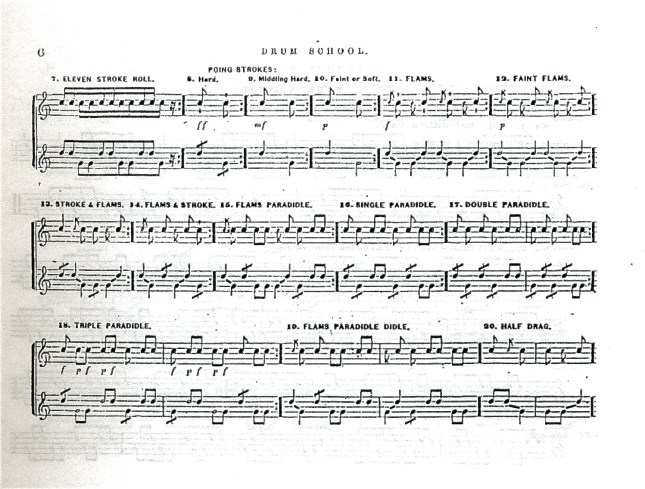
1864. William Nevins, Chicago. Drum Major of Gen. McClellan’s5 Body Guard.

Army Regulations for Drum, Fife, And Bugle; being a complete manual for these instruments, giving all the calls for Camp and Field Duty, to which is added Suitable Music for each Instrument. 30 Rudiments including Poing Strokes: Hard, Middling Hard, Faint or Soft.

Compare this notation with Klinehanse, above.

1864-William Nevins, Chicago, IL.

1864-William Nevins, Chicago, IL.

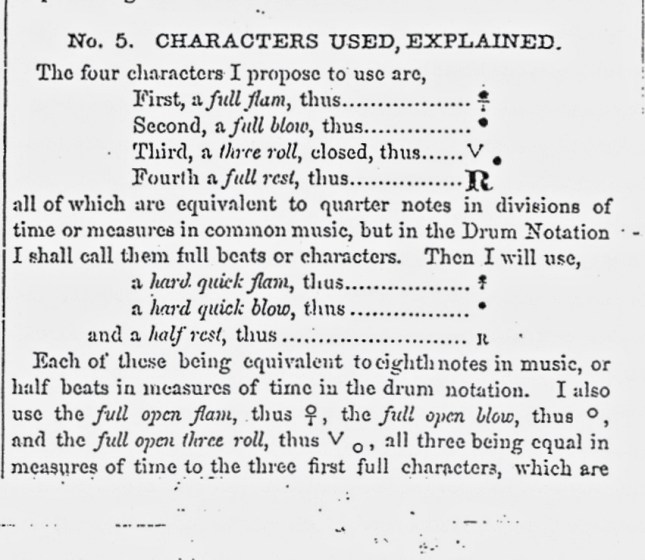
1869, Gardiner A. Strube. By Authority. Strube’s Drum and Fife Instructor: Containing the Rudimental Principles of Drumbeating, Scale for the Fife, Rudiments of Music and a New and entirely Original System of expressing Hand to Hand Drumming.6 The end The Full And Correct United states army Duty For Both Instruments. Composed and arranged in a simple and instructive manner. 25 Rudiments

Gardiner A. Strube was Drum-Major 12th Infantry, N. G. S. N. Y., Formerly Drummer in CO. A., 5th Regiment, N.Y. V., Duryea’s Zouaves

When the National Association of Rudimental Drummers (N. A R. D.) was founded in 1933 its members adopted the 25 Rudiments of Gardiner A. Strube with the addition of the Single Stroke Roll and then selected from them a group which they called the 13 essential rudiments. Some rudimental drummers today trace their lineage back to Strube whilst others declare fealty to Bruce via Ashworth.

As can be seen in the example below, Strube uses on one stave, the left-hand above, right hand below and the beginnings and endings of phrases in the middle (see The Young Drummer’s Assistant, Part 1.)

1869-Gardiner A. Strube, New York, N.Y,

1869-Gardiner A. Strube, New York, N.Y.

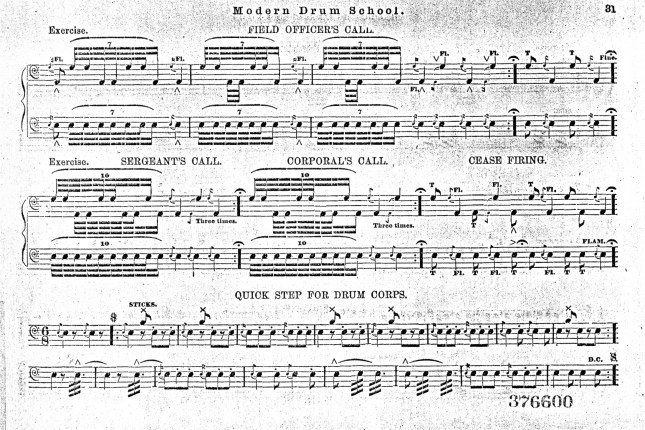
I began writing these articles because I hoped to answer the question, “Why did military drummers continue to invent arcane and sometimes unintelligible drum notations after a viable system was already in use by composers and performers of Western art music?”

I believed one answer to have been vanity. The numerous drum books published in the United States during the first two decades of the 19th century, many of which boldly stated the superiority of their system and notation, assured me that vanity was indeed the raison d’être for some authors.

Another possible answer, really a guess based on hearsay, was that military drum teachers were looking for a quick and simple way of teaching the signals, calls and rudiments of drumming to young boys new to military service.  However, after studying the examples above and the books from which they are derived, I believe this to be untrue.

My original intention was to end these examples of snare drum notation with the Strube book of 1869 because I  believe the major issues of drum notation, at least in North America, had pretty well been resolved by the third quarter of the 19th century.

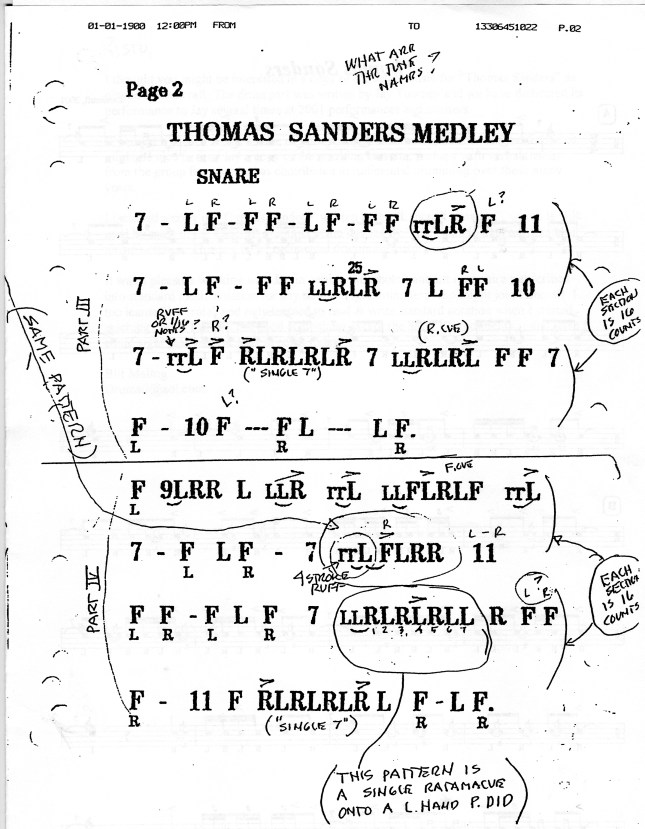
But midway through this third article, serendipity intervened. An e-mail from my friend Doug Kleinhans, former Hellcat drummer with the West Point Military Academy, drum corps instructor and composer of brilliantly quirky snare drum solos, sent me the first notation shown below.

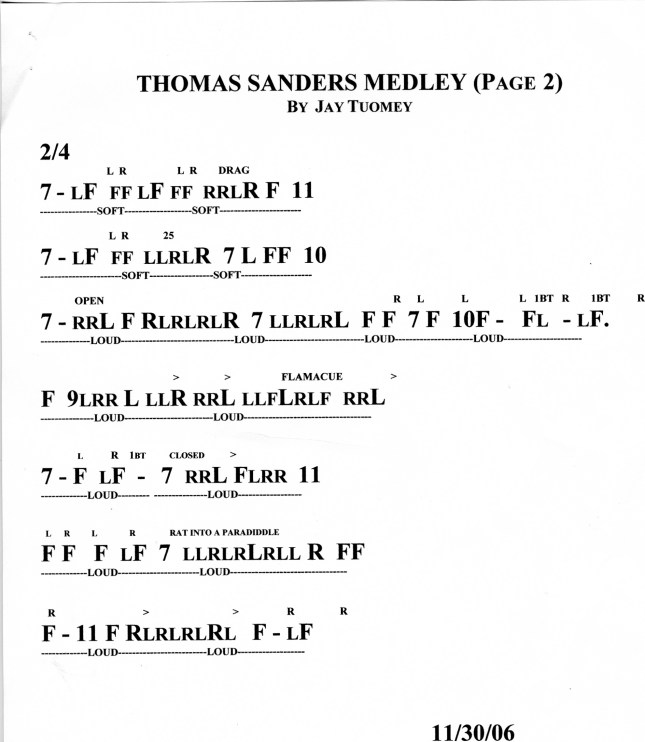
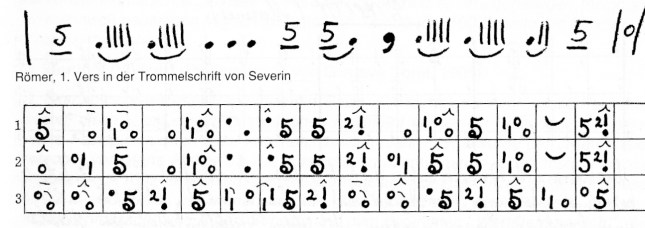
A former student of his who had studied with the late great New England rudimental drummer Earl Sturtze, had sent Doug this manuscript. Doug thought the notation was called the “Connecticut Code” and that it was associated with the Lancraft Fife and Drum Corps.7 I contacted Lancraft’s Web master, fifer, restorer and publisher of historical fife and drum books, Edmund Boyle, sent him a sample notation and asked him what he knew about this “Code”. There ensued a correspondence with perhaps a half a dozen Lancraft members which in itself is a story.  I learned that perhaps only one or two Lancraft drummers read music and this notation is a shorthand they use to learn their beats during all practices together and privately at home.

I was told that they can learn and memorize a their beatings faster using this shorthand than drummers who read music.  There are issues of phrasing and dynamics,etc. which are handled in detail, but teachers such as Earl Sturtze and Ken Mazur have it tested to the efficacy of this shorthand system and have only taken time to teach students how to read music when the student has demanded to be taught.

Here then is another answer to my question, albeit modern. The Lancraft drummers do not refer to this  as “The Code”, but depending on their teacher, they are all familiar with some short hand system.

2006-Thomas Sanders Medley, Snare drum in Lancraft shorthand.

2006-Thomas Sanders Medley, Snare drum in Lancraft shorthand.

2006-Thomas Sanders, Ken Masur shorthand version.

2006-Thomas Sanders, Ken Masur shorthand version.

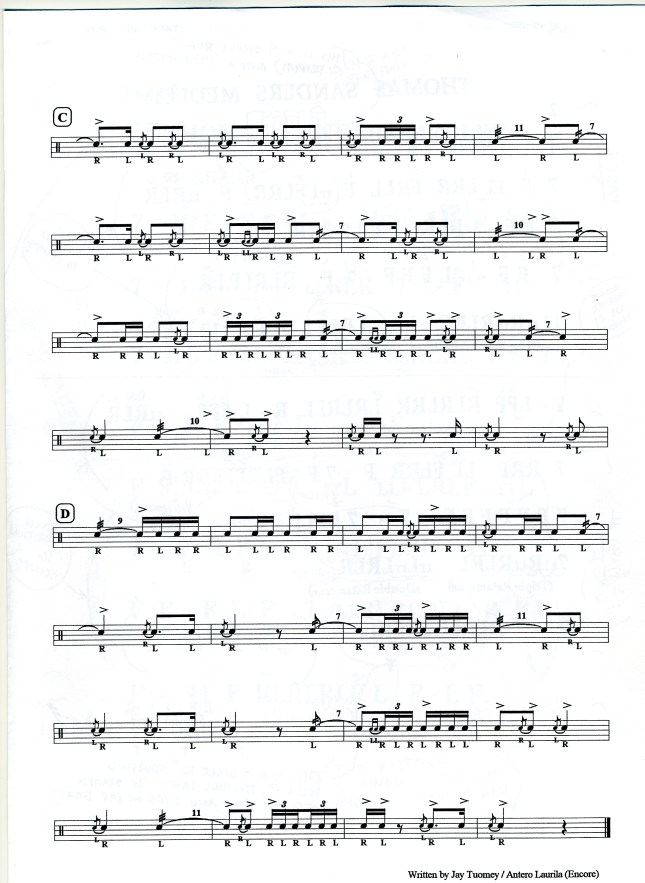
Thomas Sanders, Jay Tuomey, page 2., copied by Risto Skrikberg.

Thomas Sanders, Jay Tuomey, page 2., copied by Risto Skrikberg.

Footnotes to Part 3:

1. From a three CD set, Trommeln und Pfeifen in Basel, Ursprunge Entwicklung Perspektiven,CD181996.  BREO.  This is an aural history of drumming in Switzerland performed by some of Switzerland’s greatest drummers from old and modern manuscripts. A large, copiously illustrated booklet (In Swiss) accompanies the set.

2. Praise indeed.  Two compositions by Edward (Ned) Kendall  were chosen by George B. Bruce and Daniel D. Emmett for inclusion in their famous Drummers and Fifer’s Guide of 1862.  They appear on page 69, “Ancient and Hon. Artillery” and 70, “Ned Kendall’s”.

3. Concerning the “Downfall of Paris”, arguably Bruce and Emmett’s masterpiece, the legendary drummer, author, and drum maker Sanford A. “Gus” Moeller wrote, “it has always been the pride of the schooled drummers, not only to play it so it sounded correct, but also to beat it in the prescribed way. When drummers from different parts of the country get together and drum such beats as this with perfect uniformity they prove themselves worthy brethren.” Please see my article, “Le Carillon National, Ah! ca Ira and the Downfall of Paris”.

4. When I began working on Hart’s system, I was reminded of some of the contemporary Western art music compositions I had to learn during the 1960s, 70s and early 80s which required players to learn unique notations devised by the composer; this was all the rage among certain composers of the period. As a percussionist my task was doubly vaunting. I had many instruments to gather and arrange and I also had to learn a new notation, sometimes a different one for each piece on the concert!

5.  George B. McClellan (1826-85) was nicknamed  Little Mac or The Young  Napoleon by the troops under his command who usually thought highly of him, but after the Peninsula Campaign and the Battle of Antietam, he was sacked by Pres. Lincoln. Gen. Ulysses S. Grant called McClellan an enigma.

Even so, McClellan had powerful supporters and ran as a Democratic candidate in opposition to Lincoln in the 1864 presidential campaign, but was beaten decisively. During the last years of his career, he served as governor of New Jersey (1878- 86) and wrote a memoir defending his actions, many might say, inactions, during the Civil War.

Given McClellan’s great popularity and notoriety, it’s reasonable to assume that Nevins capitalized upon his position as Drum major in McClellan’s body guard, by having his book published during the 1864 presidential campaign and in Chicago, which was hosting the Democratic convention that year and was home to Nevins publisher, Root and Cady, one of the Union’s largest music publishers,

6. There are elements of Strube’s  notation that differ slightly from some of the other books examined for these three articles, but In my opinion they fall far short of being “a New and entirely Original System of expressing Hand to Hand Drumming.”

7. The Lancraft Fife and Drum Corps, now of North Haven. CT.   was founded in 1888 and named after an oyster man, one Ed Lancraft who befriended the corps by providing them with uniforms and rehearsal space. Later on he purchased drums for them which were in the shape of oyster barrels and for awhile the Corps was known as the “Oyster Kegs”.

In 1970 the great Swiss basel drummer Alfons Grieder who had heard the corps while studying in the United States, invited Lancraft  to Switzerland and for his efforts Alfons was made an honorary member of the corps.

Lancraft has been blest with some of the greatest field drummers in North American history: Sanford A. ‘Gus’ Moeller not only played in the corps, but made five drums for them in 1954 for $85 a piece!, Frank Arsenault, Earl Sturtze, and Jay Tuomey (mentor to the Finnish rudimental pathfinder Risto Skrigsberg),- a drum line for the ages.

 
2 Comments

Posted by on June 24, 2010 in Articles, Fifes & Drums


Note for a Canadian Brass CD Booklet

In 1775 the drum purchased by the citizens of Lexington, Massachusetts for 16-year-old William Diamond, achieved a special place in the history of the United States of America when William used it to call the Minutemen onto Lexington’s green in the overture to the shot heard round the world. Almost 100 years later, 12-year-old Johnny Clem was immortalized as “The drummer Boy of Shiloh” after his exploits during one of the seminal battles of the Civil War.

There is truth and fiction in these stories, but there can be no doubt as to the importance of their drums and the hundreds of thousands of drums that have accompanied America’s soldiers in times of conflict. For these drums commanded a soldier’s every movement, and their rich, heroic sounds and the tunes they accompanied, gave men the courage to march across  open fields in the face of enemy fire.

Towards the end of the Civil War the field telephone and telegraph replaced drums on the field of battle. Metal drums, products of the machine age, began to appear, usually in much smaller versions of their larger military ancestors.

The drums played on this recording display this genealogy. All of the rope tensioned, wooden shelled drums were made by The Cooperman Drum Company of Bellows Falls,Vermont. They are accurate replicas of 18th and mid-19th century military drums and on this recording, were used primarily in the arrangements of music from that era.

The other drums used on this recording  are smaller and were made by a variety of manufacturers from a mix of wood and metal or entirely from metal. These are, on the whole, rare drums highly prized by percussionists/collectors. They are heard here in the arrangements of late 19th and early 20th century repertoire. The majority of drums used on this recording have calf skin heads and gut snares or wire wound gut snares.

 
2 Comments

Posted by on March 4, 2010 in Articles, Fifes & Drums