RSS

Category Archives: Fifes & Drums

ROPE DRUMS and BRASS

About a week before Christmas 2009 Chuck Daellenbach  of the Canadian brass called to ask if I would be interested in helping the ‘Brass’ make a recording of American patriotic music for The American Heritage Society. Chuck wanted to use rope tension field drums. He knew the sound of these instruments quite well because we had played a concert together in the Glenn Gould Theatre in Toronto about eight years earlier. I had made an arrangement of four prominent military songs  for the Canadian brass and Nexus which was premiered on that concert.

At that time Chuck and I talked about the possibility of piccolo trumpets playing music intended for fifes. Chuck had remembered that conversation as well as the sound of the rope drums and when the American Heritage Society contacted him, he immediately thought of me and my interest in-fife and drum music, and my rope drums.

The brass arranger for this recording would be the venerable Canadian musician Howard Cable, who incidentally, lives just a couple of blocks from my home. When Chuck mentioned me to Howard, Howard suggested that he and I get together. I have known Howard for probably 40 years. He has a distinguished career in Canadian music as a producer, script writer, conductor, composer and began his association with the Canadian Brass in 1977.

Howard came to my home, heard my arrangements for the brass, and asked if I would be interested in doing all the percussion parts for his arrangements. I was happy to accept. Soon, Howard’s arrangements began arriving from his copyist to my computer, and I set out writing for rope field drums and cymbals. All of the arrangements were completed by mid-January, and rehearsals began in a Toronto church on February 8, 2010. The CD is scheduled to be released in time for the Fourth of July holidays in the United States.1

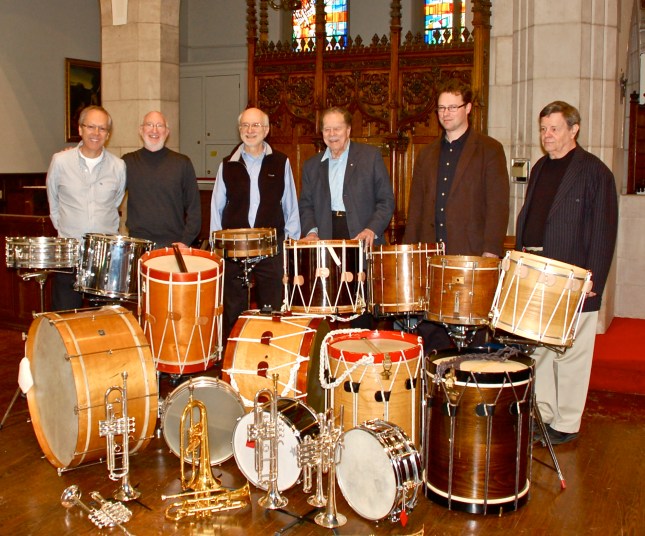
Below this article are some photographs from the recording sessions. They show the drums used for the recording. I think the collection of drums is impressive, and it seems quite possible to me that no recording in the past has included such a large and interesting array of snare drums, bass drums and cymbals.

I wrote each arrangement with specific players in mind. I had asked Chuck to engage Bob Becker and Russell Hartenberger, former colleagues of mine in Nexus, and Ryan Scott a former student who is now one of the most sought after percussionists in Toronto. All of them are expert drummers and fine musicians who appreciate the particular style of drumming I employed in the arrangements; that is, the “Ancient” or “Open” style prevalent during the 18th and 19th centuries.
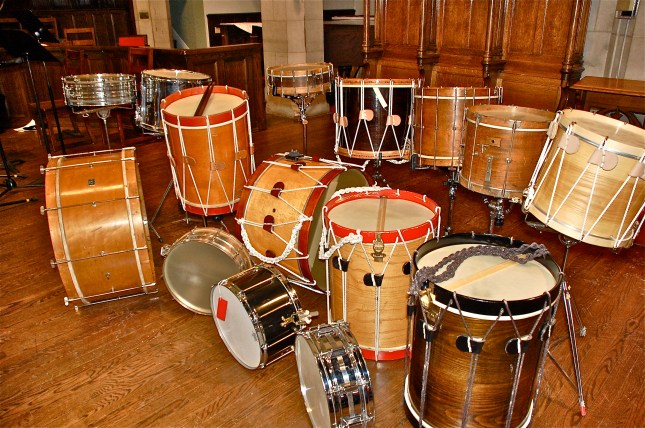
Drums used on the recording sessions.

(Bass drum dimensions are Depth-diameter. Snare drum dimensions are Diameter-depth,)

Front row, Left to Right : Ryan’s Ludwig Universal model Bass drum, 14″x28″, calf heads, (ca. 1961)-

Bob’s Ludwig “Super-Ludwig” Theatre Model, brass shell, 15″ X 5″, calf heads and gut snares, (ca. 1927)-

Ryan’s Noble and Cooley Birch Snare Drum (with Patterson cable snares) 14″x8″-Rogers Dynasonic 14″x5″ (ca.1967).

Middle row: Robin’s Eames Bi-Centennial model field drum, plywood shell, calf heads, heavy gut snares,16″x18″, (1976)-Coopperman Bass drum, plastic heads, (2002)-

Russell’s Cooperman Liberty model field drum, 17″x20″, calf heads, gut snares, (ca. 1978)-

Bob’s Cooperman Liberty model, 17″x20″, calf heads, gut snares, (1981).

Back row: Bob’s Spenke & Metzel, brass shell, 14″ X 5″, calf heads, wire wound silk snares, (ca. 1965)-Premier Field drum, mahogany shell with chrome veneer, 15″ X 12″, calf heads and gut snares, (ca. 1975)-

Ryan’s Ludwig and Ludwig,14″x4″ free-floating wood shell, original maple rims, 16 claw lugs, calf snare head, with “Ludwig Playon Plastic” batter head.  Original wire wrapped gut snares and working throw (ca. 1920).-

Robin’s Cooperman custom made field drum with narrow inlayed hoops, brass hooks and Liberty strainer, 17″x15″ (2002)-Walberg & Auge, 16″x15″, single tension wood shell field drum, calf heads, original gut snares, serial # 02820, (Worcester, Massachusetts, before 1910)-

Ryan’s Joseph Rogers Jr. &  Son “Union Brand The Quality Drum”, original wire wrapped gut snares,14″x10″ (ca. 1938)-

Robin’s Cooperman custom made (for this recording) snare drum, ash shell, brass hooks, calf heads, gut snares. narrow hoops, modified Liberty strainer, 14″x12″ (2010).

Cooperman concert Bass drum, 19"x36", ca.2000.  (On loan from The Canadian Opera Company.)
Cooperman concert Bass drum, 19"x36", ca.2000. (On loan from The Canadian Opera Company.)

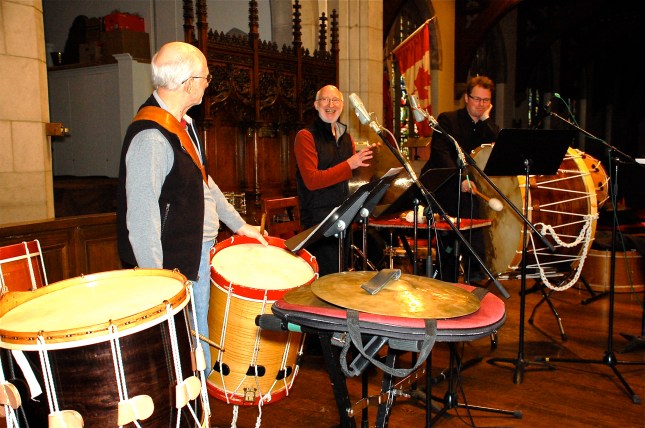
Russell Hartenberger, Bob Becker and Ryan Scott
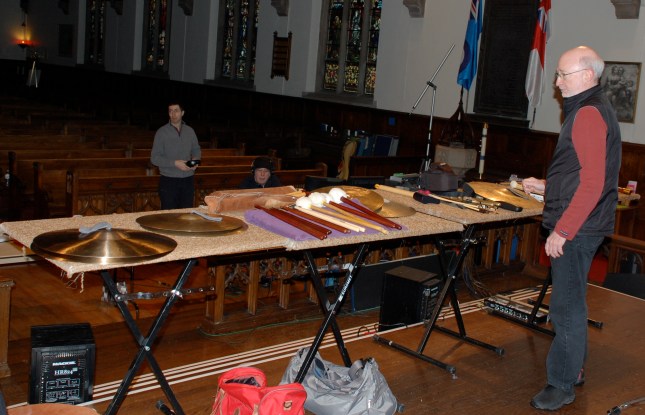
Cymbals and beaters.
Chuck Daellenbach, Bob Becker, Russell Hartenberger, Howard Cable, Ryan Scott & Robin Engelman.

Notes about the music:

The works recorded consisted of marches and songs written during a span of time beginning with the American war for Independence and ending soon after the First World War:  Chester by William Billings, the 1814 and 1931 versions of The Star-Spangled Banner, Dixie’s land, Stars and Stripes Forever, National Emblem, Battle Hymn of the Republic, Johnny Comes Marching Home, Hail Columbia (The President’s March), America, a selection of George M. Cohan songs, a medley of U.S. military service songs, and also, O Canada.

1. The CD “Stars & Stripes” is now available to the public.
 
6 Comments

Posted by on March 1, 2010 in Articles, Fifes & Drums


Western Military Drums in Japan

The first Opium War between China and Great Britain  (1839-42) was a humiliating defeat for China’s Qing (Tsing) Dynasty. Its armies, with overwhelming numerical superiority, had unwittingly marched into the maw of Western military science and technology. 1,000 miles to the East, Japanese war lords took note. It was clear to them that very soon Japan would once again find the West on its doorstep.

The first verifiable contact between Japan and the West occurred after a disabled Portuguese ship was forced to land on Tanegashima Island in 1543.1 The Portuguese are remembered, among other things, for introducing to Japan, firearms, castle fortification, tobacco, Christianity and syphilis.

Western music arrived in 1551 when flutes and oboes accompanied the landing of Portuguese Jesuit missionaries. By 1580, 200 Catholic churches existed in Western Japan and the lute, diatonic harp, viola de arco, clavichord and organs of various types were present by the end of the century.

In 1592-93, Dominican and Franciscan friars arrived. Their aggressive proselytizing dramatically altered the temper of Japanese authorities, as well as antagonizing the Jesuits. By 1640, Christianity was outlawed, its adherents banished or killed, its churches closed, and foreign travel by Japanese nationals banned. Japan drew its curtain of isolation against the West.

But not completely. Some Japanese intellectuals kept abreast of international events by reading foreign books, officially banned, and with news from a colony of Dutch merchants allowed to live near Nagasaki.2 In 1839, the first year of the first Opium War and fifteen years before Commodore Perry (1794-1858) arrived in Edo harbor (Tokyo) for the last time, Takashima Shirodayū, a scholar who had studied Dutch military science in Nagasaki, was ordered to introduce Western-style military training. Music for trumpets, flutes and drums, according to the Dutch model, was considered essential.3

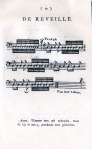
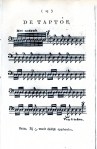
In 1855, a Dutch frigate captain submitted to Japanese administrators a detailed plan for the organization of their navy. The plan required one drummer (taiko-kata) for each warship. His duties were to beat Reveille (okoshi-taiko or “wake up drum” in Japanese), Roffel (Dutch for roll), for raising and lowering of the flag, Appèl 4 for the lowering of the top mast’s spar and Taptoe, (Tattoo in the English Camp Duty) recalling enlisted men to their quarters.

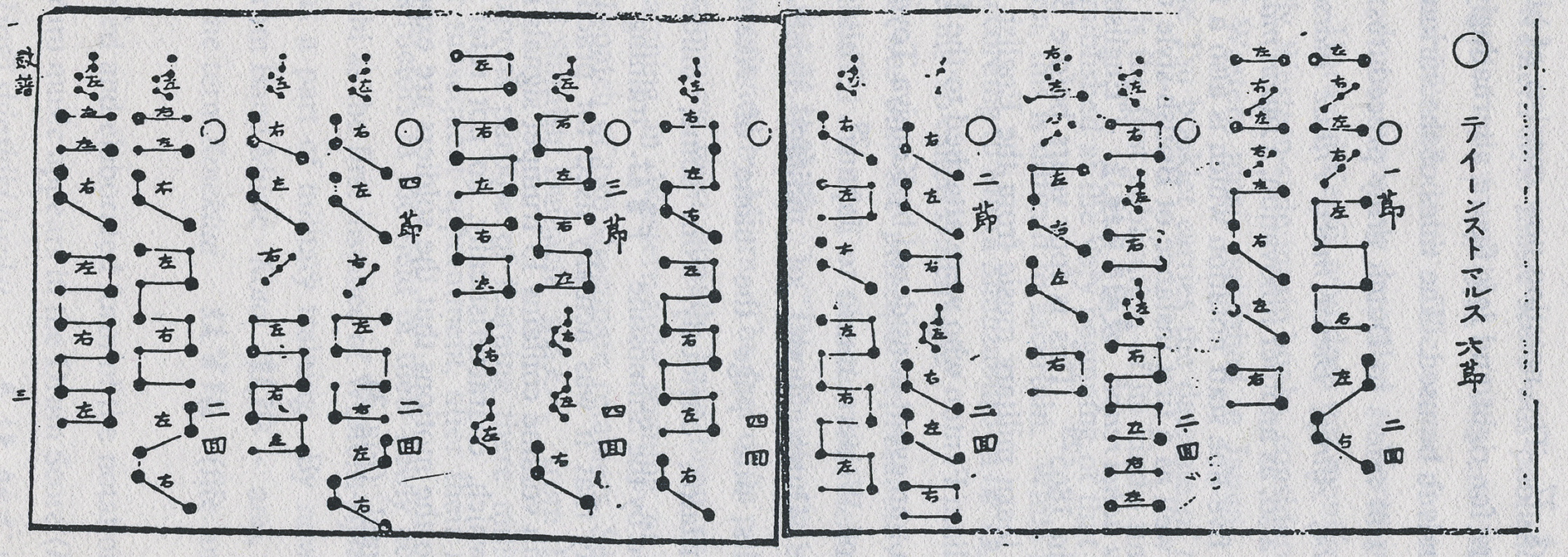
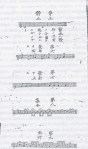
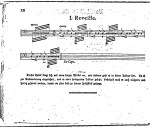
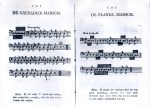
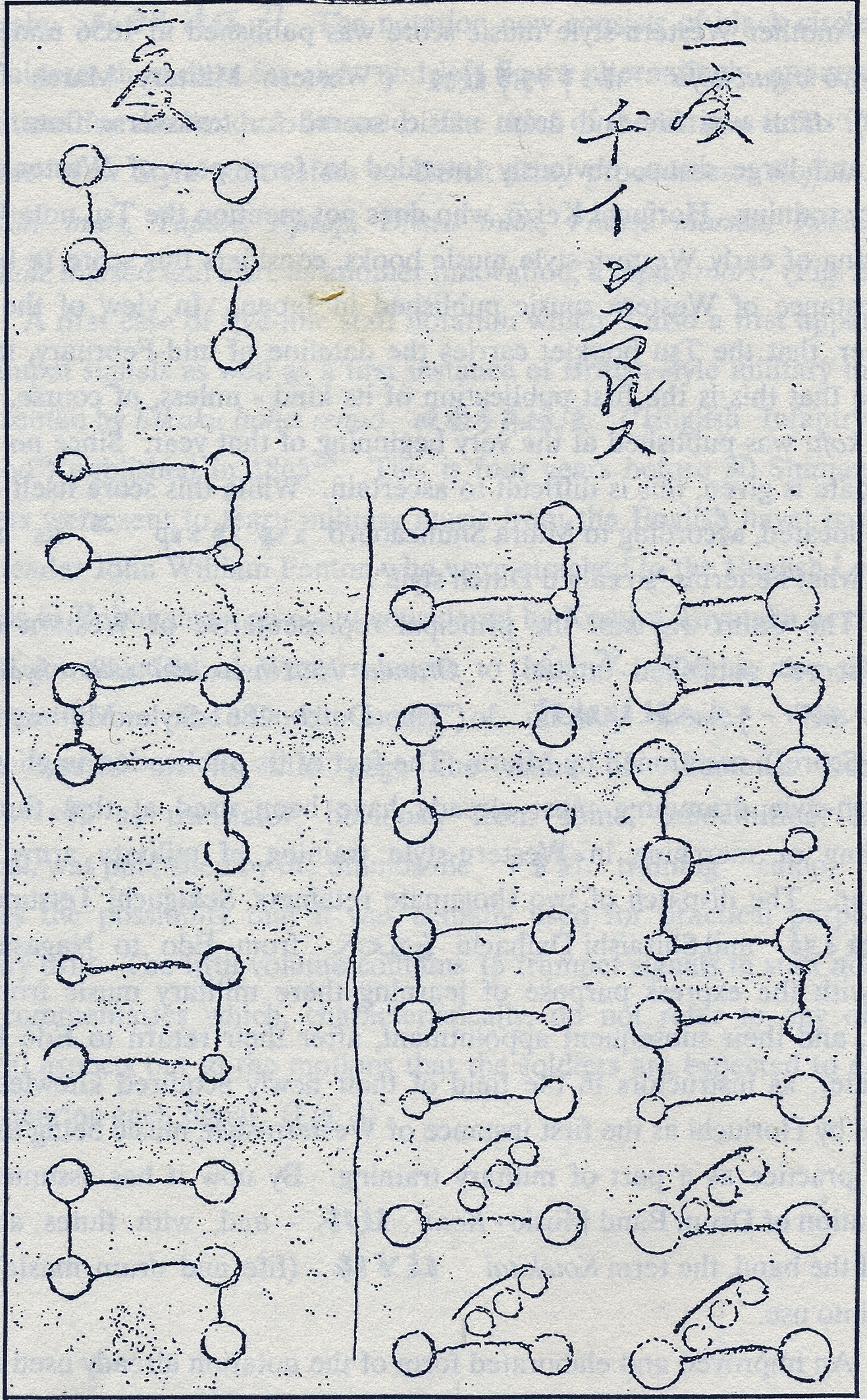
Taiko-fu or “drum score”, (“Western-Method-Drum Score for Tanhoru Drill as brought over from Holland”), was published in mid-February 1856 and contains what may be the earliest extant notation for drum signals and marches.5

Dienst mars
Dienst mars

In 1864, two Shogunate retainers were sent to Nagasaki with express orders to learn Dutch military music, and, upon their return to Edo, they were charged with teaching that music to students.

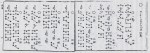
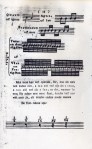
In 1865, Hosō Shinshiki furoku (“The Infantry’s New Style Training Manual”) was written by Inukai Kiyonobu. His notation is similar to Taiko-fu, above, but appears more explicit. It also contains Chinese characters for Right and Left, evidently indicating the right and left hands. The signals are still of Dutch army origin: Roffel, Appèl, General mars, Taptoe, Aftrap,6 Dienst7 mars, Franse marsen, Kolonial mars, and interestingly, a Japan mars.

Dienst mars
Dienst mars

A mnemonic system was devised as an aid to memorizing the new music  – hihiyāra  dondokodon hihiyāra  hiyāra  dondoko  dondokodokodon  hihiyāra  hiyāra.  Western snare drummers will immediately understand the idea, if not the words, as being similar to their traditional onomatopoeia – Paradiddle, Ratamacue, Flam and Ruff – words coined to enable young drummers to memorize the component parts of a drum beat.

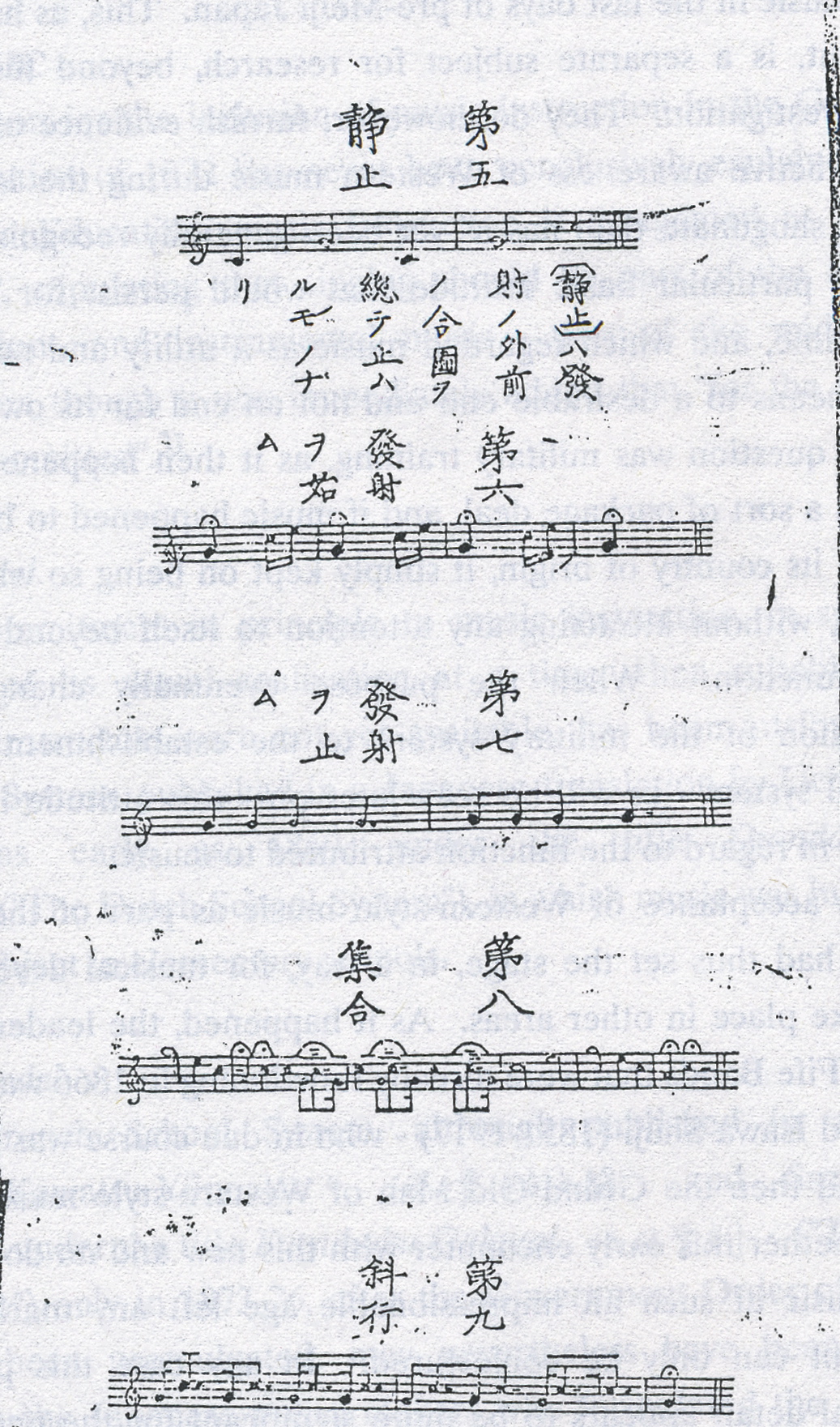
The first appearance in Japan of five line staff notation, trumpet music, and the influence of British military music, was the trumpet calls in Eikoku hohei renpō, (“English Infantry Drill Method”) of 1865.

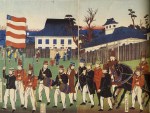
Four years later (1869), thirty Japanese soldiers of the Shimazu clan were sent to Yokohama to study English military music with John William Fenton, leader of the English Naval Band attached to the English Legation Guards. This was the first departure from the Dutch model of military music.

Japan’s official policy seemed to embrace rather than exclude foreign ideas. Besides understanding the futility of confronting Western military power, there were compelling social, economic and traditional governance issues behind restoring the Emperor and looking outward. But as noted above, these had begun internally, well before the arrival of United States war ships.

In 1875 an aristocratic ministry official and former fife and drum band leader, Shuji Izawa (1851-1917) was sent to Boston, Massachusetts to study American pedagogic methods under The Boston Music School director Luther Whiting Mason (1828-96) – no relation to pioneering American composer Lowell Mason (1792-1872).8 Upon his return to Japan, Izawa’s report was studied by a committee that eventually recommended officially adopting the teaching of Western music in Japanese schools. Thus, to the consternation of many nationals, Japan became the first and only country to do so in the far East.

Japanese dismissive of their traditional music, and those who defended it, never resolved their differences, but Western music it would be. Given Japan’s patriarchal society, it is interesting to note that the first instrumental composition in a fully Western-art-music style,  was written by a woman, Nobuko Koda (1870-1946)9. In a span of only 100 years, Japanese composers would begin to assume world wide importance in Western avant-garde art music.10

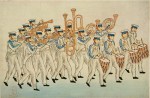
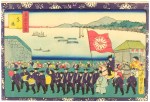
The tradition of Fife and Drum Corps in Japan (Kotekitai) began in the pre-Meiji era and survives today in various guises, mostly as Drum and Bugle Corps in the style of Drum Corps International. It is a pity that no one alive knows how to play the old drum beats. It would be exciting to hear how the Dutch beats were altered, if at all, to suit Japanese needs and fancies.

Footnotes:

1. The information on the beginnings of Western Music in Japan is taken almost exclusively from Southern Barbarian Music in Japan, an essay by Professor emretus David Waterhouse, written for Portugal and the World, the Encounter of Culture in Music, Publicacoes Dom Quixote, Lisboa, 1997.

2. A history of the comings and goings of foreigners during Japan’s ‘isolation’ is beyond the scope of this article, but official policy was malleable: from 1797 to 1809, several American ships traded in Nagasaki under the Dutch flag. The Dutch requested this as their ships could not be sent due to the Napoleonic Wars.

3. The early history of Western military music in Japan and the illustrations from Japanese drum manuals are taken from a book by Ury Eppstein, The Beginnings of Western Music in Meiji Era Japan, The Edwin Mellon Press, Queenston, Ontario, Canada, and used by the kind permission of the author.

4. Appèl in modern Dutch means an urgent request, a visible display or calling out of names. I have as yet to find a contemporary Dutch military translation for this and other Duty terms listed below. Jan Pustjens, Principal percussionist of the Concertgebouworkest, could not translate the text of my 1809 Dutch drum manual because the Dutch, in his words, “was too old”.

5. Also published in 1856, but without a publication date, was Seyiō kogun kofu ( “Western Military March Drum Score”) a book of Fife and Drum music scored for Transverse flute, small and large drum. Thus it’s not clear which book came first.

6. Aftrap=beginning. (See footnote 4 above.)

7. Dienst=exercising, stretching, stepping out. (See footnote 4 above.)

8. The information on post-Meiji era Japan, is taken from The Music of Toru Takemitsu; Peter Burt. Cambridge University Press, 2001; chapter One.

9. “Sonata for Violin”, 1897. Koda studied briefly with Luther Mason.

10. 1948 was the year of Toru Takemitsu’s first known, un-published work, Kakehi (Conduit), for piano solo.

 
1 Comment

Posted by on September 20, 2009 in Articles, Fifes & Drums


Vince Battista on The National Mall in Washington, D.C.

Sgt. Major Vincent  J. Battista, Percussion Section Leader
-The United States Army Band, “Pershing’s Own”-
Fort Myer, Virginia, 1940 through 1969.

Sgt. Major Vincent  J. Battista

Sgt. Major Vincent J. Battista

-Official United States Army Band photograph of Vincent Battista with the draped “Kennedy Drum”-

The Kennedy funeral procession drum beat written by V. Battista

The Kennedy funeral procession drum beat written by V. Battista

For lovers of culture, The National Mall in Washington, D.C. rivals any destination in the world. The nineteen buildings that enclose its 2 mile, 300 acre rectangle, are part of the Smithsonian Institution and house some of the world’s greatest art and precious artifacts of the United States.  These treasure houses, courtesy of the U.S. taxpayer, are open without charge to the public.¹

My wife and I visited The Mall in early February, 2009. Our first stop was the newly refurbished National Museum of American History. Its interior had been gloomy, filled with an uninviting pastiche of poorly organized, dowdy exhibits. Now, its interior is bright and there are many well designed exhibits.

Just a few feet from the restored Star Spangled Banner, the great flag that waved O’er the ramparts of Fort McHenry while the U.S. beat the Brits for the second and last time, we came upon a U.S. Army rope tensioned field drum and drum sticks that had been used in President John F. Kennedy’s funeral procession. Above them was a photograph of the man who had played that drum, Vincent Battista.

This was a surprise. Vince is a friend of ours, a quiet, reticent man who had never mentioned the existence of a public display such as this.  We had been introduced to him and his wife Phyllis, by Bill Platt, Principal percussionist with the Cincinnati Symphony Orchestra (ret.), probably during the 1999 Percussive Arts Society International Convention in Columbus, Ohio. According to Bill, no mean drummer himself, Vince was one of the all-time great snare drummers and section leaders. Recently, Bill wrote:

“In 1965, I think, Jack Moore became the Principal of the Rochester Orchestra, having just completed 3 years with Vince in The Army Band.  Jack was very much influenced by Vince’s playing and passed along many of Vince’s concepts to me during the year.  I graduated from Eastman on June 3, 1966 and received my draft notice the very next morning!  Jack suggested I go to DC and play for Vince.  I did, however the band had no immediate openings, BUT Vince talked with the Colonel and they made an opening for me.  This gesture on Vince’s part saved my deployment to Vietnam and probably saved my life.

The next 3 years along side Vince in the band were probably the best years of my life – I learned so much from him – all who knew him at that time would agree that no one got the sound out of a snare drum like Vince did!  There are a lot of great snare drummers, but Vince showed me that you can actually make MUSIC on an instrument that basically produces noise.  Vince’s hand positions are impeccable thanks to his affinity for Moeller and his hands are a model for me to this day.

Sanford A. “Gus” Moeller (1886-1966) was Vince’s close friend and mentor. In response to my query regarding his teachers, Vince wrote:

“My main teacher influences were Ferdinand Lhotak, former Sousa euphonium player and my band leader at Valley Forge Military Academy.  He certainly was an inspiration.  Also Bill Kieffer, retired drummer and xylophone soloist from the U.S. Marine Band (Charles Owen’s predecessor).  Above all, whatever I have accomplished as a snare drummer, I credit my association with dear friend Sanford A. (Gus) Moeller.”

Recently, Battista made a 37 minute DVD (cymvideo@msn.com) titled Vince Battista Presents a Tutorial, The “Gus” Moeller School of Drumming in which he demonstrates Moeller’s snare drum techniques. The Moeller Book (Ludwig Drum Co., ©1956) contains three film strips showing Moeller, frame by frame, playing a right and left hand stroke and they help clarify what Vince recalls as Moeller’s “arms around a barrel” motion.¡

“I like to make drums so well it is never tiresome”, – Gus Moeller

Moeller was a dedicated snare drummer and gifted drum maker. His drums are collector’s items, much revered by devotees of the “Ancient” Style of field drumming. His last drums-1960-were assembled by Baltimore drum maker Buck Soistman and can be seen behind the snare drummers in The United States Army Band (TUSAB) photograph below and, unassembled, behind Moeller in the photo of his workshop. ²

It is one of those drums that resides today in the Museum of American History. Vince explains:

“The joint services drum corp came into existence because of a request from Jackie Kennedy. She wanted the President;s body to be transported from the White House to the Capitol Rotunda at the sound of drums only. Hence, the “joint service drum corps” was assembled in about 24 hours. Our assistant band leader, Col. Gil Mitchell immediately contacted the other military services and within hours assembled all drummers in our rehearsal room at Ft. Meyer. He appointed me as lead drummer and asked me to play the beat to be used in the procession. When I received a certificate signed by Gen. Wehle,³ it was for performance of duty as principal drummer of joint service drum corps.

Shortly after the Kennedy funeral, the commanding officer of the TUSAB received a request from the Smithsonian Institution for a drum that was used in the funeral procession, to be used as the basis of a future public display. At that time, all inquiries, questions or comments about drums or drummers received by the band were referred to me for solution.  It was certainly an easy decision for me to donate the drum that I used! It was not my own drum but one of the five drums ordered by TUSAB as shown in the Gus Moeller photo. Col. Gil Mitchell was happy to approve the transaction and made the necessary arrangements to transfer U.S. Army property (Drum) to the Smithsonian.

I have been told that the Smithsonian has a facility in Arizona where they hold in storage items intended for display at some future date.  Initially, I did not include sticks and sling because I continued to use them until my retirement in 1969.  In fact, it was not until about 5 years ago that I made an appointment with a Mr. Rubenstein of the Smithsonian, at which time I presented him with the sticks and sling I used in the funeral; together with an official army photo of me with the drum and a copy of a “certificate of Appreciation” for performance as principal drummer of the joint services drum corps. Mr. Rubenstein was happy to receive these items and they all became part of the final exhibit. Shortly thereafter, I received a certificate from the Smithsonian acknowledging the “gift” of these items and signed by Director Brent D. Glass.”

"The Valley Forg"

“The Valley Forg”

-From A Revolutionary War Drummer’s Book, ca. 1778, Massachusetts Historical Society-

At age sixteen, Vince attended Valley Forge Military Academy (founded 1928) outside Philadelphia, PA on a band scholarship, graduated from high school at Valley Forge in 1938 and and graduated junior college in 1940. Vince auditioned for the US Army Band in 1939 and joined in September the following year after graduating and completing ROTC camp. Vince served overseas in Algiers during the 1940s. His wife Phyllis, in Bill Platt’s words, “mother to all us kids in the army band”, passed away in November, 2008 and is buried in Arlington National Cemetery, Arlington, VA..(Vince died on the morning of November 29, 2010.  His son and family were at his bedside.)

I am grateful to Vince Battista and Bill Platt for sharing their memories and giving me permission to quote them. Vince sent me copies of a Moeller speech  and a personal letter from Moeller dated 1954 as well as all the photographs in this article with the exception of “The Valley Forg” & “The Civil War Veteran”.  I also thank George Carroll, Canadian by birth, who was a member of TUSAB, established the Old Guard Fife and Drum Corps and, in 1962, retired from TUSAB and established the Colonial Williamsburg Fifes and Drums and, later, the fife & drum corps of Epcot Center in Florida. A historian, author, teacher and drum maker, Carroll’s American Drums of War-1607 to 2007 , (© Coleraine Incorporated, Alexandria, VA., 2008) is an historical reference deserving a wide readership.

J. Burns Moore, Moeller, Eames, Soistman, Reamer and Cooperman are some of the great field drum manufacturers. Their interconnectedness is as fascinating as their drums. So too are the percussionists of the United States military bands throughout the 20th century.

Footnotes:

¹ The Library of Congress is not officially a part of The National Mall, but its vast resources and visual grandeur are as impressive as any of its brethren on the Mall.)

² The six small drums in front of the Army Band were made by “Buck” Soistman in 1968-69 for Richard M. Nixon’s first inaugural parade. Soistman was very close to Moeller.  After Soistman’s death in 1975, his widow Marie, passed on Moeller’s “Bending Machine” and other drum making tools and materials to Bill Reamer.

³ Phillip Campbell Wehle (1906-1978), Maj. General US Army, Commanding General of the District of Washington, D.C.-1962-65. Wehle oversaw three state funerals in a span of 12 months: John F. Kennedy, Nov. 1963; Herbert Hoover, October, 1964 and Douglas MacArthur, April 1964. Wehle helped plan all three of these funerals which featured Black Jack, the riderless horse. (Black Jack was used once more for the funeral of Lyndon Johnson in 1976.)

 
8 Comments

Posted by on July 14, 2009 in Articles, Fifes & Drums, History


Tags: , , , , , , , , , , , , ,