Prelude:
After the defeat of China’s army by the British in the first Opium War, (1839-42) Japan, concerned with the possibility of a foreign invasion, adopted Dutch military music for fifes, drums and trumpets to discipline and train their Samurai warriors in western infantry tactics. This was the first western music sanctioned by Japan since the expulsion of foreigners in 1640. In 1875, Japan’s government introduced a nation wide public school music program based on an American model. By 1965, only 90 years after this official embrace of western music, the influence of Japanese composers began to be felt in western avant-garde art music circles [1.].
The Marimba in Japan:
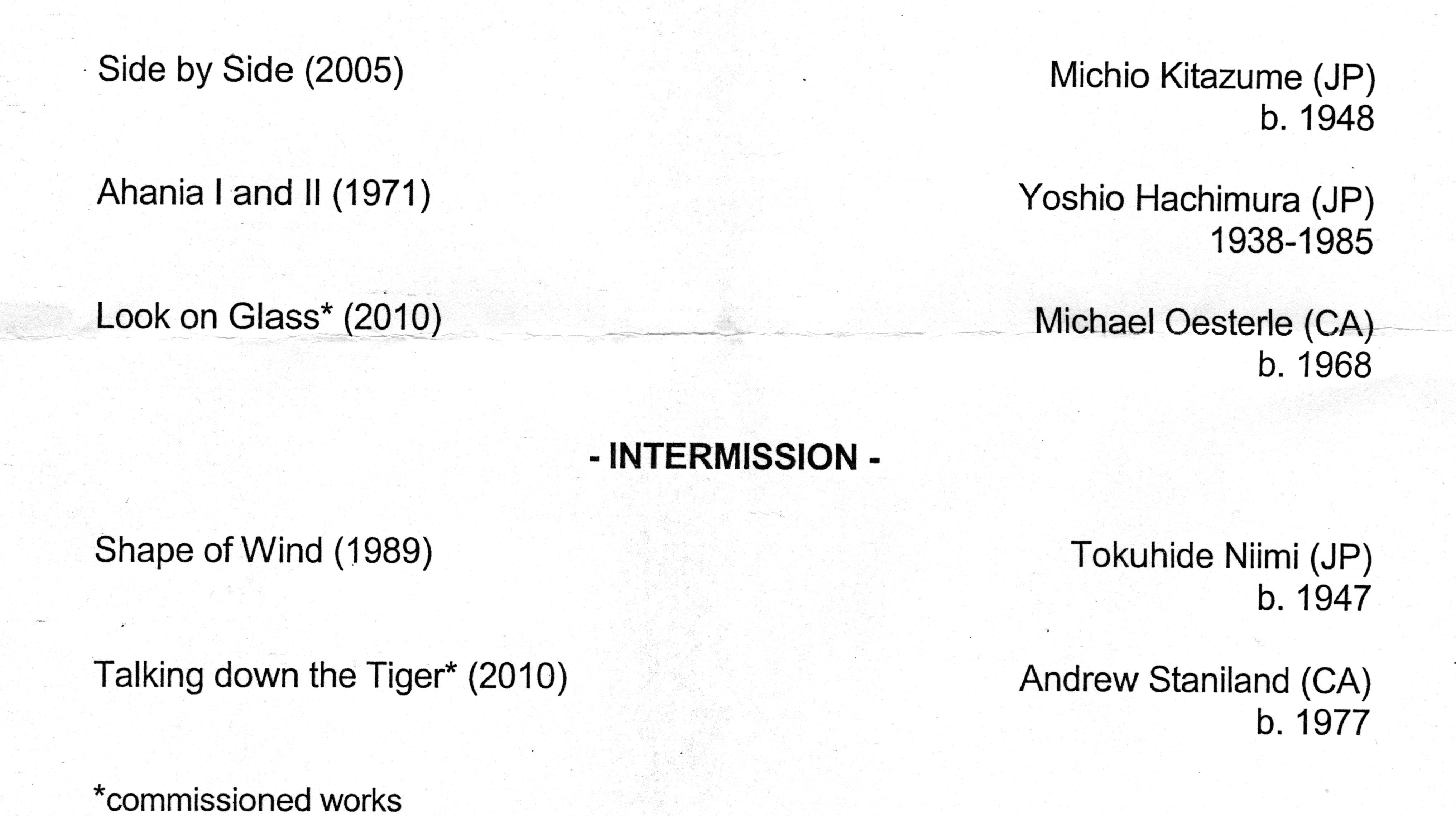
The programme above is from Ryan Scott’s first DMA recital, played in Toronto, Ontario on 22 January, 2014. Ryan’s DMA thesis will probe Japanese art music for marimba. His work on this project has been facilitated in part by New York City resident and former Keiko Abe student Alan Zimmerman. Alan gave Ryan access to his encyclopedic knowledge and massive library of Japanese compositions for marimba, dating from its inception as art music in the 1960s, to the present.
Ryan anounced from the stage that prior to 1965, Japanese marimbists played arrangements of traditional folk songs and western classical music. Marimba virtuoso Keiko Abe (b.1937) convinced prominent Japanese composers to write art music for marimba and manufacturers to upgrade the quality of their instruments.[2.] Between 1965 and1985, more than 500 works of art music were written for marimba by Japanese composers and many of them are still performed today.
I had thought to write a critique of Ryan’s performance, but instead,found myself musing over his announcement regarding Keiko Abe and Japanese composers. I began thinking about the marimba in North America. What follows is almost entirely anecdotal, but during a lengthy telephone conversation, Ruth Cahn, who has been in the middle of most things percussive for many years, confirmed most of my remembrances. Thank you Ruth. Nevertheless, I take responsibility for all errors and the opinions expressed.
The Marimba in America:
Clair Omar Musser, (1901-98) a marimba virtuoso, composer, arranger and conductor, organized concerts for marimba orchestras. One of the first of such groups was a 25 piece, all-girl marimba ensemble for a Paramount Pictures event in Chicago. In 1933, Musser presented a concert with 100 marimbas and in 1950, a concert with 500 players for a Chicago railroad fair. His repertoire consisted mainly of arrangements of popular classics along with compositions of his own. Musser was also an engineer. The marimbas he designed for the J.C. Deagan Company are considered today the finest of their kind ever made. [3.]
The Percussive Arts Society:
Founded in 1961, the Percussive Arts Society (PAS) today has a membership that includes percussionists from almost every university, college and conservatory in North America. Administered primarily by and for university percussionists, the PAS acts as a nexus for students, teachers, composers, performers and manufacturers, providing them access to school programs, pedagogic trends, new instruments and music.
Leigh Howard Stevens:
By 1980, a nascent group of educators and performers began to champion the marimba as a solo instrument and the popularity of marimba playing grew exponentially. Arguably the most influential marimbists was Leigh Howard Stevens (b. 1953). Stevens studied with Vida Chenoweth [4.] and later created an entire system for marimba playing. He devised a new grip, new mallets and a new marimba design, all complimensts to his vision. Stevens also wrote hundreds of etudes, and a vade mecum to disseminate his ideas. His work has influenced marimba composition and performance and has been adopted and adapted by marimba players throughout the world.
Marimbas in the United States:
A marimba provides melodic and harmonic components often lacking in all but a few percussion programmes of the past. In most major music schools, marimba studies have become the backbone of its percussion department. Importantly, this helps validate percussion studies within academia. Post graduate degrees, often unavailable to percussionists prior to the marimba’s ascendency, are today, the norm, even for students who eschew traditional instruments and specialize in solo marimba performance.
Marimba Music in the United States:
Two major concertos for marimba were written before 1960: Paul Creston,1940 and Robert Kurka,1956. From 1969 forward, most concertos were being written by foreign composers. [5.] In 1987, John Serry completed a marimba concerto commissioned by Leigh Howard Stevens and other marimba soloists followed suit with commissions of their own. Unlike Japan however, only a small amount of solo music for marimba has been written by America’s art music composers. One of these, by Jacob Druckman (1928-96), is Reflections on the Nature of Water (1986) a masterwork, now almost thirty years old. Aside from the Druckman work, practically all pedagogic, ensemble and solo recital music has been and is being written by percussionists. A recent national marimba competition provided applicants a repertoire containing 15 compositionds, 13 of them written by percussion teachers.
Their music has failed to make an impact on audiences outside percussion circles. It is commonly based on classical forms and structures and is heavily influenced by basic marimba technique or the latest fad. Their music also demonstrates the American percussionist’s preference for loud, fast, continuous and repetitious music. [6.] For example, soon after the appearance of Steve Reich’s Music for Pieces of Wood, in 1973, percussion students and teachers began writing pattern music and continue doing so. In the words of a professional musician and friend, “Most composers are arrangers”.
Conclusions:
Note: The works on Scott’s program above by Yoshio Hachimura, particularly Ahania II, and Tokuhide Niimi, differed in substantive ways from many American compositions for marimba. They were mesmerizing, rhythmically and harmonically ambiguous and occasionally weightless. Remarkable too were their sudden, surprising silences and absence of expectation. [7.] The latter, best described by John Cage who said of his close friend, “I love Takemitsu’s music because it doesn’t lead me anywhere”.1
I was impressed by Ryan’s lack of histrionics, all too common among players today, and the concentration of his mature artistry which allowed the music’s unique qualities to appear without his intervention. Michio Kiazume’s Side by Side is a congenial and equally virtuosic substitute for Xenakis’ Rebonds and was played with clarity and panache. I was delighted.
Ryan is commissioning a select group of composers. One being a marimba concerto by Erik Ross (2007). On the program above, the work by Oesterle for marimba and koto is a welcomed addition to the repertoire.
Ryan Scott has two more recitals and as rumour has it, he plans to present both by May of this year. I look forward to hearing another half dozen works from Japan, all new to me and I thank Ryan for instigating these ruminations.(Ryan’s last two recitals will now be played in the Fall of 2014.)
Foot Notes:
[1.] See Burt, Peter: The Music of Toru Takemitsu, Cambridge University Press, 2001.
[2.] Many percussionists including myself, were familiar with the works of Keiko Abe before her first visit to North America in November,1977. Though impossible to quantify, her presence inspired many students to play modern music and encouraged marimba soloists to write their own original compositions.
A detailed comparison of the grips, mallets and styles of Abe and Stevens and their effects on marimba performance would make interesting reading and a beneficial companion to Scott’s thesis.
[3.] If one wishes to hear a large marimba orchestra playing typical Musser repertoire, one can purtchase the CD The Marimba Festival Orchestra conducted by Frederick Fennell and recorded in the Eisenhower Theater of the United States Military Academy in West Point, New York. The orchestra was assembled by Lee Howard Stevens and featured soloists Gordon Stout and Bob Becker. Resonator Records by Marimba Productions, Inc. 1999.
[4.] The importance of Vida Chenoweth and her teacher, Clair Omar Musser, are worthy of attention.
Vida Chenoweth ( b.1929), one of Musser’s students at Northwestern, played her first solo recital in Chicago in 1956. She performed concerts world wide until an accident prevented her from playing at her former level. She is a member of the Percussive Arts Society Hall of Fame.
[5.] See: Conklin, M. Christine: An Annotated Catalog of Marimba Concertos Published in the United States Between 1940 – 2000. Marimba Concertos listed, chrinologically, alphabetically by composer, with orchestration, marimba size, date of composition, an interview and reviews, DMA thesis, University of Oklahoma, Norman, 2004. UM number 3134393.
[6.] I sent trombonist/composer Vinko Globokar an ensemble improvisation recording. His reply, paraphrased, was, ” This is typical of American music. Continuous, repititious. For the trio improvisations, our percussionist brings only two or three small instruments. Our idea is to never repeat. Always search for new ways to make sound”.
[7.] See Takemitsu, Toru: Confronting Silence, Fallen Leaf Press, Berkeley, California, 1995. Pgs. 51-57 contain Takemitsu’s thoughts on his use of silence and the concept of Ma.

 Robin Engelman
VIENNA UNDER SIEGE, 2014.
Note:
This article was prompted by a discussion on National Public Radio (NPR) during the last week of February, 2014. Four experts grappled with the Vienna Philharmonic’s ethos. Some believed it had not changed and others believed it was changing. Every visit to the United States by the orchstra precipitates discussions such as this. NPR’s panel was unable to arrive at any conclusions. I heard nothing new about the old things and all the new things had been old for many years. I wondered, who produced this show and why?
The city of Vienna and its orchestra are almost synonymous. New Year’s Eve, the Strauss family, and the Wiener Philharmoniker personify Viennese sophistication, opulence and gemuchlikeit.
Both have been under siege, the city in 1683 by the Ottoman Empire and the orchestra in 1945 by Allied war crimes investigators. The siege of Vienna lasted two months. The orchestra has endured almost 70 years of periodic assaults,each launched by the tocsin of misogyny and Nazism.
The most recent attacks began early in 2014 after it was announced the orchestra would headline Carnegie Hall’s festival, Vienna the City of Dreams. [1.] The Philharmonic’s reputation as an all white, all male orchestra and its past association with Nazism, provided ample fodder for its critics.
The Philharmoniker is governed by its members. Before and during World War II, the director of the orchestra was a trumpet player and rabid Nazi Party member. There are many who continue to condemn the orchestra for a decision it made under his aegis almost 90 years ago, the expulsion of its Jewish players.
Today, criticisms of the orchestra seem peevish and are often specious. They ring false on modern ears. When the orchestra first engaged Leonard Bernstein, it was mocked for being a political move intended to show the West it had nothing against Jews. The hiring of its first female player, was labled tokenism. The orchestra’s critics admit some issues are being addressed, but complain about the slow pace of change. Today there are about 10 women in the orchestra including an assistant concertmaster.
At one time I was emboldened by knowing an all male, all white, all Austrian trained orchestra was alive and well in the world, carrying on a rich cultural history that included a great music tradition. In matching shirts, ties, vests, jackets and pants, they were cool, Some spice for the world’s symphonic mix I thought. I assumed Vienna had the orchestra it wanted and needed.
The PC continue to fulminate against the Vienna Philharmonic. Barking and snapping at its heels, they demand it become like other orchestras. But will these critics ever level their political correctness on the Israel Philharmonic? Now that is a story I hope never to read. The last thing our over homogenized world needs is for its cultural traditions to merge.[2.]
[1. http://www.carnegiehall.org/vienna/
[2.] I have edited somewhat the article below which was reprinted in Douglas McLennan’s ArtsJournal‘s of 14 April. R.E.
Reuters, Sat Apr 12, 2014 ) – The Vienna Philharmonic Orchestra will return to a French family a valuable painting that was looted by the Nazis and given to the orchestra as a gift in 1940 by a Viennese secret police official.
The heirs of the painting’s late owner, Marcel Koch, will receive “Port-en-Bessin” by neo-Impressionist Paul Signac at a ceremony this year, the orchestra said on Saturday, announcing the latest step to address its past association with Nazism.
About half the Philharmonic’s musicians were Nazi party members by 1942, four years after Hitler’s annexation of Austria. Thirteen musicians with Jewish origins or relations were driven out of the orchestra and five died in concentration camps.
The orchestra is known for its New Year’s Concert, an annual gala of Strauss waltzes broadcast to millions around the world. The New Year’s Concert was invented as a Nazi propaganda instrument.
“The deeper one digs into the Vienna Philharmonic’s past, the more ‘corpses’ emerge from the orchestra pit,” he (Green Party member Harald Walser) said.
See also the Birgit Nielsen Prize for 2014, http://www.telegraph.co.uk/culture/music/opera/10754804/Vienna-Philharmonic-worthy-winner-of-the-Birgit-Nilsson-Prize.html
Posted by robinengelman on March 10, 2014 in Articles, Commentaries & Critiques, History
Tags: Carnegie Hall, misogyny, Nazism, Vienna City of Dreams Featival, Vienna Philharmonic, Wiener Philharmoniker, World War II