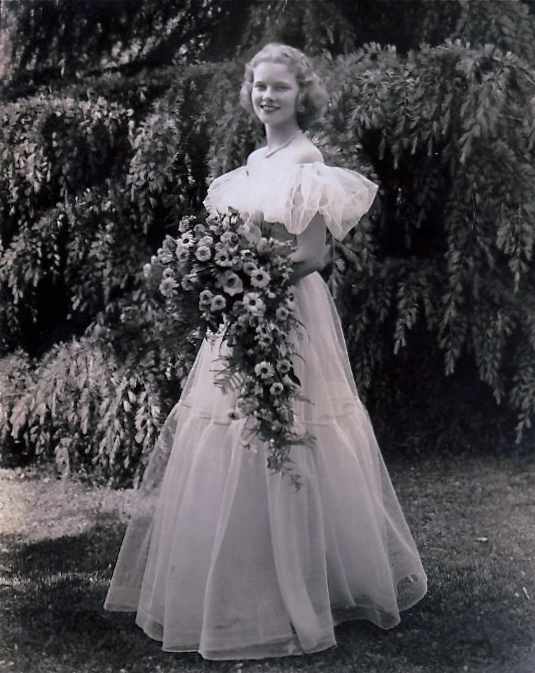
Aunt Rose, May Day Court, Randolph Mason Women’s College, Lynchburg, VA.,1939.
One of America’s great cultural calamities was its Civil War. For my southern relatives, the war became a lingering ache for what should have been. Their cause had been just, their generals venerable and their fighting men heroic beyond measure. The south’s loss became a badge of honour shielding them from the usurpation of their country, northern egalitarianism and centralized government.
As a youngster I spent my summers in Tennessee. My first encounter with southern political sympathys occurred in the small town of Fayetteville when I was five years old. As I relive the scene today, I am my own spectator, standing behind a small boy of 5 who rocks gently on a porch swing, humming softly as he gazes down a hazy, empty street. In the distance stands a relatives hilltop mansion. The boy plays croquet on its lawn, walks through its gardens and shuttered rooms. Strangely, no one is home and quiet reigns. Dimly lit, the rooms seem huge to the boy. He knows its safe here. Still, when he ascends the massive staircase, he holds unto its bannister and moves as quietly as possible. In a tall darkened second floor hallway, he is confronted by a giant Confederate flag and is no longer in a relatives home, but in a church, the flag its symbol. Utterly absorbed by the vision, he stands transfixed,.

Cliffside, Fayetteville, Tennessee. Photograph inscribe to the author, “Cliffside, Mulberry Road Fayetteville, Tenn. Come to see me, Mrs. Rees”
Though my mother was a Tennessean, I was born and raised in Maryland, an eastern border state. My education, social views and career were formed in a northern ethos. I was a Yankee. An enmity for slavery and racial bias contrived to make me reticent when as an adult, I occasionally visit my Tennessee family. When I spoke I limited myself to noncontroversial topics. They too were reluctant to speak but this seemed to come naturally to them. quiet and soft spoken, even their laughter was delivered sotto voce.
Aunt Rose, Mrs. E.A. Robertson Jr., was my favorite southern relative. No matter what fates had befallen other members of her extended family, Rose in her mid 80s, was still the quintessential, beautiful Southern Bell, with brains. My wife and I visited Rose in Franklin during a heat wave. Rose greeted us just outside the front door in a topical dress, nylon hose, jewelry, white gloves, and high heels. [1.]
Rose had married my Uncle, a well-to-do member of the Robertson family and heir to the largest privately owned insurance company in Tennessee. Eventually he divested himself of the business and moved his family into Harpeth Hall in Franklin, about 20 miles south of Nashville and became a gentleman farmer. Besides all the familiar duties of a wife and mother, Rose took it upon herself to learn her husband’s family history. From the founder of Nashboro, later Nashville, to the in-laws of my Missouri born Grandmother Crump, she rarely hesitated while reciting the interwoven webs of our ancestry.
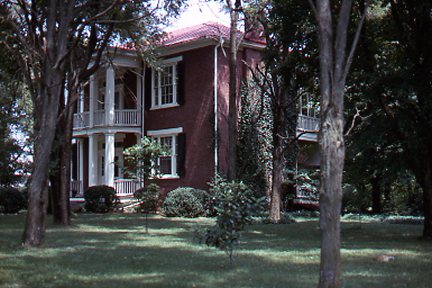
Harpeth Hall, now a private school.
I thought her rather insulated from the larger world. She never cursed, or discussed art, music, theater or dance. Politics and religion were strictly the domain of men. As long as he lived, my Uncle was indisputably the head of the house. I thought her rather naive, something like a precious flower guarded by glass, a Rose if you will, but I was mistaken. [2.]
One day as we drove towards the Franklin Battlefield Rose said, “Rob, have you read Midnight in the Garden of Good and Evil?” “Yes”, I answered, a bit taken aback. Rose continued, “Lady Chablis was my favorite character”. That was a stunner. Lady Chablis was an unrepentant and preoperative black transsexual and local drag queen. And my Aunt’s favorite character? It took me awhile to muster up a chuckle and respond, “Me too”.[3.]
Minus an arm and a leg, Lt. General John Bell Hood, began moving north through middle Tennessee in the Fall of 1864. His army, the second largest of the Confederacy, numbered approximately 40,000 to 50,000 men. Upon reaching the town of Franklin, 30 November,1864, Hood cast 20,000 of his men against a well protected Union force under Major General John M. Schofield. His men marched two miles without cover into the Union lines that day. After five hours of unremitting assault, Hood’s losses were 6,000 killed, wounded, missing or captured. When darkness fell, Hood is reported to have wept.
Shortly after Franklin, remembered now as Pickett’s Charge of the West, Schofield retired to Nashville where Hood met Major General George H. Thomas, commander of Union forces in Tennessee. (15-16, December). In what was probably the greatest Union tactical victory of the Civil War, Hood’s exhausted army was subjected to a double envelopment and almost annihilated [4.] When the retreating Hood left Tennessee he had only 8,000 men remaining under his command and the southern cause was irretrievable.
The armies of the Confederate States of America were comprised primarily of men recruited from the same district, town or village. Friends and family members fought side by side. With a few exceptions, the war was fought entirely on southern soil. Thus, unlike Union men, Confederates soldiers died at home, sometimes literally. During the battle of Franklin, Carter House, a private home, was the high-water mark of the Confederate assault. Captain Tod Carter, scion of Carter House,died on the front steps of his home while his father Fountain Branch Carter sheltered the rest of his family in the basement. After an absence of three years,Tod was home again. Rose knew all of this and much more.
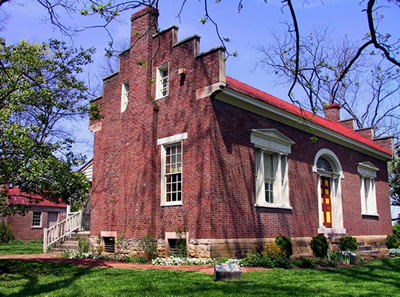
Carter House, Franklin, Tennessee. Chimney faces south.
Today the original site of Hood’s grand parade is practically non existant. Just a few yards south of the former Union Army barricades at Carter House, one is confronted by a suburban bungalow. Urban sprawl, including a golf course, now mask grounds where some of the most vicious and arguably most important fighting of the Civil War took place. Franklin never achieved the historic gravitas of Shiloh, Bull Run, Antietam and Gettysburg, nor friends powerful enough in the National Park Service or Congress to champion its cause.
Located east of the battlefield, Carnton Plantation was requisitioned as a Confederate field hospital and soon its mansion was awash in blood and piles of amputated limbs.
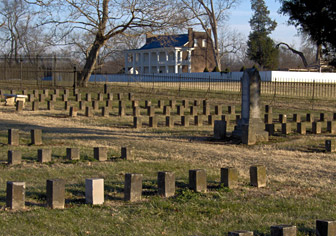
CARNTON PLANTATION HOUSE and CEMETERY.
Aunt Rose served Carnton Plantation as a volunteer and understood the anguish visited upon it during and after the Battle. In an upstairs room she showed my wife and me the blood stained floor where Confederate surgeons had worked. Downstairs we paused beneath the portrait of Carrie McGavock the mistress of Carnton who ministered and fed the wounded.
Our pace slowed as Rose led us outside to Carnton’s famous back porch. Quietly Rose said, “Six generals were killed in the battle and four of them were laid together here under these windows” . She began to recite their names. Major Gen. Patrick Cleburne, Maj. Gen. States Rights Gist, Maj. Gen. Otho Strahll and Maj. Gen. Harry Granbury. Rose spoke intimately about these dead of 150 years. Each name was followed by a brief eulogy that proclaimed the general’s place in Rose’s world. She spoke as if, had we simply taken Franklin Pike north to Brentwood or Oakhill, we could visit them in their homes and she would introduce us.
In 1866 Carrie McGavock and her husband John began moving the remains of Confederate dead from their shallow battlefield graves for re-internment on the grounds of their home. They buried 1,500 soldiers. Carrie identified and meticulously noted 750 of them in a book. For forty years, she carried this book on her daily visits to the cemetery and wore black until her death in 1905. She is known as “The Widow of the South” and her cemetary book survives today, a Carntn relic.
The spell Rose cast that sunlit afternoon at Carnton, took me back to an antebellum mansion and a little boy transfixed before a Confederate flag hanginging in a dark hallway. I believe Rose had exposed a very private part of her southerness and in so doing, welcomed me into her family.
More then 50,000 books about the Civil War have been published in the United States. But a human intercession is required for Carnton moments as those unveiled by Aunt Rose. The vignettes in Ken Burns’ Civil War documentary featuring author Shelby Foote, come close. Foote’s baggy eyes and poignant stories, related in a soft, mellifluous southern drawl, evoked for me and I suspect millions of viewers the pain and longing of southerners who have never been able to free themselves from the dark, sad umbra cast so long ago.
The North absorb 670,000 casualties before the carnage ended and its pain can be seen on the face of its leader. The contrast between the portraits of Abraham Lincoln taken prior to his election as president of the United States and during his last months in office, are painful to see. They show a deep and intense sadness as well as exhaustion.
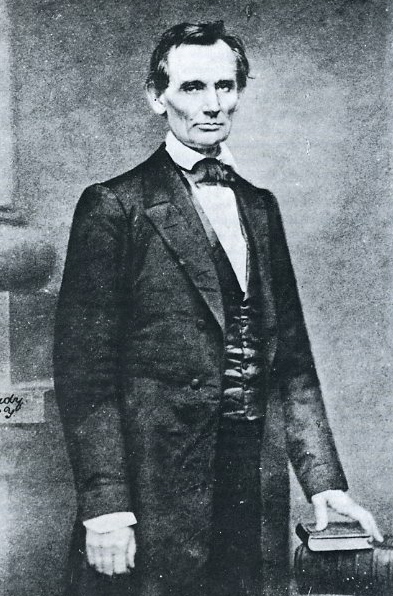
1860-A. LINCOLN
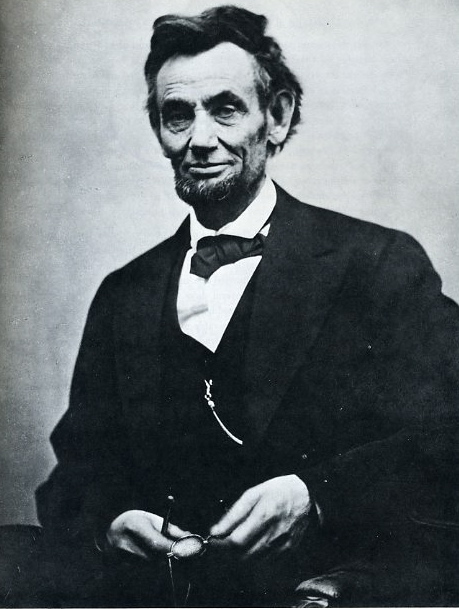
1865-A.LINCOLN.
Shelby Foote recounts a conversation between a former Confederate and Union soldier in which the southerner says, “We would have beaten you if we’d had your music”.
The South too had songs, but only one that was great,”Dixie’s Land”. Ironically, “Dixie” as it is known today, was written before the war by an Ohioan for the Bryant Minstrel Show a New York minstrel company. It was a favorite north and south, but after the war began, northern lyricists could not find words as euphonious as “In Dixie’s Land I’ll take my stand, to live or die in Dixie”, and Dixie became the unofficial national anthem of the South.[5.]
One reason for the paucity of songs from the south may have been cultural – a reluctance to display its heart on its sleeve. Also, the south did not possess the population or infrastructure to profitably manufacture and distribute sheet music. Whereas the manufacturing based North, its large energized urban population criss crossed with rail and telegraphy plus a multiplicity of newspapers, viewed the war as an opportunity as much as a patriotic duty.
The lyrics of northern Lament songs, combining as they did sadness and longing, may sound treacly today. But these songs were a legitimate way for people to deal with mind numbing casualty rates and were enormously popular with civilians and soldiers alike. One of the most popular lament songs was “The Drummer Boy of Shiloh”, words and music composed by William Shakespeare Hays.[6.]
Musicians of the University of Toronto Faculty of Music; Lisa Di Maria, soprano – Julian Rodrigo and Emma Tessier, flutes – Andrei Strelieav, organ – Antti Ohenoja, tenor drum – arranged by R.E.
Despite the number of popular songs produced in the north, none expressed the south’s powerfully wistfull ethos as did Aunt Rose. Rose believed southerners fought because they were defending their country, each state being a country.. Their code was based on a blend of capitalism and chivalry.
From the beginning the Confederacy was doomed. By almost any gauge, the results would have been the same, a victorious north. Although the south’s agrarian society produced superior cavalry and marksmen, there were not enough of them to compete with the population and industrial strength of the North.[7.]
The myths and realities of the Civil War were a part of Aunt Rose’s upbringing. As a child, she conjoined them and became a southern woman of stature, civility and grace. Her presence alone was capable of soothing traditional north south antipathies. In this, she was Queen like, holding fast to the virtues of her cultural heritage . Aunt Rose died at the age of 90. She leaves a wistfulness of her own; remembrance and a deep sense of loss. Rose was my favourite relative and will live with me until I die.
Footnotes:
[1.] At Rose’s funeral the eulogy was delivered by her minister. He related how he first met Rose. “She was answering phone calls in the church and was dressed in a fashionable suit. high heels, nylons and jewelry. I introduced myself as the new minister and Rose said, Oh my, if I’d known you were here, I’d have dressed properly.”
[2.] During her marriage and after my Uncle’s death, Rose was responsible for all the financial duties of a large estate as well the maintenance of a large home and grounds. Rose had charming mannerisms. When she brought food to the table, she’d make an offhanded, self deprecating statement about its quality. “I don’t know if you’ll like this, I may have overcooked it a bit.” Then she’d let “the men” take the lead.
If a subject distasteful to her was broached, Rose would look away slightly apologetic and say in a soft voice, “Well, I don’t talk about those things”. Then she’d wait an appropriate moment and continue on from where she had been distracted.
[3.] “Midnight in the Garden of Good and Evil” by John Berendt, 1994, Random House, non-fiction.
1997 movie directed by Clint Eastwood.
[4.] I direct your attention to the book “Master of War: the Life of General George H. Thomas” by Benson Bobrick, Simon & Schuster, 2009. The Rock of Chickamauga, Thomas never lost a battle and had by far the lowest casualty rates of any general of either army, particularly U.S. Grant. The machinations of Grant and Schofield to deny Thomas recognition and advancement make for fascinating reading.
[5.] Daniel Decatur Emmett is credited with writing the song for Bryant’s Minstrels in 1859. It was the greatest hit of the era, bar none. (Well, ‘The Battle Hymn of the Republic” was close.) I think it was U.S.Grant who said, “I know two tunes and one of them is not Dixie.”
However, Emmett, the composer of “Zip Coon” and “Turkey in the Straw”, may not have written ‘Dixie’s Land” after all. See “Way Up North in Dixie” by Howard and Judith Sacks,Smithsonian Institution Press. They make a compelling case and an interesting read, for authorship of Dixie by a family of black musicians living close to Emmett and with whom Emmett regularly made music.
[6.] Johnny Clem was the real life Drummer Boy of Shiloh and he did not die in the war. He was 12 years old at the time of the battle and was made Sergeant in 1863. The song sold a million copies and spawned numerous “Drummer Boy” wanna bes to cash in on the craze.
There was in fact a Confederate drummer boy from Cockrell’s Missouri Brigade who, during the battle of Franklin, Tennessee (Nov. 30, 1864), gained immortality of a sort when the loaded union cannon, in whose muzzle he was trying to jam a loose timber from an earthwork, was fired resulting in “a shower of body parts and splinters in a ghastly rain”. (The Confederacy’s Last Hurrah, Wiley Sword, University Press of Kansas, 1992.)
[7.] The Union Army’s new breech loading rifles, capable of firing 8 to 10 rounds per minute and the Minnie Ball, which expanded on impact, wreaked devastating casualties upon the Army of Tennessee.
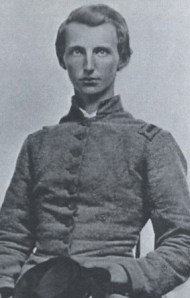
Capt. Tod Carter.
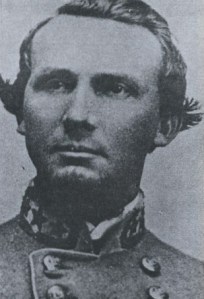
Staes Rights Gist.
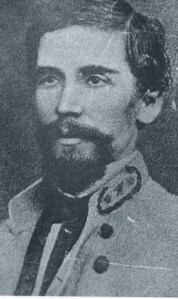
Gen. Patrick Cleburne.
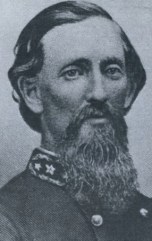
Gen. Otho French Strahl.
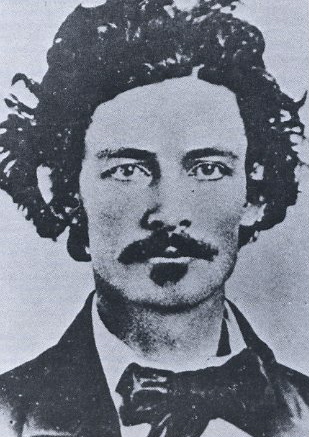
Gen. Hiram B. Granbury.
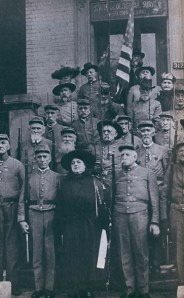
Carrie McGavock with Company C 1st Tennessee, ca. 1

 Robin Engelman
PRISTINE Classical – an update
Pristine Classical was a major part of my posting about the Horowitz , Tchaikovsky 1st Piano Concerto recording made in 1941 and restored by Andrew Rose. (See under Alphabetical List of Articles, Horowitz and Tchaikovsky’s First Piano Concerto.) I mentioned in my article Rose’s weekly commentaries. (pristineclassical.com) The article below is a recent example and I thought it might be of general interest and specifically, interesting to percussionists. The recording was made in 1953. Does anyone know who the snare drummer might have been?
Too loud to record properly?
Ravel’s Boléro is only one
When Maurice Ravel wrote his Boléro in the late 1920s he had no idea it would go on not only to become his most well-known work, but also one of the best-loved piece of classical music produced in the 20th century. Indeed, the composer actually predicted that most orchestras would refuse to play it!
Boléro was helped greatly in its rise to fame by its US première and adoption thereafter by Toscanini – as well as word of a famous falling out between Toscanini and the great composer over the tempo at which it should be played, with the maestro bluntly telling the composer “When I play it at your tempo it is not effective”, to which Ravel responded that he should therefore not play it at all.
Regardless of this, it went on to be played many times thereafter and to become a firm concert hall favourite. I recall as a child going to the Town Hall in Birmingham to a musical workshop with the CBSO where the work was discussed and then played. It is indeed childishly simple to explain the premise, and as a result it’s rather unique. See if you can spot it in this waveform representation of the complete Paul Paray album we’ve issued today:
Paul Paray album
Not too difficult, is it! Here it is again, in close up:
Boléro
Musically, the fundamental essence of Boléro is one very long crescendo. The same basic idea is repeated over and over again as the intensity builds up and the melody moves around different sections of the orchestra. There’s no musical “development” in the traditional sense, and as a musical experiment it leads almost nowhere, at least in the view of its composer – though further developments later on in twentieth century music in the field of endless repetition of simple figures might have come as a surprise to Ravel had he lived to hear them.
Recording a work such as this, especially in the pre-digital days of tape and disc technology, was always going to present a major problem. In fact, even with digital technology it’s not necessarily straightforward. This is the direct result of the huge dynamic range of the piece.
I was reminded when listening to it this week of my first visit as a young trainee BBC sound engineer to the corporation’s Big Band studio at the Hippodrome in Golders Green, in north London. It was the first time I’d encountered the specially designed and built large loudspeakers that were installed in but a handful of the BBC’s major recording venues back then (I’ve no idea if they’re still in use). As far as I recall, each loudspeaker was approximately the size of a stacked pair of domestic washing machines, with four large woofers surrounding a central tweeter. The speakers were mounted into the walls with a spring system allowing the entire enclosure a degree of movement forward and backward – if you pushed at them they’d “bounce” back and forth into the wall and then back towards you for a few moments.
The reason for these custom-built monsters was soon explained to me. The Big Band was individually mic’d up, the feed of these microphones going through a mammoth mixing desk with some 96 channels or so. That must have been a nightmare to get right first time! But the biggest problem they had was that of dynamic range, and above all that of the big bass drum. The drum, when whacked appropriately hard, had a dynamic range of a huge 120dB.
Even the very best digital recording systems we had at the time, which were all 16-bit back then, could only cope with a theoretical maximum dynamic range of 96dB. In order to cope with this discrepancy the BBC’s engineers decided that they needed to be able to hear the drum properly on their monitors, even if they couldn’t actually record its full range – hence the design and building of these monster speakers. (To me that sounds like a great ruse for getting hold of a pair of the most humongous loudspeakers imaginable from the BBC’s notoriously tight-fisted radio management – but it obviously worked.)
Come back to Ravel’s Boléro and we have perhaps a similar problem – it starts very, very quietly indeed, and finishes just about as loud as an orchestra can possibly play. Go back to 1953 and we have a much bigger problem that we did in 1990 – the dynamic range of a standard non-Dolby tape machine back then (and Dolby was a good decade and a half away from inventing his first noise reduction system – or as it was originally billed, his “signal-to-noise stretcher”) was perhaps somewhere in the 45-60dB range. Likewise the LP. Back in 1930, when Ravel conducted a recording with the Lamoureux Orchestra for 78rpm discs it would have been considerably less again.
So we come to a thorny compromise which was immediately audible in the original LP transfer of Paul Paray’s 1953 Detroit Symphony Orchestra Boléro, known as “gain riding”. Quite simply, as Paray slowly increased the volume of his orchestra, Mercury’s sound engineer was slowly decreasing the volume of the microphone to try and make sure that both the quiet opening and the loud ending fitted within the range and abilities of the recording equipment and media.
To the careful listener this manifests itself as a rather hissy opening to the piece. But it’s a curious kind of hiss, which gradually diminishes across the course of the work, until by the end it’s entirely inaudible. It’s been my assumption that the hiss heard at the start of the piece comes not from the tape or disc surface but from the microphone and its amplifier. Pushed to their upper limits this is what comes out of the electronics – but start to pull the faders back a little and that hiss disappears into the background noise of any analogue recording – tape hiss being the major culprit by the early 1950s.
I tried, in my remastering of Paray’s Boléro, to undo this gain-riding compensation, at least to a degree. The problem is that it’s very difficult to gauge how much of this actually took place. I began by measuring the background hiss at the start of the recording and comparing this to later in the piece. This at least gave me a starting point to work from. The problem with this approach is that I’m actually measuring two different things – the microphone hiss to start with and the residual tape hiss later on. And at the same time there’s an orchestra playing, making it difficult to take any noise measurements at all!
Anyway, I worked on this principle to begin with, and starting making my own adjustments, which first involved dropping the volume at the start by about 40% and then gradually increasing it across the entirety of the performance. But this still didn’t sound convincing. A further 30% drop at the beginning, again with an increase spread across the duration of piece back up to 100% sounded better – we were getting closer. Then I spotted that the music at the end wasn’t hitting the “end stops”, and I was able to add a further 20% to the final climax, which goes audibly into peak-overload distortion anyway on the original, suggesting even higher original levels were played than can be heard here.
The end result is something which comes, I hope, a little closer to what Paul Paray had in mind – though I retain a sneaking suspicion that there was probably an even greater contrast between the start and the finish than I’ve dared represent here.
The effect technically is to bring that opening hiss level right back down. You’ll still hear it at the beginning because we have the technology today to handle a much wider dynamic range and leaves it quietly audible when you turn the volume up on replay, but it’s much quieter than it was on the LP, as is the orchestra too at this point.
The effect musically is to make the entire performance even more startling and effective, the relentless drive of the orchestral crescendo in its slow build up is rendered more powerfully than a 1953 LP could ever hope to replicate. I do wish there was some I could do for the slight distortion at the end, but to a certain extent, just as it can in some rock music, this serves only to accentuate to the listener the intensity of the music’s conclusion. It’s an incredible piece, and Paray’s is a truly magnificent performance of it.
Scroll down the page and click on the Paray sample link and you can hear the entire performance in full.
Andrew Rose
11 May 2012
Posted by robinengelman on May 11, 2012 in Articles, Commentaries & Critiques, Composers, History