RSS

Category Archives: History

ULALUME: An Opportunity Lost.

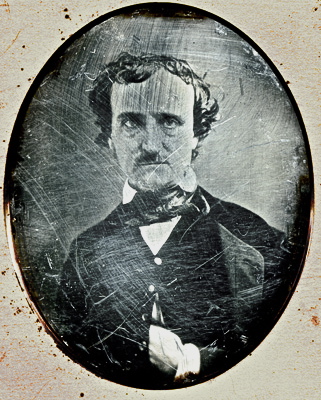
Edgar Allan Poe, circa1849.


The name Edgar Allan Poe was popularized most recently by the movies of Roger Corman (b.1926) starring Vincent Price (1911-93): The Fall of the House of Usher (1960), The PIt and the Pendulum (1961), The Premature Burial (1962),4 The Raven (1963), Masque of the Red Death (1964) and The Tomb of Ligeia (1965).  I went to see these movies because, as a young boy,  I had read the tales upon which they were based and the sound of Poe’s words had captivated me; he was reported as having a vocabulary of over 150,000 words, and he spoke several languages.

Poe was born in Boston, Massachusetts in 1809 and died in Baltimore, Maryland in 1849.5 His criticisms, essays, grotesque tales and sensual, mellifluous poetry influenced an entire generation of French Symbolists and Impressionists.6 He is credited with inventing the Detective  Story genre which later inspired Sir Arthur Conan  Doyle (1859-1930).  Poe’s tale The Gold Bug (1843), began a fad for cryptology in the United States 7 and inspired William Friedman (1891-1969), to devote himself to deciphering codes which eventually resulted in his breaking the “Purple Code” of the Japanese prior to the outbreak of World War II.

But today Poe seems to have dropped beyond the general public’s  literary horizon. I wonder if his tales and poetry are being taught or even recommended to students in public schools and I wonder too if his tales of the macabre, so lacking in physical violence and concerned more as they are  with individual psychic struggle, would fare well in today’s entertainment market. Yet Edgar Allan Poe had a great impact on Western literature, primarily with European writers, and for a brief time achieved fame in his native United States, as an author, critic and lecturer particularly after the publication of his poem The Raven (1845).

My interest in composing electronic music began when I decided to take an electronic music course under the tutelage of Gustav Ciamaga (1930-2011) at the Royal Conservatory of music in Toronto. My first and, as it turned out, last composition in that genre was ULALUME an Electro-Acoustic ballad for magnetic tape and Japanese Buddhist temple bowls inspired by Poe’s poem of the same name.

Ulalume, the first verse of which appears above under the photograph of Poe, was written in 1847 at the request of a Rev. Cotesworth Bronson. Rev. Bronson was to give a lecture on public speaking and wanted a work that demonstrated vocal variations in expression. Ulalume Was written during Poe’s last creative period. In my mind the mood of Ulalume is closely aligned with German romanticism as expressed in the paintings of Caspar David Friedrich (177401840) whose dark, mysterious paintings of forests with subordinate human figures express the feelings of Poe’s work.  And I also hear the Adagio, Scene in the Country, of Hector Berlioz (1803-69) Symphonie fantastique (1830) with the the English horn’s plaintiff call. Berlioz and Poe maintain that melancholy was the source of their creations.

The first performance of “my” Ulalume was scheduled for Expo 70 in Osaka, Japan but disruptions in travel delayed my arrival and the opportunity went begging. The work was never played and I have no idea what became of the tape, but its simplicity  remains in my mind and when I read Ulalume now, I can hear the sounds.

When asked what Ulalume was about, Poe replied, “It is about the only true business of a poem–making a beautiful sound”.8

Footnotes:

1.  sere – dry; arid : a harsh life on the sere granite ledges of those remote offshore islands-  dry (esp. of plants) withered.

2.  Weir, a low dam built across a river to raise the level of water upstream or regulate its flow, but in this case, Poe may be referring to Robert Walter Weir (1803-1869), a painter of the Hudson River School famous for his landscapes. And his reference to Lake Auber ) may mean Daniel François Esprit Auber (1782-1871, a composer of sad operatic tunes

3.  tarn – a small mountain lake. ORIGIN Middle English (originally northern English dialect): from Old Norse tjҩrn

4. Interestingly, with Ray Milland not Price in the title role

5.  Poe’s alleged addiction to drugs has been rejected by modern scholars, but he is known to have been a user of alcohol and contemporary reports show that he was often drunk.  Joseph W. Walker found Poe, lying delirious in a street outside Ryan’s Tavern in Baltimore. He was taken to a hospital and died four days later at five o’clock in the morning of October 7. 1849. He was dressed in clothes that were not his.

6.  Stéphane Mallarmé (1842-96),  Paul Verlaine (1844-96), Arthur Rimbaud (1854-91), Charles Baudelaire(1821-67). Édouard Manet (1832-83), illustrated the Stéphane Mallarmé translation of Edgar Allan Poe’s The Raven, 1875.

7.  The Gold Bug Cypher:

8.   As quoted by Laurence Meynell in his Introduction to Tales, Poems, Essays, Edgar Allan Poe, (p 15), Collins, London and Glasgow, 1966.

Click HERE for THE RAVEN animated on YouTube
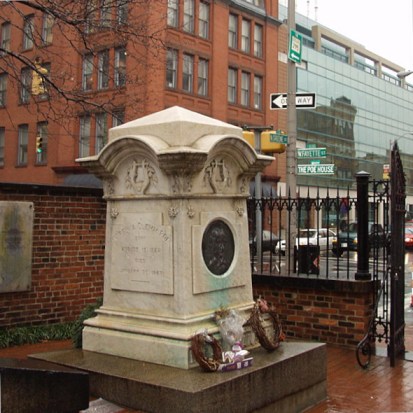
E. A. Poe grave, Baltimore, MD.

E. A. Poe grave, Baltimore, MD.

 
Leave a comment

Posted by on September 15, 2010 in Articles, History


“a flag so large the British will have no difficulty in seeing it from a distance.”

Thus spoke Major George Armistead (1780-1818) when he ordered the flag that would fly over Fort McHenry and enter history as “The Star-Spangled Banner”.

Armistead had recently been promoted for his exploits during the capture of Fort George on the western end of Lake Ontario, (May 1813) and was reassigned to Baltimore in June to assume command of Fort McHenry, the 18th-century star-shaped fort guarding the entrance to Baltimore Harbor at the northern end of the Chesapeake Bay.

The flag was made in Baltimore in six weeks by Mary Young Pickersgill, (1776-1857) a trained flag maker whose home is now the Star-Spangled Banner Flag House and 1812 Museum. True to Armistead’s command, Mrs. Pickersgill and her assistants created a flag measuring 42 feet x 30 feet with stars 26 inches from point to point. Mrs. Pickersgill was paid $544.74 for her work. (app. $7,110.00 in today’s money.)

“O! Say can you see by the dawns early light,
What so proudly we hailed at the twilight’s last gleaming,
Whose broad stripes and bright stars through the perilous fight,
O’er the ramparts we watch’d were so gallantly streaming?”

This was the flag Francis Scott Key (1779-1843) saw in the “Dawn’s Early Light” from the deck of a U.S. boat about four miles down the Patapsco river from Fort McHenry, and which inspired his poem “Defence of Fort McHenry”. Key found himself a captive of the British when he had tried to secur the release a friend accused by them of being a potential spy.

“And the rockets’ red glare, the Bombs bursting in air”, evoke scenes of an horrific struggle, a majestic battle. The truth however is quite different. The bombardment lasted 25 hours, but bad weather considerably reduced the effectiveness of British naval ordnance.

When the bombardment began on the morning of 13 September, 1814, the winds on the Bay were up and it was raining. Many of the bomb fuses were extinguished en route and many more blown off course or inaccurately delivered. The Congreve rockets proved completely useless, both in their destructiveness and psychological effect. Of the 1000 Fort McHenry defenders, only 24 were wounded and four killed. One of the dead was a woman blown in half while delivering supplies to the defenders.

“Gave proof through the night that our Flag was still there:”

a case of poetic license? Due to the wet weather, the great flag was taken down during bombardment day and replaced with a smaller flag, (17’x25′).  Next morning at 9:00 AM, the Star Spangled Banner, kept dry, was  raised while the fort’s fifes and drums played “Yankee Doodle”.

“Key probably didn’t see the flag during the battle – but figured out the flag was there because the British were still shelling the fort.  Come morning, Key is wondering who won – the firing now being over. He was overjoyed at seeing the big flag – so he did see the flag, just as the battle ended!  Key stated numerous times that he did in fact, see the flag.” (National Park Service Ranger Vincent Vaise, Chief of Interpretation, Ft. McHenry National Monument and Historic Shrine in an e-mail to R.E.)

As if to accompany the ascension of the Star Spangled Banner, British Vice-Admiral Sir Alexander Cochran(1758-1832) ordered his fleet from the Chesapeake Bay and headed South with Wellington’s finest regiments to an even greater humiliation by General Andrew Jackson’s “rabble” at the Battle of New Orleans (January 1815).

As a Baltimore native, I am somewhat chagrined to admit that my first visit to Fort McHenry was just a few of weeks ago. I’ve visited Fort York which now resides a couple of blocks from my home in downtown Toronto, and Fort George in Niagara-on-the-Lake where I’ve taken my rope drum to be pressed. I also recently visited Fort Niagara which rests on a bluff of the Niagara River directly opposite Fort George.

The visit to Fort McHenry was at once anticlimactic and singularly moving. Baltimore has grown up around the old Fort and when one looks down the Patapsco River towards Chesapeake Bay, one cannot help but notice the industrial detritus of what was at one time one of North America’s most thriving ports. Still, the fort is hallowed ground and is revered by visitors, particularly school students and their teachers.

After a very engaging documentary film on the war of 1812 and the bombardment and defense of the Fort, a recording of the Naval Academy chorus singing a stirring arrangement of the Star-Spangled Banner began playing while a curtain along one entire wall of the visitor’s center slowly withdrew to reveal the northern walls of the fort and a replica of the flag that flew over the fort during the bombardment. A snappy breeze enhanced the effect by keeping the flag alive and proud over the ramparts. The entire audience stood as one, turned to face the flag and place their right hand on their breast.

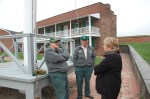
Standing casually at the flagpole’s base just inside the entrance to the fort, were two National Park Service volunteers, Robert Cyphers and Andrew Stritch.  They knew quite a bit about the history of the Fort and the war of 1812. Mr. Stritch invited us to the ramparts for our first view south to where sixteen British ships including broad beamed heavy mortar and rocket boats had dropped anchor just out of range of Fort McHenry’s guns, and begun their fateful bombardment. The British ships of the line were anchored 4 miles down the bay as their heavy draft would not allow them to come any further.

Very dimly on the horizon we could see the remains of Fort Carroll under the modern Francis Scott Key Bridge and tried to imagine, how this scene would have appeared in September of 1814. We wandered the ramparts ignoring as much as possible the youthful frenzy of the schoolchildren, found a plywood replica of a rope field drum with slack dry heads sitting on top of one of the barrack cots and wandered back to the gift shop where I took some more photos and purchased a CD by the Fifes and Drums  of the Fort McHenry Guard, titled ” O’er the Ramparts, War of 1812 Fife and Drum music”.

The repertoire and playing on this CD are splendid. When listening to this I can almost envision myself standing on the parade ground of Fort McHenry during the War of 1812. The tempos are properly slow, the drumming is open and the repertoire is interesting. A goodly number of the tunes were new to me. One revelatory medley couples “Ah! Ca Ira” with “Downfall of Paris” two tunes often but erroneously thought to be related, and another pairing with “March to Boston” and a version of “Yankee Doodle” that I’d not heard. Mr. Tim Ertel is the music coordinator for Fort McHenry. He is a fifer, researched the music and produced the recording. It’s worth hearing and reeks of authenticity. This CD can be ordered via

www.fortmchenryguard.org.


Notes:

For his defence of Fort McHenry, Major George Armistead was breveted Lt. Colonel by President Madison and died four years later. He was the uncle of Civil War Confederate States General Lewis Armistead who was killed at the battle of Gettysburg during Pickett’s Charge. His body was secretly brought to Baltimore and buried next to his uncle in Old St Paul’s Cemetery.

Mary Young Pickersgill became a wealthy business woman 150 years before women entered the business world.  She was founder of the “Impartial Humane Society” and founded homes for aged women and men.  The “Impartial Humane Society” is known today as the Pickersgill Retirement Community and is headquartered in Towson, Maryland.

Francis Scott Key was released by Admiral Cochran and upon his return to Baltimore, re-wrote his poem and delivered it to the Baltimore American Newspaper where it was type set, printed and distributed in hand bill form. Key, who lived in the Washington suburb of Georgetown, led a productive life and was greatly admired for his wisdom and religious faith. He argued cases before the Supreme Court and died of pleurisy while visiting his daughter in Baltimore. The Star Spangled Banner was officially designated the National Anthem of the United States of America in 1931.

Vice-Admiral Sir Alexander Cochran, commander-in-chief of the North American station, was victorious at the 1814 battle of Lake Borgne, then defeated at the battle of New Orleans 26 January,1815. He was promoted to Admiral in 1819 and from 1821 to 1824 he served as commander-in-chief of the entire British fleet. He died in Paris in 1832. His brother Charles had been killed in 1781 during the battle of Yorktown and had married the daughter of major John Pitcairn.

The Star Spangled Banner was made a permanent gift to the Smithsonian Institute in 1912. Work to conserve the flag began in earnest in 1999 and the final result which cost approximately US $7,000,000, is on display in the Museum of American History, Washington, D.C.

For a detailed overview of the War of 1812 in Maryland and the participants and events at Fort McHenry, readers are advised to visit: http://www.nps.gov/history/history/online_books/hh/5/hh5d.htm

 
1 Comment

Posted by on April 22, 2010 in Articles, History


Luca Della Robbia: A Joyful Noise

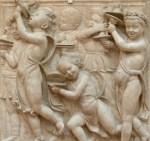
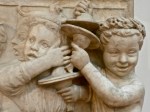
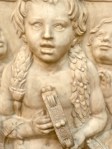
Luca della Robbia, Cantoria(1431-38-Detail)Florence, Italy, Museum dell'Opera, dell Duomo. Photo,R.E.

There is no doubting the skill of Italian Renaissance artists. No matter the medium; stone, wood, paint, glass, porcelain, cloth, silver or gold, the fruits of their labors continue to transfix those of us fortunate enough to view them in situ.

Christianity inspired, or at least subsidized, many of the great Renaissance artists. Their work’s often depicted  intense pain and suffering, for saints and sinners alike; martyrdom and everlasting peace for the former, Hell and eternal damnation for the latter. Their Crucifixions, many fascinatingly gruesome, held the promise of forgiveness and resurrection for those who confessed their sins.

My wife and I recently vacationed in Italy. We had come, as do most tourists, to eat, drink, take in the scenery, and  to see Renaissance art. We began our journey by visiting hill towns in Tuscany.  The great art and architecture of these towns reside primarily on their highest points. To view them, one must often climb incredibly steep and circuitous paths of stone. For a condo dwelling sedentary like me, this was a Calvary of its own.

As the days of sightseeing passed, a kind of visual weariness began to set in. At times, I had to force myself to look critically at another beheading of John the Baptist, the arrow ridden body of St. Sebastian, unbelievers in the agonized throes of consummation by ghoulish beasts of Hell, a weeping Madonna, or a bloody Christ.

Relief came in Florence, the home of countless visionaries during the Italian Renaissance. The divine Fra Angelico (c.1395-1455), whose Annunciation, and the  paintings he made for the cells of his fellow monks of San Marco, including, ironically, one for Girolamo Savonarola (1452-98), an opponent of the Renaissance, are unparalleled in their exquisite timelessness.

But, when we discovered the recently renovated Museo dell’Opera dell Duomo, a spiritual shift from the sanguinary to the sublime occurred in the space of one room.

The Opera, as it is referred to locally, is a balm for foot sore, eye weary tourist. The interior is spacious and  calm, the art hung at eye level, the stairs, by some magic of architecture, take one effortlessly, ever higher. And then, The Room.

I had seen the  work of Luca della Robbia(1400-82) in many fine art books, but here, his sculptures transfixed me.  Has any artist, before or since, captured the pure joy, the impish glee and innocent perfection of music and dance as did Luca della Robbia when he created his Cantoria? (1431-38)

His stone children tease sounds from cymbals and drums, send their voices into the world untroubled by pedagogy and dance for the pure thrill of movement. They have been doing this for more than 600 years. A reminder for us all. A Joyful Noise indeed.

 
Leave a comment

Posted by on December 1, 2009 in Articles, History