I grew up listening to the NBC Symphony Orchestra. Led by the charasmatic Toscanini (1867-1957), they sold recordings of classical music in large, previously unimagined numbers. Toscanini was known for his explosive temper and quest for perfection. The covers of his RCA Victor Beethoven Symphony LPs were decorated with 20 snapshots of Toscanini conducting, all depicting him as the quintessential Maestro, no smiles, this was serious business no matter how you looked at it. Toscanini rode a Hi Fidelity sales wave as CBS, Columbia Broadcasting System, tried to catch up with the more subdued and introspective Bruno Walter. [1.] Using Toscanini as a marketing model, record companies planted the maestro mantle on other conductors, Bernstein the great home-grown communicator, Szell the meticulous teacher, Reiner the beady eyed dictator and Ormandy the curator of Philadelphia’s lush sound.
During my college days, I’d gather with a few friends for listening sessions. One of us would put on an LP and with no hints allowed, the others, in a kind of blind aural tasting if you will, had to name the orchestra. Back-in-the-day, major orchestras had their own distinctive sound. They could also be recognized by their conductor’s style, the suave sound Karajan achieved with the Berlin Philharmonic, its choice of recording venue, the super dry studio H of the NBC Symphony, and in some cases, its principal players – Voison’s trumpet in Boston, Kincaid’s flute in Philadelphia, Goodman’s timpani playing with the New York Philharmonic and the Brass section in Chicago. French wood wind sound was thin and reedy, German brass was warm and round particularly the horns and the Russians were still playing post revolution Boosey and Hawkes instruments in desperate need of up-dating. Hearing one or more of these ‘tells’, our answers were correct more often then not. These distinctions are almost impossible to make today. When asked in a NewYork Times interview why today’s orchestras sounded alike, Seiji Ozawa said Mahler was what mattered, not the orchestra. Though oblique, even evasive, Ozawa’s answer confirmed the question’s premise. It also beggared another. How did it happen?
I believe recording technology and record companies’ desire to control the results of the final product was and is at the heart of this phenomenon. Almost overnight compact digital discs replaced LP records. The effects of this revolution influenced recording companies, musicians and the public in ways unimaginable at the time, unalterably changing their attitude towards each other and the music. Working with CD technology was a far cry from the good ole direct-to-disc days of yore when performers had to play each movement straight through, no stops. If a mistake was made, a new vinyl replaced the old and another complete performance was attempted. Thus, early 78 rpm recordings were ‘live’ performances. After the invention of recording tape, mistakes could be cut out, literally. An offending passage or note was removed with a razor blade. A correction was inserted and the gap closed with Scotch Tape.
Whereas traditional recording studios are grounded, digital studios are compact and transportable. With digital technology, studio quality recordings can be made anywhere on earth. After the Cold War, former Eastern bloc orchestras and soloists, now in possession of quality instruments and eager for hard currency, willingly provided their services for fees dramatically lower than their western counterparts. In a few years, hither-to unknown performers began to flood the world’s art music market with solo, chamber and symphonic recordings. Sales of American made recordings plummeted. Critically, digital recordings allowed producers to manipulate sounds of lesser orchestras enough to satisfy a public more interested in The Great Gate of Kiev’s sonic splendors than which orchestra and conductor recorded it. For many record buyers, the sound of an orchestra and the subtleties of a maestro’s interpretation became almost irrelevant.
Some North American recording companies went out of business and many large orchestras lost their recording contracts. Solists and ensembles tried to energize ther careers by crossing over into the burgeoning pop music market. Recording companies tried hyping up performances of classic favourites such as Vivaldi’s Four Seasons and marketed Mozart for babies, for lovers, for fine dining and for working out.[2.]
Today the death of the CD seems imminent and mp3 downloads may well be the heir apparent. The sound quality of an mp3 is inferior to the CD, but will that matter to the public? Anyway, I have a large collection of LPs and too many CDs. Most of my recordings, made in the last 30 years, are sonically indistinguishable. They offer me no fresh insights into the music I often enjoy. I do not need another technically dazzling Rachmaninoff Piano Concerto #3 when the 1951 Horowitz, Reiner collaboration with the RCA Victor Symphony Orchestra trancends performances by all pianists, past or present [3.]
So, I’ve been listening to early Twentieth century recordings of symphonic repertoire conducted by the likes of Beecham, Klemperer, Mengelberg, Bletch, Furtwangler and Stokowski, all judiciously digitalized by Andrew Rose at Pristine Classical. Aided by the latest audio equipment, Rose discovers instrumental voices present, but hidden or diminished by early recording equipment and makes them audible. Along with balances, Rose may have to justify pitch, tempo and overtone fluctuations as well as reducing or eliminating surface noises and the thin metallic sound common to many old 78 recordings. He is acutely aware of the dangers in taking his remasterings too far and assiduously maintains relationships indicated by the recordings, his ears and technology. Rose often leaves surface and audience noises in order to maintain the life of an especially significant recording.
The orchestra players of this era were superb and with their conductors, created performances technically comparable to their modern counterparts while differing substantially, in some cases dramatically, to readings by almost all of today’s conductors. These interpretations changed or enhance aspects of a work in ways not always indicated by the composer, especially phrasing, accents, dynamics and tempi. Toscanini railed against conductors he considered guilty of these transgressions. And yet, leaving an NBC Symphony concert at intermission, Wilhelm Furtwangler said of Toscanini, “He’s just a time beater”.
Are you old enough to recall the admonition, “Don’t just play what’s on the page”? Many conductors of yesteryear were not bound by the page and were unafraid to trust their feelings, allowing works to take them spontaneously wherever their spirit’s willed. They are an elite compared to the replicators who constitute today’s majority. Below are some examples from a bygone era. I suspect most of you know the works from which the samples are taken. Like them or not, they demonstrate a time when conductors knew from common practice that scores were not written in granite. They knew the music had to speak differently to different people. [4.]
I chose the last movement of Beethoven’s Ninth Symphony because it is a series of contrasting events which Mengelberg realized beautifully. His pacing and tempi bring the messages of Schiller’s poem to life in ways unmatched by contemporary recordings. To my ears, modern singers, often heavy handed opera stars, are here, sensitive masters of the oratorio style and have time to listen and give each other space. As well, each section of the movement is allowed its own space, this sometimes by simple means such as a significant dimenuendo or extended fermata. For the first time I understood what Beethoven disciples meant when they spoke of this work as monumental. The bass drum, cymbals and triangle verge on inaudible, but the penultimate timpani bar makes up for those failings and provides a monumental ending. All excerpts are products of Pristine Classical digital recordings.
NOTE: These audio samples cannot be heard from e-mail. They can only be accessed from my web site, robinengelman.com.
Opening and Recitative, 4th movement of Beethoven’s Ninth Symphony. Mengelberg and the Concertgebouw Orchestra, Live recording in Amsterdam,1940.
First vocal quartet, 4th movement of Beethoven’s Ninth Symphony. Op Cid.
March, 4th movement of Beethoven’s Ninth Symphony. Op Cid.
Last quartet, 4th movement of Beethoven’s Ninth Symphony. Op Cid.
Last measures from the last movement to Beethoven’s Ninth Symphony. Op Cid.
And finally, some opening bars from Mozart’s Overture to The Marriage of Figaro, The Thomas Beecham Orchestra,1916.
Though the great string bass player and teacher Oscar Zimmerman was first to mention Thomas Beecham to me 50 years ago, I have just recently begun listening to his recordings. Beecham is the first to make me hear the inherent character of individual Mozart symphonic movements. After years of ho hum listening, a revelation.
Postlude: Please see my article Listening to the Past: An Addendum.
Foot notes:
[1.] But according to Norman Lebrecht,Toscanini’s charisma and recordings did not increase attendance at classical music concerts. Ironically, Columbia invented the Long Playing record.
[2.] The CD has always had its detractors. Its sound is dry and extreme dynamics are truncated, simply rejected by a predetermined electronic limit. As of this writing, 2014, the LP has made a limited comeback. A large Toronto audio retailer has reintroduced high end turntables and a limited number of LP records.
[3.] Serge Rachmaninoff said of Horowitz’ playing his Concerto No. 3, “He swallowed it whole. He had the courage, the intensity, the daring.”. (Wikipedia) Rachmaninoff, one of the century’s great virtuosos, made this comment while on tour in the United States playing the same concerto.
[4.] “If you want to play Schubert well, you need to know the atmosphere in Vienna, especially during the night, to know the literature, to breathe what is Vienna. It’s not just the notes you see in the score. Culture is translated in phrasing, timbre, all that makes the sound that expresses what you know about a composer, the spirit beyond forte and piano (loud and soft).” Ricardo Muhti as quoted by Nancy Malitz, Chicago in the Aisle, 3 November, 2014.
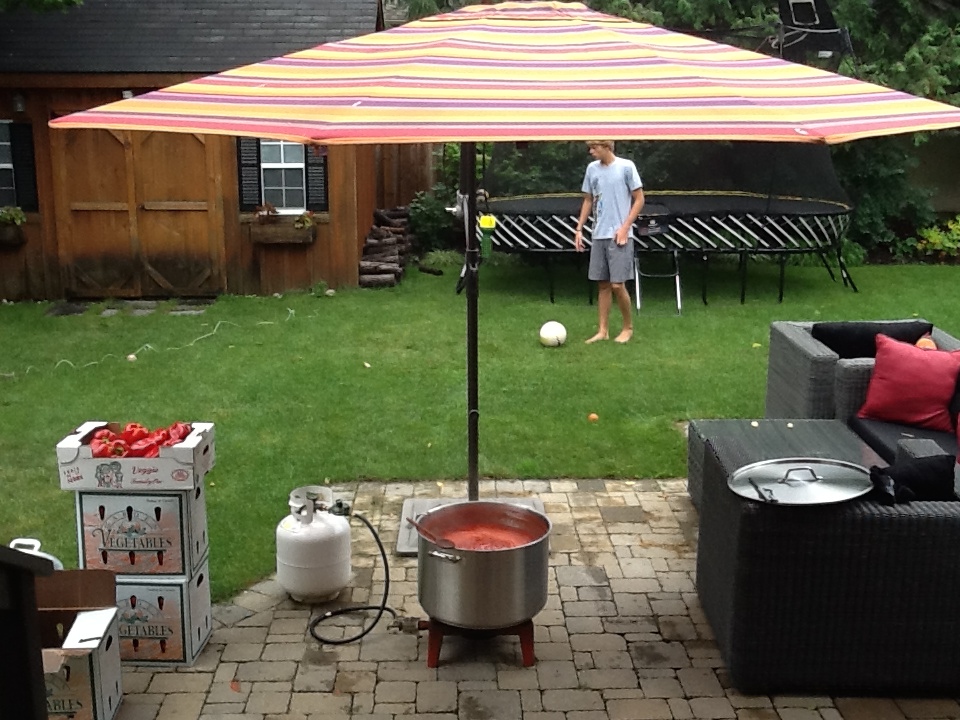
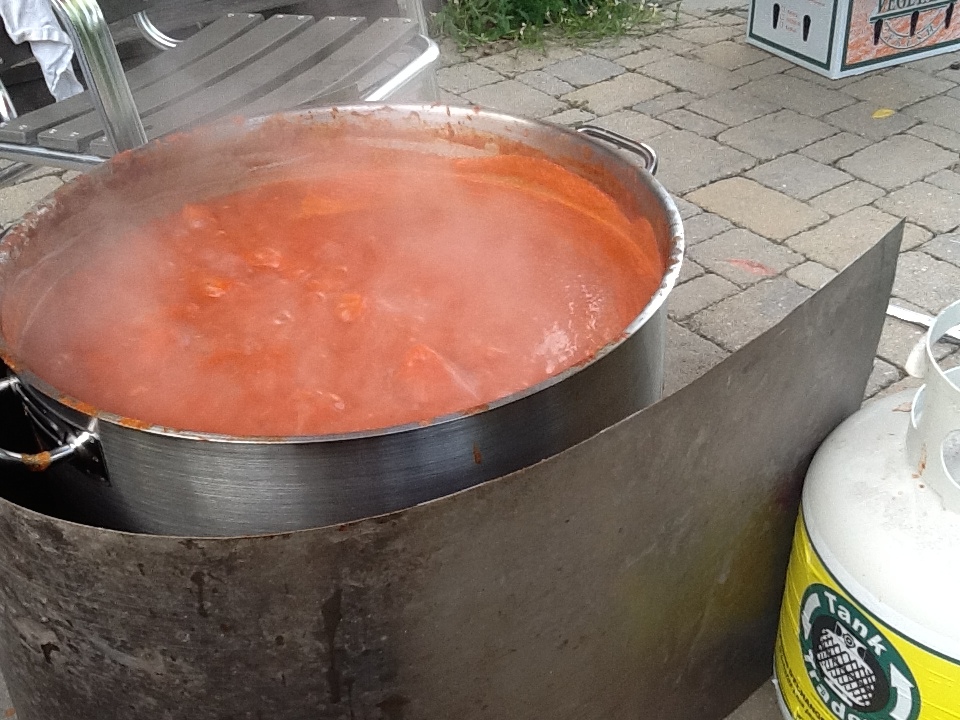
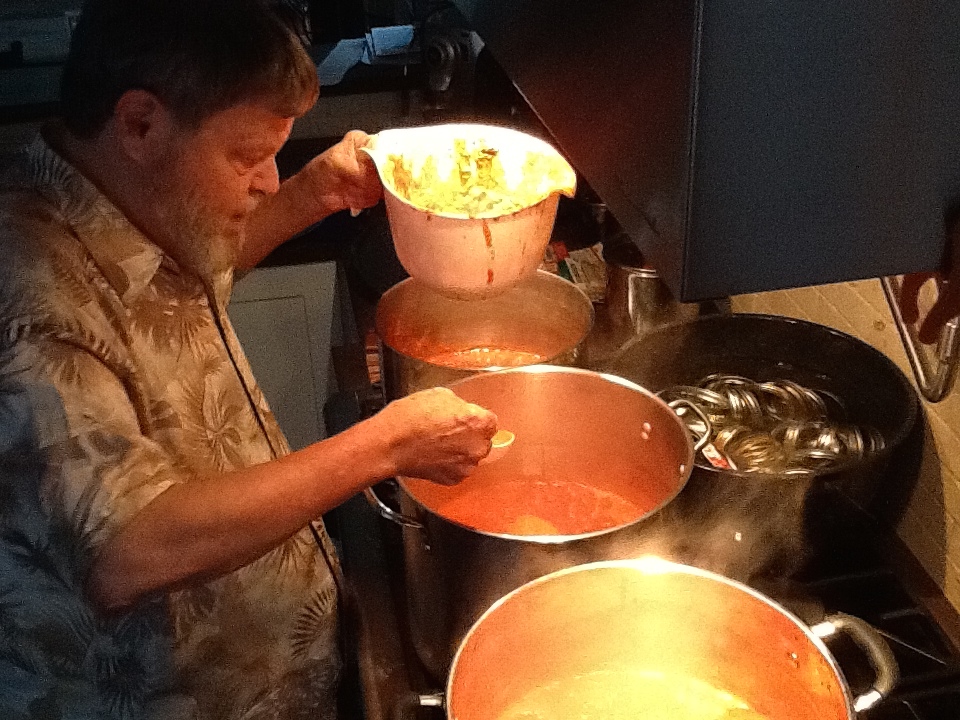
At the instigation of my project oriented son, our family gathered last summer to make tomato sauce.[1.] Assembly line sauce making was not new to us, but this time, given our production numbers, processing bushels of tomatoes with a machine too small, was particularly arduous. The tasks of blanching, skinning and quartering bushels of tomatoes, peeling sacks of onions and garlic, stirring and skimming froth over a hot stove and lifting sauce filled kettles for 16 hours, proved a bit strenuous for some members of our clan who next day suffered from post tomato stress. This summer, my son purchased a ‘real’ tomato processor. As fast as tomatoes could be inserted, It separated pulp from waste. No skinning, no quartering and the waste went to a neighbor’s compost. After the major work was finished, we convened a board meeting to discuss the events of the day and changes we’d make next summer. The meeting was accompanied by pizza and very good wines. Then too, it was one of those perfect Canadian evenings, blue skies, nary a breeze, and a shirtsleeve temperature one could barely feel, neither warm nor cool.
The notes below were taken by our sauce secretary.
6 bushels San Marzano tomatoes ($23/bushel @ Canal Road)
40 lbs Vidalia onions
1 1/2 bushels red peppers, roasted
48 heads garlic, roasted
24 jalapeños, roasted
1/2 bushel banana peppers
5 cups sugar
1 1/3 cup salt
6 cups Bertoli extra virgin olive oil
8 medium bunches of Basil
Total cost for vegetables =Cdn $310.00 [2.]
Started at 6:00am -boiling water, Esme and Bryce started tomatoes by 7:30. Eleanor and Robin arrived at 10:00 – Dorothy and Jane at 11:30. Jane, a close family friend, left around 3pm; Dorothy around 5:30.
Stephanie came over with Meghan (a schnoodle) but Jane suggested a cock-a-poo. [3.]
This year Bryce bought the 1/2 hp tomato mill and it made a huge difference: each bushel took 30 minutes.
We processed in 2 batches. We did three bushels and stopped then did all the ingredients for both batches then started processing the rest of the tomatoes at 5:00pm. started canning the last batch by 8:30p. First batch was finished by 4:30. The first, using 3 bushels of tomatoes was canned by 5:30.
We made burgers from Bruno’s with buns from Cobbs; crudites and tortilla chips and it was a great break around 2:00. Earlier would be better.
Jane brought a fabulous red wine that we had with Pizzaiola Pizza in the back yard: Chateau La Fleur Jonquet 2009.
Next year:
Buy a stirring paddle for the big pot. Buy another burner and pot. with the new tomato press.
6 bushels was the right amount; in 2013 we had 3 batches.
San Marzano tomatoes were pulpier and we should get those again.
Make sure there are lots of lids. Walmart had them. Small is 70mm; wide is 86mm. Don’t buy 76mm!
[2.] The tomatoes and vegetables were from Holland Marsh, about 31 miles north of Toronto. Years ago the land was a vast bog. Over time, Dutch settlers drained the marsh,eventually exposing 21,000 acres of fertile black soil, perfect for planting root crops. Holland Marsh, or the Marsh as it is referred to, is the bread basket of Ontario.
[3.] I have become interested in non-shedding, hypo allergenic puppies. As a condo dweller, I’m interested in non-pooping, non-peeing, non-barking puppies that are fed by breathing and require no exercise.
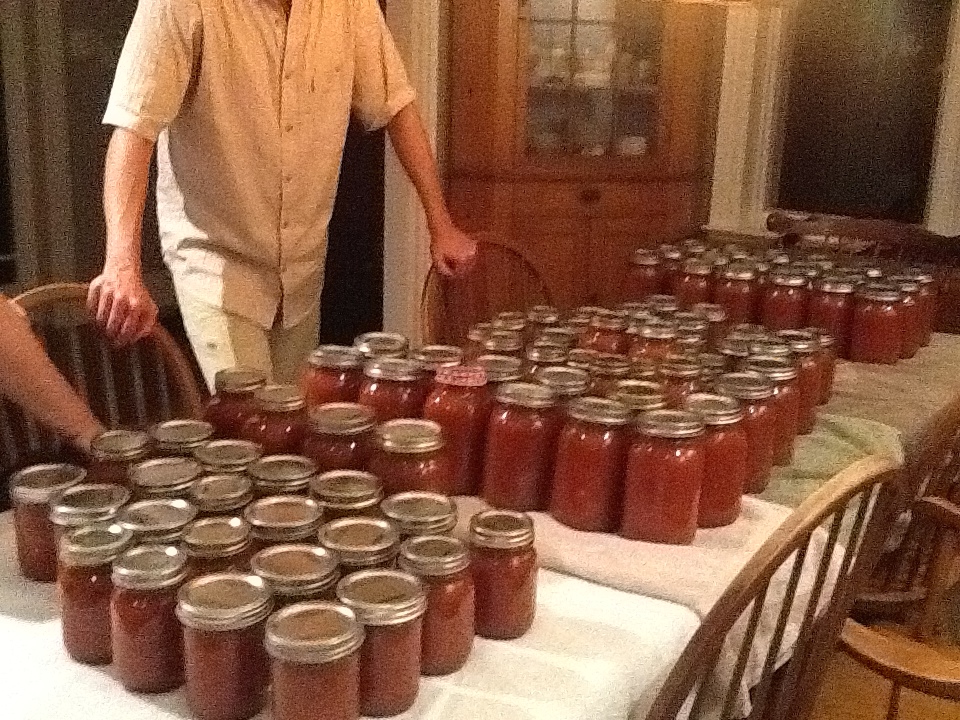
Part of our 88 quart production for the day.
Meeting of the Board with the Green Egg in background.
Had an 8AM bus to start the day. Our schedule, – The Great Wall, Peking duck dinner, Nexus treats our Chinese hosts.
The Great Wall – well what can I say? The bus pulls up to a parking lot near a building with a big sign in English” The Great Wall Souvenir Shop” and “Coca Cola.” Could be Niagara Falls except the crowds are mostly Chinese and the attraction is a giant wall outlining the crest of some of the most beautifully shaped hills I’ve ever seen. (Note: Today, 2014, most of the visitors to Niagara Falls could well be from China.)
Have to stop for a moment. In the hotel I hear a lot of French voices in the hall. “Les Grande Ballet Canadian” has just arrived in Beijing and are staying on our floor. Good luck kids! Perhaps I’ll be able to speak to some of them tomorrow. I want to re-meet my square dance partner from Ottawa.
May 10, 7 AM
At the wall we can turn either left or right, conditions imposed by the wall itself. We go left, left because there are less people in that direction. Less people in that direction because the client is so steep. It starts out innocently enough – just a good plodding gait. Our goal is the highest visible tower. At one point the angles are 45 to 55 degrees. There is one section where, coming down John and Russ’s heads are the only visible part of them and they are only 15 steps below us. The view is incredible – looking north and west over a vast plain to more hills and mountains in the distance. Kwang Chao stopped shortly after our assent and says she will wait for us. She knows what’s coming. Wang explains after our climb that we are now heroes. Beyond the highest point we reach, the wall has crumbled in some places. it is now a faint line against the hills. From the look of these hills and mountains I can appreciate now the graphic representations found in Chinese art. There are many hills in a chain and many shapes, some very sharp. Here there are no single massive structures as found in the Rockies. There was a twinge visualizing thousands of Mongolians and ponies moving towards that wall.
“Shawn Lay Bah!” (phonetic spelling for “get on the bus”, a command we hear often.) The Ming tombs rest with their backs against a low chain of hills and look out over a beautiful valley. No wonder so much Chinese art shows people as insignificant against the landscape. There are 12 or so tombs being excavated and only one is open. Each have Temple buildings. Their tombs were constructed so that when the doors were closed a large marble slab fell in place behind them. The workers were killed and the entrances hidden. Mao’s mausoleum is much larger.
We get back to the hotel with about 40 min. to spare for dressing and resting before Peking duck. The restaurant where we eat invented this dish during the Ming Dynasty. The meal is the best we’ve had to date. The seating is arranged in two tables. At our table is Mr. and Mrs. Rose, two young Chinese diplomats; my favorite speaker, Mr. Sung; John and Jean; a heavy from the Arts Bureau, Bill and one other Chinese cultural official. We have a few appetizers and John makes his speech in English, translated by Kwang Chao. When he thanks a whole list of people, ending with her, she finds it embarrassing to refer to herself and the officials at our table chuckle at the impossibility of her predicament.
After Mr. Sung’s speech, when small groups are conversing I compliment him on his speaking abilities. The drama of his gestures and his rich voice. He explains that he used to be an actor and singer (base). His voice is not so good now perhaps too much smoking and mai tai. The Chinese are proud of the food at our banquet and Mr. Sung mentions that Italy got its noodles from China. He says that when he was in Italy they only had one size of noodle and it was not as good as noodles in China.
I ask him the Chinese theory on 1st man. He begins a reply, is taken back, chuckles and defers to Mr. Whoever – two bodies to my right. The explanation is pure Darwinism.
I asked Mr. Sung if he ever played a musical instrument. He talked about his childhood and playing a drum during spring festivals. He then produced a short but very moving analysis of what percussion meant to him. How his heart beats to the music and how soft and loud a drum can be – “A pin dropped on the ground and thunder”. We toast each other with mai tai. While watching each other out of the corners of our eyes we throw it back draining the glass in one gulp and then show the empty glass to each other. I am reminded of the scene in “Patton” when George C Scott and the Russian general toast one another.
There was a toast after John’s speech and as we raised our glasses. Kwang Chao said “Bottoms up”. We’ve been teaching her slang but she was immediately worried that it was not serious enough for the occasion. I told her “Bottoms up” could be expressed seriously and threw back my brew. Mrs. Rose remarked with some alarm that I did indeed take “Bottoms up” seriously and I told her it was the act of a coward. That I had learned from the 1st banquet how to handle the drink. Mr. and Mrs. Rose ( David and Judith) were slightly alarmed that Nexus had been teaching slang to Kwang Chao. Kwang is very fast and remembers a great deal. She is impressed by how openly we express our opinions and state our views. Some phrases we have taught her:
” He doesn’t have a full deck” say this while pointing to your temple with your 1st finger. “You’re coming from left field” ” Grody to the max” ” Funky”, “Get down”, “ Holy cow”, “He bought the farm”, Here’s mud in your eye” “Up yours”, The shit’s hit the fan”.
Her favorite is ”Get your ass in gear.”
We explained to David and Judith that we will refine her education during the next week so that she will know when and in front of whom to make these remarks.
When we get back to the hotel, Bill wants to talk and offers to buy the warm Cokes. We stay up for about an hour. Bill didn’t want to go to the banquet and when he told, John the response was not empathetic. I admitted that I had thought about becoming sick but decided against it.
As a whole, Nexus does not function well in official situations – at least Chinese official situations. Interestingly enough, neither do the Chinese. It appeared to both Bill and me that the heavies would rather have been someplace else. There was some covert watch watching.
When we talked to Guy St. Jacques at the end, he told us that their table discussed dope. The Chinese wanted to know how marijuana, hashish, cocaine and heroin were used and to what effect. Sounds like they were at a different banquet. Obsequiousness is not our style. Perhaps we should have taken them to Donald Duck’s fast food restaurant. It is my individualism confronting this lack of individualism. But as I said earlier, you have to do what you do, let it hang out, let it all hang out. Diplomatic people are playing in shadows. Once in a while they appear, do something they thought about for a long time and then fade back into the dusk. What you’ve heard sounds okay but there is nothing to indicate flesh and blood. It is a cliché, (another favorite definition of Kwang Chao).
Our last concert was reviewed in the Chinese press. The review listed the pieces we played and said we received a warm response. That was it. Our last concert was videotaped by Beijing TV and we will receive a copy – also a tape of our 2nd concert for radio. Anton Kuerti is coming with Bob Aiken, Joel Quarrington, and Jim Campbell sometime in the near future. Tony is noted for stopping a performance and telling the audience to shut up. I would love to be here for his 1st performance. He cannot tolerate smoking and spitting and he’s a vegetarian. Good luck!
I have grown increasingly fond of Guy St. Jacques. Good sense of humor and good conversationalist, very open. I spent this morning in my room writing and admiring a book of paintings I purchased for 30 yuan at the Ming tombs. Very relaxing. We fly to Shanghai tonight at 7:40. Mrs. Rose has promised I will have a closet in my hotel room in Shanghai. I hope she’s right. David Rose described our hotel there as colorful. Ummm. I’m not losing weight – even feel as though I’m gaining. Is rice, veggies, shrimp and beef fattening? I’ve eaten no breakfast since leaving Toronto. I thought I was off to a good start when I had 2 great bowel movements in Japan. I’m plugged, no , it’s Metamucil time!


 Robin Engelman
LISTENING to the PAST
I grew up listening to the NBC Symphony Orchestra. Led by the charasmatic Toscanini (1867-1957), they sold recordings of classical music in large, previously unimagined numbers. Toscanini was known for his explosive temper and quest for perfection. The covers of his RCA Victor Beethoven Symphony LPs were decorated with 20 snapshots of Toscanini conducting, all depicting him as the quintessential Maestro, no smiles, this was serious business no matter how you looked at it. Toscanini rode a Hi Fidelity sales wave as CBS, Columbia Broadcasting System, tried to catch up with the more subdued and introspective Bruno Walter. [1.] Using Toscanini as a marketing model, record companies planted the maestro mantle on other conductors, Bernstein the great home-grown communicator, Szell the meticulous teacher, Reiner the beady eyed dictator and Ormandy the curator of Philadelphia’s lush sound.
During my college days, I’d gather with a few friends for listening sessions. One of us would put on an LP and with no hints allowed, the others, in a kind of blind aural tasting if you will, had to name the orchestra. Back-in-the-day, major orchestras had their own distinctive sound. They could also be recognized by their conductor’s style, the suave sound Karajan achieved with the Berlin Philharmonic, its choice of recording venue, the super dry studio H of the NBC Symphony, and in some cases, its principal players – Voison’s trumpet in Boston, Kincaid’s flute in Philadelphia, Goodman’s timpani playing with the New York Philharmonic and the Brass section in Chicago. French wood wind sound was thin and reedy, German brass was warm and round particularly the horns and the Russians were still playing post revolution Boosey and Hawkes instruments in desperate need of up-dating. Hearing one or more of these ‘tells’, our answers were correct more often then not. These distinctions are almost impossible to make today. When asked in a NewYork Times interview why today’s orchestras sounded alike, Seiji Ozawa said Mahler was what mattered, not the orchestra. Though oblique, even evasive, Ozawa’s answer confirmed the question’s premise. It also beggared another. How did it happen?
I believe recording technology and record companies’ desire to control the results of the final product was and is at the heart of this phenomenon. Almost overnight compact digital discs replaced LP records. The effects of this revolution influenced recording companies, musicians and the public in ways unimaginable at the time, unalterably changing their attitude towards each other and the music. Working with CD technology was a far cry from the good ole direct-to-disc days of yore when performers had to play each movement straight through, no stops. If a mistake was made, a new vinyl replaced the old and another complete performance was attempted. Thus, early 78 rpm recordings were ‘live’ performances. After the invention of recording tape, mistakes could be cut out, literally. An offending passage or note was removed with a razor blade. A correction was inserted and the gap closed with Scotch Tape.
Whereas traditional recording studios are grounded, digital studios are compact and transportable. With digital technology, studio quality recordings can be made anywhere on earth. After the Cold War, former Eastern bloc orchestras and soloists, now in possession of quality instruments and eager for hard currency, willingly provided their services for fees dramatically lower than their western counterparts. In a few years, hither-to unknown performers began to flood the world’s art music market with solo, chamber and symphonic recordings. Sales of American made recordings plummeted. Critically, digital recordings allowed producers to manipulate sounds of lesser orchestras enough to satisfy a public more interested in The Great Gate of Kiev’s sonic splendors than which orchestra and conductor recorded it. For many record buyers, the sound of an orchestra and the subtleties of a maestro’s interpretation became almost irrelevant.
Some North American recording companies went out of business and many large orchestras lost their recording contracts. Solists and ensembles tried to energize ther careers by crossing over into the burgeoning pop music market. Recording companies tried hyping up performances of classic favourites such as Vivaldi’s Four Seasons and marketed Mozart for babies, for lovers, for fine dining and for working out.[2.]
Today the death of the CD seems imminent and mp3 downloads may well be the heir apparent. The sound quality of an mp3 is inferior to the CD, but will that matter to the public? Anyway, I have a large collection of LPs and too many CDs. Most of my recordings, made in the last 30 years, are sonically indistinguishable. They offer me no fresh insights into the music I often enjoy. I do not need another technically dazzling Rachmaninoff Piano Concerto #3 when the 1951 Horowitz, Reiner collaboration with the RCA Victor Symphony Orchestra trancends performances by all pianists, past or present [3.]
So, I’ve been listening to early Twentieth century recordings of symphonic repertoire conducted by the likes of Beecham, Klemperer, Mengelberg, Bletch, Furtwangler and Stokowski, all judiciously digitalized by Andrew Rose at Pristine Classical. Aided by the latest audio equipment, Rose discovers instrumental voices present, but hidden or diminished by early recording equipment and makes them audible. Along with balances, Rose may have to justify pitch, tempo and overtone fluctuations as well as reducing or eliminating surface noises and the thin metallic sound common to many old 78 recordings. He is acutely aware of the dangers in taking his remasterings too far and assiduously maintains relationships indicated by the recordings, his ears and technology. Rose often leaves surface and audience noises in order to maintain the life of an especially significant recording.
The orchestra players of this era were superb and with their conductors, created performances technically comparable to their modern counterparts while differing substantially, in some cases dramatically, to readings by almost all of today’s conductors. These interpretations changed or enhance aspects of a work in ways not always indicated by the composer, especially phrasing, accents, dynamics and tempi. Toscanini railed against conductors he considered guilty of these transgressions. And yet, leaving an NBC Symphony concert at intermission, Wilhelm Furtwangler said of Toscanini, “He’s just a time beater”.
Are you old enough to recall the admonition, “Don’t just play what’s on the page”? Many conductors of yesteryear were not bound by the page and were unafraid to trust their feelings, allowing works to take them spontaneously wherever their spirit’s willed. They are an elite compared to the replicators who constitute today’s majority. Below are some examples from a bygone era. I suspect most of you know the works from which the samples are taken. Like them or not, they demonstrate a time when conductors knew from common practice that scores were not written in granite. They knew the music had to speak differently to different people. [4.]
I chose the last movement of Beethoven’s Ninth Symphony because it is a series of contrasting events which Mengelberg realized beautifully. His pacing and tempi bring the messages of Schiller’s poem to life in ways unmatched by contemporary recordings. To my ears, modern singers, often heavy handed opera stars, are here, sensitive masters of the oratorio style and have time to listen and give each other space. As well, each section of the movement is allowed its own space, this sometimes by simple means such as a significant dimenuendo or extended fermata. For the first time I understood what Beethoven disciples meant when they spoke of this work as monumental. The bass drum, cymbals and triangle verge on inaudible, but the penultimate timpani bar makes up for those failings and provides a monumental ending. All excerpts are products of Pristine Classical digital recordings.
NOTE: These audio samples cannot be heard from e-mail. They can only be accessed from my web site, robinengelman.com.
Opening and Recitative, 4th movement of Beethoven’s Ninth Symphony. Mengelberg and the Concertgebouw Orchestra, Live recording in Amsterdam,1940.
First vocal quartet, 4th movement of Beethoven’s Ninth Symphony. Op Cid.
March, 4th movement of Beethoven’s Ninth Symphony. Op Cid.
Last quartet, 4th movement of Beethoven’s Ninth Symphony. Op Cid.
Last measures from the last movement to Beethoven’s Ninth Symphony. Op Cid.
And finally, some opening bars from Mozart’s Overture to The Marriage of Figaro, The Thomas Beecham Orchestra,1916.
Though the great string bass player and teacher Oscar Zimmerman was first to mention Thomas Beecham to me 50 years ago, I have just recently begun listening to his recordings. Beecham is the first to make me hear the inherent character of individual Mozart symphonic movements. After years of ho hum listening, a revelation.
Postlude: Please see my article Listening to the Past: An Addendum.
Foot notes:
[1.] But according to Norman Lebrecht,Toscanini’s charisma and recordings did not increase attendance at classical music concerts. Ironically, Columbia invented the Long Playing record.
[2.] The CD has always had its detractors. Its sound is dry and extreme dynamics are truncated, simply rejected by a predetermined electronic limit. As of this writing, 2014, the LP has made a limited comeback. A large Toronto audio retailer has reintroduced high end turntables and a limited number of LP records.
[3.] Serge Rachmaninoff said of Horowitz’ playing his Concerto No. 3, “He swallowed it whole. He had the courage, the intensity, the daring.”. (Wikipedia) Rachmaninoff, one of the century’s great virtuosos, made this comment while on tour in the United States playing the same concerto.
[4.] “If you want to play Schubert well, you need to know the atmosphere in Vienna, especially during the night, to know the literature, to breathe what is Vienna. It’s not just the notes you see in the score. Culture is translated in phrasing, timbre, all that makes the sound that expresses what you know about a composer, the spirit beyond forte and piano (loud and soft).” Ricardo Muhti as quoted by Nancy Malitz, Chicago in the Aisle, 3 November, 2014.
Posted by robinengelman on October 4, 2014 in Articles, Commentaries & Critiques, History
Tags: Beecham, Bernstein, CD, Columbia LP, Furtwangler, Karajan, Klemperer, Mengelberg, Norman Lebrecht, Ormandy, Oscar Zimmerman, Ozawa, Pristine Classical, RCA Victor, Reiner, Ricardo Muhti, Roger Voison, Saul Goodman, Stowkowski, Szell, Toscanini, William Kincaid