Barbara Hannigan studied singing at the Music Faculty of the University of Toronto with Mary Morrison. She then moved to London, England for studies at the Guild Hall School. Her next big decision was to live in Amsterdam and her career took off. A spectacular New Year’s Eve concert ended with Barbara resplendent in flowing white, standing high above thousands of revellers in Amsterdam’s city square, singing a melismatic accompaniment to a popular rock and roll song. Written especially for her extremely high tessatura, it was a tour de force that can be seen on YouTube.
Barbara has appeared more often with the Berliner Philharmoniker then any other soprano. Specializing in new music, she has premiered operas and chamber music throughout Europe and Scandinavia. Barbara has also toured with chamber ensembles and has become involved as an artistic director of festivals.
Her recent portrayal of Alban Berg’s Lulu caused a sensation in Europe. In the first act, Barbara, as Lulu, lay spread eagle in bright blue panties while a man, his cheek resting on a bare inner thigh, gazes at her crotch and strokes her clitoris. Later in scene 3, Barbara in a tutu dances on pointe while singing. Ballerinas are traditionally employed in this scene, but Barbara wanted to dance as Lulu, as a dancer in the opera would have done. Another tour de force.
As a student, Barbara began singing sentimental songs from the early 20th c. on Nexus concerts. I also had the pleasure of conducting her when she performed Oliver Knussen’s Hums and Songs of Winnie the Pooh in Toronto.
Encouraged by Simon Rattle, she began conducting as well as singing her concerts. Below I have attached a partial review of the recent Lucerne Festival by James R. Oestreich, from 17 August New York Times.
A late-night concert on Saturday proved a tour de force for the Canadian soprano Barbara Hannigan, who is taking up a second career as a conductor. Singing maestros are a rarity. The tenor Plácido Domingo conducts some, as did the baritone Dietrich Fischer-Dieskau late in his career, both typically sticking to either conducting or singing.
But Ms. Hannigan is intent on combining the two, as she did here with the Mahler Chamber Orchestra, which forms the basis of the festival orchestra, in the KKL. She conducted orchestral works by Rossini, Fauré and Ligeti fluidly and more than capably. She sang three Mozart arias beautifully, facing the audience and using slightly exaggerated expressive gestures to cue the players, but she also knew when to leave well enough alone or to the concertmaster.
She inevitably made her biggest splash with her calling card, “Mysteries of the Macabre,” three arias from Ligeti’s zany opera “Le Grand Macabre,” sung in kinky black leather or a semblance thereof. (New Yorkers may recall Ms. Hannigan’s brilliant performance in the opera with Alan Gilbert and the New York Philharmonic in 2010.) Here, in character (the head of the secret police), Ms. Hannigan’s conductorial gestures became more assertive and aggressive.
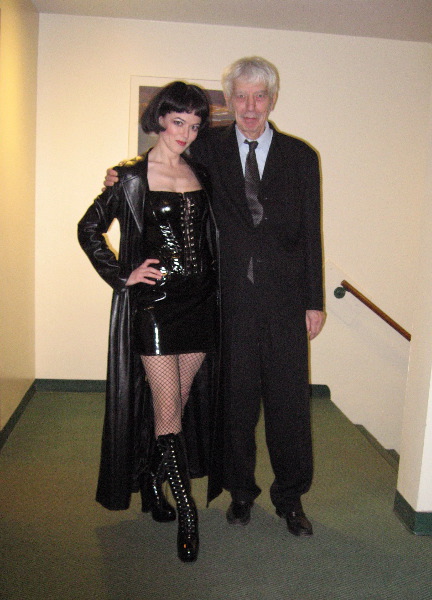
Barbara Hannigan in costume backstage with conductor Reinbert de Leeuw after a performance of Ligett’s “Mysteries of the Macabre” in Lincoln Center, New York.
The conductor Simon Rattle, in town for work with the academy and Ms. Hannigan, made a brief cameo appearance, stalking down the aisle to take the stage and interrupt the performance with the immortal spoken line “What the hell is going on here?” It was all in good fun, as was Ms. Hannigan’s performance, though no one tried to answer that question.
How far will — or can — Ms. Hannigan take this new venture as she maintains a busy singing career? To opera? To Mahler symphonies?
That remains to be seen. But to the extent that sheer musicality and personality can do the trick, she seems to have it all, and you probably wouldn’t be wise to bet against her.
The Lucerne Festival runs through Sept. 14; http://www.lucernefestival.ch.

 Robin Engelman
Barbara Hannigan redux
Her Hands Lead, Her Voice Follows. Barbara Hannigan Sings and Conducts at the Lucerne Festival
By JAMES R. OESTREICHAUG. 19, 2014
In fact, barring the need for surgical removal of an appendix, the hands and arms can be an even bigger problem, since they are inescapably visible. Aspiring vocalists may take years to learn to use their hands expressively or, alternatively, to keep them out of mind, if not out of sight.
Barbara Hannigan, a superb and versatile Canadian soprano, has found another use for her hands and arms. At 43, she is developing a second career, as a conductor, and she seems to be stealing shows around Europe with some regularity, as she did here on Saturday in a late-night concert with the Mahler Chamber Orchestra at the KKL Concert Hall as part of the Lucerne Festival.
This sort of career realignment is rare among singers. Ms. Hannigan cites the parallel example of the French contralto Nathalie Stutzmann, who conducts and often sings at the same time.
The tenor and baritone Plácido Domingo is the best-known example of a classical vocalist who conducts regularly, though typically in the opera pit, where he is not singing at the same time.
But why not do both on the concert stage? Ms. Hannigan sees no reason not to, arguing that singers actually have an advantage over instrumentalist-conductors who play along with an orchestra: precisely that availability of hands and arms, otherwise idle, to lead the band.
“You sing like a conductor,” colleagues used to tell Ms. Hannigan of her musical personality and stage manner, she said in an interview on Sunday. And you can see some of that when she conducts while singing.
In three splendidly delivered Mozart arias here, her beating of time and cues to players often seemed mere amplifications of expressive gestures she might have made anyway. Since much (most?) of a conductor’s job takes place in rehearsal, she was able to leave a lot of the last-minute coordination and balancing of parts to the concertmaster.
Colleagues have also told Ms. Hannigan that her arm movements are particularly expressive, she said, and this, too, was borne out in her conducting of purely instrumental works: Rossini’s “Scala di Seta” Overture, Ligeti’s “Concerto Romanesc” and Fauré’s “Pelléas et Mélisande.” Her arms seemed fluid, elbowless entities, shoulder to wrist, evoking curvilinear waves of sound, and she did not use a baton.
This is one reason that Ms. Hannigan, unlike many other female conductors, chooses not to shroud her arms, or her femininity as a whole, in, say, a dark suit. She wore one for her conducting debut, at the Théâtre du Châtelet in Paris in 2010, and that was the last time.
“I thought, ‘I never wear a suit to sing,’ ” she said. “ ‘Never, ever. That isn’t my uniform.’ ”
She decided that from then on, she would wear “something that suited the music, suited the program,” she said.
For her concert on Saturday, she wore a glittery knee-length sheath until the grand finale, Ligeti’s “Mysteries of the Macabre,” a series of high-flying arias drawn from the composer’s nonsensical opera “Le Grand Macabre.” Ms. Hannigan, a specialist in modern and contemporary music who recently won great acclaim in productions of Berg’s “Lulu” and George Benjamin’s “Written on Skin,” has made this work — which she has sung often — her calling card.
She says she now sings it only when conducted by the English maestro Simon Rattle, a frequent and favorite collaborator, or — more often — herself. She performs it in vampy black leather, high-heeled platform boots and a wig, and inevitably brings the house down, as she did on Saturday.
Mr. Rattle has mentored Ms. Hannigan and sent her to the wizardly Finnish maestro and pedagogue Jorma Panula, who, Mr. Rattle says, came out of retirement to guide her.
“We’ve only worked together for eight or nine years,” said Mr. Rattle, who is in town to work with students of the Lucerne Festival Academy, “but it quickly became apparent that she is one of the best musicians out there. When she brought up the notion of conducting, I was surprised but not staggered. It seemed a fairly normal thing to do.”
A latecomer to conducting, Ms. Hannigan now faces the challenge of building up an orchestral repertory while maintaining a busy singing career in Europe and expanding it in North America. But Ms. Hannigan, with musicality to burn, says she is in it for the long haul.
“Conducting is now 20 percent of my schedule,” she estimated. “Eventually it will be 50-50, and then I will only conduct.”
She looks to tackle bigger orchestral works, with Mahler’s Fourth Symphony in the offing. (Ms. Hannigan will sing the soprano solo in the finale of that work in a performance here on Sept. 6, with Matthias Pintscher conducting the Lucerne Festival Academy Orchestra.)
She also looks to conduct opera, with Stravinsky’s “The Rake’s Progress” being a possible starting point.
For her and audiences alike, it promises to be quite a ride.
Posted by robinengelman on August 21, 2014 in Articles, Commentaries & Critiques, Contemporary Music
Tags: Barbara Hannigan, conducting