
Variations III, No. 14, a 1992 print by Cage from a series of 57.
Long before I met John Cage, there was a wash of popular scuttlebutt clinging to him. He was one of the 20th centuries’ most talked about musicians. Cage was a man whose name my teacher refused to speak. During my first year of college I suggested performing one of Cage’s percussion works and his response was a withering look that shivered my timbers.
That was in 1958. I had not seen a photograph of Cage nor heard any of his music. My ignorance was rectified somewhat in 1960 when I saw Cage on the television show I’ve Got a Secret. Cage’s secret was “I am going to perform one of my musical compositions. And he did. It was Water Walk (1959) and the performance can be seen on You Tube. [1.] My teacher had certainly known about the infamous “silent piece”, 4’33” .(1952) His objection to Cage, though never voiced, made some sense considering his academic rectitude,.

Set-up for Water Walk.
As time passes, a chronology of life’s events can become skewed. I cannot remember how or when I first met Cage, but I do recall an after concert reception in someone’s Toronto home where most of us, including Cage, were seated on the floor. Nexus had just released a recording and I offered a copy to John who said, “I don’t like recorded music, but I’ll donate this to the University of Chicago Library.” On another occasion, a casual hello may have passed between us during a Percussive Arts Society International Convention (PASIC) in Ann Arbor, Michigan. (1984) I remember Cage having a meal with Percussion Group Cincinnati, which may not have been their name at the time. As they left the restaurant, a greeting might well have passed between us.
I know I met and spoke with him at length during a Celtic Festival in Toronto when he performed ROARATORIO (1979) with a wonderful group of Irish musicians including Paedre Mercier and his son Mel playing Bodhran.[2.]

John Cage, Paeder Mercier and R.E. during a Celtic Festival party in Toronto, Ontario, Canada, 1982.
Convocation Hall on the campus of the University of Toronto was the venue for ROARATORIO, January 29 and 31, 1982, and as a warm-up, members of Nexus played Third Construction (1941) while John and Merce Cunningham sat first row center. As might be expected, it was a very special performance. Afterwards we congregated backstage to share the moment. Merce was crying. “I have not heard this since I played the first performance. This is the part I played” he said to me, referring to my Lion’s roar, ratchet and maracas etc. Cage said, “I didn’t think the piece was so clear”.[3.]
In 1984, I was one of four conductors in Cage’s Dances for 4 Orchestras. [1982] Convocation Hall is circular with a balcony and the orchestras were positioned in various places with mine on the main floor stage. As conductor of Orchestra 1, it was my duty to begin the piece. I gave a downbeat and almost immediately the hall’s cavernous space was cleaved by a raw edged sarcasm. “Robin, is that what you call piano?” From a distant balcony, it was Paul Zukovsky in high dudgeon. Cage came to my rescue with his distinctive, mellifluous voice,. “I think it’s soft enough Paul.” [4.]
For a television show, I had recently conducted in full symphonic dress, an orchestra of 25 automobiles performing O Canada in a stadium with their horns. Someone told Cage about seeing a newspaper photograph of this event and Cage asked me for a copy which I gave him during our first rehearsal. He was delighted.
Before leaving Toronto’s Celtc Festival, I must mention the great Celtic harpist, singer and historian, Gráinne Yeats. She was married to Michael Yeats, the son of poet and playwright William Butler Yeats.(1865-1939) I had the honor of improvising music with Gráinne for the W. B. Yeats play Cuchulain. Gráinne explained much to me about the Celtic or Irish harp history. For instance,Irish warriors fought naked and were driven to fighting frenzy by the sound of the harp. She also casually mentioned her father-in-law sitting on his porch composing poetry by humming. This past March, 2013 I phoned Ireland to speak with her but she was too frail for a phone conversation. Gráinne died 18 April, 2013.
Part of the lore surrounding Cage was his tolerance for and acceptance of accidental sounds occuring during performances of his music. It was this “anything works” dictum that I accepted as truth. Nexus members, Bob Becker, Russell Hartenberger and I, played his work Amores (1943) in 4 movements for Prepared piano and 3 percussionists 7 October, 1977. The opening movement for Prepared piano is followed by two movements for percussion trio. Cage was again in the audience and our first , the 2nd movement, was a stunner. The audience spontaneously applauded after the last note. When all had settled down, we were ready for the third movement when the pianist began playing the last. Cage rose from his seat and slowly made his way to the stage. He whispered to the pianist, “the percussionists have another movement to play”. Embarrassed, the pianist stopped playing and when Cage was once again seated, we continued on. So much for urban myths.
I participated in Musicircus, Cage’s 75th anniversary celebrations during the Los Angeles Festival (12 September,1987) and was asked to play in “but what about the noise of crumpling paper etc.” (1982) [5.] I believe John prided himself on his penmanship and clarity of expression. He approached me during the first rehearsal and complained about my not playing the way he had explained in his performance note. He was, for Cage, quite exercized and I was apologetic. I told him I had read his note and was conscientiously playing as I had understood it. He told me what he wanted and that was that. After the evening performance John approached and said,” You were correct. I reread my note and there was a missplaced comma which I have moved to its proper place.” Alas, I never asked him to show me the revision.
Nexus played Branches (1976) for a Cage celebration at the Kennedy Center in Washington, D.c. (17 November, 1982) We discussed Cage’s performance notes which I understood to mean each of us was to toss the iChing coins to determine how we would interpret our parts. One of our head strong members objected to this reading and insisted we toss the coins just once to arrive at a group interpretation. We tossed one series and played. Cage later said, “Nexus does things their own way. They played Branches linearly, not the way I intended.” Upon reading this, my respect for Cage blossomed and as well, his comment provided me an ah ha, I told you so moment.

During the writing of an article about percussion ensembles in North America, I called John at his home in New York City. After the usual greetings, I asked him if he had invented the percussion ensemble as we in North America knew it. He said he did not. “It was in the air” he said. Continuing, ” I suppose I was the first to have an ensemble that rehearsed regularly. That was to play my music.”
Nexus spent an afternoon in Amsterdam shopping for cactus, an adventure that blew away my mid tour doldrums. Local technicians provided exceptionally sensitive contact mics and a very good sound system. All the prep was for Child of Tree.(1975) After our evening performance of Child of Tree, an audience member with bravura vocal chords, called out “Bullshit”. After moving to our next set-up, I looked at the audience and said,”Cactusshit”. Next day, that was our concert review headline.
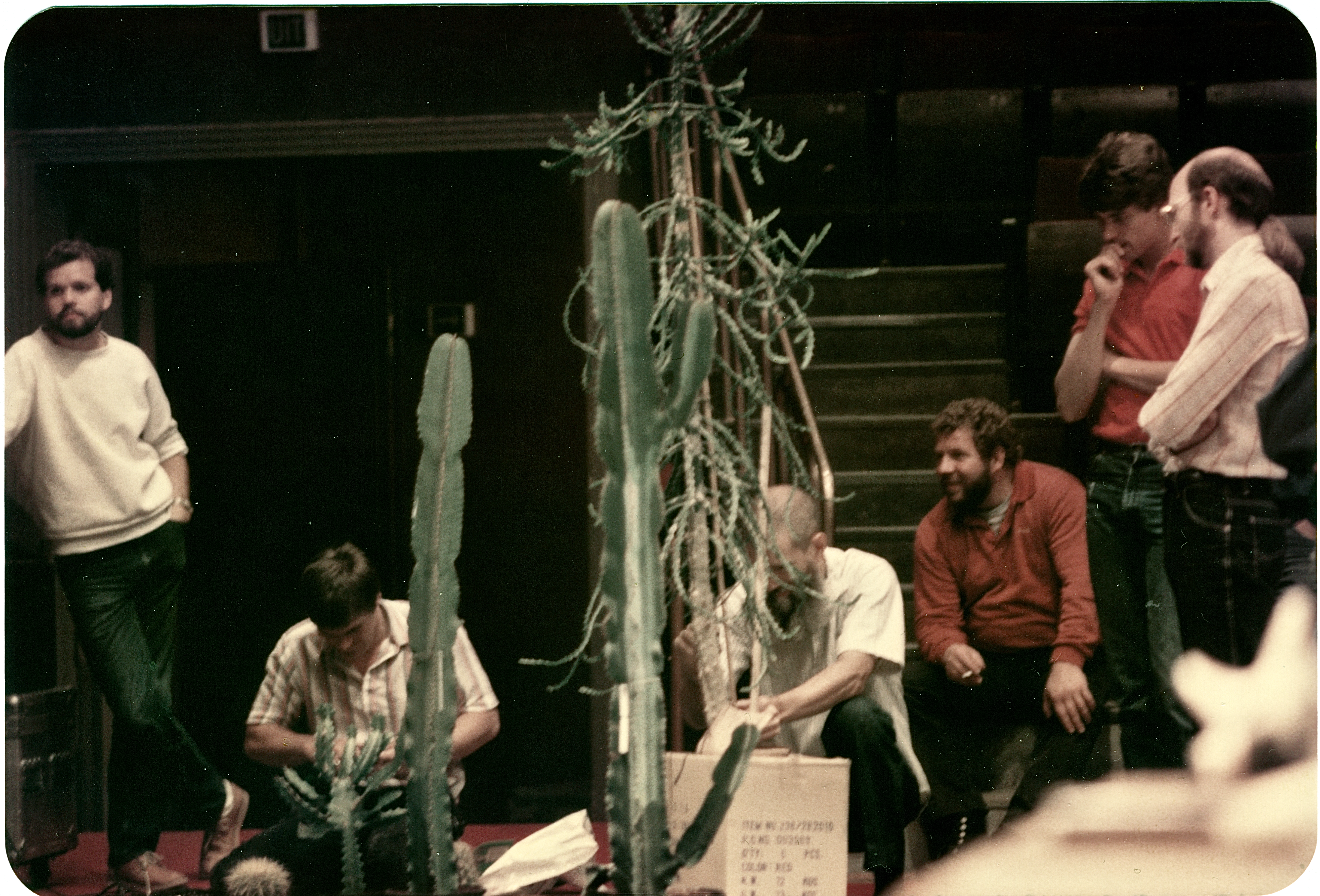
L. to R. Our roady,, Dave Campion, R.E., John Wyre, 2 technicians, Bob Becker.
ASLSP, for piano or organ (January 1985). This experience with Cage is related on this site in my article: John Cage Goes As Slow As possible in Halberstadt, Germany.
[1.] http://www.youtube.com/watch?v=SSulycqZH-U
[2.] Before Paeder left Toronto, he sold me his Bodhran and gave me a couple of lessons. Years later we were scheduled to meet in Liverpool, but his brother’s death called him home. We never met as Paeder himself died a year or two later. One can hear Paeder’s wonderful playing on early Chieftain recordings.
[3.] Cage limited his critique of our performance to the almglocken used in place of the Cow bell. “I had in mind an old farm cowbell. This sounds too pure.”
[4.] Paul Zukovsky and I remain long distance friends. He now lives in Hong Kong. From my perspective, his major contributions to 20-21st century music are his interpretations of violin music, his conducting and the Musical Observations Inc. CP2 digital recordings which he owns and which demonstrate both his playing and conducting skills. Nexus recorded Jo Kondo’s Under the Umbrella for CP2, each movement recorded in one take, no edits. Paul also conducted and recorded the Cage Sixteen Dances (1982) also available on CP2. Nexus played the latter work with Paul in Toronto, 30 Jamuary, 1982, ( during the Celtic Festival) 15 November, 1982 in Symphony Space, New York City and two days later on the aforementioned Kennedy Center concert, November 17..
The CP2 catalogue consists of 18 splendid CDs encompassing works from our two most recent centuries. All containing rare musical gems played and produced with the highest professional standards.
http://www.musicalobservations.com/recordings/index.html
[5.] The complete title: But what about the noise of crumpling paper which he used to do in order to paint the series of “Papiers froissés” or tearing up paper to make “Papiers déchirés?” Arp was stimulated by water (sea, lake, and flowing waters like rivers), forests, for percussion ensemble (August 1985).

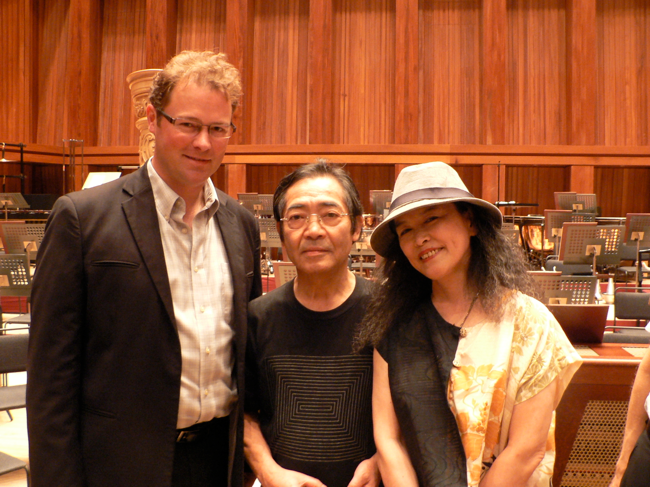
 Robin Engelman
SCENES from ARRAY MUSIC HALL
Scene I, 15 December 2013.
The televised concert specials from New York City are predictable. They feature everyone I’ve heard before and didn’t want to hear again. Over and over, the same pastiche of music hall tripe, broadway warbles and symphonic war horses featuring the only pianist, cellist and singer in the world.
On the Toronto home front, creators of concerts besides being more modest, have considerably fewer formulaic thoughts and produce resoundingly successful entertainments of high artistic merit without Big Apple budgets, celebrity hype and hyperbole.
Case in point, the recent Array Music Benefit, 15 December www.arraymusic.com. My ticket to ride included dinner! All delicious and all prepared by Array Music supporters and staff. The best chicken wings I’ve tasted in this hockey, wing and beer society and that’s saying a lot. Array space was set up cabaret style with tall round tables and scattered seating. The entertainment was in three short, but riveting parts, each followed by ample time for drinks, eats and schmoozing.
Though Marie Joseé Chartier is known for her choreography, dancing and leading her own dance company, http://www.chartierdanse.com, she is also no mean chanteuse. Marie Joseé sang two a cappella songs. The first one, during which she flirted with me, was by Rogers and Hart, Everything I’ve Got, made famous by Blossom Dearie. The second was La Vie en Rose, the Edith Piaf hallmark. Moving with ease through and around her audience in a wispy white floor length dress, Ms Chartier made both songs memorable with enchanting, unaffected performances.
Patricia O’Callaghan, www.patricia-ocallaghan.com, sang Zu-Potsdam Unter Den Eichen by Kurt Weill and Wonderful Widow of Eighteen Springs by John Cage. Reading Wikipedia I learned O’Callaghan was an exchange student in Mexico when she decided that rather than becoming “either a rockstar or a nun” she would combine both these ambitions by becoming an opera singer. This non sequitur in and of itself endeared her to me. She studied opera singing at the University of Toronto and became infatuated with cabaret music. I think her voice is lovely and she is a fine musician. Wonderful Widow of Eighteen Springs was the best of many I’ve heard over the years- true to the score with no vibrato and rendered in time, the closed piano accompaniment played clearly and with delicate authority by percussionist David Schotzko. A beautiful taste of Cage and an example of impeccable ensemble performance. Schotzko also played drumkit on the Weill and Gregory Oh played piano normally.
In the midst of the evening Array Music Artistic Director, percussionist and composer Rick Sacks sang his Rap styled song I Does Art , written in response to a long forgotten uproar over some art censorship in Toronto during the early 1980s. Rick continues to surprise me. I love this song and its performance was reality itself, both poignant and humorous. I learned he had at least three more songs in his oeuvre and if they are anywhere near as good as I Does Art, he needs to record them.
Three delightful songs by Allen Cole were next: Falling in Love with You and the Clam Song, both from an Array Music commission titledThe Wrong Son; and The Girl in the Picture from The Girl in the Picture, another Array Music commission. Patricia O’Callaghan sang Falling in Love with You and The Girl in the Picture accompanied by Greg Oh at the piano. The Clam Song was sung by Rick Sacks with accompanyment by David Schotzko on bongos and wood block.
The entire evening was a culinary, social and musical success. Sacks has plans for the Array Music space infrastructure, including among other things, HD audio and visual recordings of concerts and an elevator. Array Music is just three blocks from my home so it is taxi and TTC free. A boon by any standard. It is becoming the venue of choice for some of Toronto’s most interesting and talented performers.
My wife and I joined two friends for an early dinner at Boland’s Open Kitchen on New Year’s Eve. Our easy patter lighted upon art galleries in Toronto and I admitted to being an infrequent visitor, knowing little about today’s artists and their output. One of our dining companions, Joanne Tod, is a well established and successful Canadian artist presently specializing in portraiture though during her long career, she has created work in many mediums. Joanne is a regular art gallery visitor, but opined that many young artists latch onto the latest fad and stay there, unable or unwilling to take risks. Assuming the role of music critic, I offered pretty much the same opinions about some keyboard percussion music.
Scene II, 9 December, 2013.
The concert given in Array Music by Dan Morphy, his duet partner Ed Squires and TorQ colleague Adam Canpbell, www.torqpercussion.ca began with Eric Richards’ The Unravelling of the Field arranged by Dan Morphy for two vibraphones from the original score for one pianist playing from two grand staves in four simultaneous, but different tempi. This work has been performed with many combinations of resonant percussion instruments, all, including Morphy’s rendition, engaging and musically satisfying in every respect.
Following the Eric Richards work were the four keyboard percussion pieces that prompted my comments to Joanne Tod, . For the most part, they were based on patterns as if influenced by the music of Steve Reich. Reich himself was influenced by percussion music and percussion technique, so the composers of these works, all trained percussionists, are condemned to comparison with the more famous works of Reich, whether or not he had any influence at all upon them.
It’s the patterns that plug my ears. Pattern music is aggravating because of their forms, usually A-B-A with no attempt at transitioning. The rhythms, though sometimes complex, are laid out like dictionary entries, one riff after another, often without any discernable relationship and interminably long. The harmonies are simplistic, without any frisson to tweak one’s ears. No more than a measure goes by before I sigh, slide a bit in my seat, get comfortable and wait for the end. A sort of trans Pacific flight mentality.
There is a sub text to the foregoing. Years ago I visited the emminent percussionist John Beck in his studio at the Eastman School of Music. John was working on a Henry Cowell trio I had recently played that contained a prominent xylophone part. John said the part was difficult to learn because it contained no patterns. I held my tongue because its lack of patterns was precicely why I had found it easy to learn. I had the same experience with the xylophone part in Messiaen’s Oiseaux exotiques. Seiji Ozawa once turned to me and asked, “Is the xylophone part to Oiseaux exotiques difficult?” I knew he had scheduled the work for his orchestra on an up coming concert and knowing patterns to be every drummer’s raison d’etre, I had to hesitate before answering “No”.
After intermission came the music of Ken Shorley www.kenshorley.com. Ken Shorley, a percussionist and composer new to me, is a former student of Trichy Sankaran, a master of Karnatik music who teaches at York University in Toronto. As Shorley announced, his compositions are influenced by the classical music of South India. He incorporates the vamps or brief motifes used by mridagam players in extended solos, but only as starting points. His works are not arrangements. They are fresh, inventive creations which to a great degree, conceal their heritage. There were moments of surprise, delightful quirks. I never had the sense that Shorley was padding his music. This was clean and lean music trimmed of fat and artifice. And they were all played from memory by Shorley, Adam Campnell and Dan Morphy.
Music of Ken Shorley:
About Time (tambourine trio) – 2011
Helix (darabuka, frame drum, caxixi/tala bells) – 2012
Three Into Five (frame drum trio) – 2002 (rev. 2012)
Cobra (gongs, bells, frame drum) – 2012
Sarvalaghu (solkattu, jawharp) – 2011
Root Cellar (wastebasket, triangles, tin cans, shakers) – 2011
The Bright Side (darabuka, riq, cajon/caxixi) – 2010
Monk’s Drum (darabuka trio) – 2011
Posted by robinengelman on December 19, 2013 in Articles, Commentaries & Critiques, Composers, Contemporary Music
Tags: Allen Cole, Array Musyc, Gregory Oh, Joanne Tod, Ken Shorley, Marie Joseé Chartier, Patricia O’Callaghan, Rick Sacks, Toronto, TorQ