RSS

Category Archives: Articles

BERLIOZ

Hector Berlioz in 1863.

This is the third article in a series devoted to aspects of composers’ works and lives not generally known by average concert goers.  Perhaps these articles will encourage readers to dig further into the life and times of other composers.

As a youngster I began my survey of Western music with Beethoven and his 9 symphonies. Toscanini was at his peak of popularity and his LP recordings for RCA Victor with the NBC Symphony Orchestra were thought by many people to be the definitive interpretations of these works. I stayed with Beethoven for a long time. After sessions of listening to Beethoven’s late quartets, I attended a lecture by Louis Krasner 1who said of the quartet op. 135, ” When man first lands on the moon, they will hear the opening music of this quartet.” Ten years later they landed but I don’t know what they heard or what Krasner thought about the event.

Later I decided to educate myself in a linear manner by going back to Bach, then Handel, Haydn, Mozart, Beethoven, Tchaikovsky, Brahms, Debussy and Ravel. Note the leap from Beethoven to Tchaikovsky.  No Schubert, no Cherubini, no Rossini, no Mendelssohn and no Berlioz.

I can think of no good reason for my omission of these great composers.  I knew Schubert’s “Unfinished Symphony” was unfinished, Cherubini’s “Requiem” contained a tam-tam note, Rossini had written the music for  the Lone Ranger and Mendelssohn’s  “Midsummer’s Night Dream” had a great overture. But Berlioz did not figure into my mix until later.

When I learned the “Symphonie Fantastique” was written in 1830, just 7 years after Beethoven’s last string quartet and two years after Schubert’s death, I was stunned. To me their works sounded light years apart. As distant from one another as 19th century Vienna and Apollo 11.

Berliozs manuscript, frist page of Symphonie Fantastique.

Berliozs manuscript, first page of Symphonie Fantastique.

I have never forgotten the the first time I heard those plaintiff opening woodwind triplets nor the intense longing of the following violin melody. But those were only the first few notes of an entire symphony of longing and struggle. Berlioz wrote, “melancholy is necessary for a composer”.

I first heard the work live in Carnegie Hall, New York City with the Boston Symphony Orchestra conducted by Charles Münch.  (Vic Firth played the principal timpani part in his inimitable style.) My only disappointment came during the “Witchs Round Dance” which is in a fast two beats to the bar. At one point all strings and winds play  chords in unison rhythm, off set by one eighth note from the prevailing beat and are joined four measures later by the brass and timpani playing the same syncopation, but one eighth note earlier. These eight measures of three against three against two create an exquisite tension which I had anticipated with glee.  But Münch chose to conduct the brass and timpani measures in three four. He played safe and a teeth grinding moment became too smooth by half. However, this disappointment was offset by the artistic cymbal playing of the late Tommy Thompson. 2

Joseph Jean-Baptist Laurent Arban (1825-89) 3.was a cornet teacher, soloist, conductor and composer  who in 1848 developed with Adolph Sax a cornet which met his standards for ease of play and intonation. It could have been around this time that Berlioz, who had certainly heard Arban perform, decided to add a cornet part to the “Waltz” (Un bal) of “Symphonie Fantastique”. Some may consider this a case of gilding the lily. I think the cornet adds some bravura which is not out of place. It transforms the “Waltz” without distorting its lovely motion. The recording I own and the only one I know with the cornet part was made by Jean Martinon and the Orchestre de National l’ORTF on EMI in 1973. The CD transfer is excellent and the performance is expansive, musical and one of the two best recordings in my collection.

It was the improvements in brass instruments by Adolph Sax which gave Berlioz the courage to write his monumental “Grande messe des morts” (op.5, 1837), containing four antiphonal brass choirs and multiple winds. When I was in Paris, too long ago, I visited Les Invalides and entered the chapel of Saint-Louis-des-Invalides (1679), where the premier had taken place. Upon entering the chapel and finding myself alone, sang in my most stentorian voice, one of  the tenor parts in “Dies Irae, Tuba mirum spargens sonum”, etc. A personal oblation to one of my heroes. Near the end of his life Berlioz told some friends,”Of all my works I wish the Requiem to survive”. My favorite recording of this work was made by Hermann Scherchen in the chapel of Saint-Louis and the vinyls were later transfered to CD with disastrous results. The diffused rhythms of the antiphonal choirs and the cavernous roar of bass drum, timpani and tam-tam were completely lost.  Sadly, Scherchen’s recording is out of print though one might find it among sellers of rare recordings.

During my college days a teacher who understood my proclivity for grand gestures suggested I look at the Berlioz “Treatise on Instrumentation”. The Treatise had first been published in 1844. ( It is now available from Amazon with edits by Richard Strauss.)  Another Berlioz moment awaited me near the very back of the book, his article titled “The Orchestra”. In this portmanteau of  revolutionary ideas Berlioz encapsulated his instrumental and musical dreams; how I wish he could have realized them.

A choir of460 voices and:

An orchestra of 465 instrumentalists including 12 pairs of ancient cymbals in different keys *, 30 pianofortes and 30 harps, 8 pairs of kettledrums, 6 drums, 3 bass drums, 4 pairs of cymbals, 6 triangles, 6 sets of small bells *, two large very low bells, 2 gongs, 4 crescents.

Berlioz imagines “combining the 30 pianofortes with the 6 sets of small bells, the 12 pairs of ancient cymbals, the 6 triangles (which might be tuned in different keys like cymbals), and the 4 crescents into a metallic percussion orchestra-gay and brilliant expression in mezzo forte; by combining the 8 pairs of kettle drums with the 6 drums and the 3 bass drums into a small, almost exclusively rhythmic percussion orchestra-menacing expression in all shadings; by combining the 2 gongs, the 2 bells and the 3 large cymbals with certain chords of the trombones-sad and sinister expression in mezzo forte.”

* these are described in the percussion instruments section of the treatise.

The last article in his treatise is devoted to conducting and contains his thoughts on the role of conductor and patterns for beating different time signatures. He talks about technical issues with certain instruments. Berlioz was better known in his lifetime as a conductor not a composer. He conducted in France, Germany, England and Russia as well as other countries. He conducted concerts having as many as 1000 performers. Berlioz and Wagner had met in Germany and in fact had discussed conducting. It is ironic that “Wagner on Conducting” by Richard Wagner was first  published in 1869, the year  Berlioz died.4

The influence of Berlioz was critical for the further development of Romanticism, especially in composers like Richard Wagner, Nikolai Rimsky-Korsakov, Franz Liszt, Richard Strauss, Gustav Mahler and many others.

Berlioz destroyed many papers prior to his death, but kept a baton given him by  Mendelssohn  and a guitar by Paganini. On his death bed to friends attending he was reputed to have said, “At last they will play my music”.

Hector Berlioz ( the Z is pronounced),  born La Côte-Saint-André, December 11, 1803 –died Paris, March 8, 1869.

Footnotes:

1. Louis Krasner  (1908-1984) played the premiers of both the Alban Berg (1936) and Schoenberg Violin Concerto (1940). He commissioned the Berg (1935) and its premier was given in Barcelona, Spain. The Schoenberg was premiered with Stokowski in Philadelphia. Krasner also commissioned American composers Henry Cowell, Roger Sessions and Roy Harris. His lecture at Ithaca College, Ithaca, New York was given before the music students and staff in 1959.  At that time he was a professor at Syracuse University having previously served as concert master of the Minneapolis Symphony Orchestra under Antal Dorati (1906-88).

2. Many years later in Tanglewood, I was fortunate enough to  sit at a table with Vic Firth and the other guys in the percussion section of the Boston Symphony. The conversation turned to Tommy Thompson and I asked everyone to confirm whether or not my memory of his simple yet exquisite playing in “Symphonie Fantastique” was correct or had I transmogrified this youthful vision into something mythological. I was gratified and amazed when everyone confirmed my old impression. Vic even demonstrated Tommy’s motion. Thompson was able to play fortissimo cymbal crashes with no more gesture than he used for pianissimo.  Thompson’s playing can best be heard on a recording of Tchaikovsky’s “Romeo and Juliet Overture” conducted by Arthur Fiedler. I am fortunate enough to have the beautiful sound of the original LP release. Thompson was a cymbal playing giant. I wonder how many people now living remember him or ever heard him play.

3. Arban’s “Grand Method for the Cornet ” was first  published in 1864. It is a treasure of musical and technical demands well suited for marimba and xylophone sight reading and recital pieces.

4. “Wagner on Conducting”, Richard Wagner, translated by Edward Dannreuther,  Dover Books.

Written almost 150 years ago, this book contains a paragraph of wisdom equally applicable to today’s percussionists as well as conductors:

“As a proof of my assertion that the majority of performances of instrumental music with us are faulty it is sufficient to point out that our conductors so frequently fail to find the true tempo because they are ignorant of singing.  I have not yet met with a German Capellmeister or Musik-director who, be it with good or bad voice, can really sing a melody.  These people look upon music as a singularly abstract sort of thing, an amalgam of grammar, arithmetic, and digital gymnastics;-to be an adept in which may fit a man for a mastership at a conservatory or a musical gymnasium; but it does not follow from this that he will be able to put life and soul into a musical performance.” (page 19) Italics by Wagner.

 
2 Comments

Posted by on September 7, 2011 in Articles, Composers


Heinrich Ignaz Franz Biber von Bibern

This is the second article in a series devoted to aspects of  composers works and lives not generally known by average concert goers. Perhaps these sketches will encourage readers to dig further into the life and times of other composers.

Who was the first Western composer to write col legno for strings, the first to write in multiple keys simultaneously, the first to employ what is known today as a “Bartok pizzicato” and which composer first thought of weaving paper among the strings of a bass viol?

Not too long ago I would have answered in order, Hector Berlioz, Charles Ives, Bela Bartok and maybe Henry Cowell.  Now that I’ve discovered the works of Heinrich Biber , a man music historian Charles Burney named as the best violin composer of the 17th century, I know better.1 The discovery wasn’t my personal Olduvai Gorge, but it was an Ah Ha moment that made me re-evaluate aspects of my music school education.

The music of Heinrich Ignaz Franz Biber von Bibern expunged a trove of old ideas from my mind and led me on a delightful voyage of discovery through music of the late 17th century hitherto unknown to me.

Heinrich Biber is regarded by violinists, particularly aficionados of early music, as one of the most important composers for the violin in the history of the instrument. His technique allowed him to employ multiple stops in intricate polyphonic passages, and explore the various possibilities of scordatura or retuning.2 He also wrote one of the earliest known pieces for solo violin, the astonishing “Passacaglia”.3Paul Hindemith (1895-1963) proclaimed Biber the best Baroque composer prior to J.S. Bach.  As Biber’s other works had not as yet been discovered or printed, Hindemith’s evaluation was made solely on the strength of the “Rosary” or “Mystery Sonatas” (1676) which were unknown until their publication in 1905.

After first hearing Biber’s “Passacaglia”.4 I began to explore his music further. Therein I discovered his “Battalia” or Battle music and the 17th century infatuation composers had with war and the sounds of battle. All this more than100 years before the most famous, or infamous work in this genre, Beethoven’s “Wellington’s Victory” wherein Beethoven employed antiphonal bass drums, snare drums and wooden ratchets which simulated the cannonade, the march of soldiers and the rapid fire of muskets.

If Biber was not the first to hit strings with the wood of a bow or compose a work in eight simultaneous tonalities, or ask for pizzicatos forceful enough to snap the finger boards or weave paper around bass strings, he was way ahead of the guys my teachers had credited with first doing these things.
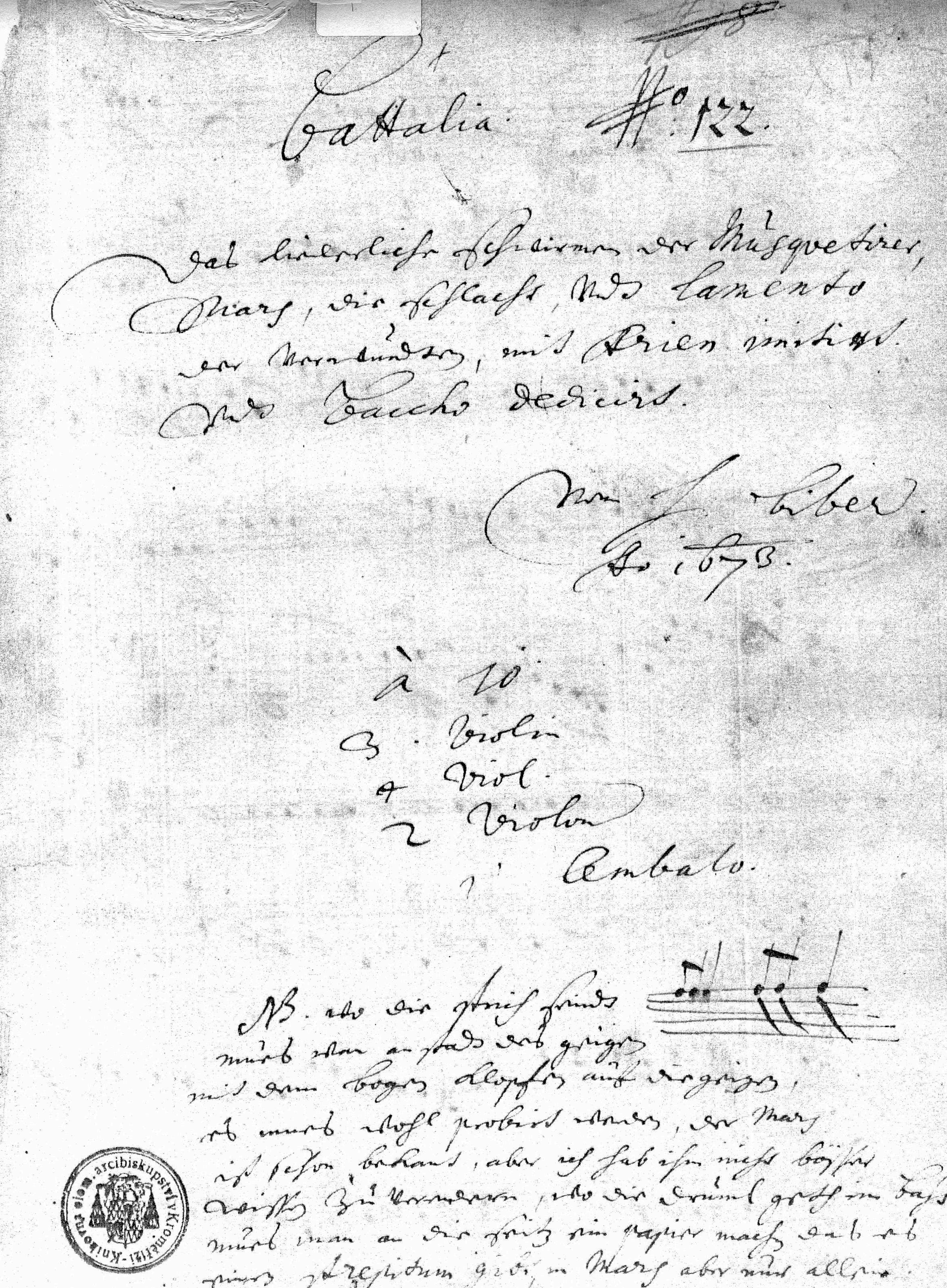
And all of those sounds Biber put in one work, “Battalia à 10” written in 1673.  Having the sound of musket and canon imitated by stringed instruments alone, Biber creates a battle experience more stimulating to one’s imagination then the literalism of Beethoven’s “Wellington’s Victory”, a television versus radio comparison if you will.

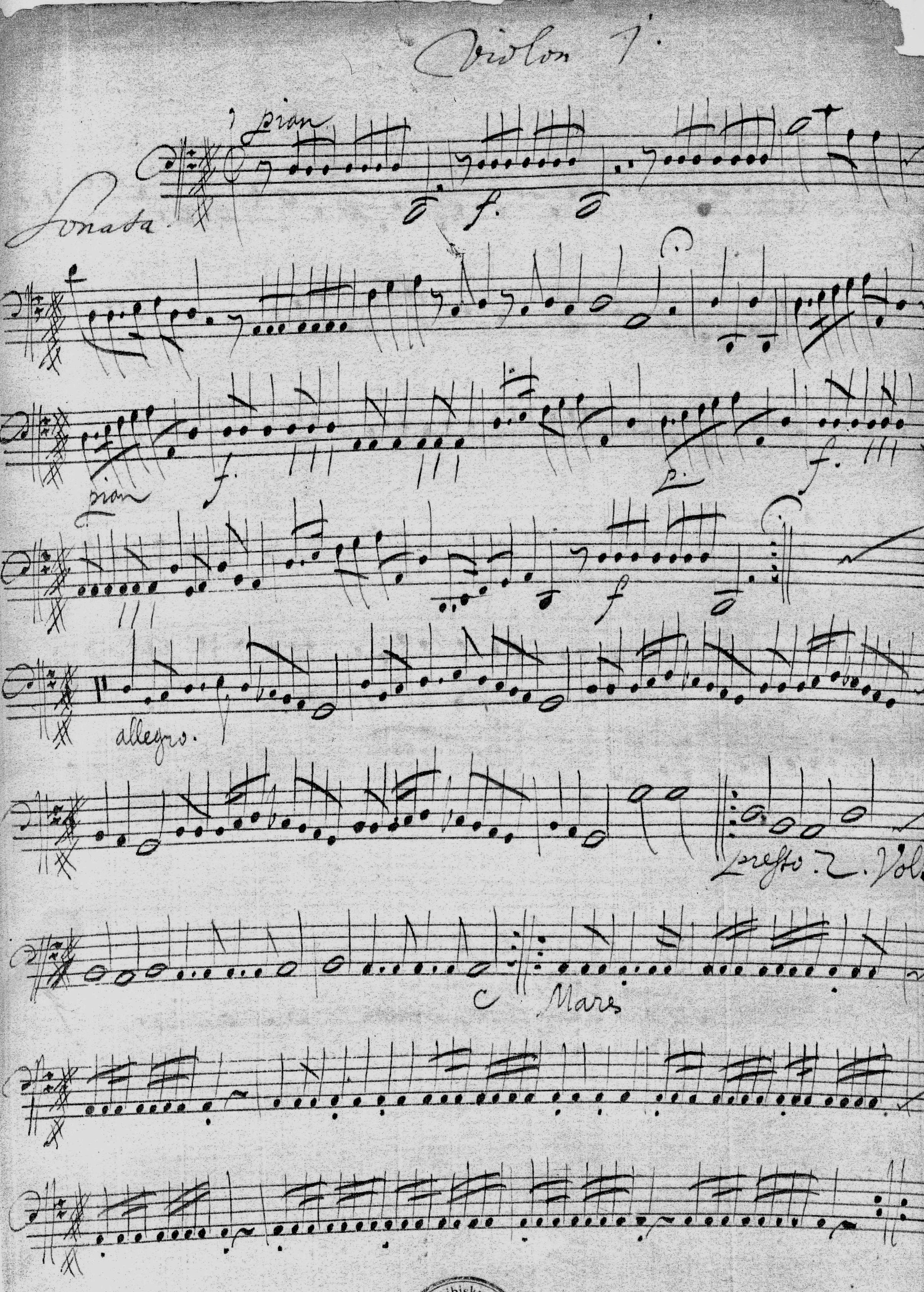
Biber’s “Battalia à 10” contains the following eight movements:   “Sonata” (col legno), “Die liederliche Gesellschaft von allerley Humor” (in eight tonalities), “Presto”, “Der Mars” (violin solo and bass viol prepared with paper and played col legno), “Aria”, “Presto” (Bartok pizzicatos), “Der Schlacht”, “Lamento der Verwundten Musquetierer” (lament for the dead soldiers).

As suggested earlier, Biber was not the only composer to delve into the 17th century’s infatuation with the Art of War. In fact, the genre appears to have begun in Italy during the 16th century. A more immediate predecessor of Biber was Carlo Farina (ca 1600-39), who in his “Capriccio stravagante” (1627) presages some of Biber’s compositional devices, with the use of folk tunes, short movements  alternating fast and slow tempi, drones ala bagpipes, sudden extremely discordant outbursts, simultaneous glissandi in various keys and col legno.

One commercial CD I highly recommend for those interested in exploring the military genre of the 16th and 17th century is ‘batailles”, with La Bande Montreal Baroque and Concerto Palatino. This disc includes eleven works devoted to battle music written between 1557 and 1673.  The performances are superb. (Also of interest is the sound and fluidity of Baroque trumpets played by Concerto Palatino.) This recording includes the Biber “Battalia à 10”.  A Jordi Savall CD is titled “Biber,Battalia à 10” also contains Biber’s “Requiem à 15 in Concerto”.

There are also two other  CDs of distinction. Both Biber’s fifteen “Rosary” or “Mystery Sonatas” 5 and eight other violin sonatas and “Romanesca” were recorded by Andrew Manza. Both two CD sets deserve a hearing, or two or three. When one hears these works one cannot help but compare them to Bach’s Sonatas and Partitas written a half century later.

Bach was a ‘systematic’ composer, that is, he was interested in form and harmony and his works could often be played on any combination of solo or ensemble instruments, whereas Biber to my ears was most interested in sound and advancing violin technique and expression.  (Listen to Sonata 10 of the Sonata CD.)

Heinrich Ignaz Franz Biber von Bibern, baptised, Wartenberg (Stráž pod Ralskem) 12 August 1644 – died Salzburg, 3 May 1704.

What has been will be again,

what has been done will be done again;

there is nothing new under the sun.

Ecclesiastes 1:9

1.  Charles Burney, (1726-1814)

2. The tunings used by Biber in his “Rosary”” or “Mystery Sonatas”.

With these tunings, a violinist fingers the passages as normally, but other notes sound.

3. Biber’s unaccompanied Passacaglia concludes the Rosary Sonatas and was written in 1676.  The three sonatas and partitas for solo violin by Bach were completed in 1720.

4.  The name “Passacaglia” is derived from two Spanish words Pasar ( to walk) and calle (street). In the first quarter of the 16th century Giroloma Frescobaldi refined the form. Later he invented the Chacconne.  A triple metre and bass ostinato are now considered two characteristics of both.

5.  Biber’s  sixteen “Rosary Sonatas”, each with its own name, are in three contiguous groups of five sonatas called Mysteries: “The Five Joyful Mysteries”, “The Five Soulful Mysteries”, “The Five Glorious Mysteries”  and end with “Passacaglia for Unaccompanied Violin”. The entire set is titled “The Rosary Sonatas”.  The first Sonata is called “The Annunciation” and the fifteenth, “The Beatification of the Virgin”.
A comparison of the Biber and Bach sonatas is enlightening. It is also worth noting that Leopold Mozart (1718-87)  published his famous “Violin School” in 1756,  83 years after the “Rosary Sonatas” and 52 years after Biber’s death.

Following up on Leopold and programatic music, in the next century Leopold was much concerned with a naturalistic feel to his compositions, his “Jagsinfonie” (or “Sinfonia da Caccia for four horns and strings”) calls for dogs and shotguns, and his “Bauernhochzeit” (Peasant Wedding) includes bagpipes, Hurdy Gurdy, dulcimer, pistol shots and whoops and whistles, ad. lib.)

Cover to Batallia a 10

Cover to Batallia a 1

Bass violon part to Mars, page 2.

Bass violon part to Mars, page 1.

Bass violon part to Mars, page 1.

 
Leave a comment

Posted by on September 4, 2011 in Articles, Composers


Tags: ,

ARRAY MUSIC, RIXAX

Rick Sacks

Rick Sacks

Last September 2010 Rick Sacks became the latest director of Array music, a Toronto organization that by mandate encourages and performs works by young Canadian composers. Sacks is also a composer, a trained percussionist, and a quipster – his e-mail address begins rixax. With little provocation, Rick can slide easily into New York City hip, an endearing persona much prized by friends and acquaintances.

Rick’s solo compositions are generally quirky, sometimes slap-stick funny theater pieces suited to his upbeat temperament. But like a Charlie Chaplin film they often carry another more serious message. Rick’s Life in the Factory which he performs in a working man’s overalls behind a conveyor belt filled with found instruments is a modern  percussionist’s take on Modern Times. This is all to say that Rick’s humor should not deceive. He is a man of many parts who also has a gift for promotion. In today’s economic climate, Rick’s promotional acumen may well benefit Array Music.

About thirty years ago, Canada’s federal government established a policy of Multiculturalism. All minority ethnic groups were encouraged to dress, pray, speak and act as though they were living in their native land. These groups subsequently asked for funds from government art budgets to subsidize their community initiatives.

As the government responded to their requests, the Art’s money pie was cut and served in ever smaller pieces. Here-to-for favored music ensembles devoted to a Euro-centric music tradition found themselves under funded and sometimes, in their eyes, under appreciated. Then came the added burden of the financial crisis of 2008.

Particularly sensitive to budget cuts were ensembles specializing in contemporary music. There are a half dozen ensembles in Toronto that perform four to six concerts a year. Their audiences have always been small and to a large extent government grants have kept them afloat. Ensembles such as Array Music responded to the financial crunch by reducing the number of concerts or by programming less expensive repertoire. But one of the most artistically bothersome problems inherent in government funding is a ritualized commissioning off Canadian composers.

The cycle of funding composers is simple and politically justifiable. In order to receive government money, ensembles must demonstrate a  commitment to Canadian composers. They must also apply every year for funds to commission new works and every year a new batch of compositions is created. Last year’s works are filed away and the cycle begins anew. No music is put into repertoire, rehearsed and performed beyond their premieres.

One of Rick Sacks’ first decisions as Director of Array Music was to expand upon an idea of former Array director Bob Stevenson.  Rick is searching through Array’s library of over 300 commissioned scores, collected during its forty-year existence for worthy, though forgotten works, and bring them once more to the public. This could ameliorate to a considerable extent the artistically frustrating and financially wasteful results of yearly commissions being relegated to file drawers.

The quality of contemporary music performance is exacerbated by the jobbing musician. Every ensemble in Toronto specializing in contemporary music is made up of players who work all over town playing all kinds of music. This and the fact that they rarely play anything more than once makes them good sight readers, but poor interpreters.  If they’re part of the busy elite, they rarely have time to hone the skills that brought them this far. A sight reading mentality and lack of rehearsal time become a way of life that produces uninspired concerts.

Established in 1971, Array Music, is housed in a rather crowded second-floor room that appears to be a former factory. Stacked against its walls and hanging from its beamed ceiling are the accoutrement of a well used rehearsal space : a variety of percussion instruments, music stands, a covered baby grand piano stacked with music, filing cabinets, chairs and a desk or two.  Array rents their space to other groups when it is not otherwise busy with its own projects.

Rick’s enthusiasm and commitment are infectious. There is an esprit de corps in this year’s Array ensemble that has been lacking since the death of Michael Baker, for eight years an inspiring director  who died young. Today Array’s performers are communicating their commitment and, just as important, pleasure.

Composer Linda Smith has also had a significant part to play in Array Music. Ms. Smith is a composer of considerable standing in Canadian arts. She is a Jules Leger Prize winner. She too was a director of Array and her musical and administrative skills were exemplified by a concert given late in the 2009-10 season. Linda chose the  concert repertoire. Each work was related in some way to other works on the program.

Along with innovations in repertoire, there were noticeable personnel changes in Array’s traditional group of seven players. It was all good and a couple of months later was followed by yet another successful concert.

Array Music has turned a corner and is now headed in a refreshed and creatively rewarding direction.

Recently Rick announced Array as recipient of an unsolicited grant of US $10,000 from the Lucerne Foundation of Switzerland. The work that attracted the Swiss was Array’s month long Young Composers Workshop. After a call for scores, Array selects four fledgling composers from anywhere in the world. They are brought to Toronto to work with Array instrumentalists and a mentor who is an established Canadian composer, and this year, Christopher Butterfield.  While composing a new work, they receive feedback from the professional players of Array, the resident composer and fellow students. At the end of the month their works are performed before the public.

I attended the most recent of these once a year concerts. Rick conducted the ensemble and introduced the composers who came forward to make brief statements about their works. Of the four compositions performed that evening two of them had real promise. An extraordinary percentage of success.

Rick is something of a workaholic. Besides administrative, conducting and performing duties with Array Music, he has recently joined the board of directors of New Music Concerts of Toronto and continues his non stop composing music for theatre.

During the month of July, 2011 he will be at the Banff Centre composing music for a new dance work in collaboration with Red Sky and New Zealand’s dance company Black Grace. With Red Sky Performance he toured the 2009 Cultural Olympiad (Beijing), the  2010 Vancouver Olympics and the May 2010 World Expo (Shanghai) with TONO a dance and music piece that received a DORA award in 2010 for best new music in a dance production..  Rick will be in Beijing, Mongolia and New Zealand this fall performing TONO.

Adventures of the Smoid, a new work written and composed by Rick in collaboration with the Evergreen Club Gamelan, premiered June 2011 features shadow puppets designed by Rick in association with David and Ann Powell of Puppetmongers. I went to this performance and was as usual delighted. He was commissioned by the Evergreen Club and the plot involves an astronaut, the Smoid, rocketed into space where he avoids strange asteroids, comes back to earth, falls in love, marries and has three children.

Everything Rick attempts is done with good grace , a keen imagination and a desire to entertain and inform. I’ve thought of suggesting he slow down, but a cup of black coffee is all he seems to need, that and the next project.

 
1 Comment

Posted by on June 15, 2011 in Articles, Contemporary Music