PROLOGUE to Examples of Snare Drum Notation:
I have studied military snare drum manuals published during the 18 and 19 centuries. They provide insights into the beats drummer’s played and the type of drum instruction available 100 or more years ago. They have their own personalities and the diaries written with quill pens, books printed with crude type, hand made paper, colorful, antiquated language and interesting notation provide glimpses into the life and times of their authors.
As I turned pages, I became fascinated with their unique and sometimes indecipherable notations. Had these been invented to assist drummer boys learning the military camp duties, boys who were often unable to read music, or had the teachers, grappling with the intricacies of a drum beat, been forced to invent their own notations, or both? But those theories didn’t make complete sense.
For example, music notation had become highly evolved and standardizeds during the Baroque era (ca. 1600-1750), well befor the first drum manual was published in America in 1810. An extensive set of symbols, particularly for keyboard and string music, was developed for embellishments ranging from single grace notes to trills and complex ornaments. Thomas Arne (1710-78) wrote in traditional notation, eight and five stroke snare drum rolls for March with a side drum in his Masque Alfred (1740).
So, why did teachers of the drum develope their own unique notation and sometimes nomenclature, while all the music surounding them was using a notation familiar today. I believe the answer is rather mundane. The authors wanted to sell books. It is interesting to note how often the words best, authentic, most, easiest, true, approved, complete, etc. appear on their front pages immediately after the title.
The war for independence had just ended and the tradition of local militiamen was still very strong. In New England where all of these books were written, every hamlet, village, and town maintained an armed militia and at least one fifer and drummer. This area of the United States was still sparsely settled particularly outside a large town such as Boston. Competition among teachers and teaching methods and rivalries between militias and their fifers and drummers must have existed, as they continue to do.
Today, Much effort has been expended by teachers and instrument manufacturers in attempts to standardize sound, methods and nomenclature. In Examples of Snare Drum Notation one will encounter not so much an evolution of the drummers craft as his independent spirit. As the reader will discover at the end of Part 3, there are drummers still marching to a different notation.
PART 1:
Until the early twentieth century, instruction books for snare drummers were written to conform with military protocol.1 These books contained names for drum strokes, signals for camp duty and field maneuvers, exercises or ‘rudiments’2, and often, appropriate tunes for fife, the instrument most commonly paired with the field snare or side drum. They did not tell drummers how the drum was played,3
Creating symbols for the snare drum strokes, signals and exercises, and staves upon which to put them, has occupied players and teachers of military drumming for at least 350 years. The examples of drum notation which follow, are arranged as closely as possible in chronological order and represent all extant drum manuals or fragments thereof in my possession from the period of time covered
1555? The first mention of military drum signals in English history, date from the reign of Queen Mary (1553-58). They applied to foot soldiers and were titled March, Alarm, Approach, Assault, Battle, Retreat and Skirmish. However, these seven signals survive as names only, no music notation for them is known to exist.4
1589. The earliest extant music notation for military drum is in Orchesography, a treatise on the honourable exercise of dancing by Thoinot Arbeau, published by Jehan des Preyz, Langres, France.5
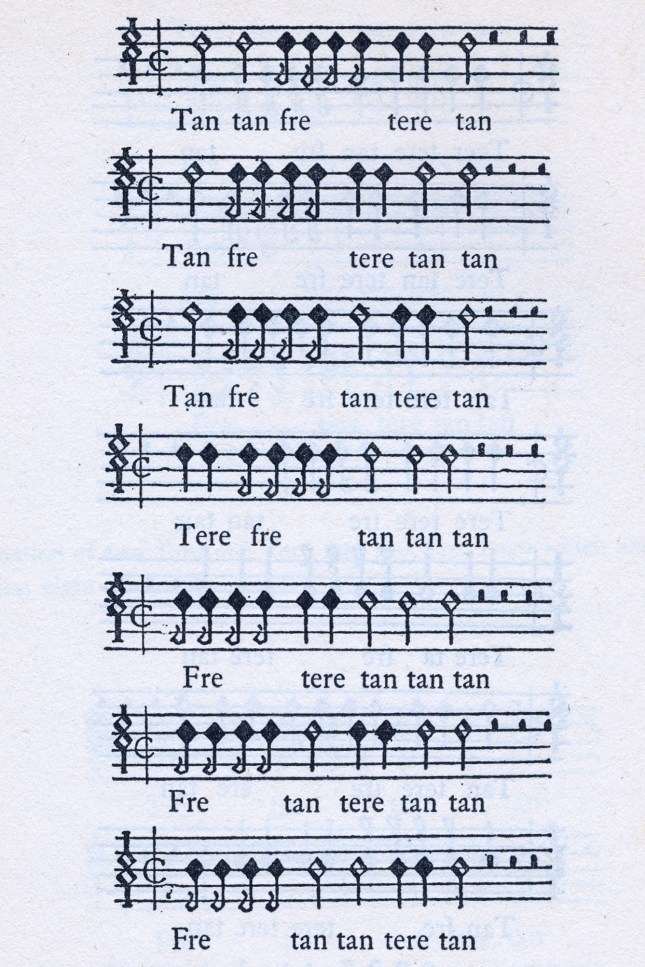
1589-Orchesography,Thoinot Arbeau, Langres France.
Arbeau’s notation is easily understood today if one reduces each note by half, i.e., a half note (minum) to a quarter note, a quarter to an eighth, etc. There are no grace notes or rolls in Orchesography. The right hand plays the first note of each group and both hands together play the last note. The right hand stroke coincides with the left foot, and the fifth note-hands together-coincides with the right foot, thus completing one stride. This sequence of right hand-left foot, left hand-right foot, “keeps the player in balance” while marching.6 Some scholars believe the 16th c. minum was a relatively quick beat much like the quarter note today; perhaps 115 beats per minute”
1627. Bonaventura Pistofilo’s, Torneo (Bologna, Italy,), a book of illustrations instructing Cavaliere (Knights or soldiers) in postures for weapon’s drill, 7 contains, according to James Blades (1901-99), the first drum beats actually used in a military context.8 In the example below, lines one and three show the drum beats, while lines two and four dictate the soldier’s movements in response to the drum. The notation is similar to Arbeau, but the bar lines, typical of the age, do not mean what they mean today.*9
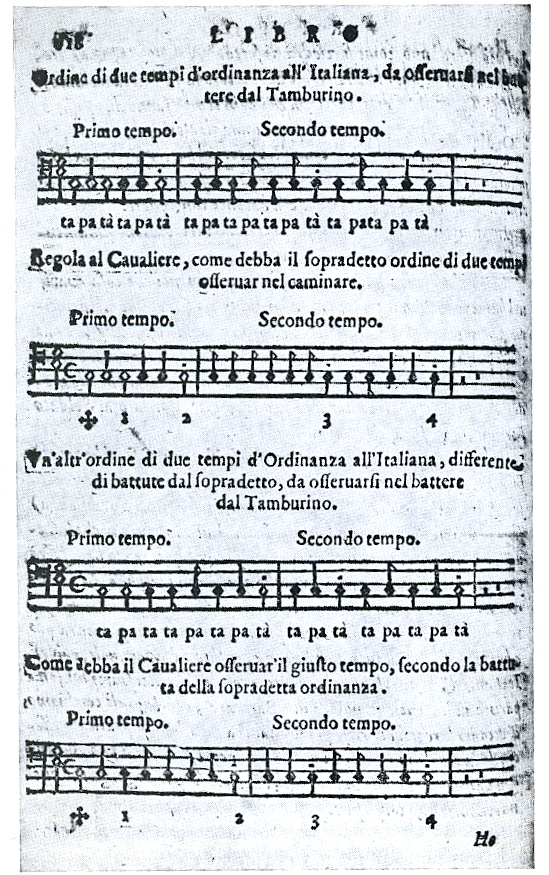
1621-Torneo, Bonaventura Pistofilo.
There are other mysteries as well. What is the relationship between “Primo tempo” and “Secondo Tempo”? What is the meaning of the dots over some notes, the + (‘crosses’) and the numbers 1, 2, 3, 4, which appear only under the soldier’s staves? These remain to be deciphered, but the onomatopoeia device, here, ta – pa, was also used in Arbeau and will be familiar to modern military drummers.10 So too is the stem down, stem up notation which may make its first appearance here, and probably indicates right and left hands, a device in use to this day.
1632. Charles I of England(1625-49), issued a Warrant directing the restoration of the English March to its original rhythm as it had suffered from improper interpretation. Copies of the march and warrant have appeared in various texts. The original has not been found.
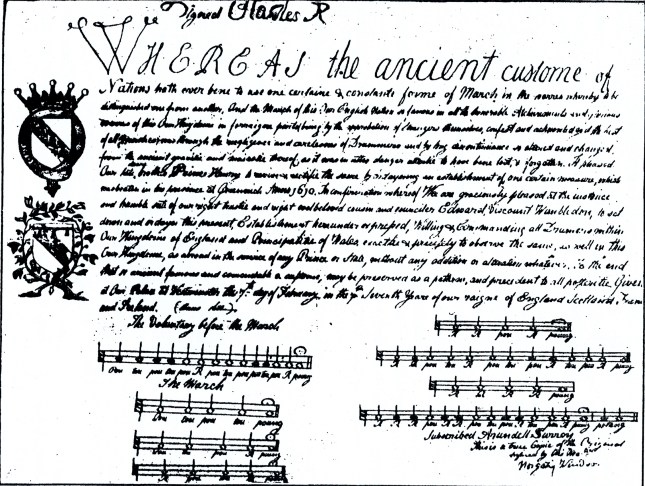
1632-Warrant, English March.
At first glance, the deciphering of this beat seems to be at our fingertips: the notation in Arbeau and Pistofilo are similar, but how this march was played, has been argued since its actual sound faded from memory.11 Note the use of both single and double bar lines, fermatas, and the onomatopoeia, here pou and tou, with a final poung.12 The capital R, appears with intriguing regularity and may indicate a roll or a ruff; perhaps a key to deciphering the March.
1634. After these tantalizing examples of almost decipherable drum notation,two unique and aggravatingly obscure manuscripts appear. The first is a version of The English March shown in the Warrant above and published by Thomas Fisher in Warlike Directions or the Soldiers Practice.13
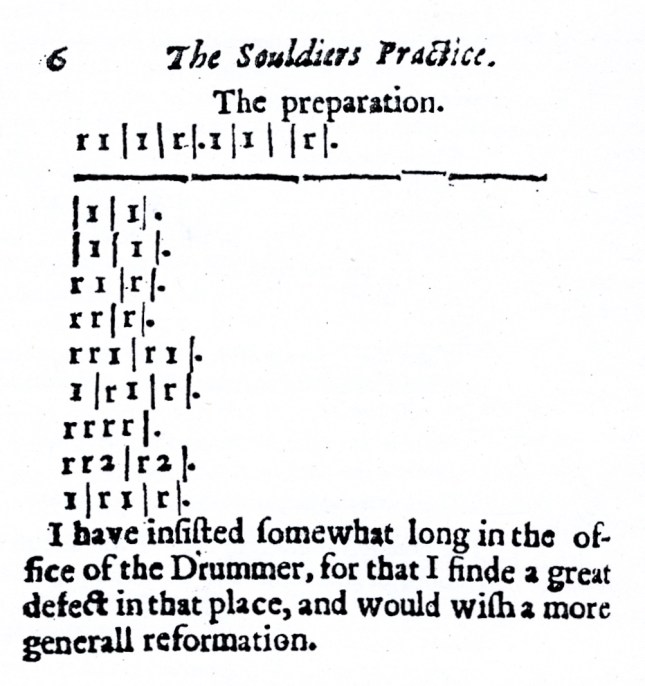
1644-Warlike Directions, Thomas Fisher.
1= Left Hand, I= Right Hand, r= Full Ruff, 2= 1/2 Ruff, Ir= Stroke and Ruff, r2= A Ruff and a half joined together. (6 Rudimenss in this beating.)
The Preparation. which precedes the drum beat is, in Charles’ Warrant,The Voluntary Before the March
In the sentence below the drum beating, Fisher says, “I have insisted somewhat long in the office of the drummer, so that I find a great deficit in that place, and would wish a more general reformation.” Fisher is petitioning King Charles I for a job as drum instructor throughout the kingdom, and if the credentials he gives for himself in his book’s preface are believable, he may well have been qualified.
1650-90. And then, this curious document. Discovered glued to the inside of a book in the Bodleian Library, Oxford, England, it is referred to as the Douce (pronounced Dowse) Document after the book’s original owner. Shown below is one page of the document titled “The Grounds of Beating Ye Drum”. Under this title, arranged from left to right, are 11 symbols or pictographs representing drum strokes or rudiments.
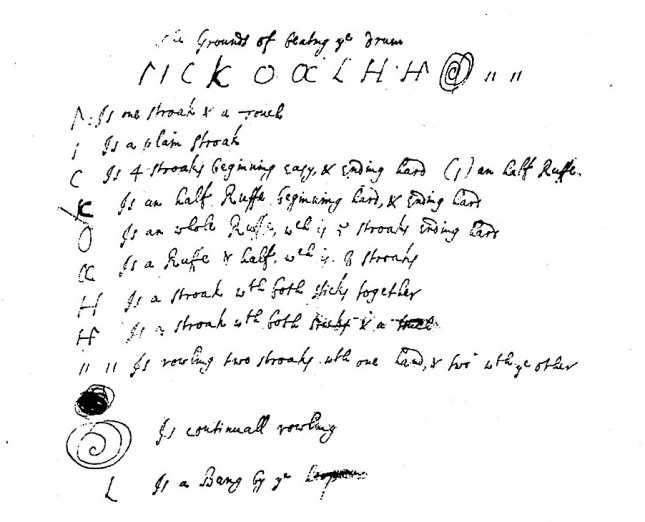
1650-90 (ca.)-Douce, Grounds for Beating Ye Drum.
The interpretations for these symbols read as follows: “one stroke and a touch”, “Is a plain stroke”, “Is 4 strokes beginning easy and ending hard”, “Is a half ruffe beginning loud and ending loud”, “Is a whole ruffe which is 5 strokes ending loud”, “Is a ruffe and half which is 8 strokes”, , “Is a stroke with both sticks together”, “Is a stroke with both sticks and a touch”, “Is rolling two sticks with one hand and two strokes with ye other”, “Is continual rolling”, “Is a bang by ye hoop” (a Pointing, Poung, pong or poing stroke? There is a similar instruction in Levi Lovering’s 1818 book,page 9.See my posting “What was a Poing Stroke?”)
1777. Reveille from Trommel Spielett, George L. Winters,(Berlin); according to the late James Blades,the earliest military drum manual in existence. The upward slanting being this on all the roles indicate crescendos. (A combination of upward and downward slanting beams appear on other pages in the manual.) The beating below is identical to the Reveille in use today in the Swedish and Dutch armies. (see Part II)
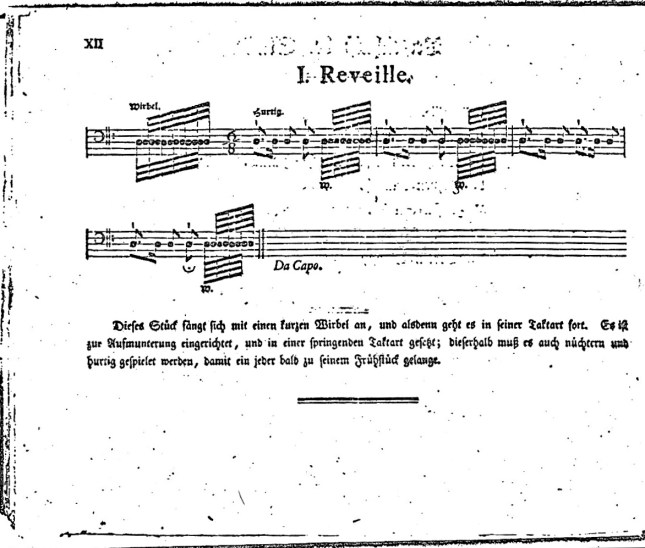
1777-George L. Winters, Berlin.
1778. The Valley Forg (sic)drum beating below, is from A Revolutionary War Drummers Book, a possession of the Massachusetts historical Society. It’s twenty nine pages were written entirely with a quill pen, and contain much to recommend them to drummers. On his opening pages the anonymous author lists 20 exercises (rudiments). He begins with what he terms “The Rule of the first roll or Gamut for the Drum” i.e. closing the long roll.Included also is a Twelve stroke roll.
In the example below, the very first note is an eighth note with a backward beam. This is a 7, and indicates a seven stroke role, the first six notes of which precede the downbeat, but are not shown. “The letter R signifies A roll”. The two staves which separate Right and Left hands, are, to my knowledge, the earliest extant example of this device, a variant of the single stave with up and down stems in The Young Drummers Assistant from the same period.
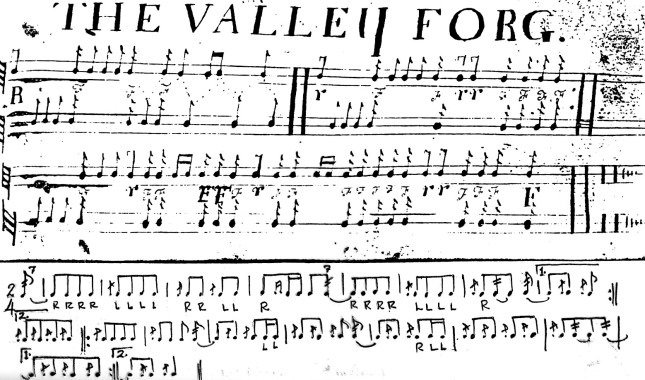
1778(ca.) A Revolutionary War Drummer’s Book.
Above is my interpretation of the Valley Forg beat. Every drum beating in the book was named for a tune it was meant to accompany. (The Valley Forg(e) is a catchy tune.) Finding these tunes, many existing under different names,and transcribing the drum beatings into modern notation,was often a challenge, but always exciting.
1779-84. With the appearance of The Young Drummers Assistant (London), illustrated below, drum notation appeared to be continuing in the mainstream of common practice, and the Thomas Fischer and Douce manuscripts appeared to have been anomalies.
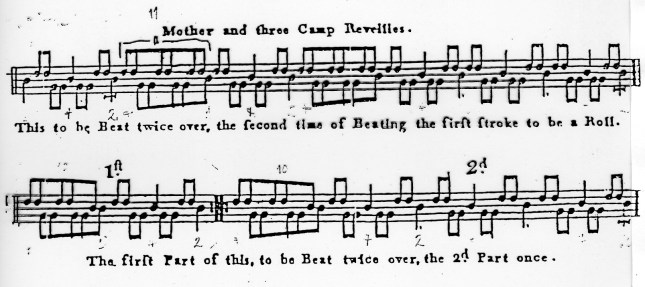
1784(ca.)-Young Drummers Assistant, London.
The Young Drummers Assistant may well be the first drum manual published in the West utilizing three line notation; the notes on the middle line indicate the primary beats, in this case, the end note of rolls. Stems up indicate the Left hand, stems down, right hand.
“Mother”, is the five stroke roll.(See Ashworth, Part II) This book contains 12 “Marks” (rudiments), but the 5 stroke roll is not among them. Interestingly, “Roll Continued” is listed recalling the “Roll Continuing” in the Douce Document from approximately 100 years earlier. Also included is a “Pointing Stroke” Which cannot help but remind one of the “Poing Stroke”.
ca.1780-90. This Book titled Scotch (sic) Duty Beatings is part of the Thomas Shaw–Hellier collection devoted to mid to late 18th-century music manuscripts in possession of the Music Library, Barber Institute of Fine Arts, University of Birmingham, England. The staff of the Shaw–Hellier collection has not been able to date this manuscript, but agreed with me that based on its similarity to The Young Drummers Assistant above, it probably dates from the same decades, The Scotch Duty Beatings’s staves are printed, but the notation is by hand and made with quill pen. I have chosen to reproduce a similar section of Mother and three Camps Reveille from both books. The book contains 12 rudiments including a Six stroke roll.
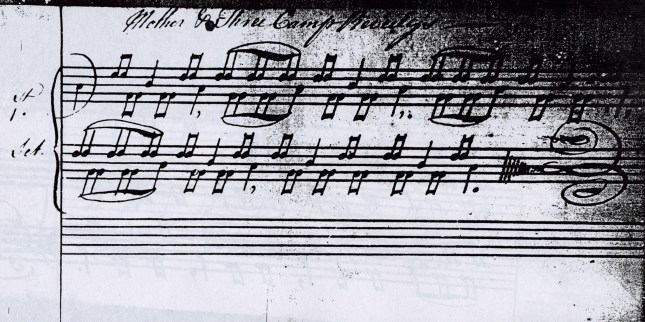
ca1780-Scotch (sic) Duty Beatings
1788. Die Erste Tagwacht, (Reveille.) The text reads: “The First Morning Call. To every measure of this morning call belongs a step. One will always beat the first and second part twice.” (repeat both parts always.)
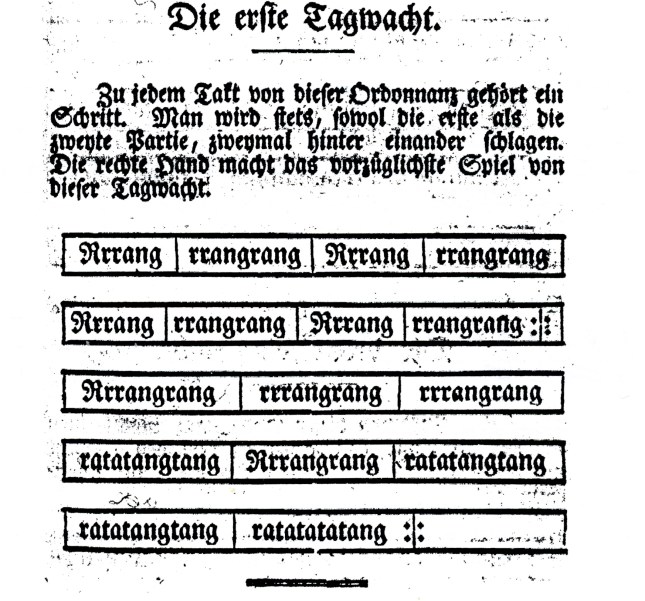
1788-Swiss notation, Reveille.
A totally phonetic approach to teaching drummers. This Tagwacht drum beating “from the Berner Ordommanx1788. Likely even earlier, it appears as the identical French drum call, ‘Premier Reveille’ with the pretty melody, ‘Goddess Diana at the Break of Day.’ The oldest known morning call”.14
1797. Below is a reproduction of one page from Benjamin Clark’s Drum Book Titled Rules for the Drum. The notation is similar to The Young Drummers Assistant and the Scotch Duty aboveexcept for the direction of the note stems, and lists rolls of varying lengths – the long roll, 10, 9, 7, 5, and 3 stroke rolls, as well as drags and ‘ruffe’. Clark’s book was discovered in 1974 by Kate Van Winkle Kellerand subsequentlySusan Cifaldi collected and transcribed the fife tunes to match the books drum beatings transcribed into modern notation by Bob Castillo.15
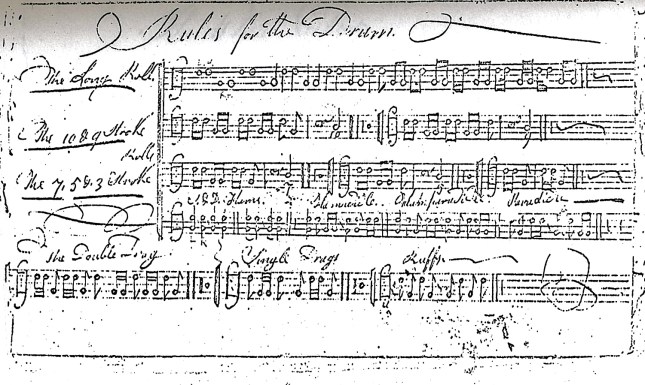
1797-Benjamin Clark drum book.
Clark’s book contains nine exercises (rudiments) including a Three stroke roll..
Footnotes to Part 1:
1. In the late nineteenth and early twentieth centuries, two men wrote instruction books for percussion instruments which deviated from the military norm. Harry A. Bower, who played in the Boston Symphony(1904-07), was first in 1899 with his Imperial Method for the Drums, Timpani, Bells Etc.. The John Church Co., Philadelphia, PA., and followed in1911 with his System for Drums, Bells, Xylophone and Timpani., Carl Fischer, N.Y.
Carl E. Gardner was next in 1919 with his Modern Method for the Drums, Cymbals and Accessories, Carl Fischer, N.Y. Gardner had also played with the B.S.O. and, at the time he wrote his books, was Supervisor of Bands and Orchestras in the Boston Public School System.
Though the books of both men contained some of the essential rudiments–flams, ruffs, and short rolls– Bower and Gardner wrote primarily to train percussionists for symphony orchestra, Vaudeville and theatre orchestra snare, timpani and mallet playing.
2. The word ‘Rudiments’ first appears in print on page 3 of A New Useful and Complete System of Drum Beating by Charles Stewart Ashworth, published in Boston, Massachusetts in 1812. A complete list of exercises or rudiments shown in each book will be attached to the end of Part II. (Also, see my article, A Brief Note on Drum Rudiments posted on this blog.)
3. In his Imperial Method for the Drum (1899), Harry A. Bower included three very simple line drawings intended to show the right and left hand grip and the proper angle for setting a concert snare drum. In his System for Drums, Bells, Xylophone and Timpani (1911), Bower used photographs to more clearly show the hand, arm and playing positions for the snare drum.
4. Grosse, Military Antiquities, 1801, in Henry George Farmer: The Rise and Development of Military Music, 1912-1970. These seven signals (commands) do, however, suggest a rather sophisticated drum technique, as each signal would have been distinctly different, one from the other, in order to impress itself upon men engaged or about to be engaged in the stress and distractions of battle. When encamped, a 16th c. army may well have used additional signals such as Reveille, Assembly and Tattoo, which, in one form or another, were common camp duty signals of the 18th and 19th c. It may reasonably be assumed that drummers of the 16th c. had a required repertoire of ten or more distinctive drum beats.
5. Thoinot Arbeau: Orchesography, Dover Publcations, New York., soft cover. Orchesography is in the form of a dialogue between its author and his student Capriol, The first chapter explains the correlation between drum beats and moving soldiers together in time, calculating distance and time of travel. Arbeau illustrates how seventy-six variations of five consecutive minims can be created by gradually substituting crochets and quavers for the first four minims.
6. This right, left correlation persists today, even in some non-military snare drum solos. The right hand, commonly the strongest, plays the first beat of each measure, thus helping to clarify a beat’s tempo and form. Historically, left handedness was considered to be evil, unnatural or simply undesirable. Even today, some left handed young people are forced to use their right hand, particularly for writing. Left handed drummers have always been required to begin with, or change to, a right hand grip in order to conform to either the uniform appearance of a military drum line, or with drum methods and solos based on a right hand lead. The matched grip, so prevalent today, has not entirely done away with left handed issues, as the music military drummers play is written, intentionally or not, from a right hand perspective.
7. Besides emphasizing martial prowess, many of the postures are balletic; befitting the age of Chivalry which empathized grace, refinement, honour and noble gestures.

8. James Blades and Jeremy Montague: Early Percussion Instruments from the Middle Ages to the Baroque, (page 11),Oxford University Press, 1976.
9. Understanding the precise function of bar lines during the 16th c, is problematic. They were not always employed, and when used, seem to have served different purposes depending on the composer. In the 15th century, vertical lines were used to divide the staff into sections. These lines did not initially divide the music into measures of equal length as most music then featured fewer regular rhythmic patterns then in later periods. The use of regular measures became commonplace by the end of the 17th century. In Orchesography, Arbeau does not use bar lines in his drum beats, perhaps because of their short, uniform length, but he does use them occasionally and always in his melodic examples.
10. For example: Paradiddle, ratamacue, ruff and flam.
11. See Maurice Byrne: The English March and Early Drum Notation, Mr. Byrne spent a good deal of his life comparing and analyzing the English March as it appears in the four known copies of the Charles I Warrant, with the notation in the Fisher and Douce manuscripts and their subsequent reflections in The Young Drummer’s Assistant and Samuel Potter (1815, see part II).
Mr. Byrne’s paper is fascinating, informative and a joy to read. However, if one thinks a final solution to the enigma of the English March awaits, a sentence in Byrne’s second paragraph will give pause. “All of these notations are incomplete,* but by analyzing their basic rhythm it is possible to interpret the significance of the pause sign which they use so that the march can be written down in modern notation”. Dr. Harrison Pawley of Brigham Young University, Provo, Utah, told me he knew without doubt how this English March was played, but did not volunteer his solution. (*emphasis mine)
12. This appears to be the Pong or Poing stroke of the late 18th century. (See my posting What Was a Poing Stroke?)
13. I am grateful to Graeme Thew, Principal Percussionist, Grenadier Guards Band, for providing me with copies in readable script of the Thomas Fisher and Douce manuscripts.
14. I am indebted to the eminent Swiss percussionist Fritz Hauser for his translation of Tagwatch and other texts from Trommeln Und Pfeifen In Basel, CD 181996 BREO, a three Compact Disc history of Swiss drumming.
15. In a phone conversation Ms Cifaldi told me she had found very faint watermarks on some of the pages of Clark’s book. These watermarks belong to a printer in Boston who operated between the years 1800 and 1810. Even so I have decided to place this manuscript in the 18 c. because Clark, though perhaps writing his book at a later date, had been a drummer in the War for Independence (1775–83) and had himself dated the book.
Benjamin Clark’s Drum Book 1797, Containing 36 Drum Beatings from the year 1797 and 46 Fife Tunes from the same time period With appropriate historical notes provided by the editors. Drum Beatings rendered into modern notation by Bob Castillo, Fife Tunes collected and transcribed by Susan Cifaldi, copyright 1989 Susan L. Cifaldi. This book may be purchased from Mr. Leo Brennan: colonialsutler@comcast.net> Price, $15.00 plus postage.


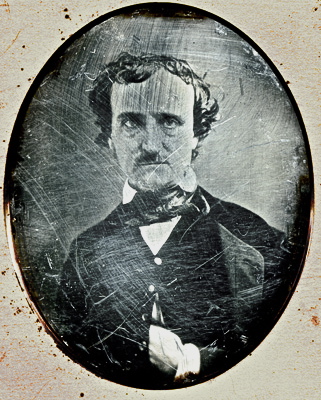


 Robin Engelman
