Thus spoke Major George Armistead (1780-1818) when he ordered the flag that would fly over Fort McHenry and enter history as “The Star-Spangled Banner”.
Armistead had recently been promoted for his exploits during the capture of Fort George on the western end of Lake Ontario, (May 1813) and was reassigned to Baltimore in June to assume command of Fort McHenry, the 18th-century star-shaped fort guarding the entrance to Baltimore Harbor at the northern end of the Chesapeake Bay.
The flag was made in Baltimore in six weeks by Mary Young Pickersgill, (1776-1857) a trained flag maker whose home is now the Star-Spangled Banner Flag House and 1812 Museum. True to Armistead’s command, Mrs. Pickersgill and her assistants created a flag measuring 42 feet x 30 feet with stars 26 inches from point to point. Mrs. Pickersgill was paid $544.74 for her work. (app. $7,110.00 in today’s money.)
“O! Say can you see by the dawns early light,
What so proudly we hailed at the twilight’s last gleaming,
Whose broad stripes and bright stars through the perilous fight,
O’er the ramparts we watch’d were so gallantly streaming?”
This was the flag Francis Scott Key (1779-1843) saw in the “Dawn’s Early Light” from the deck of a U.S. boat about four miles down the Patapsco river from Fort McHenry, and which inspired his poem “Defence of Fort McHenry”. Key found himself a captive of the British when he had tried to secur the release a friend accused by them of being a potential spy.
“And the rockets’ red glare, the Bombs bursting in air”, evoke scenes of an horrific struggle, a majestic battle. The truth however is quite different. The bombardment lasted 25 hours, but bad weather considerably reduced the effectiveness of British naval ordnance.
When the bombardment began on the morning of 13 September, 1814, the winds on the Bay were up and it was raining. Many of the bomb fuses were extinguished en route and many more blown off course or inaccurately delivered. The Congreve rockets proved completely useless, both in their destructiveness and psychological effect. Of the 1000 Fort McHenry defenders, only 24 were wounded and four killed. One of the dead was a woman blown in half while delivering supplies to the defenders.
“Gave proof through the night that our Flag was still there:”
a case of poetic license? Due to the wet weather, the great flag was taken down during bombardment day and replaced with a smaller flag, (17’x25′). Next morning at 9:00 AM, the Star Spangled Banner, kept dry, was raised while the fort’s fifes and drums played “Yankee Doodle”.
“Key probably didn’t see the flag during the battle – but figured out the flag was there because the British were still shelling the fort. Come morning, Key is wondering who won – the firing now being over. He was overjoyed at seeing the big flag – so he did see the flag, just as the battle ended! Key stated numerous times that he did in fact, see the flag.” (National Park Service Ranger Vincent Vaise, Chief of Interpretation, Ft. McHenry National Monument and Historic Shrine in an e-mail to R.E.)
As if to accompany the ascension of the Star Spangled Banner, British Vice-Admiral Sir Alexander Cochran(1758-1832) ordered his fleet from the Chesapeake Bay and headed South with Wellington’s finest regiments to an even greater humiliation by General Andrew Jackson’s “rabble” at the Battle of New Orleans (January 1815).
As a Baltimore native, I am somewhat chagrined to admit that my first visit to Fort McHenry was just a few of weeks ago. I’ve visited Fort York which now resides a couple of blocks from my home in downtown Toronto, and Fort George in Niagara-on-the-Lake where I’ve taken my rope drum to be pressed. I also recently visited Fort Niagara which rests on a bluff of the Niagara River directly opposite Fort George.
The visit to Fort McHenry was at once anticlimactic and singularly moving. Baltimore has grown up around the old Fort and when one looks down the Patapsco River towards Chesapeake Bay, one cannot help but notice the industrial detritus of what was at one time one of North America’s most thriving ports. Still, the fort is hallowed ground and is revered by visitors, particularly school students and their teachers.
After a very engaging documentary film on the war of 1812 and the bombardment and defense of the Fort, a recording of the Naval Academy chorus singing a stirring arrangement of the Star-Spangled Banner began playing while a curtain along one entire wall of the visitor’s center slowly withdrew to reveal the northern walls of the fort and a replica of the flag that flew over the fort during the bombardment. A snappy breeze enhanced the effect by keeping the flag alive and proud over the ramparts. The entire audience stood as one, turned to face the flag and place their right hand on their breast.
Standing casually at the flagpole’s base just inside the entrance to the fort, were two National Park Service volunteers, Robert Cyphers and Andrew Stritch. They knew quite a bit about the history of the Fort and the war of 1812. Mr. Stritch invited us to the ramparts for our first view south to where sixteen British ships including broad beamed heavy mortar and rocket boats had dropped anchor just out of range of Fort McHenry’s guns, and begun their fateful bombardment. The British ships of the line were anchored 4 miles down the bay as their heavy draft would not allow them to come any further.
Very dimly on the horizon we could see the remains of Fort Carroll under the modern Francis Scott Key Bridge and tried to imagine, how this scene would have appeared in September of 1814. We wandered the ramparts ignoring as much as possible the youthful frenzy of the schoolchildren, found a plywood replica of a rope field drum with slack dry heads sitting on top of one of the barrack cots and wandered back to the gift shop where I took some more photos and purchased a CD by the Fifes and Drums of the Fort McHenry Guard, titled ” O’er the Ramparts, War of 1812 Fife and Drum music”.
The repertoire and playing on this CD are splendid. When listening to this I can almost envision myself standing on the parade ground of Fort McHenry during the War of 1812. The tempos are properly slow, the drumming is open and the repertoire is interesting. A goodly number of the tunes were new to me. One revelatory medley couples “Ah! Ca Ira” with “Downfall of Paris” two tunes often but erroneously thought to be related, and another pairing with “March to Boston” and a version of “Yankee Doodle” that I’d not heard. Mr. Tim Ertel is the music coordinator for Fort McHenry. He is a fifer, researched the music and produced the recording. It’s worth hearing and reeks of authenticity. This CD can be ordered via
Notes:
For his defence of Fort McHenry, Major George Armistead was breveted Lt. Colonel by President Madison and died four years later. He was the uncle of Civil War Confederate States General Lewis Armistead who was killed at the battle of Gettysburg during Pickett’s Charge. His body was secretly brought to Baltimore and buried next to his uncle in Old St Paul’s Cemetery.
Mary Young Pickersgill became a wealthy business woman 150 years before women entered the business world. She was founder of the “Impartial Humane Society” and founded homes for aged women and men. The “Impartial Humane Society” is known today as the Pickersgill Retirement Community and is headquartered in Towson, Maryland.
Francis Scott Key was released by Admiral Cochran and upon his return to Baltimore, re-wrote his poem and delivered it to the Baltimore American Newspaper where it was type set, printed and distributed in hand bill form. Key, who lived in the Washington suburb of Georgetown, led a productive life and was greatly admired for his wisdom and religious faith. He argued cases before the Supreme Court and died of pleurisy while visiting his daughter in Baltimore. The Star Spangled Banner was officially designated the National Anthem of the United States of America in 1931.
Vice-Admiral Sir Alexander Cochran, commander-in-chief of the North American station, was victorious at the 1814 battle of Lake Borgne, then defeated at the battle of New Orleans 26 January,1815. He was promoted to Admiral in 1819 and from 1821 to 1824 he served as commander-in-chief of the entire British fleet. He died in Paris in 1832. His brother Charles had been killed in 1781 during the battle of Yorktown and had married the daughter of major John Pitcairn.
The Star Spangled Banner was made a permanent gift to the Smithsonian Institute in 1912. Work to conserve the flag began in earnest in 1999 and the final result which cost approximately US $7,000,000, is on display in the Museum of American History, Washington, D.C.
For a detailed overview of the War of 1812 in Maryland and the participants and events at Fort McHenry, readers are advised to visit: http://www.nps.gov/history/history/online_books/hh/5/hh5d.htm
-

- Major Armistead Statue, Ft. McHenry, (photo by R.E.)
-

- Visitor’s Center, and The Star Spangled Banner, (photo by R.E.)

-

- Entrance to Ft. McHenry with replica of original flag, (photo by R.E.)
-
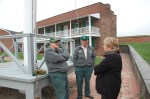
- Fort Voiunteers Cyphers & Stritch with E.E., (photo by R.E.)
-

- Students inside Ft. McHenry, (photo by R.E.)
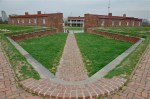
-
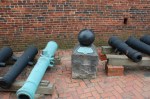
- A bomb that did not burst, (photo by R.E.)
-

- Ft. McHenry from the north, (photo by R.E.)
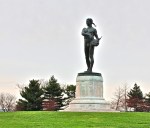
-

- Mary Pickersgill’s flag, (photo by Smithsonian Institute)
 Robin Engelman
Warren Benson: “A Primary Tutor for Snare Drum”
Warren Benson: “A Primary Tutor for Snare Drum”
(Edited by Robin Engelman & Gordon Stout)
Warren Benson(1924-2005) was a brilliant scholar, composer, percussionist, poet, and an inspiring educator who by deduction, strove to discover and convey the essence of everything he taught. He was also an early mentor to Nexus, and produced its first concert in 1971.
Warren believed the essential techniques for percussion instruments were simple and few in numbers. Once analyzed and understood, any Intelligent, reasonably coordinated person could apply them.
“A Primary Tutor for Snare Drum” was begun during Benson’s tenure at Ithaca College, in Ithaca New York. It is a compendium of the lessons he gave to music education students and percussion majors during the 1950’s and early 60’s. As Warren said, “the Tutor does not tell one how to play a snare drum, but how snare drums are played”.
After 12 one-hour weekly lessons, the music education students were required to play the 13 Essential Rudiments of the National Association of Rudimental Drummers (N.A.R.D.) as well as the “Downfall of Paris”, “Three Camps” and other drum solos in the Ancient or Open Style.
Warren also taught basic techniques for the other percussion instruments, but he considered the snare drum to be the most appealing to young percussionists and the most useful instrument for a beginner’s technique and for ensemble playing.
Warren begins his Tutor by explaining how snare drum sticks should be chosen by their shape, size and pitch -“The beginning of ear-training”. He explains the grip and how physical laws govern how sticks bounce. He explains the development of human growth from the largest to smallest muscles and how that growth comes to influence a drummer’s technique.
Thus, “A Primary Tutor for Snare Drum” is not a series of progressively difficult etudes. As Warren states in his forward, “The concern in the Tutor, is The Rudiments of Playing, not Playing the Rudiments”.
Warren never completed his tutor. He left his multi-course teaching position at Ithaca College to teach composition at the Eastman School of Music in Rochester, New York, and for years the manuscript, a rough and complicated mixture of type written or pen and pencil pages remained filed away. His last draft ended with the “down–up–taps” applied to some of the 13 essential rudiments. This technique for teaching rudiments is common knowledge and both Gordon Stout and I felt that this incomplete part of the tutor need not be published; the heart of Warren’s unique Ideas lie in the pages offered here.
In November of 2003, during a dinner in Columbus, Ohio given the night before Warren was inducted into the Percussive Arts Society Hall of Fame, the subject of the Tutor and its unpublished state, arose. Gordon Stout, like me, a former student of Warren’s, was present and said for years he’d been using ideas from the Tutor to teach his students. Gordon and I then promised Warren we’d edit his Tutor for publication.
I want to thank Gordon Stout and the Benson family, in particular Kirsten Benson, for their dedication to this project. Through our work together our friendship has grown and so too has our appreciation for Warren’s life and work. Warren died in October of 2005 just as Gordon and I were reaching the conclusion of our editing.
Sometime during the Fall of 2011 “A Primary Tutor for Snare Drum” will be available for downloading from the Warren Benson web-site, WWW.Warrenbenson.com. My advice to teachers and students is to study this unique document. There is much within the tutor which will shed light on how we play snare drums.
Posted by robinengelman on June 16, 2010 in Articles, Commentaries & Critiques