RSS

Category Archives: Articles

Note for a Canadian Brass CD Booklet

In 1775 the drum purchased by the citizens of Lexington, Massachusetts for 16-year-old William Diamond, achieved a special place in the history of the United States of America when William used it to call the Minutemen onto Lexington’s green in the overture to the shot heard round the world. Almost 100 years later, 12-year-old Johnny Clem was immortalized as “The drummer Boy of Shiloh” after his exploits during one of the seminal battles of the Civil War.

There is truth and fiction in these stories, but there can be no doubt as to the importance of their drums and the hundreds of thousands of drums that have accompanied America’s soldiers in times of conflict. For these drums commanded a soldier’s every movement, and their rich, heroic sounds and the tunes they accompanied, gave men the courage to march across  open fields in the face of enemy fire.

Towards the end of the Civil War the field telephone and telegraph replaced drums on the field of battle. Metal drums, products of the machine age, began to appear, usually in much smaller versions of their larger military ancestors.

The drums played on this recording display this genealogy. All of the rope tensioned, wooden shelled drums were made by The Cooperman Drum Company of Bellows Falls,Vermont. They are accurate replicas of 18th and mid-19th century military drums and on this recording, were used primarily in the arrangements of music from that era.

The other drums used on this recording  are smaller and were made by a variety of manufacturers from a mix of wood and metal or entirely from metal. These are, on the whole, rare drums highly prized by percussionists/collectors. They are heard here in the arrangements of late 19th and early 20th century repertoire. The majority of drums used on this recording have calf skin heads and gut snares or wire wound gut snares.

 
2 Comments

Posted by on March 4, 2010 in Articles, Fifes & Drums


ROPE DRUMS and BRASS

About a week before Christmas 2009 Chuck Daellenbach  of the Canadian brass called to ask if I would be interested in helping the ‘Brass’ make a recording of American patriotic music for The American Heritage Society. Chuck wanted to use rope tension field drums. He knew the sound of these instruments quite well because we had played a concert together in the Glenn Gould Theatre in Toronto about eight years earlier. I had made an arrangement of four prominent military songs  for the Canadian brass and Nexus which was premiered on that concert.

At that time Chuck and I talked about the possibility of piccolo trumpets playing music intended for fifes. Chuck had remembered that conversation as well as the sound of the rope drums and when the American Heritage Society contacted him, he immediately thought of me and my interest in-fife and drum music, and my rope drums.

The brass arranger for this recording would be the venerable Canadian musician Howard Cable, who incidentally, lives just a couple of blocks from my home. When Chuck mentioned me to Howard, Howard suggested that he and I get together. I have known Howard for probably 40 years. He has a distinguished career in Canadian music as a producer, script writer, conductor, composer and began his association with the Canadian Brass in 1977.

Howard came to my home, heard my arrangements for the brass, and asked if I would be interested in doing all the percussion parts for his arrangements. I was happy to accept. Soon, Howard’s arrangements began arriving from his copyist to my computer, and I set out writing for rope field drums and cymbals. All of the arrangements were completed by mid-January, and rehearsals began in a Toronto church on February 8, 2010. The CD is scheduled to be released in time for the Fourth of July holidays in the United States.1

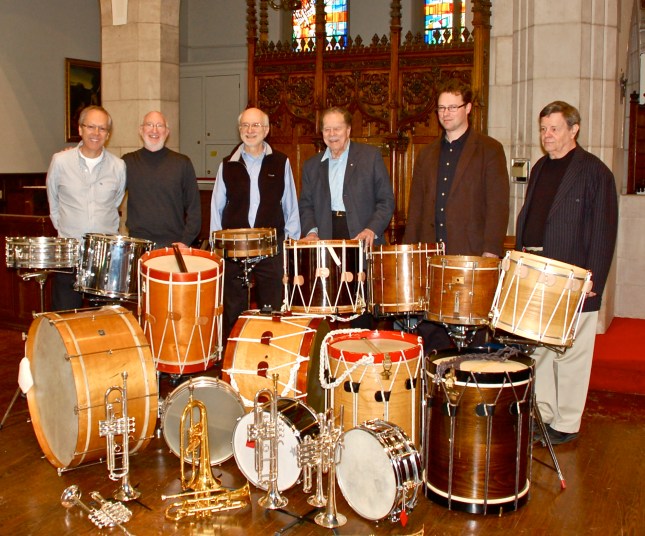
Below this article are some photographs from the recording sessions. They show the drums used for the recording. I think the collection of drums is impressive, and it seems quite possible to me that no recording in the past has included such a large and interesting array of snare drums, bass drums and cymbals.

I wrote each arrangement with specific players in mind. I had asked Chuck to engage Bob Becker and Russell Hartenberger, former colleagues of mine in Nexus, and Ryan Scott a former student who is now one of the most sought after percussionists in Toronto. All of them are expert drummers and fine musicians who appreciate the particular style of drumming I employed in the arrangements; that is, the “Ancient” or “Open” style prevalent during the 18th and 19th centuries.
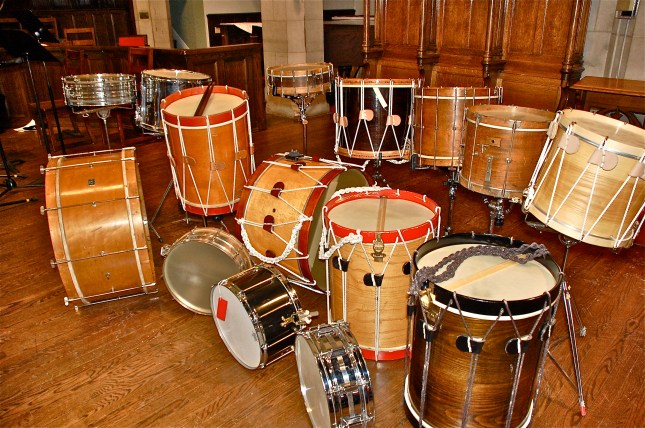
Drums used on the recording sessions.

(Bass drum dimensions are Depth-diameter. Snare drum dimensions are Diameter-depth,)

Front row, Left to Right : Ryan’s Ludwig Universal model Bass drum, 14″x28″, calf heads, (ca. 1961)-

Bob’s Ludwig “Super-Ludwig” Theatre Model, brass shell, 15″ X 5″, calf heads and gut snares, (ca. 1927)-

Ryan’s Noble and Cooley Birch Snare Drum (with Patterson cable snares) 14″x8″-Rogers Dynasonic 14″x5″ (ca.1967).

Middle row: Robin’s Eames Bi-Centennial model field drum, plywood shell, calf heads, heavy gut snares,16″x18″, (1976)-Coopperman Bass drum, plastic heads, (2002)-

Russell’s Cooperman Liberty model field drum, 17″x20″, calf heads, gut snares, (ca. 1978)-

Bob’s Cooperman Liberty model, 17″x20″, calf heads, gut snares, (1981).

Back row: Bob’s Spenke & Metzel, brass shell, 14″ X 5″, calf heads, wire wound silk snares, (ca. 1965)-Premier Field drum, mahogany shell with chrome veneer, 15″ X 12″, calf heads and gut snares, (ca. 1975)-

Ryan’s Ludwig and Ludwig,14″x4″ free-floating wood shell, original maple rims, 16 claw lugs, calf snare head, with “Ludwig Playon Plastic” batter head.  Original wire wrapped gut snares and working throw (ca. 1920).-

Robin’s Cooperman custom made field drum with narrow inlayed hoops, brass hooks and Liberty strainer, 17″x15″ (2002)-Walberg & Auge, 16″x15″, single tension wood shell field drum, calf heads, original gut snares, serial # 02820, (Worcester, Massachusetts, before 1910)-

Ryan’s Joseph Rogers Jr. &  Son “Union Brand The Quality Drum”, original wire wrapped gut snares,14″x10″ (ca. 1938)-

Robin’s Cooperman custom made (for this recording) snare drum, ash shell, brass hooks, calf heads, gut snares. narrow hoops, modified Liberty strainer, 14″x12″ (2010).

Cooperman concert Bass drum, 19"x36", ca.2000.  (On loan from The Canadian Opera Company.)
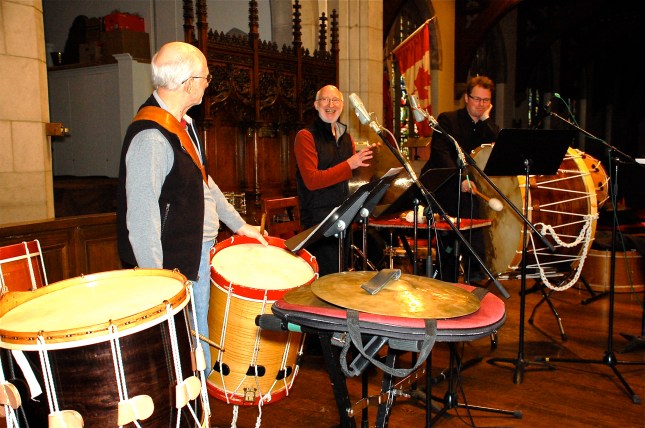
Cooperman concert Bass drum, 19"x36", ca.2000. (On loan from The Canadian Opera Company.)

Russell Hartenberger, Bob Becker and Ryan Scott
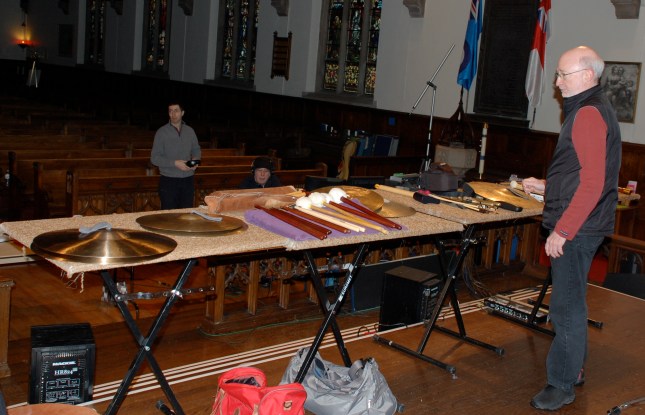
Cymbals and beaters.
Chuck Daellenbach, Bob Becker, Russell Hartenberger, Howard Cable, Ryan Scott & Robin Engelman.

Notes about the music:

The works recorded consisted of marches and songs written during a span of time beginning with the American war for Independence and ending soon after the First World War:  Chester by William Billings, the 1814 and 1931 versions of The Star-Spangled Banner, Dixie’s land, Stars and Stripes Forever, National Emblem, Battle Hymn of the Republic, Johnny Comes Marching Home, Hail Columbia (The President’s March), America, a selection of George M. Cohan songs, a medley of U.S. military service songs, and also, O Canada.

1. The CD “Stars & Stripes” is now available to the public.

 
6 Comments

Posted by on March 1, 2010 in Articles, Fifes & Drums


Luca Della Robbia: A Joyful Noise

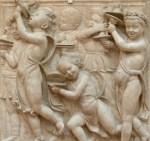
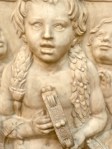
Luca della Robbia, Cantoria(1431-38-Detail)Florence, Italy, Museum dell'Opera, dell Duomo. Photo,R.E.

There is no doubting the skill of Italian Renaissance artists. No matter the medium; stone, wood, paint, glass, porcelain, cloth, silver or gold, the fruits of their labors continue to transfix those of us fortunate enough to view them in situ.

Christianity inspired, or at least subsidized, many of the great Renaissance artists. Their work’s often depicted  intense pain and suffering, for saints and sinners alike; martyrdom and everlasting peace for the former, Hell and eternal damnation for the latter. Their Crucifixions, many fascinatingly gruesome, held the promise of forgiveness and resurrection for those who confessed their sins.

My wife and I recently vacationed in Italy. We had come, as do most tourists, to eat, drink, take in the scenery, and  to see Renaissance art. We began our journey by visiting hill towns in Tuscany.  The great art and architecture of these towns reside primarily on their highest points. To view them, one must often climb incredibly steep and circuitous paths of stone. For a condo dwelling sedentary like me, this was a Calvary of its own.

As the days of sightseeing passed, a kind of visual weariness began to set in. At times, I had to force myself to look critically at another beheading of John the Baptist, the arrow ridden body of St. Sebastian, unbelievers in the agonized throes of consummation by ghoulish beasts of Hell, a weeping Madonna, or a bloody Christ.

Relief came in Florence, the home of countless visionaries during the Italian Renaissance. The divine Fra Angelico (c.1395-1455), whose Annunciation, and the  paintings he made for the cells of his fellow monks of San Marco, including, ironically, one for Girolamo Savonarola (1452-98), an opponent of the Renaissance, are unparalleled in their exquisite timelessness.

But, when we discovered the recently renovated Museo dell’Opera dell Duomo, a spiritual shift from the sanguinary to the sublime occurred in the space of one room.

The Opera, as it is referred to locally, is a balm for foot sore, eye weary tourist. The interior is spacious and  calm, the art hung at eye level, the stairs, by some magic of architecture, take one effortlessly, ever higher. And then, The Room.

I had seen the  work of Luca della Robbia(1400-82) in many fine art books, but here, his sculptures transfixed me.  Has any artist, before or since, captured the pure joy, the impish glee and innocent perfection of music and dance as did Luca della Robbia when he created his Cantoria? (1431-38)

His stone children tease sounds from cymbals and drums, send their voices into the world untroubled by pedagogy and dance for the pure thrill of movement. They have been doing this for more than 600 years. A reminder for us all. A Joyful Noise indeed.

 
Leave a comment

Posted by on December 1, 2009 in Articles, History