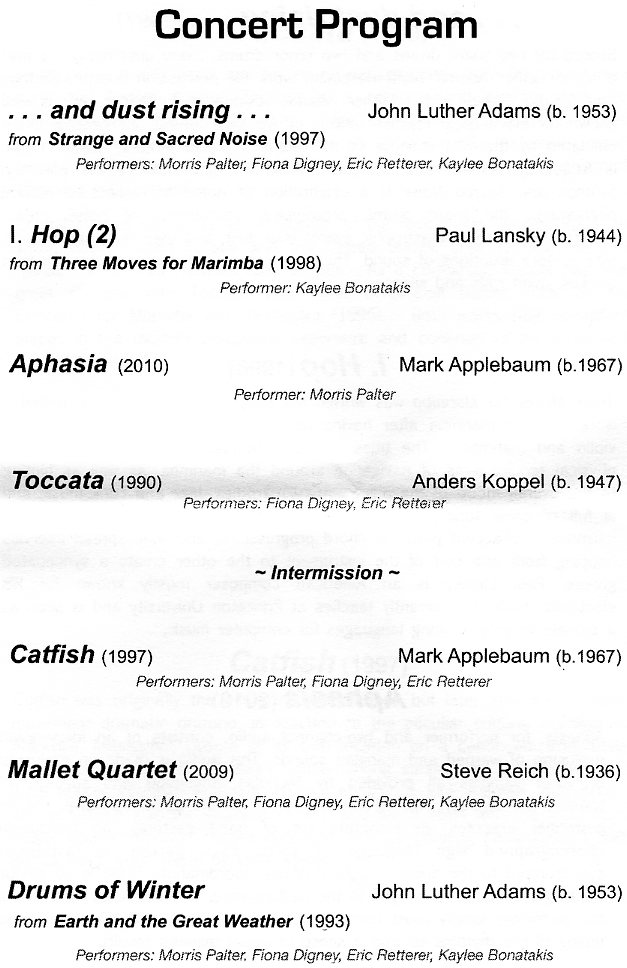
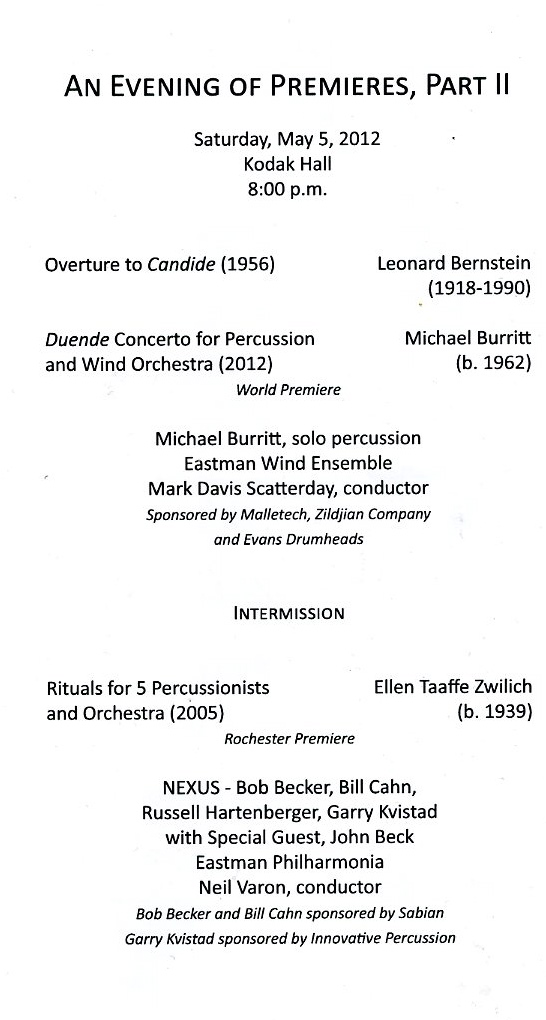
I drove to Rochester this past weekend to hear Michael Burritt play the premier of his Duende Concerto for Percussion and Wind Ensemble with the Eastman School of Music Wind Ensemble conducted by Mark Scatterday. On the same program Nexus was to play Rituals for Five Percussionists and Orchestra by EllenTaffe Zwilich (2005), a work written for and recorded by them. The part I had played in this work was performed by guest artist John Beck.
Michael’s performance was on the last concert of Percussion Rochester. P.R. was a two day percussion blitz organized by Burritt, Bil Cahn and Kathleen Holt with the help of numerous sponsors. It was an exhibition of percussion instruments and music – all played at various venues in Rochester by extremely gifted students and professionals.
The Eastman School of Music has been irrevocably transformed by the arrival of Michael Burritt as its head of percussion. Michael is a virtuoso percussionist, teacher, clinician and composer. His enthusiasm for and dedication to teaching and performing is so powerful it could not possibly be ignored by anyone or any department in this venerable school.
I am particularly aware of the changes Michael has wrought because I played in the Rochester Philharmonic from 1966 – 68 when the orchestra was closely associated with the school. I met the percussion instructor William (Bill) Street and heard tales of his legendary tenure at the Eastman School. I met John Beck who was the timpanist of the Rochester Philharmonic and who took over the percussion department upon Street’s retirement. If memory serves, I was only the 2nd principal percussionist of the Rochester Philharmonic who had not graduated from the Eastman School. I believe the first was Jack Moore who preceded me. This was 45 years ago, I was in the bloom of my career and in awe of Bill Street, John Beck and their students.
The Rochester Philharmonic consisted of a core of professional players numbering about 35. All the principal players were teachers at the school and great players they were. Playing next to Beck for two years is a memory that will always endure in my mind. He was a gracious and helpful colleague who always enjoyed playing. If extra were players were needed, they came from the student body, assigned by their teachers. This created the first and only conflict in two of the most productive years I’ve ever spent in an orchestra. Street assigned different students to every concert. One day I told John Beck, “I want to select the extra players and keep them all year””. And so it came to pass.
I knew this system was good for Street’s students. But it wasn’t good for me, nor I thought, for the orchestra. If only for one year, I wanted to establish a relationship, with the extras who came to play in the orchestra. I had grown comfortable with Bill Cahn and his future wife Ruth McLean. I wanted them to play with the orchestra for as long as they were in school and, in fact, both joined the orchestra immediately after I left for Toronto. Of course, Bill came to be one of my colleagues in Nexus not too many years later. But I digress.
The standard of percussion at Eastman has always been high. The school’s first percussion ensemble was formed by John Beck, Street having no interest in the percussion ensemble genre. His interest was primarily in orchestra percussion. At the time, John Cage was known by many musicians, the pathfinder percussion soloist Max Neuhaus was performing and recording and far away in Europe the Strasbourg Percussion Ensemble was commissioning works from European composers. Nexus pushed further ahead by writing its own repertoire, collecting percussion instruments from other cultures and improvising. Generally speaking however, percussion ensemble music and the level of percussion playing in academia was from todays’ perspective, just emerging from the dark ages. The Renaissance came quickly.
As I sat listening to Michael percussion concerto I could not help but be amazed. A revolution had occurred at the Eastman School of Music.
And the change was also exemplified by the students. In the afternoon of our arrival I heard a concert in Kilbourn Hall given by Eastman percussion students and simply sat slack jawed as I heard them zoom their way through a program of works with precision and flexibility unthinkable 25 or 30 years ago, all without conductor, except for the Harrison Concerto for Violin and Percussion. Speaking with former colleagues and friends, I learned that the incoming freshman auditions were, to say the least, illuminating. Kids just out of high school were playing works PhD students couldn’t have played, or have thought to play, not too many years ago. On the whole, it has been percussion composers such as Leigh Stevens, Bob Becker, Gordon Stout and Michael Burritt who have been responsible for this incredible advance. Their compositions and teaching innovations have prodded new generations of exceptionally gifted percussionists. Now the question arises in my mind, “What can they do with all their skills? ”

After the student performance we took dinner across the street at Max’s. We ordered a dozen oysters on the half shell and fillet mignons, accompanying both with two bottles of 2004 Chateau Berliquet, Grand Cru St. Emilion. So satisfying.
Michael’s Concerto must have been a kick in the ass for any composer in attendance who has dreamed their way through a composition for percussion based on some ‘concept’. Duende, a work in one movement, begins with a virtuoso fanfare of tom-toms so fast and clear as to leave no doubt in the minds of listeners as to Michael’s secure artistry. It’s a classically designed work, thoroughly professional in its orchestration and structures. A few years ago I had heard his French horn concerto with percussion orchestra, but was not prepared for the maturity of Michael’s compositional skill. Duende is much more advanced. In response to Michael’s marimba playing, there were woodwind passages of surprising originality and beauty. From the very first note I was caught up by his energy, passion and when required, delicacy of touch. Duende is a work I’d love to hear again and again.
Duende is a spirit associated most commonly with the music of Spain. El duende prompted the famous Andalusian poet Frederico Garcia Lorca to write a now famous lecture about its affects on art and artists. Duende is a complex emotion, referencing among other things death and transcendence. To Lorca, its presence evoked a heightened sense of awareness, a spiritual wholeness. [1.] In Spanish and South American mythology, Duende is also an imp, a small, mischievous devil or sprite. Both definitions of Duende are applicable to the Burritt concerto, though I like to believe the shift to hand drums at the end, bongos and conga for the soloist and mounted tom toms for the ensemble percussionists, represented the Imp while the largest part of the work dealt with more spiritual aspects.
Whatever Michael’s intentions, his solo on bongos and conga was disconcerting. To my ears, the sounds of those instruments undeniably announce a kind of pop dance music from another culture. They rang falsely against the much larger body of his European Abstract Art Music. Well, picky, picky, but I cannot deny the shiver of surprise and disappointment I felt when I heard those sounds.[2.] The feeling dissipated when Michael was joined by his students in a tight knit exciting duet more suited to the work.
Michael and his accompaniment received a long and well deserved standing ovation. In response he played a short , lovely marimba solo.
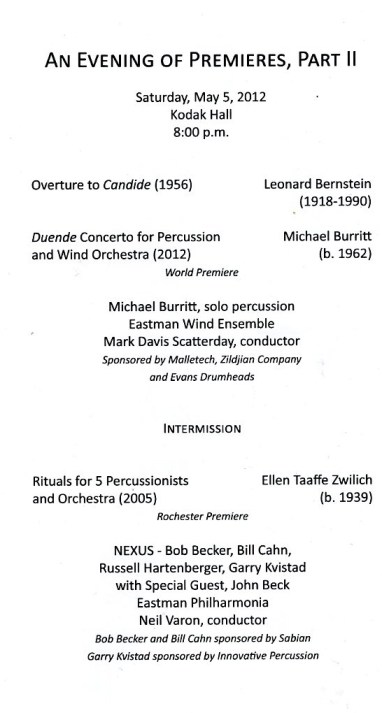
The concert ended with a performance of Rituals, the Ellen Taffe Zwilich Concerto written for and played by Nexus. I knew this work pretty well because I had played it a number of times and recorded it with Nexus. Sitting out front was a wholly different and very impressive experience. Because of the clarity of Nexus and the superb playing of the Eastman student orchestra conducted by Neil Varon, I could grasp the scope of the work in its sonorities for the first time. It’s a terrific work, particularly in its contrast to other percussion concerti. The metal percussion, symbols and gongs, combined with string and woodwind chords, create clouds of gorgeous, complex overtones. Some of the movements seem to hang over the newly renovated Eastman theater, enveloping everyone. It is not a piece without rhythm but the overall impression is amorphous. The snare drum rhythms don’t actually propel the music but are simply layered into it. Bill Cahn’s tuned gongs, Becker’s soft tom-toms stand out, but otherwise the percussion instruments are a part of the orchestration, often making it into harmonic clouds. John Beck played my old part and the chimes which open and close the 2nd movement, always my favorite moments, were beautifully played.
I came away feeling the four movement work is one movement too long. Which movement should go? The removal of one would require a reshuffling of the remaining three. Maybe the last. Its’ ending was a problem when first written and after hearing it May 5, it is still a problem.
Footnotes:
[1.] http://en.wikipedia.org/wiki/Duende_(art)
[2.]Joseph Schwantner concluded his Concerto No. 2 for Percussion Section, Timpani and Orchestra with a similar idea. His instruction for the drummers was to improvise and they didn’t know when enough was enough. With Burritt’s work, thoroughly composed, it was the device itself that troubled me.

 Robin Engelman
U.S. Open Golf ala 2012.
The 2012 US Open was played on the Olympic Club golf course overlooking San Francisco’s Golden Gate Bridge. The course was constructed in 1920 and is devilishly difficult even without 12 inch deep rough typical of past US Opens. Level lies are almost impossible to come by. A new par 3 8th hole was constructed for the tournament and the 16th hole was lengthened to 671 yards, the longest par 5 of any US Open venue. The weather was good for golf. The professional commentator was Johnny Miller who as a youngster was a merit member of the Olympic Club. He knew the course intimately and his comments as usual were bluntly informative and wryly humorous.
Winning the US Open is the dream of every serious golfer and the Ultimate Thule of every professional. Winning the US Open allows a pro to play the Open for the rest of their lives and comes with a 10 year exemption from qualifying for any other tournament. To top it off the prize money is usually somewhere in the range of a million and a half bucks. No amateur has won the open since the legendary Bobby Jones. I had to wonder what the pros were thinking at the end of the 2nd day when they saw their butts were being kicked by a 17-year-old. After all, these guys have high-profile endorsement contracts and enormous egos, though for some of them, the bloom is off the rose.
It was a treat watching the antics and agonies of multimillionaires unable to consistently break par. The winning score was 1 over, but there were moments of brilliance. A 17-year-old amateur made the cut, allowing him to play the week end and at one time was just three over, far better then most of the pros. I think in all there were 3 teenagers who finished the tournament. A 14 year-old had qualified! 14 years old? Gimme a break! A 53-year-old Olympic Club member who has spent his entire golfing life trying to qualify for a US Open, made it this year and on his home turf. This guy made the cut and played on the weekend. I’m sure he was not happy with this final score but by golly did he play well.
As Johnny Miller pointed out, Tiger Woods – can you imagine calling yourself Tiger – had his game face on and sure enough Tiger played 2 rounds of very good golf. By the time the weekend came around it looked as if the pros were going to grab the tournament back and save face. As expected the amateurs began to fade, but still made statements strong enough to capture the attention of TV execs who gave them equal on- camera time with the pros. The tournament maintained its excitement and wonderful blend of youthful and aged amateur and professionals, many of the latter completely unknown or on their last major tournament go rounds. It came down to the last day.
Sometimes it doesn’t. For example, when Ben Hogan, Jack Nicolas and the Tiger of recent fame were on top of their games and leading by a few strokes on Sunday, you could pretty well bank on the final outcome. This time you couldn’t bank on anything.
The guy who won is well over 6 feet, looks to be in his early to mid twenties, has a flat belly, blond hair and Phil Mickelson’s baby flushed cheeks and is married. He’s too good looking, too happy and his wife is blond, pretty and seven months pregnant. Almost unknown except to family and friends, he appeared from out of the blue. He had attended Wake Forest University on an Arnold Palmer scholarship. He said he hoped his win would bring a smile to Arnold. He said he had been at peace and had prayed 3 times during the last few holes. Now we have to wait to see if his name ever appears again at the top of a Leader Board.
The average pro golf tournament is made for TV and its sponsors. Scores usually range from 10 to 20 strokes under par and if a pro can finish in the top ten a few times, he’s made plenty enough money to live on for the year and probably beyond. It was a satisfying experience to see some of the best players in the world sweating just to get around at level par and not succeeding. Two pros hit tee shots that disappeared into a Cypress tree alongside the first fairway – imagine an eagles nest – and never dropped to the ground. One of those guys provided a real US Open moment when he borrowed a pair of binoculars and stood in the fairway scanning the offending tree. A golfer has 5 minutes to find and identify his ball before declaring it lost and re-hitting his shot. Both players had to make a humiliating walk back to the tee to try again.
This US Open was fun to watch and exciting. Tiger Woods, Ernie Els, Jim Furyk, last year’s open winner McDowell and a phalanx of other well-known professional golfers either did not make the cut or committed non-pro-no-nos along the way. The winner of course was the course; the Olympic Club and a winning score of 1 over par. That’s the way it should be.
Posted by robinengelman on June 21, 2012 in Commentaries & Critiques, History, Unassigned
Tags: Ernie Els, Jim Furyk, Tiger Woods