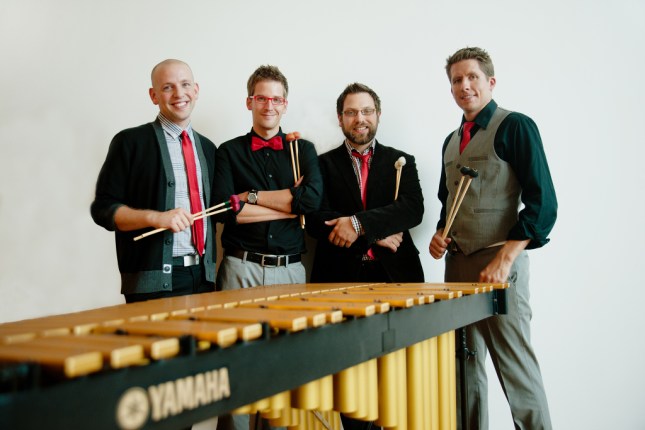
TorQ
Years ago, I read a National Geographic article about a newly discovered tribe in the wilds of South America. The tribe had no predators, their children were raised communally, abundent supplies of food were always within arms reach, they did not work and the men spent much of their time lazing in hammocks. Their average lifespan was 30 years. Scientists reporting on tribe’s seemingly idyllic existence, speculated their early deaths were due to boredom. The tribe had no music or dance. None at all.
Beyond this cultural anomaly, music and dance are universal, historically percussion being the prominent music purveyor. From the single rhythm Inuit and native American Indian frame drums, to the complex percussion ensembles of Africa; from Turkish hand drums and Korean Samulnori ensembles, to Brazilian Samba clubs; from Indonesian Gamalans and Caribbean Voodoo drums, percussion instruments provide the heart and impetus to dancers.
Composer John Cage comes first to mind when I think of percussion and dance in North America. A prime emxaple is Cage’s CREDO IN US (1942), a work for percussion whose original choreography is not extant. Throughout the United States and Canada, Cage’s music and populal misconceptions about his ideas on improvisation, have led to a multitude of annual collaborations between university dance and percussion departments.
I’ve participated in my share of these collaborations, some of them free-for-all wastes of time. The best were choreographed by professional teacher dancers, but in recent years I’d not been aware of professional percussion ensembles pursuing this creative medium. Until now.
On May 3 and 4, 2013, TorQ percussion quartet gave three sold out concerts under the name New Manoeuvers in the Dancemakers facility of the Distillery District of Toronto. TorQ had asked Jacob Niedzwiecky, Louis Laberge-Côté, Lauren Van Gijn and Linda Garneau to choreograph works for their student dancers by Janes Rolfe, a TorQ commission, a recent work by Steve Reich, a new work byTorQ member Daniel Morphy, and a classic John Cage quartet dating from 1942.
Dancemakers performance space is a rectangle. The audience and performers are separated by a long, wide area covered by a dancer’s floor. There are about 70 bleacher seats for the audience and across the way, there seemed to be adequate space for TorQ. The acoustic was altogether satisfying and percussion sounds rang true.
The program began with the premier of Janes Rolfe’s, Why You. Jacob Niedzwiecky named his choreography Meek, Bent and MIld. Rolfe intended his music to be one continuous movement, but the choreography, employing ropes, required pauses, which to my ears, hindered not at all the music’s effectiveness. The music is ebulliant, well orchestrated and constructed. It is reminiscent of moments in John Cage’s early percussion works and his Sonata’s and Interludes for prepared Piano. But only reminiscent. This is a unique work and was delightfully danced. TorQ should keep Why You in its quartet concert repertoire.
Steve Reich’s Mallet Quartet is just a couple of years old, but I’ve had the opportunity to hear it a number of times. It doesn’t appeal to me as, say, his Music for Pieces of Wood. His quartet sounds to me like a “Toss-off”. But one problem is how its been played. It seems Reich’s music for percussion is always played mechanically and loud. These interpretations aggravate me and after a short time I’m compelled to say, “Enough already. I get it”. Still, as music for dance, Mallet Quartet worked. The vibraphones were played with a lilting swing which, though loud enough, was a human touch. I still think this work is of little significance, but TorQ’s interpretation made listening tolerable. The dancers were Michael Caldwell and Jordana Deveau. Michael Caldwell was the star of the duo, self assured, polished and thoroughly musical. Jordana was a great partner if just a touch less compelling. I had not expected to see student dancing of this calibre. Their performance of the Louis Laberge-Côté choreography Three Times Two, gave the Reich work its raison d’etre.
For me and I think the audience, the work that stole the show was Daniel Morphy’s Dance Cycles # 1 having the choreographed name of Restless / Reverie. Morphy’s music and the dance were seamlessly blended into a time stopping bouquet of sound and movement. As the music begins, dancers enter stage left and right with small hand-held tuned gongs, each stroke timed to the dancers personal count. The effec of their slow swirls creates magic. At the end of the work Morphy plays on small resonant metal percussion, a long diminuendo that carries the ear and the performance to rest. A gem.
Percussionists have an important relationship with John Cage and his music. Cage’s early works, all written for percussion, is the core repertoire for North American percussion ensembles. Of those works, Third Construction is generally considered to be his finest creation and I was very interested to hear it with dance. Linda Garneau named her choreography Reconstructions: an architectural study and was satisfyingly danced by Mia Delina. I was infatuated by TorQ’s performance. There’s a wooden tongue drum solo mid way that is very soft. It was played softly, but at half tempo. A startling effect, something akin to a reverse “Warp Speed, Scotty”. From that point to the end, TorQ was passionate and exciting. TorQ has recorded this work on BEDOINT RECORDS.
TorQ’s programme was refreshing, musically satisfying and exciting. All in all, a significant evening of memorable entertainment. In the case of New Manoeuvers, collaboration between percussion and dance created an artistic success. One that could bear exploration.


 Robin Engelman
U S Open Golf ala 2013
Taming the Donkey by Eduarso Zamacois y Zabala, 1868
Schadenfreude. It crept up on me mid-day Friday during the second round.. I’ve been watching US Open golf tournaments for many years, but had never experienced such delight watching the trials and tribulations of professional golfers. I shamelessly giggled at my TV screen as putts swerved by cups, tee balls flew into hinterlands and the usually laser-like shots with short irons managed to wind up, well, anywhere but There. (Phil Mickelson had five wedges in his bag.) By late Sunday afternoon I knew I’d witnessed the most dramatic and satisfying major tournament of my life.
The scene was Merion Golf Club, one of the good ole goodies, in Ardmore, Pennsylvania near Philadelphia. Built on 112 acres and measuring just 6,996 yards, Merion is short by today’s standards. The average length of PGA tournament courses today is around 7,500 yards, often built on hundreds of Better Homes and Gardens gated community acres. Many golfing aficionados were predicting low scores at Merion.
Merion had real US Open rough. If a fairway was missed or an approach shot went astray, both as common as divots, awaiting was deep, snarly, inpenetrable stuff into which pant cuffs disappeared and, if lucky, a ball could be advanced 100 yards, usually less. Trying to hit a little flop-shot onto the green could result in leaving the ball in “the shit” as they say, or sending it completely over the green into more shit.
Merion’s East Course opened in 1912 and was designed by an amateur golfer and club member. He had never designed a course for golf and never did again. Merion’s greens were not particularly fast by US Open standards, but now they were old and tricky with very subtle undulations. Often the pros couldn’t see the breaks, even when three feet from the cup.
Merion, though short, is also tight. One 3 par hole played from 90 to 115 yards and pro after pro came up short of the green, “in the shit”. I watched all four days and if I had been able to place bets against pros accurately hitting a 100 yard shot or sinking a putt of almost any length, I’d now be a rich man.
75 of the world’s best professional golfers missed the 8 over par Cut. Tiger Woods ended his quest to tie Nicklaus in major tournament winds at 13 over par, K. J. Choi the same. Adam Scott, the new wunderkind and Sergio Garcia fell on their five irons at 15 over par. It was a blood bath. Oh my.
U.S. golf tournament attendees yell,”Go in the hole” the instant a player strikes his tee ball and applaud every final putt, even those for triple bogey. The pros usually touch the bill of their caps in acknowledgement. This week, it was difficult for them to acknowledge applause or anything other than the sinking queasiness of humiliation. They sometimes looked embarrassed and they were obviously suffering. The big names feast on adulation and first class perks. They hit the ball 350 yards, no problemento, and create more spin on a ball than a dragster, but even when gearing back with 3 woods and driving irons, they couldn’t keep it on the short stuff, and they couldn’t sink a putt.
And then there were the amateurs who “went low” and got to play on the week-end. 20 year old Michael Kim was just five strokes off the lead after the third round. Yikes, that’s not good for a multimillionaire ego, particularly when it’s commiting sepuku on national television.
The winning score was 1 over par. The last guy to finish in the money was 28 over par. The over all purse was $ 8,000,000. The winner collected $ 1,440,000. An American, Kyle Stanley, finished last with a score of 308, 28 over par and earned $16,325.00.
Which brings me back to Schadenfreude.
Posted by robinengelman on June 30, 2013 in Commentaries & Critiques, History, Unassigned
Tags: 2013 US Open Golf, Merion Golf Club, Schadenfreude