
Mary Jolliffe, November 11, 1923 – October 29, 2014.
I first met Mary Jolliffe at a soirée in the home of Karin Wells and Peter Schenkman. Mary was seated at the dining room table and I was introduced to her as a musician. Mary looked me in the eye and said, “You’re not going to discuss the meaning of art are you?” Her voice had an edge honed by a life time of smoking cigarettes and quaffing booze. Though I don’t remember my response, I recognized the challenge in her question and probably mumbled something along the lines of me knowing nothing about art.
Karin Wells, a C.B.C. producer, had met Mary years before me and they had been fast friends ever since. At the time we met Mary, she was no longer working as a publicist, editor and general factotum to the theater and dance world. She was already a legend. She had been inducted into the Order of Canada and though she never wore its distinctive pin, she thought that kind of thing was silly, she certainly deserved it.
My wife and I attended many dinners given by Karin and Peter and often came to drive Mary home at the end of the evening. We became friends though I doubt she knew anything about music. Once in a while she would ask me a question about music, but she was only trying to include me in the conversation. We didn’t need to talk about music or theatre or dance. We just enjoyed being together, and though our topics were often of a serious nature, we could slide easily into the humorous and the absurd.
Mary had been born in China to missionary parents. During Mary’s Memorial service, Karin said that Mary would wake-up in the morning in China and see dead bodies outside her parents compound wall. Mary told me that at the beginning of the troubles in China, she had been flown to safety by a member of Clair Chennault’s flying Tigers. Later in Canada she was hired by Tyrone Guthrie to be the Stratford Shakespeare Festival’s first publicist. Thus began her long career in the arts.
Mary had a clear perspective on the vagaries of people and their bureaucracies. She kowtowed to no one and did not tolerate bull shit. Frail as she appeared, there were tines when she reminded me of Japan’s national treasures, those old Zen masters of martial arts, who could prostrate a room of young wannabes without appearing to move. After Stratford, she made invaluable contributions to National Ballet of Canada and spent a few years in New York City with the Metropolitan Opera’s Touring Office. Mary came back to Canada to work with the new National Arts Center in Ottawa and later the Ontario Arts Council and the Canada Council.
I’ve never met anyone who loved the English language more than Mary. The most serious moments I ever had with her concerned the subtleness of language. She knew I enjoyed words, though she was a master far, far beyond me. One day as she read the opening paragraph of Bleak House by Charles Dickens, her voice almost acquired a reverential tone. When she had finished she said, “Isn’t that incredible? Such beautiful language. The mastery of it”. Months later Mary gave me her copy of the Nonesuch edition of Bleak House, a reproduction of the original edition.
Mary’s personality, her impetuosity and spontaneity, were what drove my wife and I to her. She had reached an age when she “didn’t give a damn”. And much like the late C.B.C. director Franz Kramer, she could be counted on to speak the truth and to express her thoughts, even at times deemed inappropriate by her friends. Her voice was loud and energetic, probably because she was hard of hearing and often refused to wear her hearing aid, or maybe not.
We went with Mary and another friend to dinner at a respectable middle-class restaurant. We were having a good time and were talking rather than deciding what to order, so the waiter had to come back a couple of times. On or about his third trip to our table, Mary picked up the menu for the first time, glanced at it for a moment and said in a voice well above a stage whisper, “Oh fuck it, I’ll have the lamb”. The restaurant became quiet and the waiter smiled.
During Mary’s Memorial, former associates remarked on Mary’s Oh fuck it moments. She had other opinions as well. “Oh darlings, he, or she, was a gormless ass”, Or ” He, or she, was an ego ridden non-entity”. Mary always correctly pronounced ego as Eggo.
My wife and I have lived in a smokeless environment since I gave up cigarettes about 20 years ago and we discourage smoking in our condo. Mary, who really needed cigarettes, was our exception. Mary tried to quit, but as she often remarked, “Darlings, at my age, what the Fuck does it matter?”. Many years ago Mary had been fired from a job because of alcohol abuse and its affects on her dealings with people under and above her. She finally took the pledge and when we met her, she had been holding a steady course for many years excluding the occasional brief lapse. Though she tried, Mary was never able to give up her smokes.
When her dementia began, Mary became terrified during her lucid moments. She once looked at me and said, “I’m scared” and she truly was. At 90 years of age she was beginning to lose control and knew it. My wife and I drove her to doctors appointments and meals of dim sum, helped her shop and retrieve her prescriptions. But it was clear that Mary often did not know who we were and we stopped visiting. Soon after, we learned of Mary’s death in her last residence, a nursing home.
She had lived for a long time among friends, well, some friends, in Toronto’s Performing Arts Lodge (PAL). When she unknowingly began to drop lit cigarettes, Mary was reluctantly convinced to enter a home. She had contributed mightily to the success of PAL. She served for years on the PAL’s board of directors and her ability to read and write comprehensively and argue cogently, pulled them out of one hole after another. Now that Mary is no longer there, they’ll have to take care of themselves.
My wife and I are among a large group of people who miss her more than words can express. She had repeatedly and adamantly refused to write her memoir. Pity.
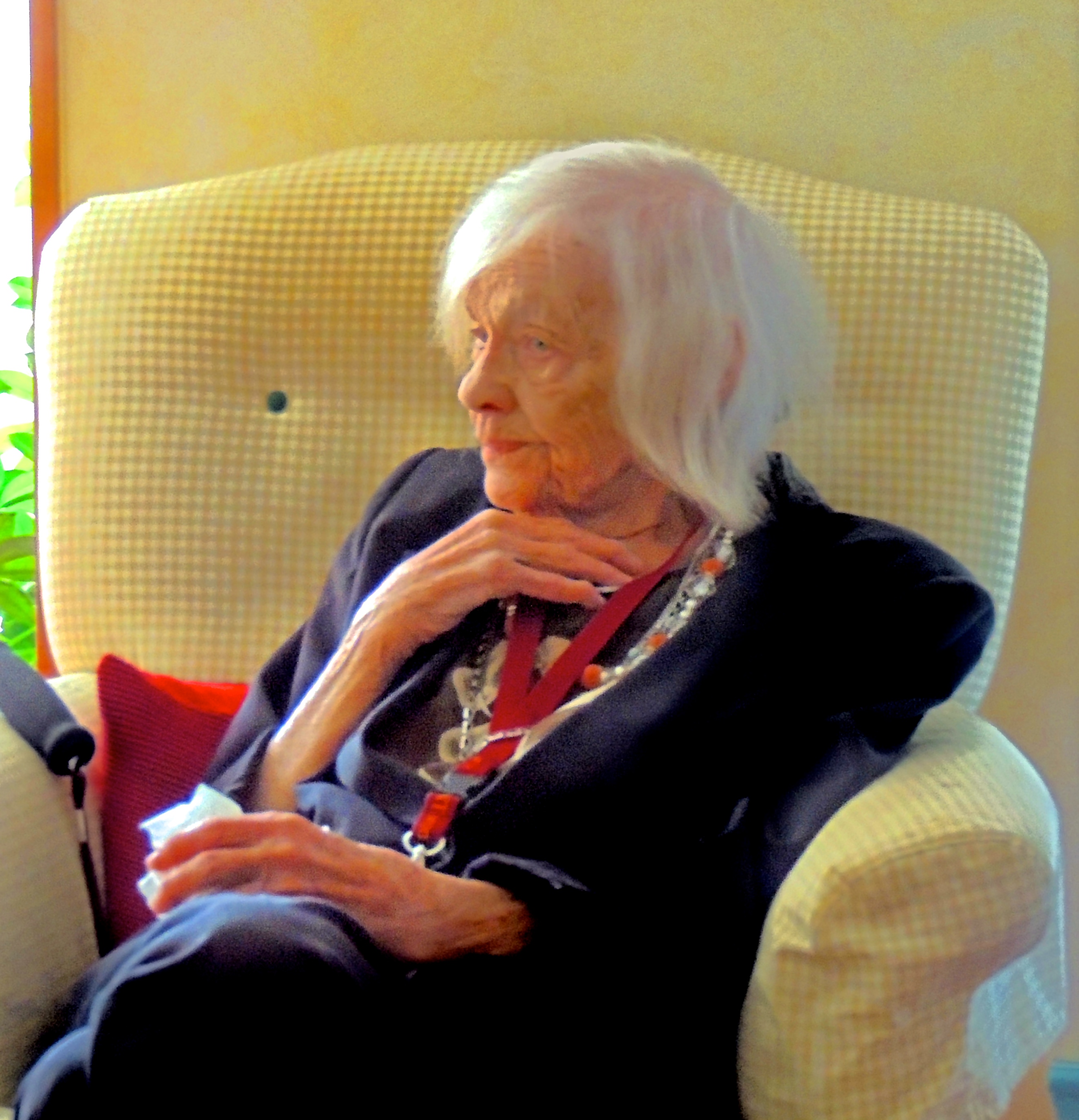
Mary, not long before her death.


 Robin Engelman
Linda Catlin Smith, Sandy Baron, Rick Sacks and Array Space.
MOKEE (MOKI, MOQUI) DUGWAY
SAN JUAN COUNTY, UT. [1.]
Photo by Sandy Baron. Used with permission of the photographer.
Last night I attended a memorable concert of new music. One work, a duet for violin and percussion by composer Linda Catlin Smith, titled Dirt Road, was performed by violinist Sandy Baron and percussionist Rick Sacks. Calgary born, Ms. Baron has played in the Canadian Opera Company Orchestra for 19 years. During the summer months she plays with the Santa Fe, New Mexico Opera Company and when not in the pit, she drives around New Mexico’s outback photographing desert landscapes intersected by the dirt roads she travels in her 1971 vintage Ford blue and white pick up. When Ms. Baron returns to Toronto, the pick up is left to winter in the south-west.
With Sandy to one side and Rick to the other, Dirt Road (2006-15) was performed in front of Array Music’s new, very large and very clear rear projection screen upon which Baron’s lonesome dirt road photographs appeared in and out in an approprately slow accompaniment to the music. Dirt Road was written in 15 movements, any number to be played in any order. It is one hour long and occasionally I began to fidgit. My lack of control aside, the work was mesmerizing. Linda’s Dirt Road is generally quiet and slow. It demands patience, nuanced control and a lyrical, expressive sound. [2.] All these were provided by Ms. Baron.
Rick Sacks played vibrphone, large gong, four cymbals, triangle, glockenspiel and bass drum. On the whole, these were played sparingly as accompaniments to the violin. The vibraphone part was difficult, frequently four mallets, closely voiced and not easily memorized. The solo percussion movement, placed about mid-way, was a highlight. Many non pitch percussion instruments produce short or unanalyzable sounds, or both. In order to bridge the inherent silences or distractions created by these anomalies, a listener must retain sounds in order to attach them to the next. Rick’s phrasing provided the necessary continuity and the movement hung in space. Ms. Baron’s solo violin movement was a melodic gift, elegant yet casually proffered. A judiciously rendered foil to the percussion sounds. For me, these two movements formed the works apex.
The concert was pretty well sold out and even with my poor peepers, I saw John Beckwith, Kathleen McMorrow, Henry Kucharzyk, Adele Armin, Beverley and Austin Clarkson.
Notes:
[1.] “MOKEE (MOKI, MOQUI) DUGWAY, SAN JUAN COUNTY, UT. (southeast Utah)
The Mokee Dugway is located on Utah Route 261 just north of Mexican Hat, UT. It was constructed in 1958 by Texas Zinc, a mining company. The three miles of unpaved, switchbacks descend 1100 feet from the top of Cedar Mesa from where the photograph above was taken.
The term “mokee” is derived from the Spanish word moqui, which was a general term used by the 18th century Spanish explorers and settlers in this region to describe the Pueblo Indians they encountered and the vanished culture which had left behind the numerous ruins they discovered during their travels.
Today the standard term used to describe these prehistoric Native Americans, who lived in this region more than 1000 years ago, is “ancestral Puebloans”. It is based on present day Puebloan tribes and archaeologists believe these people were the ancestors of the today’s Hopi, Zuni, Acoma and Rio Grande region cultures. You may also see them commonly referred to as the “Anasazi”, a Navajo word meaning “enemy ancestors”. note by Sandy Baron, edited by R.E.
[2.] I hope one day a recording is made of Blue Sky (2006) a percussion quintet Linda wrote for Nexus. In my opinion, percussion repertoire would be enhanced by its inclusion. It is an aesthetic experience percussionists have for too long been deprived.
Posted by robinengelman on April 28, 2015 in Articles, Commentaries & Critiques, Composers, Contemporary Music
Tags: Anasazi, Canadian Opera Company, Linda Catlin Smith, Nexus, Rick Sacks, Sandy Baron, Santa Fe Opera Company