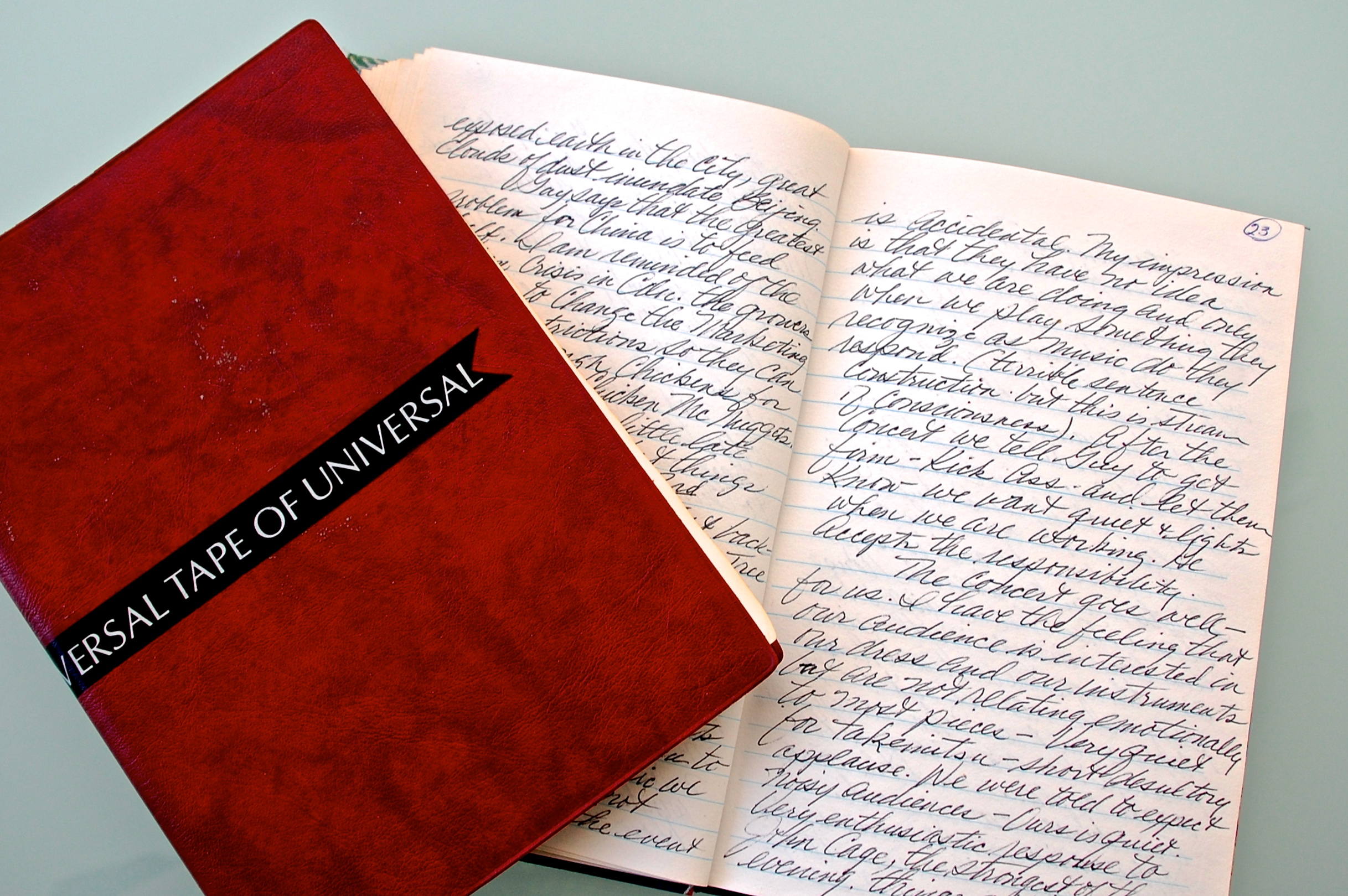
After the dental appointment.
On my trip to the Embassy I question Kwang Chao, our translator, about Mao suits. She explains that as a form of protest to feudalism, Dr. Sun Yat-sen adopted the Western suit rather than the traditional gown. Mao adopted this in his own design and many men still wear this. At one point in the Cultural Revolution only three colors were allowed: Army green, black and gray. Now the young people consider these men conservative and have adopted Western dress as a form of protest. Chao explains that it is young women who have started wearing the most colorful clothes. She says that men do not care about their appearance. There is no significance to grey or black in terms of rank. After the hospital Guy explains that the average wage in China is about 45-50 yuan a month. The political leaders make 500 yuan per month but they get many perks.
The forbidden city is so called because the common people in the days of the emperors were not allowed on the grounds. Today the Chinese leaders live here in compounds which are off limits to Chinese citizens.
I casually asked Guy (Guy St. Jacques, Canadian Embassy) why the Chinese don’t grow grass in the city. Years ago the government had all the grass destroyed in the war against insects. Now they are planting trees and grass as quickly as they can because the city is a dust bowl in the winter. The Gobi desert is about 500 miles north and when the winter winds come, huge dust storms blow in and added to the exposed earth in the city, great clouds of dust inundate Beijing.
Guy says that the greatest problem for China is to feed itself. I am reminded of the chicken crisis in Canada. The growers wanted to change the marketing boards restrictions so they can produce enough chickens for McDonald’s chicken McNuggets.
I arrived a little late for our rehearsal but things feel good – the Cage “Third Construction” comes right back – the Rags float along. “Raintree” is a little strange because of the great resonance in the hall.
We have some problems with getting the stagehands to give us enough light but interestingly enough the lights come on full when we began to rehearse the Chinese music we brought. It does not appear to us that the event is accidental. My impression is that they have no idea what we are doing and only when we play something they recognize as music do they respond. (Terrible sentence construction but this is Stream of consciousness.) After the concert we tell Guy to get firm – kick ass and let them know we want quiet and lights when we are working. He accepts the responsibility.
The concert goes well for us. I have the feeling that our audience is interested in our dress and our instruments but are not relating emotionally to most pieces – very quiet for Takemitsu – short desultory applause. We were told to expect noisy audiences–ours is quiet. Very enthusiastic response to John Cage, the strongest of the evening. Things get interestinger and interestinger. Not much enthusiasm for the Chinese piece. Um…we expected quite a bit of pleasure from that one.
The African charts go well. We all feel good and the concert is cooking -rather the performances are. Good response for the Rags. John tries to say something in Chinese at the end and has a blank. He opens his arms and looks upward in supplication and brings the house down. The Chinese girl who has been introducing the pieces–even though the audience have programs–comes out to the rescue just as John remembers. He says his sentence and to warm applause and the girl announces our encore. “Xylophonia” is not received with any more enthusiasm and we bow. A huge bouquet of flowers is brought out by 2 girls and the Canadian and Chinese officials, come on stage to congratulate us and have a photographic session. Only 50 or 60 of the audience stay in the hall as the officials come on stage. For the photos I stand between “Tom Monohan” and “the elf “with a great smile who sat next to Russ at the banquet. (Note-Tom Monohan, 1937-94, was for many years the principal contra bassist with the Toronto Symphony. He was very over weight, a terrific musician, teacher and good friend. The Chinese official reminded me in some ways of Tom.)
Our feeling is that the audience got off on what we were doing. We wonder if we are the 1st people to play Cage and Takemitsu in China. If this is indeed the 1st performance of any new music. We will get reviews but I wonder if we will ever know the significance of their responses. Are Chinese audiences subdued, normally, when confronted with totally new musical experiences? To what kind of music would they respond? I felt good–very good, and am not myself convinced, but the concert had some ambiguous moments. Our hosts from the banquet seemed generally very pleased. As we stood for pictures “the elf” was beaming and took my hand for a moment of genuine affection, respect and appreciation–”Monohan” I discovered, was well into his 70s seemed very moved and went out of his way to congratulate me more than once.
The bouquet was ours. We loaded it on the bus and presented it to the lobby of our hotel. Dinner was waiting and our stage manager, publicist and translator from the arts Bureau presented us with Chinese linen tablecloths and napkins. I had my 1st full nights sleep since leaving Toronto.
In one hour – 9 AM – we leave for the hall to rehearse for tonight’s concert. Tonight we will improvise for them and play Bruce’s “Clos de Vougeot”. The hall is very good–that’s a plus for Bruce’s piece–but I’m really concerned. In the West “Clos de Vougeot” is a difficult piece for audiences–very balanced but quiet generally and very strange structurally, with many silences. Western audiences have applauded after some of the sections and that tends to break the mood. Tonight, I think, we’ll have to work.
Postscript: a fellow traveler brought 2 large boxes of chocolates from Toronto. After lunch we had a binge. Chocolate never tasted so good.
 Robin Engelman
TORQ IN ARRAY MUSIC CONCERT HALL
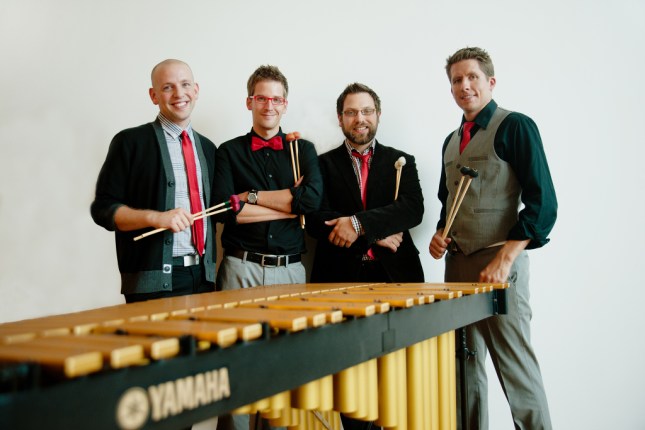
TorQ Percussion Quartet in the Array Music Concert Hall, 20 November, 2013.
L. to R. Adam Campbell, Jamie Drake, Daniel Morphy, Richard Burrows. Cell phone photo courtesy Frank Morphy.
TorQ struck again, pun intended, this time with a concert of music for Prepared Piano by John Cage, all arranged for traditional percussion instruments by members of TorQ.
I last heard TorQ in the Toronto Dance Theatre, playing works which were choreographed for existing music, as I reported on this site in TorQ Ensemble: Morphy, Rolfe, Reich and Cage, 28 June, 2013. That concert was an unforgettable experience. Consequently, I was prepared for this one to be at best, less memorable.
This TorQ program began with Bacchanale (1938-40), a vivacious complexity of rhythms and tempi written for dance and the first work by Cage for Prepared Piano. Of the 20 movements in Cage’s Sonatas and Interlues, (1946-48),TorQ members arranged and played 11: 8 Sonatas and 3 Interludes. The first half ended with an exquisite arrangement by Jamie Drake of the mezmorizing In A Landscape (1948), the only unprepared piano work on the program and ended with an arrangement of a John Cage oil painting titled Chess Pieces (1944). The program was appropriately titled Sonatas and Interludes.
Western percussion ensembles and the Prepared Piano are commonly thought to have been invented by John Cage: the percussion ensemble to provide him with solutions to compositional issues and later, the Prepared Piano to provide him with a percussion orchestra free from extra players, their accoutrements and expenses. However, there were important antecedents to both the western percussion ensemble and the Prepared Piano and Cage himself affirmed this during a phone conversation. When I asked him if he had invented them Cage said, “No, they were in the air”. His exploitation of both genres popularized them and they became indelibly associated with his name. The Prepared Piano proved to be an instrument that offered fresh insights into the aesthetics of sound and influenced generations of performers and composers.
The piano is a percussion instrument. When its strings are affixed with nuts, bolts, erasers and other knicknacks, its sounds are altered dramatically, and it sounds even more percussive. Thus, Cage’s Prepared Piano music was written on a percussion instrument altered to sound like other percussion instruments. Somehow, TorQ‘s arrangements for quartet and multi percussion had closed an historic circle in music history. Or have they opened a new one?
I was seated with my wife and the very fine percussionist Alison Bent who has recently become part of TorQ‘s management team. Some of the Toronto notables in attendance were John Miller the music impresario of the Stratford Summer Music Festival [1.] and Ray Dillard, percussionist, recording engineer and President of the Toronto Musician’s Association. Also in the audience was Toronto pianist Henry Kucharzyk, whose fine recording of the Sonatas and Interludes (1990) provided inspiration forTorQ arrangers.
Toronto percussionist and composer Rick Sacks made his first appearance of the night playing his Kat, an electronic instrument programed for Prepared Piano. Cage never embraced electronic sounds. He did not like recorded music and donated all gifts of recordings to libraries. The Kat’s ersatz Prepared Piano sounds were at variance with the otherwise all acoustic sounds made by TorQ. The Kat simply rang false and yet, its sounds were appealing on their own.
Rick is the artistic director of Array Music and is the force behind its new music hall and administrative offices. He is an indefatigable worker. The new hall is splendid. Seating at most 50 people, it is an acoustical gem. The sound is not distorted by excessive dryness or resonance. Small dance and music ensembles not yet aware of its comforts need to check it out.
Cage was studying chess under the tutelage of Marcel Duchamp and made a painting titled Chess Pieces for an exhibit by Duchamp and other New York based visual artists. Cage painted a chess board and filled each square with snippets of music. These snippets define the form and structure of the work. American pianist Margaret Leng Tan arranged these squares of music into a piano solo. Thus, Bryan Nozny’s arrangement of Chess Pieces, is an arrangement of an arrangement of an oil painting and sounding within the purview of Cage’s aesthetic.
The Sonatas and Interludes concert was a garden of delights, always unexpected, always satisfying. I have grown accustomed to TorQ‘s artistry. They move in unison while remaining flexible. What excites me most about TorQ, is their desire to search out new ideas and realize them, time after time, in musically satisfying ways.
Note:
[1.] It was announced that John Miller has named TorQ the Stratford Summer Music Festival Artists in Residence for the summer of 2014.
Posted by robinengelman on November 21, 2013 in Articles, Commentaries & Critiques, Contemporary Music
Tags: Aonatas and Interludes, Array Music, Bacchanalle, Bryan Nozny, Chess Pieces, Henry Kucharzyk, In A Landscape, John Cage, John Miller, Margaret Leng Tan, Ray Dillard, Rick Sacks, Stratford Summer Music Festival, TorQ Percussion Quartet