Warren Benson: “A Primary Tutor for Snare Drum”
(Edited by Robin Engelman & Gordon Stout)
Warren Benson(1924-2005) was a brilliant scholar, composer, percussionist, poet, and an inspiring educator who by deduction, strove to discover and convey the essence of everything he taught. He was also an early mentor to Nexus, and produced its first concert in 1971.
Warren believed the essential techniques for percussion instruments were simple and few in numbers. Once analyzed and understood, any Intelligent, reasonably coordinated person could apply them.
“A Primary Tutor for Snare Drum” was begun during Benson’s tenure at Ithaca College, in Ithaca New York. It is a compendium of the lessons he gave to music education students and percussion majors during the 1950’s and early 60’s. As Warren said, “the Tutor does not tell one how to play a snare drum, but how snare drums are played”.
After 12 one-hour weekly lessons, the music education students were required to play the 13 Essential Rudiments of the National Association of Rudimental Drummers (N.A.R.D.) as well as the “Downfall of Paris”, “Three Camps” and other drum solos in the Ancient or Open Style.
Warren also taught basic techniques for the other percussion instruments, but he considered the snare drum to be the most appealing to young percussionists and the most useful instrument for a beginner’s technique and for ensemble playing.
Warren begins his Tutor by explaining how snare drum sticks should be chosen by their shape, size and pitch -“The beginning of ear-training”. He explains the grip and how physical laws govern how sticks bounce. He explains the development of human growth from the largest to smallest muscles and how that growth comes to influence a drummer’s technique.
Thus, “A Primary Tutor for Snare Drum” is not a series of progressively difficult etudes. As Warren states in his forward, “The concern in the Tutor, is The Rudiments of Playing, not Playing the Rudiments”.
Warren never completed his tutor. He left his multi-course teaching position at Ithaca College to teach composition at the Eastman School of Music in Rochester, New York, and for years the manuscript, a rough and complicated mixture of type written or pen and pencil pages remained filed away. His last draft ended with the “down–up–taps” applied to some of the 13 essential rudiments. This technique for teaching rudiments is common knowledge and both Gordon Stout and I felt that this incomplete part of the tutor need not be published; the heart of Warren’s unique Ideas lie in the pages offered here.
In November of 2003, during a dinner in Columbus, Ohio given the night before Warren was inducted into the Percussive Arts Society Hall of Fame, the subject of the Tutor and its unpublished state, arose. Gordon Stout, like me, a former student of Warren’s, was present and said for years he’d been using ideas from the Tutor to teach his students. Gordon and I then promised Warren we’d edit his Tutor for publication.
I want to thank Gordon Stout and the Benson family, in particular Kirsten Benson, for their dedication to this project. Through our work together our friendship has grown and so too has our appreciation for Warren’s life and work. Warren died in October of 2005 just as Gordon and I were reaching the conclusion of our editing.
Sometime during the Fall of 2011 “A Primary Tutor for Snare Drum” will be available for downloading from the Warren Benson web-site, WWW.Warrenbenson.com. My advice to teachers and students is to study this unique document. There is much within the tutor which will shed light on how we play snare drums.

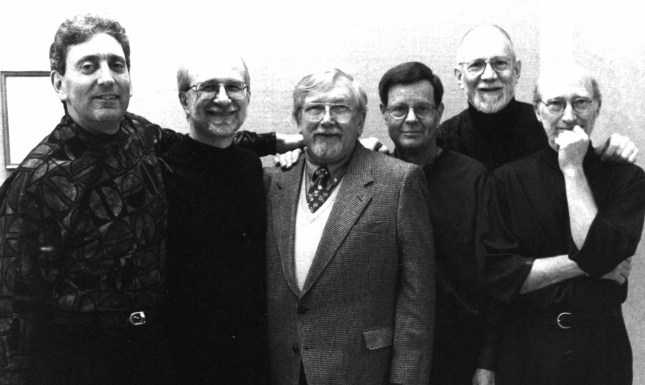
 Robin Engelman
The Super Ball vs. A Queen’s Square Hammer
My neurologist, Dr. Casaubon, probably a descendant of thirteenth century Cathar heretics,1 pinged ans ponged me with her Queen’s Square hammer and declared me normal. Still, just in case her hammering had missed a mark, she ordered up for me a Magnetic Resonance Imaging and a Magnetic Resonance Angiogram.
I had already come into contact with the Queens hammer in the offices of my family doctor and had experimented by rubbing its rubber mallet on all surfaces of his office with marvelous results. When I demonstrated the wonderful nuances in sound I could produce in his office, my family doctor was impressed. But not nearly as much as me, for in this wonderful instrument I believed I had found the answer to all my past Super Ball woes.
I asked my doctor for its name. He said, “It’s called the Queen’s Square Hammer. Its named for a square in London, England. When I got home I typed the name into Google Earth, and was immediately taken to Queens Square Imaging Center in London, England, and there, for the nonce, my quest rested.
I purchased my Queens Hammer (Patella Percussor) in the medical section of the University of Toronto bookstore for $6.99. It’s not quite as good as the one owned by my family doctor whose rubber ball is a bit harder and whose handle is more flexible. Even so I don’t hesitate to recommend this to all percussionists seeking a more reliable instrument for producing those wonderful groans and buzzes we all so love.
If you Google “Queen’s Hammer, you’ll have to scroll past a rock band with the same name. I suggest you search out a percussor with a bamboo handle and a rubber ball almost twice the size of the one I purchased. Also, pass up the small tomahawk shaped percussor with a metal handle. Insist on a Queen’s Square Hammer used by neurologists and other Patella punchers.
1. Indeed, Dr. Casaubon’s ancestral village, Casaubon (Cazaubon), lies in southern France within sight of the Pyrenees foothills, one of the focal points of the Albigensian Crusade,.
Posted by robinengelman on June 17, 2010 in Articles, Commentaries & Critiques