I drove to Rochester this past weekend to hear Michael Burritt play the premier of his Duende Concerto for Percussion and Wind Ensemble with the Eastman School of Music Wind Ensemble conducted by Mark Scatterday. On the same program Nexus was to play Rituals for Five Percussionists and Orchestra by EllenTaffe Zwilich (2005), a work written for and recorded by them. The part I had played in this work was performed by guest artist John Beck.
Michael’s performance was on the last concert of Percussion Rochester. P.R. was a two day percussion blitz organized by Burritt, Bil Cahn and Kathleen Holt with the help of numerous sponsors. It was an exhibition of percussion instruments and music – all played at various venues in Rochester by extremely gifted students and professionals.
The Eastman School of Music has been irrevocably transformed by the arrival of Michael Burritt as its head of percussion. Michael is a virtuoso percussionist, teacher, clinician and composer. His enthusiasm for and dedication to teaching and performing is so powerful it could not possibly be ignored by anyone or any department in this venerable school.
I am particularly aware of the changes Michael has wrought because I played in the Rochester Philharmonic from 1966 – 68 when the orchestra was closely associated with the school. I met the percussion instructor William (Bill) Street and heard tales of his legendary tenure at the Eastman School. I met John Beck who was the timpanist of the Rochester Philharmonic and who took over the percussion department upon Street’s retirement. If memory serves, I was only the 2nd principal percussionist of the Rochester Philharmonic who had not graduated from the Eastman School. I believe the first was Jack Moore who preceded me. This was 45 years ago, I was in the bloom of my career and in awe of Bill Street, John Beck and their students.
The Rochester Philharmonic consisted of a core of professional players numbering about 35. All the principal players were teachers at the school and great players they were. Playing next to Beck for two years is a memory that will always endure in my mind. He was a gracious and helpful colleague who always enjoyed playing. If extra were players were needed, they came from the student body, assigned by their teachers. This created the first and only conflict in two of the most productive years I’ve ever spent in an orchestra. Street assigned different students to every concert. One day I told John Beck, “I want to select the extra players and keep them all year””. And so it came to pass.
I knew this system was good for Street’s students. But it wasn’t good for me, nor I thought, for the orchestra. If only for one year, I wanted to establish a relationship, with the extras who came to play in the orchestra. I had grown comfortable with Bill Cahn and his future wife Ruth McLean. I wanted them to play with the orchestra for as long as they were in school and, in fact, both joined the orchestra immediately after I left for Toronto. Of course, Bill came to be one of my colleagues in Nexus not too many years later. But I digress.
The standard of percussion at Eastman has always been high. The school’s first percussion ensemble was formed by John Beck, Street having no interest in the percussion ensemble genre. His interest was primarily in orchestra percussion. At the time, John Cage was known by many musicians, the pathfinder percussion soloist Max Neuhaus was performing and recording and far away in Europe the Strasbourg Percussion Ensemble was commissioning works from European composers. Nexus pushed further ahead by writing its own repertoire, collecting percussion instruments from other cultures and improvising. Generally speaking however, percussion ensemble music and the level of percussion playing in academia was from todays’ perspective, just emerging from the dark ages. The Renaissance came quickly.
As I sat listening to Michael percussion concerto I could not help but be amazed. A revolution had occurred at the Eastman School of Music.
And the change was also exemplified by the students. In the afternoon of our arrival I heard a concert in Kilbourn Hall given by Eastman percussion students and simply sat slack jawed as I heard them zoom their way through a program of works with precision and flexibility unthinkable 25 or 30 years ago, all without conductor, except for the Harrison Concerto for Violin and Percussion. Speaking with former colleagues and friends, I learned that the incoming freshman auditions were, to say the least, illuminating. Kids just out of high school were playing works PhD students couldn’t have played, or have thought to play, not too many years ago. On the whole, it has been percussion composers such as Leigh Stevens, Bob Becker, Gordon Stout and Michael Burritt who have been responsible for this incredible advance. Their compositions and teaching innovations have prodded new generations of exceptionally gifted percussionists. Now the question arises in my mind, “What can they do with all their skills? ”
After the student performance we took dinner across the street at Max’s. We ordered a dozen oysters on the half shell and fillet mignons, accompanying both with two bottles of 2004 Chateau Berliquet, Grand Cru St. Emilion. So satisfying.
Michael’s Concerto must have been a kick in the ass for any composer in attendance who has dreamed their way through a composition for percussion based on some ‘concept’. Duende, a work in one movement, begins with a virtuoso fanfare of tom-toms so fast and clear as to leave no doubt in the minds of listeners as to Michael’s secure artistry. It’s a classically designed work, thoroughly professional in its orchestration and structures. A few years ago I had heard his French horn concerto with percussion orchestra, but was not prepared for the maturity of Michael’s compositional skill. Duende is much more advanced. In response to Michael’s marimba playing, there were woodwind passages of surprising originality and beauty. From the very first note I was caught up by his energy, passion and when required, delicacy of touch. Duende is a work I’d love to hear again and again.
Duende is a spirit associated most commonly with the music of Spain. El duende prompted the famous Andalusian poet Frederico Garcia Lorca to write a now famous lecture about its affects on art and artists. Duende is a complex emotion, referencing among other things death and transcendence. To Lorca, its presence evoked a heightened sense of awareness, a spiritual wholeness. [1.] In Spanish and South American mythology, Duende is also an imp, a small, mischievous devil or sprite. Both definitions of Duende are applicable to the Burritt concerto, though I like to believe the shift to hand drums at the end, bongos and conga for the soloist and mounted tom toms for the ensemble percussionists, represented the Imp while the largest part of the work dealt with more spiritual aspects.
Whatever Michael’s intentions, his solo on bongos and conga was disconcerting. To my ears, the sounds of those instruments undeniably announce a kind of pop dance music from another culture. They rang falsely against the much larger body of his European Abstract Art Music. Well, picky, picky, but I cannot deny the shiver of surprise and disappointment I felt when I heard those sounds.[2.] The feeling dissipated when Michael was joined by his students in a tight knit exciting duet more suited to the work.
Michael and his accompaniment received a long and well deserved standing ovation. In response he played a short , lovely marimba solo.
The concert ended with a performance of Rituals, the Ellen Taffe Zwilich Concerto written for and played by Nexus. I knew this work pretty well because I had played it a number of times and recorded it with Nexus. Sitting out front was a wholly different and very impressive experience. Because of the clarity of Nexus and the superb playing of the Eastman student orchestra conducted by Neil Varon, I could grasp the scope of the work in its sonorities for the first time. It’s a terrific work, particularly in its contrast to other percussion concerti. The metal percussion, symbols and gongs, combined with string and woodwind chords, create clouds of gorgeous, complex overtones. Some of the movements seem to hang over the newly renovated Eastman theater, enveloping everyone. It is not a piece without rhythm but the overall impression is amorphous. The snare drum rhythms don’t actually propel the music but are simply layered into it. Bill Cahn’s tuned gongs, Becker’s soft tom-toms stand out, but otherwise the percussion instruments are a part of the orchestration, often making it into harmonic clouds. John Beck played my old part and the chimes which open and close the 2nd movement, always my favorite moments, were beautifully played.
I came away feeling the four movement work is one movement too long. Which movement should go? The removal of one would require a reshuffling of the remaining three. Maybe the last. Its’ ending was a problem when first written and after hearing it May 5, it is still a problem.
[2.]Joseph Schwantner concluded his Concerto No. 2 for Percussion Section, Timpani and Orchestra with a similar idea. His instruction for the drummers was to improvise and they didn’t know when enough was enough. With Burritt’s work, thoroughly composed, it was the device itself that troubled me.
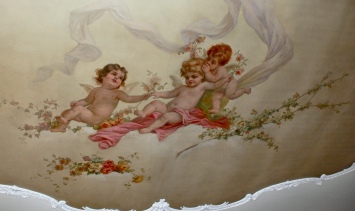
Angels, ceiling of B. & B. Bellefontaine, Pa. (photo R.E.)
(If you could travel back in time, what year and date would you choose?)
The Requiem or Grande Messe des Morts, Opus 5 -(h75), 1837 and Symphonie Fantastique, Opus 14- (H 48), 1830 [1.] both written by Hector Berlioz, are great works in the Romantic repertoire. My appreciation for his wondrous orchestrations and sonic surprises, as fresh sounding today as when I first heard them, continues to grow.
Preceding both was a work which until recently I’d not given enough attention. Written when Berlioz was 20 years old and had been studying music formally for only one year, the Messe Solennelle or Solemn Mass, (H 20A), 1824 was premiered in 1825 at the Church of Saint- Roch, Paris. [2]
For Berlioz fans, the Messe Solennelle throws a revealing light upon the composer’s growth. It illuminates the germination of ideas that would shortly appear in full bloom in his greatest works.
Gratias. from Messe Solennelle. Theme for Scenes in the Country, Symphonie Fntastique.
Sometime after the second performance of the work, Berlioz burned the orchestral and vocal parts to the Messe Solennelle. He may have thought the work unrepresentative of his more mature style. However, Berlioz gave the complete score to a violinist friend from Antwerp who before his death gave it to his brother, a church musician. Assumed to have been burned or lost, the score written in Berlioz’ hand was discovered in an Antwerp church organ bench in 1992.
One year later John Eliot Gardiner performed and recorded Messe Solennelle with the Monteverdi Choir and the Orchestre Revolutionaire et Romantique in Westminster Cathedral.
Philips Digital Classics 464 688-2
Footnotes:
[1.] Though written 7 years earlier than the Requiem, Symphonie Fantastique has a larger or later Opus number. This is the result of its publication date. Symphonie Fantastique was published in 1845 whilst the Requiem was published in 1838. In 1987 the D. Kern Holoman chronological catalogue of all compositions by Berlioz was published with the designation H before Opus numbers.
[2] The July 10, 1825 premier was conducted by Henri Valentino and Berlioz played the Tam-tam. Messe Solennelle was performed again in 1827, the year of Beethoven’s death, Berlioz conducting.
July 10, 1825 is my answer to the time travel question. Just imagine being close enough to the orchestra to watch the face of Berlioz as he waited for and then played that great note. Is this Tam-tam still in existence? Is the beater?)
Resurrexit from Messe Solennelle. Theme used in the Requiem Dies irae, Tuba Mirum.
+This article is based largely on notes written by Hugh Macdonald for the Philips recording CD booklet.
This is the third article in a series devoted to aspects of composers’ works and lives not generally known by average concert goers. Perhaps these articles will encourage readers to dig further into the life and times of other composers.
As a youngster I began my survey of Western music with Beethoven and his 9 symphonies. Toscanini was at his peak of popularity and his LP recordings for RCA Victor with the NBC Symphony Orchestra were thought by many people to be the definitive interpretations of these works. I stayed with Beethoven for a long time. After sessions of listening to Beethoven’s late quartets, I attended a lecture by Louis Krasner 1who said of the quartet op. 135, ” When man first lands on the moon, they will hear the opening music of this quartet.” Ten years later they landed but I don’t know what they heard or what Krasner thought about the event.
Later I decided to educate myself in a linear manner by going back to Bach, then Handel, Haydn, Mozart, Beethoven, Tchaikovsky, Brahms, Debussy and Ravel. Note the leap from Beethoven to Tchaikovsky. No Schubert, no Cherubini, no Rossini, no Mendelssohn and no Berlioz.
I can think of no good reason for my omission of these great composers. I knew Schubert’s “Unfinished Symphony” was unfinished, Cherubini’s “Requiem” contained a tam-tam note, Rossini had written the music for the Lone Ranger and Mendelssohn’s “Midsummer’s Night Dream” had a great overture. But Berlioz did not figure into my mix until later.
When I learned the “Symphonie Fantastique” was written in 1830, just 7 years after Beethoven’s last string quartet and two years after Schubert’s death, I was stunned. To me their works sounded light years apart. As distant from one another as 19th century Vienna and Apollo 11.
Berliozs manuscript, first page of Symphonie Fantastique.
I have never forgotten the the first time I heard those plaintiff opening woodwind triplets nor the intense longing of the following violin melody. But those were only the first few notes of an entire symphony of longing and struggle. Berlioz wrote, “melancholy is necessary for a composer”.
I first heard the work live in Carnegie Hall, New York City with the Boston Symphony Orchestra conducted by Charles Münch. (Vic Firth played the principal timpani part in his inimitable style.) My only disappointment came during the “Witchs Round Dance” which is in a fast two beats to the bar. At one point all strings and winds play chords in unison rhythm, off set by one eighth note from the prevailing beat and are joined four measures later by the brass and timpani playing the same syncopation, but one eighth note earlier. These eight measures of three against three against two create an exquisite tension which I had anticipated with glee. But Münch chose to conduct the brass and timpani measures in three four. He played safe and a teeth grinding moment became too smooth by half. However, this disappointment was offset by the artistic cymbal playing of the late Tommy Thompson. 2
Joseph Jean-Baptist Laurent Arban (1825-89) 3.was a cornet teacher, soloist, conductor and composer who in 1848 developed with Adolph Sax a cornet which met his standards for ease of play and intonation. It could have been around this time that Berlioz, who had certainly heard Arban perform, decided to add a cornet part to the “Waltz” (Un bal) of “Symphonie Fantastique”. Some may consider this a case of gilding the lily. I think the cornet adds some bravura which is not out of place. It transforms the “Waltz” without distorting its lovely motion. The recording I own and the only one I know with the cornet part was made by Jean Martinon and the Orchestre de National l’ORTF on EMI in 1973. The CD transfer is excellent and the performance is expansive, musical and one of the two best recordings in my collection.
It was the improvements in brass instruments by Adolph Sax which gave Berlioz the courage to write his monumental “Grande messe des morts” (op.5, 1837), containing four antiphonal brass choirs and multiple winds. When I was in Paris, too long ago, I visited Les Invalides and entered the chapel of Saint-Louis-des-Invalides (1679), where the premier had taken place. Upon entering the chapel and finding myself alone, sang in my most stentorian voice, one of the tenor parts in “Dies Irae, Tuba mirum spargens sonum”, etc. A personal oblation to one of my heroes. Near the end of his life Berlioz told some friends,”Of all my works I wish the Requiem to survive”. My favorite recording of this work was made by Hermann Scherchen in the chapel of Saint-Louis and the vinyls were later transfered to CD with disastrous results. The diffused rhythms of the antiphonal choirs and the cavernous roar of bass drum, timpani and tam-tam were completely lost. Sadly, Scherchen’s recording is out of print though one might find it among sellers of rare recordings.
During my college days a teacher who understood my proclivity for grand gestures suggested I look at the Berlioz “Treatise on Instrumentation”. The Treatise had first been published in 1844. ( It is now available from Amazon with edits by Richard Strauss.) Another Berlioz moment awaited me near the very back of the book, his article titled “The Orchestra”. In this portmanteau of revolutionary ideas Berlioz encapsulated his instrumental and musical dreams; how I wish he could have realized them.
A choir of460 voices and:
An orchestra of 465 instrumentalists including 12 pairs of ancient cymbals in different keys *, 30 pianofortes and 30 harps, 8 pairs of kettledrums, 6 drums, 3 bass drums, 4 pairs of cymbals, 6 triangles, 6 sets of small bells *, two large very low bells, 2 gongs, 4 crescents.
Berlioz imagines “combining the 30 pianofortes with the 6 sets of small bells, the 12 pairs of ancient cymbals, the 6 triangles (which might be tuned in different keys like cymbals), and the 4 crescents into a metallic percussion orchestra-gay and brilliant expression in mezzo forte; by combining the 8 pairs of kettle drums with the 6 drums and the 3 bass drums into a small, almost exclusively rhythmic percussion orchestra-menacing expression in all shadings; by combining the 2 gongs, the 2 bells and the 3 large cymbals with certain chords of the trombones-sad and sinister expression in mezzo forte.”
* these are described in the percussion instruments section of the treatise.
The last article in his treatise is devoted to conducting and contains his thoughts on the role of conductor and patterns for beating different time signatures. He talks about technical issues with certain instruments. Berlioz was better known in his lifetime as a conductor not a composer. He conducted in France, Germany, England and Russia as well as other countries. He conducted concerts having as many as 1000 performers. Berlioz and Wagner had met in Germany and in fact had discussed conducting. It is ironic that “Wagner on Conducting” by Richard Wagner was first published in 1869, the year Berlioz died.4
The influence of Berlioz was critical for the further development of Romanticism, especially in composers like Richard Wagner, Nikolai Rimsky-Korsakov, Franz Liszt, Richard Strauss, Gustav Mahler and many others.
Berlioz destroyed many papers prior to his death, but kept a baton given him by Mendelssohn and a guitar by Paganini. On his death bed to friends attending he was reputed to have said, “At last they will play my music”.
Hector Berlioz ( the Z is pronounced), born La Côte-Saint-André, December 11, 1803 –died Paris, March 8, 1869.
Footnotes:
1. Louis Krasner (1908-1984) played the premiers of both the Alban Berg (1936) and Schoenberg Violin Concerto (1940). He commissioned the Berg (1935) and its premier was given in Barcelona, Spain. The Schoenberg was premiered with Stokowski in Philadelphia. Krasner also commissioned American composers Henry Cowell, Roger Sessions and Roy Harris. His lecture at Ithaca College, Ithaca, New York was given before the music students and staff in 1959. At that time he was a professor at Syracuse University having previously served as concert master of the Minneapolis Symphony Orchestra under Antal Dorati (1906-88).
2. Many years later in Tanglewood, I was fortunate enough to sit at a table with Vic Firth and the other guys in the percussion section of the Boston Symphony. The conversation turned to Tommy Thompson and I asked everyone to confirm whether or not my memory of his simple yet exquisite playing in “Symphonie Fantastique” was correct or had I transmogrified this youthful vision into something mythological. I was gratified and amazed when everyone confirmed my old impression. Vic even demonstrated Tommy’s motion. Thompson was able to play fortissimo cymbal crashes with no more gesture than he used for pianissimo. Thompson’s playing can best be heard on a recording of Tchaikovsky’s “Romeo and Juliet Overture” conducted by Arthur Fiedler. I am fortunate enough to have the beautiful sound of the original LP release. Thompson was a cymbal playing giant. I wonder how many people now living remember him or ever heard him play.
3. Arban’s “Grand Method for the Cornet ” was first published in 1864. It is a treasure of musical and technical demands well suited for marimba and xylophone sight reading and recital pieces.
4. “Wagner on Conducting”, Richard Wagner, translated by Edward Dannreuther, Dover Books.
Written almost 150 years ago, this book contains a paragraph of wisdom equally applicable to today’s percussionists as well as conductors:
“As a proof of my assertion that the majority of performances of instrumental music with us are faulty it is sufficient to point out that our conductors so frequently fail to find the true tempo because they are ignorant of singing. I have not yet met with a German Capellmeister or Musik-director who, be it with good or bad voice, can really sing a melody. These people look upon music as a singularly abstract sort of thing, an amalgam of grammar, arithmetic, and digital gymnastics;-to be an adept in which may fit a man for a mastership at a conservatory or a musical gymnasium; but it does not follow from this that he will be able to put life and soul into a musical performance.” (page 19) Italics by Wagner.


 Robin Engelman
Michael Burritt – Percussion Rochester- May 4,5, 2012
I drove to Rochester this past weekend to hear Michael Burritt play the premier of his Duende Concerto for Percussion and Wind Ensemble with the Eastman School of Music Wind Ensemble conducted by Mark Scatterday. On the same program Nexus was to play Rituals for Five Percussionists and Orchestra by EllenTaffe Zwilich (2005), a work written for and recorded by them. The part I had played in this work was performed by guest artist John Beck.
Michael’s performance was on the last concert of Percussion Rochester. P.R. was a two day percussion blitz organized by Burritt, Bil Cahn and Kathleen Holt with the help of numerous sponsors. It was an exhibition of percussion instruments and music – all played at various venues in Rochester by extremely gifted students and professionals.
The Eastman School of Music has been irrevocably transformed by the arrival of Michael Burritt as its head of percussion. Michael is a virtuoso percussionist, teacher, clinician and composer. His enthusiasm for and dedication to teaching and performing is so powerful it could not possibly be ignored by anyone or any department in this venerable school.
I am particularly aware of the changes Michael has wrought because I played in the Rochester Philharmonic from 1966 – 68 when the orchestra was closely associated with the school. I met the percussion instructor William (Bill) Street and heard tales of his legendary tenure at the Eastman School. I met John Beck who was the timpanist of the Rochester Philharmonic and who took over the percussion department upon Street’s retirement. If memory serves, I was only the 2nd principal percussionist of the Rochester Philharmonic who had not graduated from the Eastman School. I believe the first was Jack Moore who preceded me. This was 45 years ago, I was in the bloom of my career and in awe of Bill Street, John Beck and their students.
The Rochester Philharmonic consisted of a core of professional players numbering about 35. All the principal players were teachers at the school and great players they were. Playing next to Beck for two years is a memory that will always endure in my mind. He was a gracious and helpful colleague who always enjoyed playing. If extra were players were needed, they came from the student body, assigned by their teachers. This created the first and only conflict in two of the most productive years I’ve ever spent in an orchestra. Street assigned different students to every concert. One day I told John Beck, “I want to select the extra players and keep them all year””. And so it came to pass.
I knew this system was good for Street’s students. But it wasn’t good for me, nor I thought, for the orchestra. If only for one year, I wanted to establish a relationship, with the extras who came to play in the orchestra. I had grown comfortable with Bill Cahn and his future wife Ruth McLean. I wanted them to play with the orchestra for as long as they were in school and, in fact, both joined the orchestra immediately after I left for Toronto. Of course, Bill came to be one of my colleagues in Nexus not too many years later. But I digress.
The standard of percussion at Eastman has always been high. The school’s first percussion ensemble was formed by John Beck, Street having no interest in the percussion ensemble genre. His interest was primarily in orchestra percussion. At the time, John Cage was known by many musicians, the pathfinder percussion soloist Max Neuhaus was performing and recording and far away in Europe the Strasbourg Percussion Ensemble was commissioning works from European composers. Nexus pushed further ahead by writing its own repertoire, collecting percussion instruments from other cultures and improvising. Generally speaking however, percussion ensemble music and the level of percussion playing in academia was from todays’ perspective, just emerging from the dark ages. The Renaissance came quickly.
As I sat listening to Michael percussion concerto I could not help but be amazed. A revolution had occurred at the Eastman School of Music.
And the change was also exemplified by the students. In the afternoon of our arrival I heard a concert in Kilbourn Hall given by Eastman percussion students and simply sat slack jawed as I heard them zoom their way through a program of works with precision and flexibility unthinkable 25 or 30 years ago, all without conductor, except for the Harrison Concerto for Violin and Percussion. Speaking with former colleagues and friends, I learned that the incoming freshman auditions were, to say the least, illuminating. Kids just out of high school were playing works PhD students couldn’t have played, or have thought to play, not too many years ago. On the whole, it has been percussion composers such as Leigh Stevens, Bob Becker, Gordon Stout and Michael Burritt who have been responsible for this incredible advance. Their compositions and teaching innovations have prodded new generations of exceptionally gifted percussionists. Now the question arises in my mind, “What can they do with all their skills? ”
After the student performance we took dinner across the street at Max’s. We ordered a dozen oysters on the half shell and fillet mignons, accompanying both with two bottles of 2004 Chateau Berliquet, Grand Cru St. Emilion. So satisfying.
Michael’s Concerto must have been a kick in the ass for any composer in attendance who has dreamed their way through a composition for percussion based on some ‘concept’. Duende, a work in one movement, begins with a virtuoso fanfare of tom-toms so fast and clear as to leave no doubt in the minds of listeners as to Michael’s secure artistry. It’s a classically designed work, thoroughly professional in its orchestration and structures. A few years ago I had heard his French horn concerto with percussion orchestra, but was not prepared for the maturity of Michael’s compositional skill. Duende is much more advanced. In response to Michael’s marimba playing, there were woodwind passages of surprising originality and beauty. From the very first note I was caught up by his energy, passion and when required, delicacy of touch. Duende is a work I’d love to hear again and again.
Duende is a spirit associated most commonly with the music of Spain. El duende prompted the famous Andalusian poet Frederico Garcia Lorca to write a now famous lecture about its affects on art and artists. Duende is a complex emotion, referencing among other things death and transcendence. To Lorca, its presence evoked a heightened sense of awareness, a spiritual wholeness. [1.] In Spanish and South American mythology, Duende is also an imp, a small, mischievous devil or sprite. Both definitions of Duende are applicable to the Burritt concerto, though I like to believe the shift to hand drums at the end, bongos and conga for the soloist and mounted tom toms for the ensemble percussionists, represented the Imp while the largest part of the work dealt with more spiritual aspects.
Whatever Michael’s intentions, his solo on bongos and conga was disconcerting. To my ears, the sounds of those instruments undeniably announce a kind of pop dance music from another culture. They rang falsely against the much larger body of his European Abstract Art Music. Well, picky, picky, but I cannot deny the shiver of surprise and disappointment I felt when I heard those sounds.[2.] The feeling dissipated when Michael was joined by his students in a tight knit exciting duet more suited to the work.
Michael and his accompaniment received a long and well deserved standing ovation. In response he played a short , lovely marimba solo.
The concert ended with a performance of Rituals, the Ellen Taffe Zwilich Concerto written for and played by Nexus. I knew this work pretty well because I had played it a number of times and recorded it with Nexus. Sitting out front was a wholly different and very impressive experience. Because of the clarity of Nexus and the superb playing of the Eastman student orchestra conducted by Neil Varon, I could grasp the scope of the work in its sonorities for the first time. It’s a terrific work, particularly in its contrast to other percussion concerti. The metal percussion, symbols and gongs, combined with string and woodwind chords, create clouds of gorgeous, complex overtones. Some of the movements seem to hang over the newly renovated Eastman theater, enveloping everyone. It is not a piece without rhythm but the overall impression is amorphous. The snare drum rhythms don’t actually propel the music but are simply layered into it. Bill Cahn’s tuned gongs, Becker’s soft tom-toms stand out, but otherwise the percussion instruments are a part of the orchestration, often making it into harmonic clouds. John Beck played my old part and the chimes which open and close the 2nd movement, always my favorite moments, were beautifully played.
I came away feeling the four movement work is one movement too long. Which movement should go? The removal of one would require a reshuffling of the remaining three. Maybe the last. Its’ ending was a problem when first written and after hearing it May 5, it is still a problem.
Footnotes:
[1.] http://en.wikipedia.org/wiki/Duende_(art)
[2.]Joseph Schwantner concluded his Concerto No. 2 for Percussion Section, Timpani and Orchestra with a similar idea. His instruction for the drummers was to improvise and they didn’t know when enough was enough. With Burritt’s work, thoroughly composed, it was the device itself that troubled me.
Posted by robinengelman on May 10, 2012 in Commentaries & Critiques, Composers, Contemporary Music, Unassigned
Tags: Eastman School of Music, Kilbourn Hall