RSS

Category Archives: Contemporary Music

So Percussion + Meehan/Perkins Duo

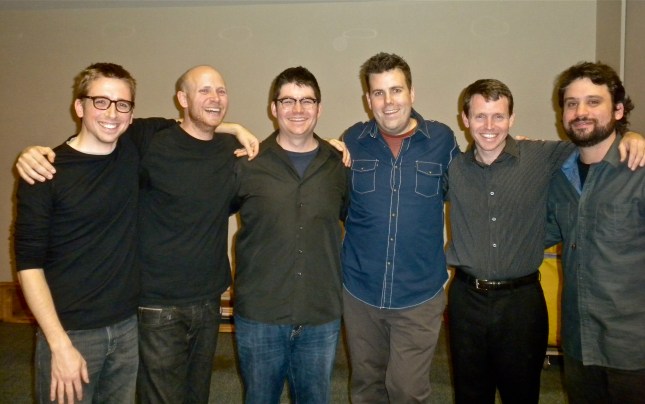
from L. to R. Eric Beach, Jason Treuting, Josh Quillen, Doug Perkins, Todd Meehan, Adam Sliwinski

from L. to R. Eric Beach, Jason Treuting, Josh Quillen, Doug Perkins, Todd Meehan, Adam Sliwinski

The Wednesday evening concert of the 2010 Percussive Arts Society International Convention in Indianapolis, Indiana featured the So Percussion group.  I had not heard So Percussion play a concert in about three years and though their contribution this evening was limited to one work, that work, Pleiades, is a four movement tour de force and arguably a seminal work in percussion repertoire if not in all of contemporary music.

About twenty years ago, Canadian composer and elegant raconteur Harry Somers 1925-99), addressed a Toronto concert audience with a fervent plea for new music. “I hope Canada  enters the 20th century before the 21st begins” he said.   But Toronto audiences continued pursuing their more traditional carrots, Handel at Christmas time, Bach at Easter and in between, Mozart, Beethoven and a Tchaikovsky ballet or two. Somers died on the cusp of the millennium, his plea unheeded.

Considering Somers’ entreaty, my first contact with the music of Iannis Xenakis (1922-2000) was, ironically, in Toronto.  James Levine, then 25 years of age, chose  to open his  conductorial debut with the Toronto Symphony Orchestra in 1968, with Xenakis’  work Metastasis, definitely not music of the carrot family.

Levine’s preparation was meticulous and although I could not have foreseen it, his work that week presaged his commitment to new music, particularly after taking over the Boston Symphony where he championed the New York school of composers – Elliott Carter, Milton Babbitt, Charles Wuorinen etc.

Pleiades was written during 1978–79 for the Strasbourg Percussion Ensemble.  It was premiered May 3,1979 with the Ballet du Rhin. My first encounter  with Pleiades was in the early 1980s in Walter Hall of the University of Toronto. Xenakis was the featured composer on flutist Bob Aitkin’s New Music Concerts.

I believe our performance in Toronto was the Canadian premiere. The work is 43 minutes in duration and besides drums, marimbas and glockenspiels, Pleiades requires six instruments which Xennakis claimed to have invented, but never built. He called these “imaginary” instruments Sixxen.

If memory serves, Xenakis’ description of Sixxen was vague. Each Sixxen was to consist of 19 slightly out of tune metal bars pitched within a tessitura similar to each, but  avoiding unisons. The father of a percussion student at the University of Toronto faculty of music worked in a foundry about 45 miles north of Toronto. He made these instruments free of charge and delivered them to Walter Hall.

They arrived covered with oil, grime and metal filings. By the time they were unloaded and ready to be played, our hands were filthy. We rehearsed and I remember very little about the piece except that it was brutally loud, very difficult to play and its pages black with notes. The late John Wyre would have said, “It doesn’t pass the light meter test”. Wags have suggested that Xenakis’ loud music was the result of his progressive deafness and that seemed confirmed by him asking repeatedly for us to play louder.

Xenakis arrived to coach the last couple rehearsals. As soon as he heard our version of his imaginary Sixxen, he objected, stating that the sound was not at all what he had in mind.1

I remember being struck by the fact that he was ungracious. He didn’t thank us or recognize in any manner our attempt to realize his sometimes fanciful instructions, but still his program note claimed the Sixxen were his invention and the heart of Pleiades.  Many years later I learned that Xenakis had objected to the original Sixxen built by the Strasbourg Percussion Ensemble and indeed, to every Sixxen built during his lifetime. And this brings me back to the So Percussion,Meehan/Perkins Duo performance.

With thirty year old memories of foundry oil, grime and metal filings and the deafening clang of Sixxen still in mind, I was more than curious about attending this performance. As I entered the convention concert hall, I felt the same vague sense of unease and anticipation as I had felt before attending my 50th high school graduation reunion.

I need not have worried. So Percussion, Meehan/Perkins Duo  were simply astounding. All the difficulties I remembered from the past vanished. The clarity of their performance made the contrapuntal and polyrhythmic complexities of  Pleiades vividly clear. Even more impressive was their orchestration. All the drums were audible, their tunings exquisitely prepared. But it was the Sixxen that most impressed me. Next to that sound, the traditional mallet percussion sound was almost a cliché.

“I built the Sixxen for So’s first performance of the full Pleiades back in 2004″, wrote Adam Sliwinski.  “Although Xenakis said not to tune unisons among the players, I made each bar quite close – but never the same – so that you can really hear unison textures”.

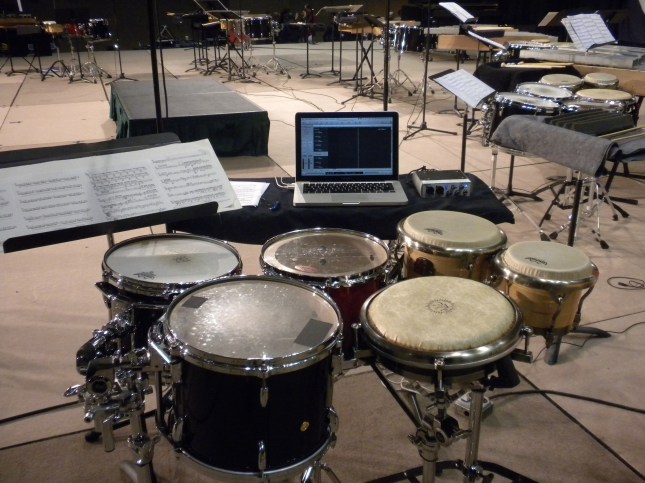
When I inquired about the computer, which I had not seen from the audience, Adam replied, “We use a click track to perform Pleiades. One of its most important compositional tactics is to oscillate between transparent unison and calculated chaos.  The polyrhythms of this chaos are really interesting, so we enjoy playing them exactly right.  Of course, it is always important to use good chamber music sense, especially when you have a pulse in your ear.”

So Percussion, Meehan/Perlins Duo’s fluidly precise performance belied the use of click tracks and Pleiades in their hands was the best performance of any single work I’ve heard at a Percussive Arts Society International Convention.2
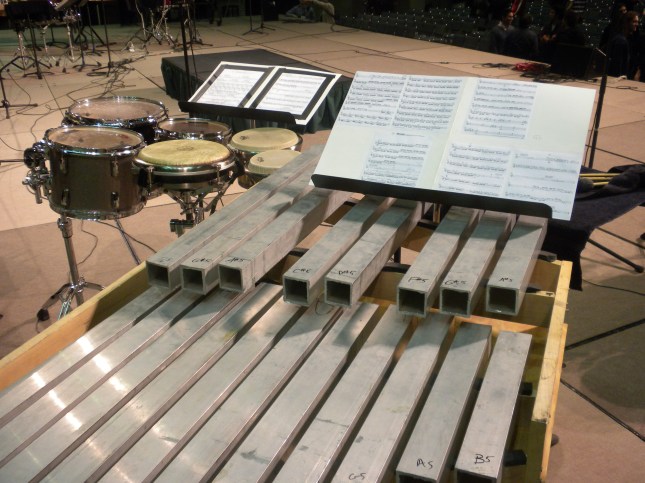
Sixxen
Sixxen

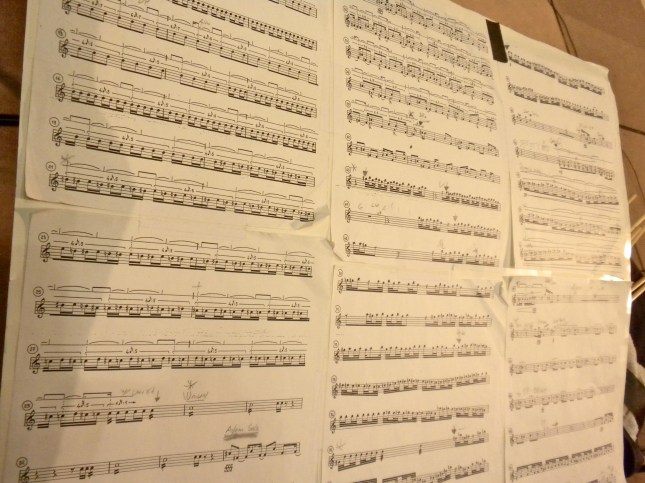
Pleiades music

Pleiades music

Pleiades, drums & computer

Pleiades, drums & computer

Foot notes:

1. “SIXXEN is a specially constructed instrument named from Six (Strasbourg) and Xenakis.  But the SIXXEN is not yet fully satisfactory.  It would be desirable to construct a new one.  This is its description: each one of the six percussionists use 19 metal pieces (made of brass, steel, etc) of approximately the same timbre.  It is highly desirable that the timbre be a really interesting metallic one.  By interesting I mean astounding, strange, full, resounding, and without too much reverberation, so that the minute rhythmical patterns be clear for the audience.  These 19 metal pieces should be tuned to produce 19 pitches but which should absolutely not form an equally tempered scale.  The whole range of the 19 pitches is arbitrary and should depend on the available pieces.  However, this range should be nearly the same for all the six percussionists and placed within the same extremes of pitch.  This means that for a given pitch out of the 19, and for any of the six SIXXEN, the other 5 corresponding ones must not form unisons.  The deviation could be slight but should still be noticeable.”  – Iannis Xenakis

2. Todd Meehan and Doug Perkins were founding members of So Percussion and also perform as the Meehan/Perkins Duo.

 
1 Comment

Posted by on December 2, 2010 in Articles, Contemporary Music


Milwaukee, Chicago and Franks Drum Shop

In 1965 I was playing percussion in the Milwaukee Symphony Orchestra with Bob Ayers and John Wyre.   The orchestra was new and I was on its first Player’s Committee. The president of the orchestra’s board of directors and its manager were doing everything they could to discourage our committee from writing a master contract: a document binding the players, the local musician’s union and orchestra management in a legal relationship that would enhance the musician’s working conditions and cost management more money.

At that time, the Chicago Symphony was playing ten concerts a year in Milwaukee’s old Pabst Theater, and occasionally, I’d meet their cymbal player, Sam Denov, in the boiler room just before his concert, for a lesson.  Sam had authored a book on cymbal playing, but he was also something of a legal expert and had helped write his orchestra’s Master Contract, the first such document to be ratified in the United States.

After our lessons together, Sam and I would sometimes talk shop, and on one occasion, I told him about our struggles with management. He offered to give me a copy of the Chicago Symphony Orchestra’s Master Contract.  This was a big deal.  A volatile atmosphere had for years, permeated the lives of symphony players. Unhappy with being ignored by the American Federation of Musician’s (A. F. of M.), representatives from orchestras met and formed their own organization.  At first, the A. F. of M. actively worked to subvert this quasi union. When they finally realized the vast sums of money they could get by collecting work dues from well paid symphony musicians, they quickly absorbed the player’s fledgling organization.

Sam had experienced all of this, and more. Though I was an orchestral player during this period, my only involvement in the player’s movement was a subscription to their news letter. Now ‘the troubles’ had come to Milwaukee.

Troubles, is not an overstatement. The Milwaukee Symphony was an orchestra in transition. Young professionals had been hired to beef up the local talent and a couple of highly paid ringers from Chicago were brought in to keep watch on everyone and everything, including the young, very inexperienced, and malleable conductor. The orchestra’s board of director’s and manager were controlled by their president. In retrospect, I’m sure he thought he had the perfect balance of temperaments to control events for years to come: a local union president, susceptible to flattery and experienced mainly in dealing with an elderly membership of friends who played week-end polka gigs; a personally appointed chain smoking personnel manager, whose vocabulary was limited mostly to grunts; a young svelte conductor, with a pair of pure white Samoyed dogs to charm Milwaukee Gold Coast residents out of their money; local musicians whose main concern was the extra money earned playing in the orchestra; the two hand picked old pros mentioned earlier; and his own ruthlessness.

Most of the young pros were ambitious and wanted change. Hence, the formation of our player’s committee. The need for change was not shared by everyone. There were a few pros who feared they’d be rocked overboard. They saw Milwaukee in their future, and wanted the committee to wait, even when we learned the local union President was reporting our ‘secret’ discussions to management. (He innocently believed he was doing everyone a favor by smoothing the path ahead of us.) We also discovered spies on our committee, and they too, were regularly reporting our discussions to management. With the help of Chicago’s master contract, pro bono advice from a Milwaukee labor lawyer and an A. F. of M. representative who flew in from New York City, we wrote, negotiated and ratified our orchestra’s first master contract. Then, almost all of the youngest and brightest resigned from the orchestra and went forth into the world to better jobs.

Many years later, Nexus played with the Milwaukee Symphony. The moment I walked on stage, a veteran from those days stepped forward, shook my hand, and said simply, “You were right”. Where was he when he was needed?

One good break from Milwaukee was a trip to Franks Drum Shop with my Daughter, Dorothy Anne. Its late, great owner, Maurie Lishon, sold me a fine sounding Ludwig snare drum that someone had jerry rigged into a Super Sensitive look alike. During that visit Maurie excitedly showed me Ludwig’s latest marvel, the Keylon xylophone. He told me it was indestructible, and to prove his point, thrust a brass headed glockenspiel mallet into my hand and said, “Go ahead. Hit it as hard as you can. Nothing can hurt it”. I aimed for one of the bars and creamed it dead center.  A chip the size of the beater flew off leaving a cream colored hole where a brown plastic coating had been. There was silence for a while and then Maurie, bless him, gave a bemused shrug and said, “Hmm”.  His wife Jan took the Polaroid photo below.1 A cherished treasure from an otherwise irksome era.

1. See: http://www.pas.org/News/memoriam/Lishon_IM.cfm


Commissioning New Music for Percussion: Four Case Studies.

Murray Schafer (b. 1933)

SHADOW MAN (2001)

R. Murray Schafer is a Canadian music icon. If you ask people anywhere in the world to name a Canadian composer, they’d most likely name Murray.

His books The Tuning of the World (The Soundscape) and The Book of noise, his Flute Concerto, eight string quartets, and his ongoing music-drama cycle, Patria are some of his most read and performed works.

Concert promoters love Murray. A new work by him generates in–the-bank government grants, high profile publicity and ticket sales.Murray’s name can get big bucks flowing, but he’s also been known to walk away from projects in mid-stream. He has walked out on rehearsals and refused to attend premiers and receptions. Like the famous snubs hurled at wealthy patrons by maestro Fritz Reiner, Murray’s antics often endear him to his followers as proof of the Artistic Temperament. They also feed the growing legend that is R. Murray Schafer.

One is never sure if artistic principal or crafty self-promotion drives his actions. Perhaps it’s both.

Murray has brought musicians, actors, props, the press and audiences to pristine wilderness areas in order to increase public awareness for the need to preserve pristine wilderness areas.

He wrote an open letter attacking the young Finnish conductor Jukka Pekka Saraste for not programming Canadian music. Saraste had not yet begun his first season with the Toronto Symphony Orchestra, but he was well known in his homeland as a conductor of contemporary music and was himself a composer. Murray’s letter seemed, if not a cheap shot, at least a poorly timed and ill informed invective. Even die hard Canadian music supporters and Schafer devotees looked away in embarrassment.

One member of Nexus had for years championed the idea of Murray writing a piece for us. Others resisted the idea, citing Murray’s rather prosaic writing for percussion.

Then in 2002, an act of generosity and the Dean of the Faculty of Music of the University of Toronto brought Nexus and Schafer together.

A Toronto patron of the arts had donated a significant sum of money to the Faculty of Music conditional upon the creation of interesting and challenging musical events for its students; one event per year for five years. For the inaugural event, the Dean suggested R. Murray Schafer write a concerto for Nexus and the student symphony orchestra.

By almost any gauge this was an astute choice. Nexus was an Artist in Residence at the faculty of Music and Murray had left the school while still an undergraduate. In subsequent years Murray said unkind things about the Faculty, and education in general, and had never again set foot in the building. Now, a path towards reconciliation had been cleared and Murray nearing his 70th birthday chose to take it.

He accepted the commission and Nexus agreed to play.

Murray met with us and brought with him the Rubank Elementary Snare Drum Method. He had been studying it to prepare for an important snare drum part in his piece. Everyone gave him a list of favorite instruments plus some no-no’s and then Murray wrote Shadowman.

The work follows the life of a military drummer from his youth to old age and death from Alzheimer’s disease. Russell Hartenberger, dressed in a British regimental uniform, played the part.

At the back of the orchestra, with our arms folded menacingly and wearing black masks ala Tudor axmen, Bill Cahn and I portrayed the Forces of Darkness. Occasionally we’d made ominous noises on drums and wooden things while downstage left and right, John Wyre and Bob Becker portrayed the Forces of Good by playing delicately on bells and other ringing metallic percussion. They were costumed in ill fitted gauzy white gowns and headdresses and ersatz angel wings framed in flimsy wire. Not to put too fine a point on it, we all looked and felt like fools.

A lovely arrangement of an old hymn tune ends the work while Russell, now only able to whine and play with his childhood toys, slowly expires on a drumhead.

During a rehearsal Murray chastised the students for laughing at this pathetic scene, but it was funny. Concert night the house was sold out, “Shadowman” was well played and Murray didn’t stick around for the reception.

Just before the premier, a friend realized Nexus had not been offered a performance fee.The Dean apologized and we wound up making $739.00 per man for our work. I had it from an unimpeachable source that Murray’s fees for Shadowman had extinguished the entire five year donation.

About a year later, Alex Pauk, director of The Esprit Orchestra, performed Shadowman and I attended the concert to learn if time would alter my opinion of the work. Former percussion students from the University of Toronto were the soloists and I was sure they would do a good job. I hoped they would do better than we had done.

But my response to “Shadowman” was pretty much the same. The soloists did a splendid job, and the old soldier died again.

Whatever fate befalls Shadowman, its two performances are an increase of 100% over most new works.

http://www.philmultic.com/composers/schafer.html

Milton Barnes (1931-2001)

ANNEXUS (1984)

Milton Barnes was a delightful ‘Hail Fellow, Well Met” sort’a guy. He had a sense of humor and was enthusiastic about life. He was a composer of taste and deep convictions. He was, I think a devout Jew and some of his best music was based on texts from the Torah and the Old Testament. I thought him without affectation, an honest musician and music maker. He was not at all reluctant to wear his heart on his sleeve.

Most of Milton’s work was chamber music. It was lyrical, tonal, and rhythmical. His orchestrations were interesting. He had a gift for making three or four instruments sound like a much larger ensemble. His harmonies were natural, at time quirky, and he had a sensitive touch with written texts.

Milton had to organize concerts of his music, but he also received many commissions. There was a group of very good musicians in Toronto who tried to make themselves available whenever he called.

I looked forward to his new works. They were always well written-‘playable’ is what professional musicians would say. They were often performed in Synagogues and he invariably conducted. The pay was rarely above scale, but making music with him was.

Milton started his musical life as a Jazz drummer, and it was Jazz and his wit that brought him and Nexus together. He was one of our first fans and composed Annexus for us.

The title comes from a conjunction of Nexus and the Annex, a section of downtown Toronto where Milton lived. Nexus premiered Annexus in the Premier Dance Theatre-now the Fleck Theatre-and later recorded it, but never played it again. (Dance of the Octopus with Judy Loman, CBC 2-1037)

Though Milton understood percussion, or perhaps because he did, he wrote for the ‘kitchen sink’. As a touring group, Nexus would have been hard pressed to take Annexus on the road, but we liked the piece and when I listen to it recently, it was fresh and still alive.

Milton didn’t seem to mind Annexus being filed away. He always gave me the impression that his reward had been in hanging out with us.

Milton was by no means the only composer who failed to consider our needs. Perhaps he did, and didn’t care. Judging from my fifty years experience in the business, I’m sure he won’t be the last.

In 2001, Milton and I spoke after a concert of contemporary music. We hadn’t seen each other for a long time and our ruminations were those of old friends, gentle and unhurried. He was still doing what he had always done and his sense of fun and love of adventure were as strong as ever. The twinkle was still there.

A few months passed and I heard he’d dropped dead. A massive heart attack had felled him at a young 71 years.

I wonder if his music will survive.I think it will.  I still have a faint twinge of regret that Annexus lies unbidden in Nexus’ files, but Milton is very much alive in me.

http://www.musiccentre.ca/apps/index.cfm?fuseaction=composer.FA_dsp_biography&authpeopleid=843&by=B

Bruce Mather (b.1937)

CLOS DU VOUGEOT (1977)

The exact date when I met Bruce Mather is disputed. He say’s one thing, I say another. (Given his skills as a composer, piano phenom with perfect pitch, and an impressive memory, his version is probably correct.) However, I do remember the first time I met his music.

It was on a stage somewhere in Ottawa, Ontario. The work was his glorious Madrigal III (1971) for alto voice, harp, piano, and marimba. At one point, I extended an ascending passage beyond the range of the marimba, playing invisible marimba bars. When I came to earth, Bruce was looking at me.

My attraction to Bruce’s music is difficult, perhaps impossible, to put in words. It casts a spell on me and has created a relationship between Bruce and me that has lasted forty years. It has also led him to create a significant body of work for Nexus and my former percussion ensemble at the University of Toronto.

The first work Bruce wrote for Nexus was: Clos Du Vougeot, for percussion quartet (1977) and the second was Tallbrem Variations, for marimba, 4 percussion & orchestra (1994).

In between these came Gattinara for viola & percussion (1982), for me and Rivka Golani, and Clos d’Audignac, for marimba, 3 percussion (1984), for Bob Becker.

Four Études, 6 percussion (2001) was written for my percussion ensemble at the University of Toronto as was For Amie Watson, vibraphone, tubular bells, 13 cowbells (1 player), (2006) -this being dedicated to a student by the same name, and Mon Ombre, marimba, xylophone & vibraphone, (2007) – a reworking of a song Bruce had written in 2000.

All of these works are playable and transportable. A trait other composers would be wise to emulate.

Bruce’s music is well known in Europe, but his compositions for percussion are  not often performed in universities and colleges outside Canada. Perhaps it’s not fashionably loud and fast enough. If so, that’s too bad for contemporary music and percussionists. His music offers uniqueapproaches to percussion and deserves a wider audience.

http://www.composers21.com/compdocs/matherb.htm

Michael Colgrass (b.1932)

A FLUTE IN THE KINGDOM OFDRUMS AND BELLS (1994)

The Canadian born flutist Marina Piccinini contacted me one day in 1993. She wanted to know if I would be interested in a work for her and Nexus by Toronto resident, Michael Colgrass. It sounded like a good idea and everyone agreed to meet for discussions.

Michael spoke individually with all the Nexus players. He asked us which instruments we liked to play, and we gave him the same speech all composers get when they set out to write a work for Nexus: “if you want more than one performance, the instrumentation has to be transportable.”

Michael grew up in Chicago as a jazz drummer and became famous to percussionists for inventing the precursor of roto-toms and, to demonstrate their capabilities,writing Variations for Four Drums and Viola (1957). As a former percussionist, Michael would understand our needs.

I asked Marina if she knew any people who could help us with Michael’s fee; the work, after all, was her idea. She replied, “I’m a flutist, not a fund raiser.” Fortunately a close friend of mine said yes and found a colleague to share the expense. Because of them, my first foray into fund raising was easy. We were off and running.

One day, the score and parts arrived -Shock and Awe! Could any work for flute and percussion have more instruments? A grand piano, two marimbas, ten tom-toms, bass drum, a set of chimes, vibraphone, glockenspiel, hand drums. A rack of gongs and bells, triangles, suspended cymbals, and a drum set with temple blocks. (I think that’s it. I can’t recall if timpani were in the mix-I hope not.)

Marina insisted the program include Jolivet’s Suite en Concert. The Jolivet, in itself, requires a large percussion set-up, and one very different from the Colgrass. In the concert hall, back stage was filled with instruments and the overflow took up the entire length of the acoustical shell on stage. The stage hands were no help during the concert: they didn’t know where we needed instruments. Our one roady was a help, but sweat and dirty hands plagued us as we struggled to set each tune before the audience went to sleep.

Of course Marina was totally oblivious to the angst all this hardware inflicted on us. She only had to remember to bring her flute on stage. I now wish this concert had been filmed. it would be a perfect lesson for composers and percussion ensembles on what not to do.

Marina played beautifully. Nexus was terrific. When A FLUTE IN THE KINGDOM OF DRUMS AND BELLS was finally in place, it was played in spades, but never again.

A few months after this premier, I met up with Marina and her husband, pianist Andreas Haefliger, in Amsterdam in the home ofJan Pustjiens, Concertgeboworkest principal percussionist.

Haefliger indicated he wanted to talk and we stepped outside. He thought the Colgrass a terrific work and wanted to know if Nexus would play it again with Marina.  I explained our issues with the work, and told him that we could simply not afford to take it on the road. He suggested Michael might alter his orchestration, and on this note, our conversation ended.

Sometime after Amsterdam, I met Michael after a concert in Toronto. He offered to eliminate the bass drum and asked if that would make Nexus more amenable to playing the work.

http://www.michaelcolgrass.com/

 
1 Comment

Posted by on August 22, 2009 in Articles, Contemporary Music