
As a subscriber to the Berlin Philharmonic Digital concert Hall I have access to weekly archived performances by this great orchestra conducted by some of the world’s best musicians. Each week I receive an e-mail notifying me of the next live performance, often on Thursday or Saturday afternoons at 3PM Toronto time which translates to 8PM in Berlin. For about $160 Canadian per year I can watch more than one hundred concerts or parts of them at my leisure. Five strategically placed cameras almost unobtrusively record the musicians and conductors, often close up. And the sound reproduction lives up to the highest standards people have come to expect from German Tonmeisters.
For the price of one decent seat in Toronto’s Roy Thomson Hall I have an ever-growing orchestral repertoire at my fingertips. Modern technology at its best.

- Sado
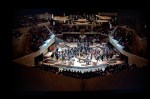
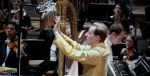
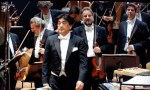
This morning I sat in front of my computer to watch and hear Toru Takemitsu’s “From me flows what you call Time” recorded live in Berliner Philharmonie just a few days ago by the Philharmoiker, five German percussionists and the Japanese conductor Yusaka Sado.
I had known for over a week that this performance was going to be broadcast. So I had a good deal of time to contemplate the experiences I might have watching other people perform a work I had played probably 100 times since Toru wrote the piece in 1991 for Carnegie Hall’s 150th anniversary, Seiji Ozawa, the Boston Symphony and Nexus. Both Toru and Seiji have been important people in my life and every time I performed “From me flows what you call Time” I was deeply touched, even when the conductor or the orchestra or both were not quite up to the challenge, or when my performance was not entirely satisfactory. So I approached this performance by strangers with feelings of ambivalence if not trepidation.

- Paduh

Things started off really well with the young French flautist Emmanuel Pahud. He has performed the Boulez …Explosant – fixe… with Boulez conducting, and performs most of the Philhaemoiker’s contemporary works and sometimes interviews contemporary composers for its broadcasts. He is an incredible player and his performance of the opening flute solo was superb; nothing over the top, just fluid, serene, and beautifully shaped. Pahud also conducted the concert interview with Sado.
But it was the percussionists I was most interested in. I was ready to be disappointed or dismissive, but it has been a few years since I last played the piece and as this performance progressed, my listening became more objective.
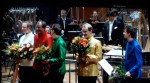
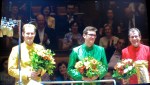
I was delighted with the way the soloists performed and the smiles on their faces at the end of the concert, the repeated calls by the audience for another bow, and the response of the orchestra and the conductor confirmed the success of their performance.
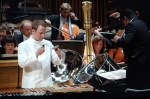
There were delightfully surprising details. At one point in the score, Takemitsu directed some percussionists to play with their fingers, something Nexus never did, but I couldn’t hear one part and another was barely audible. No one plays the same piece of music the same way, nor should they. The soloists have all the sounds, that is to say, all the instruments with the correct pitches. I wonder if Michael Ranta provided them. I understand Michael has created a set of instruments for “From me flows . . . .” The percussionists also played with artistry. I felt they were new to the work, which is probably true, and this work takes time.
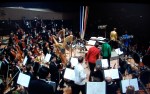
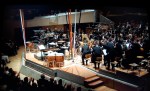
The sounds from the Berlin Philharmonic are spectacular. This is an orchestra that can play anything and under their Music Director Sir Simon Rattle, they have broken free from their limited repertoire of yesteryears. (There are also a lot of young players in the band.) The clarinets, harps, French horns, oboes, cellos and trumpets play particularly important roles in this work, but the entire orchestra has to play together and there’s no better orchestra in the world for doing this.
Never-the-less, I have to single out that great string bass section. The way they finished off the 5/8 bar crescendo just before the end and held the low C until the decay of the final wind chime note, was perfectly, if accidentally timed. The wind chimes did not ring excessively long and so the music stopped at exactly the right time to balance the work’s form.
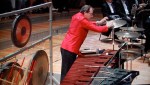
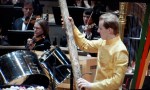
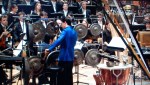
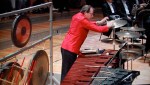
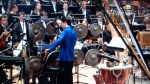
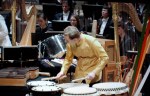
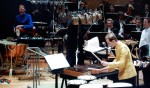
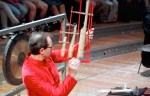
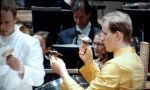
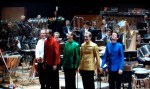
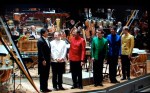
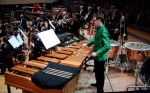
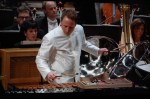
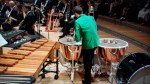
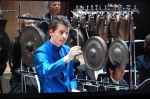
The percussionists colored jackets, representing earth, wind, fire, water and everything or nothingness were a nice touch. The percussionists were Raphael Haeger (blue/water), Simon Rössler yellow/earth, Franz Schindlbeck (red/fire), Jan Schlichte (green/wind), and Wieland Welzel (white/nothingness). Excepting Simon Rössler, they are members of the Berliner percussion section. Watching them play was a bit eerie. So many of the sounds they produced and the gestures they made reminded me of Nexus. The body language they displayed when they came on stage for their bows was also similar. They are all good players. Bravo.
As the last sounds of this magnificent work disappeared, I was convinced, as I was in 1990, that Takemitsu has created for percussionists their first major and popular concerto. Though it must be said that Takemitsu did not think of this work as a concerto. He said it was a work for orchestra with percussion. Nevertheless “From me flows what you call Time” is an astounding work which affords opportunities for percussionists and audiences to experience aspects of the percussion world beyond the bombast typically associated with drumming.
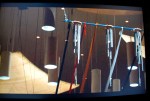
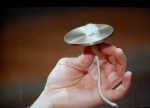
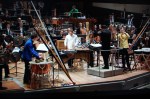
To subscribe to the Berlin Digital concert Hall, go to: http://www.digitalconcerthall.com. The photo gallery below mostly consists of photos of the percussionists and their set ups. This was purposeful as I had in mind a readership primarily of percussionists. They loosely follow the music’s progression.

 Robin Engelman
Koerner Concert Hall – Esprit Orchestra, Amadeus Choir, Nexus, Hillary Hahn, Pierre Laurent Aimard, and the Edward Westin Concert Hall.
The building on Toronto’s Bloor Street West which houses The Royal Conservatory of Music, The Glenn Gould School of Music and the Koerner Concert Hall, is wedged between Philosopher’s Walk and a small, uncovered university stadium.
The Royal Conservatory was raised in Victorian splendor, but in recent years its creaky floors had become a constant reminder of its age and the fragility of its pedagogical standing . A fund raiser was begun to bring the building into the twenty first century. A modern expansion in stainless steel and sheets of glass was built, the concert hall its linchpin and major attraction.
After a schedule of opening concerts, praise from musicians and audiences was ecstatic. A national newspaper called it “The Temple of Tone”. I suspect there were many bruised egos in the artistic community when the performers chosen for the Hall’s opening season were announced. Some local ensembles, able to afford the higher rent and hoping no doubt to rejuvenate themselves and their audiences, moved their concert series, in whole or part, to Koerner. Practically overnight, it became the place to play and the hot ticket.
Hyperbole abounds when a new hall is launched. No matter the flaws, it’s new. A lot of money, reputations and hopes rest on its success or perception thereof. If it doesn’t work, well . . . Roy Thompson Hall, the home of the Toronto Symphony, was a good example of the Emperor’s New Clothes. The symphony board of directors was intimately involved with fund raising and a Simpson Co. executive was named point man. One of his most memorable statements was in defense of the acoustician chosen for the concert hall. “Recently he’s had two major failures and Toronto will be the beneficiary of his mistakes”.
A conspiracy settled over the project. Only good news was wanted. Conductors, hastily attached themselves and their organizations to this latest Edifice Complex erection. “Finally we can hear ourselves” said a symphony musician. But it didn’t take long for truth to begin creeping, however slowly, through the cracks in the concrete of corporate, artistic and administrative hubris. James Galway, new to Roy Thompson and riding the crest of a fabulous career, stunned his audience by saying the hall’s acoustic was terrible and he would never play in the hall again. He didn’t.
After twenty years of silence, Galway’s comment emboldened Toronto’s senior music critic to suggest something should be done to improve the hall. I’m sure his suggestion,coming as it did from a local, had as much effect on the Symphony board and the hall’s subsequent six month renovation as did anything else.
Koerner Hall exists in large part because of the beneficence of Michael Koerner a resident of Toronto who is an avid supporter of the arts. He and his wife Sonja gave $8,000,000 towards the Royal Conservatory building fund including a collection of 18th century music instruments.
The Koerner concerts I’ve attended provided a wide spectrum of acoustical challenges: a symphony orchestra, a percussion ensemble, a choir, a violin recital and a piano recital. The most successful was the percussion concert. The house was sold out and I was seated mid way on the main floor and clearly heard the strokes of each player and their differences.
My seat for the orchestra concert was two thirds back and in a side box. The house was very close to full. An accordion concerto was performed with the composer as soloist. During the entire work, I could see his feet keeping time, but, aside from a short solo introduction, I did not hear a note from his instrument. Friends in the side balcony experienced the same defect, but friends who sat on the main floor heard everything. The CBC producer told me he had problems recording the soloist because he was seated a couple of feet too far upstage.
The choir stood on risers at the back of the stage and its sound was clear and fulsome. I spoke with the choir’s director and she told me the risers in that position created the best sound.
For the violin recital the house was full and my seat was five rows from the stage on the left side of the main floor. During the first half, the violin had an unsettling whine, a sharp, almost irritating sound. The tone problems were gone during the second half which was devoted to solo repertoire. The violinist had moved towards the audience about three steps. From my perspective, that’s all it took to correct the problem.
I also sat very close to the stage, again on the main floor, for the piano recital and at one point heard very high harmonics that echoed eerily after certain chords in the low register. Otherwise, all was clear.
By relating these experiences, my intention is not to suggest Koerner Hall is burdened with its own style of Emperor’s Clothes. It’s far from that. It is a welcome addition to Toronto performing spaces. It seats about 1,100 people which is a perfect size for major chamber music players. But Koerner has acoustical issues that will need to be tweaked. The question is, how long will it take for artists, administrators, conductors and audiences to face up to its flaws and explore corrective modifications? About ten miles north there is ample reason to act sooner then later.
The George Westin Recital Hall is one of Canada’s and the world’s precious gifts to music. Wigmore Hall in London comes first to mind when I contemplate comparable performance spaces. Yet Westin Is Toronto’s musical remittance man. Its exile is plagued by location. Anything north of Highway 401, the great multi lane expressway which cuts a swath across the top of the city, is felt by concert goers to be a kind of Ultimate Thule. If they have to go north of the 401, they’d rather go to dinner south of it. Too bad. Westin Recital Hall is a concert hallmark, once experienced, never forgotten.
I began this posting with the idea of writing a critique of Pierre Laurent Aimard’s piano recital. I met pianist Stephen Clarke in the lobby before the concert and his first words were, “This is the do not miss concert”. And it proved to be.
Posted by robinengelman on May 6, 2011 in Articles, Commentaries & Critiques