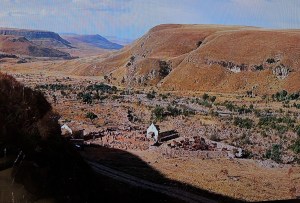
Recreation of Rorke’s Drift
Prelude:
Islanwana was the first battle in the very brief Anglo-Zulu War. It was a stunning Zulu victory and represents the blackest of pages in British military history. A Zulu army attacked and annihilated a heavily armed, encamped, but unprepared British force of 1,800 on 22 e 1879. Although an exact count of Zulu combatants may never be known, their number has been roughly calculated at 20,000. The next day four Zulu regiments, 3,000 to 4,000 men, moved against Rorke’s Drift, six miles away.
The Film:
Zulu recounts the nine hour Battle of Rork’s Drift and is one of my all-time favorite films. Zulu is Michael Caine’s first starring role and his portrayal of Lieutenant Gonville Bromhead, a public school fop whose mannerisms, not to mention his name, make him a target for people who love to hate the British upper class. Caine’s nemesis is Lieutenant John Chard of the Royal Engineers,who appears to be from more common stock. Chard is played by Stanley Baker who also produced the film. Nigel Green portrays Sgt. Bourne, a quintessential career Sergeant Major who is as imperturbable as a British marble lion. His moustache alone seems to soothe the troops and control any situation. It is doubtful anyone at Rorke’s Drift, except the Boar who delivers the news of Islanwana and stays to fight, knew who or what they were up against. They had much to fear, more than they could ever have imagined.

Michael Caine as Gonville Bromhead

Stanley Baker

Nigel Green
The progenitor of their unease was Shaka. Considered to be a military genius, Shaka (b.1787-d.1828) was born in Kwa-zulu Natal. His skill as an administrator, diplomat and politician are still disputed, but he gathered disparate local tribes under his banner and made them into an army that was feared throughout Africa. Shaka developed unique battlefield tactics and a level of discipline among his troops which years after his death, served to propelled the Zulu to stunning victories against the Dutch Boars and the British at Islanwana. Shaka’s legacy resonates today in military schools around the world.
Though filmed primarily from the perspective of the British, Zulu manages to portray both protagonists with respect and historic accuracy. Zulu was filmed mainly on location in South Africa just 100 miles south of Rorke’s Drift in a very similar landscape. In scene after scene, details in dress, weaponry, music, conduct, speech, landscape and battle tactics confirm the production staff’s dedication to authenticity. Cetshwayo kaMpande
In one of Zulu’s early scenes, Mangosuthu Buthelezi, played by his great grandson Chief Burthelezi, oversees a traditional mass wedding ceremony in his Kraal or fortified village. Here we meet the Swedish Reverend Otto Witt played by Jack Hawkins who has brought his innocent 20 something daughter to East Africa. Witt tells his daughter the Zulu are a great people, but she appears more embarrassed and titillated at the same time, as hundreds of bare breasted brides-to-be, match step for provocative step, the sensually aggressive dance of their warrior grooms.
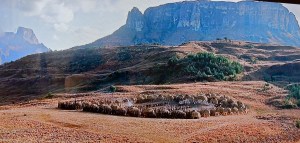
Zulu Kraal

Jack Hawkins
The remainder of the film sets the scene and portrays
the Zulu assaults upon Rorke’s Drift mission station. Bromhead and Chard, both Lieutenants, must work out which of them is in charge. This leads to my favorite line, spoken by Caine, but I won’t give it away. You can’t miss it. It takes Sgt. Major Bourne some time to adapt to an unfamiliar chain of command. But of course he soldiers on and prior to the first Zulu assault, his slow walk behind the men on the firing line, is a scene of pure dramatic genius.
The Boar draws the infamous Zulu “Bull Horns” battle formation in the sand for Chard and Bromhead and patiently explains how this now famous formation accounts for Zulu military victories.
The moment Rorke’s Drift defenders realize something sinister is afoot, the hairs on my neck raised and almost 50 years later that moment still works its magic.

The Zulu appear

Zulu chsrge & stabbing spears
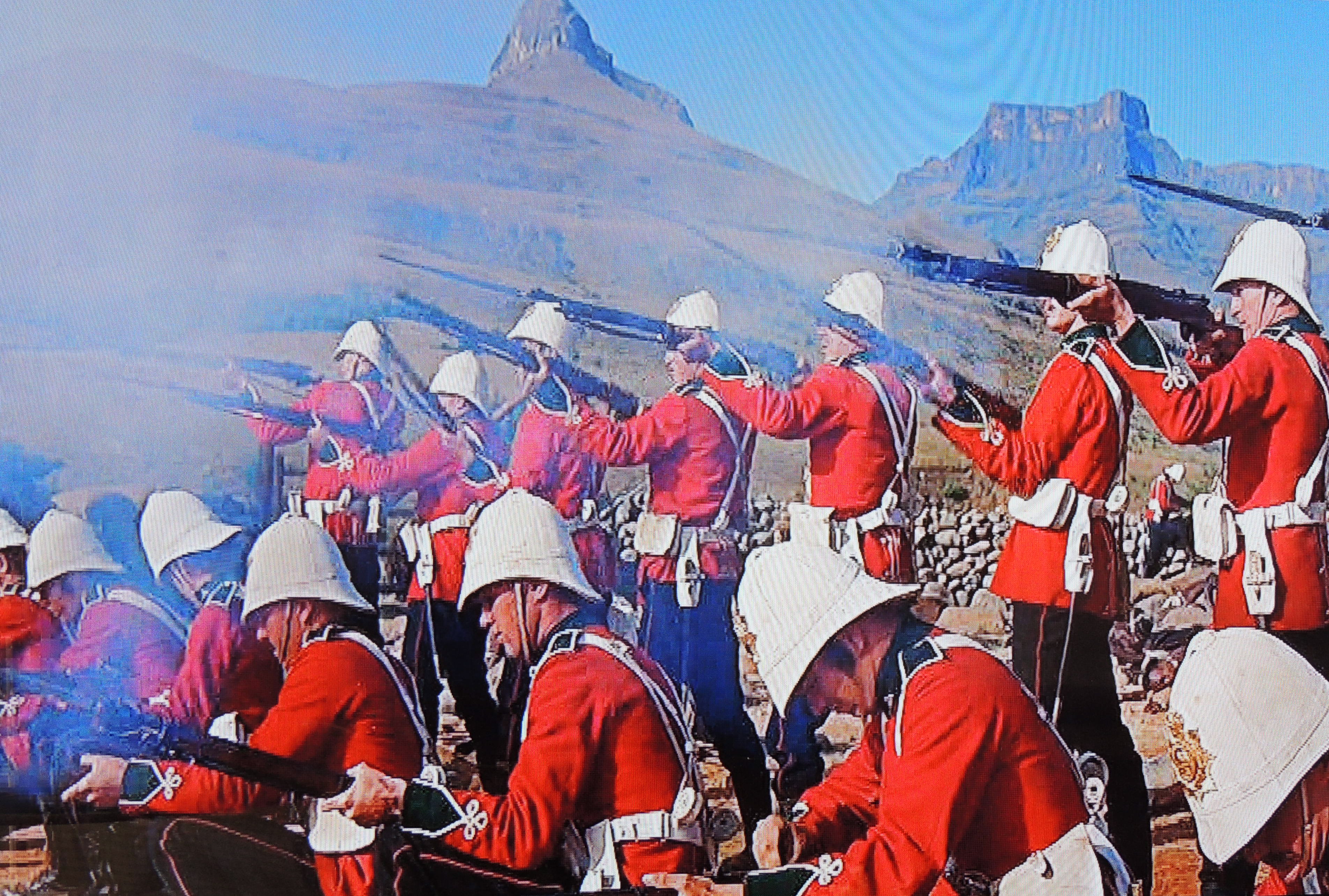
There are more subtle moments too, but most of them will be missed by all but avid military buffs. The depictions of British volley tactics are accurate as are the brief moments showing Zulu warrior’s inexperience with Martini Henry breech loading rifles. British officers wore only a side arm, a mark of courage and rank. There is a desperate moment when Caine, an officer, has a rifle thrust into his hand. The look of bemusement on Caine’s face takes only a nano second, but is priceless. Richard Burton provides the opening and closing voice over.

Postlude:
Because of apartheid, the Zulu could not be paid for their services. Director Cy Endfield gave them all the cattle used in the film, payment much more highly prized than money.
11 defenders of Rorke’s Drift were awarded theVictoria Cross, the highest number ever bestowed for one engagement. This largesse has been explained by some to be an attempt to expunge the stain of Islanwana.




 Robin Engelman
San Francisco Symphony Tour of Russia, 1972
I have been absent from the Internet for about four months and won’t bore you with explanations. Instead, I’ll relaunch with a story about my tour with the San Francisco Symphony Orchestra in the fall of 1972.
John Wyre and I had played for Seiji Ozawa in the Toronto Symphony. Seiji was now conducting the San Francisco Symphony and asked us to play extra percussion on its concerts in Europe and Russia. The tour was not going to be very difficult for us. I was to play chimes in the Charles Ives “Fourth Symphony” and snare drum in Leonard Bernstein’s “Candide” overture. I had played the one conductor version of the Ives with Gunther Shuller (b.1925) conducting the Rochester (NY) Philharmonic with Yuji Takahashi (b.1938) playing piano. At that time, I was just beginning my job as principal percussionist with the Rochester Philharmonic and in order to prepare for the first Ives rehearsal, had spent the previous summer copying by hand a complete percussion score. I had known “Candide” for many years and could play its percussion parts from memory. Thus relatively unencumbered with work, I could enjoy the travel, food and sites. We played Paris, Salzburg and Florence before flying to St. Petersburg for the first concert of the Russian tour.
As a student, John had visited Leningrad with the Eastman School of Music Symphony Orchestra. During that trip he had met the Timpanist of the Leningrad Philharmonic. Upon our arrival his friend took us to lunch. We drank copious amounts of white wine and Georgian brandy and the last thing I remember is John and me lying on our hotel room beds laughing, at what, I have no idea. Then, as if anesthetized, oblivion struck. I heard knocking at the door. I opened it and there stood the Orchestra’s personnel manager. Sobriety and a serious reality check instantly took hold.
Tony Cirone and his wife had attended mass in Florence and had missed the orchestra’s flight to Leningrad. The orchestra needed me to play Tony’s parts for tonight’s concert. His book was on stage along with all the instruments I would need. The concert hall was directly across the street from our hotel and inside were rows of simple chairs on a flat wooden floor. The hall had no proscenium arch, no curtains, just a raised wooden platform at one end of its rectangular shape. This then, was the elegant and uncomplicated home of the legendary and world renowned Leningrad Philharmonic. The acoustic was “live”. Effortlessly, sounds filled its space.
Great Hall of the Philhamonic, St. Petersburg, Russia.
The program included a Serge Prokofiev (1891-1953) “Romeo and Juliet Suite”; I can’t recall which one, with wonderful snare drum “licks” fast and soft, then slow and loud, but Bernstein’s “Serenade for Solo Violin, String Orchestra, Harp and Percussion” was the work that most occupied my attention. When I had finished practicing I played a little bit of the famous snare drum part in Shostakovich’s Seventh Symphony. Given the venue, how could I not? I became aware of a man standing about 10 feet away from me. Approaching, he pointed to the drum and said over and over, “Nazi, Nazi”. Shostakovich dedicated his 7th Symphony to the people of Leningrad and the end of fascism. Some claim Stalin was his target as much as German aggression.
Before leaving San Francisco, the orchestra was lectured by government suits. We were in the depths of the so called Cold War and their message was meant to minimize our contact with the proletariate and avoid any incidents. They warned us against bringing drugs or pornography into Russia. We were told to avoid books or magazines that might be controversial. If in doubt, don’t pack it as it was difficult to know what books might be banned. We were told to ignore requests from Russians for denim clothes or rock and roll records. These were highly prized items which could be re-sold on the black market. The message seemed to suggest we stay in our hotels and stick to playing music. Best not speak with any Russians. One could never know who was spying for the government.
These admonishments were not lost on this orchestra. It had just emerged from seven years under Josef Krips, a dictatorial martinet who used fear to dominate the players and fired some of them. With Seiji’s arrival, the paranoia spread and deepened. The players suspected more heads would roll. But that was not Seiji’s style and besides, he was just a few years away from assuming the helm of the Boston Symphony. But they couldn’t know that at the time. In retrospect, this atmosphere could explain the awkward reception given me and John by some of the players.
The Leningrad concert was an adrenaline rush. I had never played Bernstein’s wonderful “Serenade” so excuse me if I don’t remember much about that night’s performance. I do recall meeting Seiji eyeball to eyeball as we speedily made our way towards the end. It was one of those unconscious, in the zone experiences we all hope to have.
Our next stop was the city of Vilnius, Lithuania. There one evening John and I took a walk with two of the string bass players. As we strolled down the street outside our hotel, we passed a private home with 8 foot tall marijuana plants growing inside its fence, each stalk loaded with leaves. We couldn’t believe our eyes and kept walking, laughing at our good fortune. When darkness fell we stripped as many leaves as we could and hid them in our clothes. We’d show those narcs a thing or two!
We took the stash back to our hotel room, packed wet bathroom towels at the door and its transom, covered the top of a lamp shade with tin foil to concentrate the lamp’s heat and laid our leaves in small batches as close as possible to the heat. We told stories late into the morning hours as we waited for the leaves to dry enough to smoke. Our excitement was near hysteria when we rolled the first enormous joint. Each of us took a deep inhale, held it for as long as possible. Exhaling slowly, we waited for the hit to take hold. Serious now, we looked at each other, no one wanting to make the first judgement. At last we began to laugh. At about 5 AM we faced the fact that we’d been bamboozled by lust and scraggy Lithuanian weed.
While having dinner with San Francisco’s management in Vilnius, the orchestra’s manager asked if I would become their principal percussionist. I respectfully declined, citing my obligation to Nexus, just one year old at the time. But I couldn’t resist giving them my opinion on the deplorable psychological morass of their orchestra, poor morale born of insecurity, fear and suspicion – states of mind not conducive to music making. There were no rejoinders. I didn’t tell them I was afraid of an earthquake flushing the state of California and me into the Pacific Ocean.
Note:
During the 900 day siege of Leningrad, conductor Evgeny Mravinsky and Leningrad the Leningrad orchestra were evacuated to Siberia. Members of the Leningrad Radio Orchestra remained in the city. Mravinsky conducted the Leningrad Orchestra from 1938 until 1988 and is considered responsible for the orchestra’s amazing precision, particularly in its control of dynamics. I heard the orchestra in Toronto in the mid 1970s and its ability to change from fortissimo to pianissimo was breathtakingly instantaneous and precise. The premier of the 7th took place on 5 March 1942 in Kuibyshev with the Bolshoi Ballet Orchestra, Samul Samosud conducting. Karl Eliasberg gathered members of the Leningrad Radio Orchestra and the 15 or 16 members of the Leningrad B orchestra who were still living and gave the Leningrad premiere on 9 August 1942. Parts of the 7th were written in Leningrad before Shostakovich and his family were ordered by the communist party to leave Leningrad. I have on vinyl a rare recording of Shostakovich’s Symphony No. 7 , Op. 60, “Leningrad” with Mravinsky, for many years Shostakovich’s favourite conductor, conducting the Leningrad Philharmonic. Although notes on the recording are vague, it was probably recorded during the otchestra’s 1955-56 European tour. (Vanguard-VRS-6030/ 1) Between 640,000 and 800,000 people died in Leningrad during the siege.
Posted by robinengelman on June 15, 2013 in Commentaries & Critiques, Composers, History, Unassigned
Tags: Florence, John Wyre, Leningrad, Leningrad Philharmonic, Mravinsky, Robin Engelman, San Francisco Symphony Orchestra, Seiji Ozawa, Shostakovich Symphony No. 7, Tony Cirone