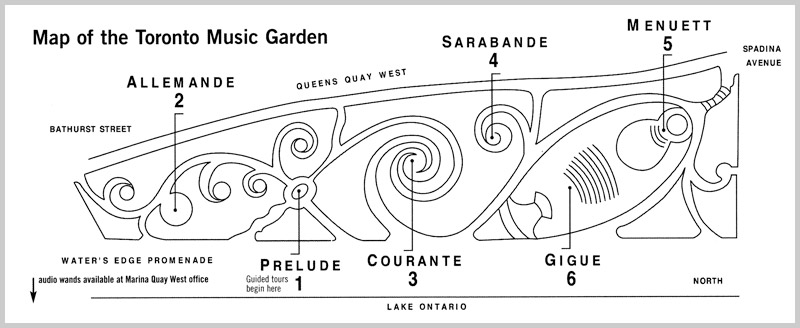
Music Garden Design.
Linda Smith writes music for dreams, dreams awash with silence. Her music gently prods the ear and takes it on a journey of discovery, each cluster of sounds a garden of delight. Her latest work titled “Rose With Thorns” for harpsichord and violin was serendipitously premiered in Toronto’s Music Garden on August 19.
This garden was the idea of cellist Yo-Yo Ma and landscape artist Julie Moir Messervy. The two came up with the idea of a “reflection in landscape of Bach’s Suite No.1 in C major for unaccompanied cello”. When the plan was completed, they took it to Boston Massachusetts in the hopes of finding a place to build it. But the city politicians of Boston vetoed the idea so Yo-Yo and Julie migrated north to a new city and a different country,Toronto, Canada.
Here in Toronto, they struck gold. They hooked up with Jim Fleck a former college bass drummer, businessman and political advisor who occupies most of his retirement hours funding important cultural organizations. Yo-Yo had found the right man. Mr. Fleck can make a phone call and people will part with significant sums of money simply by hearing “Hi, this is Jim.” Indeed, he got all the money together in a short afternoon of phone calls from his home. There was only one rejection. The owner of high end condominiums overlooking the slice of land proposed for the garden, refused to contribute even though the garden would add considerably to his property values.
It’s been a few years now since the garden was built and it has fleshed out beautifully. Native grasses, lovely shrubs and flowers and trees well on their way to maturity, make this spot if not completely tranquil, at least comforting to one’s eyes and spirit.
A decision was made to hold free week end concerts in the garden and Tamara Bernstein was chosen to organize each season’s roster. Tamara is an intelligent musician and a delightfully loquacious communicator. She has done a remarkably good job from the moment she began. Since the first Garden concert, however, problems have developed beyond those normally associated with outdoor performances.
The Music Garden exists only a sidewalks’ width from Lake Ontario. Private boats dock all along its length and a bit further out, occasional party boats pass by blaring loud music in their wakes. Porter Airlines and Air Canada launch or receive 150 flights a day from the island airport just a hefty stones throw from the garden and as evening approaches, canons are fired from the waterfront to scare Canadian geese from the airline flight paths.
On the other side are sidewalks, roads for automobiles and tracks for streetcars. From that side you get the occasional sound of horns, radios, bicycle bells, macho motorcycle motors and the clackity-clack of Toronto transit.
So what does all this extraneous noise portend for a harpsichord violin duo? Surprisingly little. The Music Garden has found a good sound-man who enhances instruments and keeps the music clearly audible against the ambient sounds. The violin harpsichord duo is from Montreal and though young, they have some very impressive things going for them. Les Amusement de la Chambres play a very interesting repertoire, mostly from the Baroque era, and play at an extremely high level of artistry. A commissioning program which regularly supplies them with contemporary works was responsible for Ms Smith’s work.
Ms Smith is slim and self effacing. For many years a major interest for her has been Tango dancing and I suspect she is very good at it. She has also become one of Canada’s senior composers. She told the audience that the title of her work came from the Rose, the violin and the plucking of the harpsichord, the Thorn. It is a substantial work, harmonically captivating with many moments of repose which allow one time to reflect and absorb.
The Music Garden’s terraced seating was filled with people and the weather was perfect. Harpsichordist Katelyn Clark and violinist Emily Redhead successfully contended with freshets of wind and noise. As for Ms Smith’s “Rose With Thorns”, they allowed its sounds to hang unhurried in the air and their performance was a treat for these ears. This duo opens many doors for music exploration and if Les Amusement de la Chambres can stay together, they will have a splendid career. They are already a welcomed addition to the chamber music of Canada.
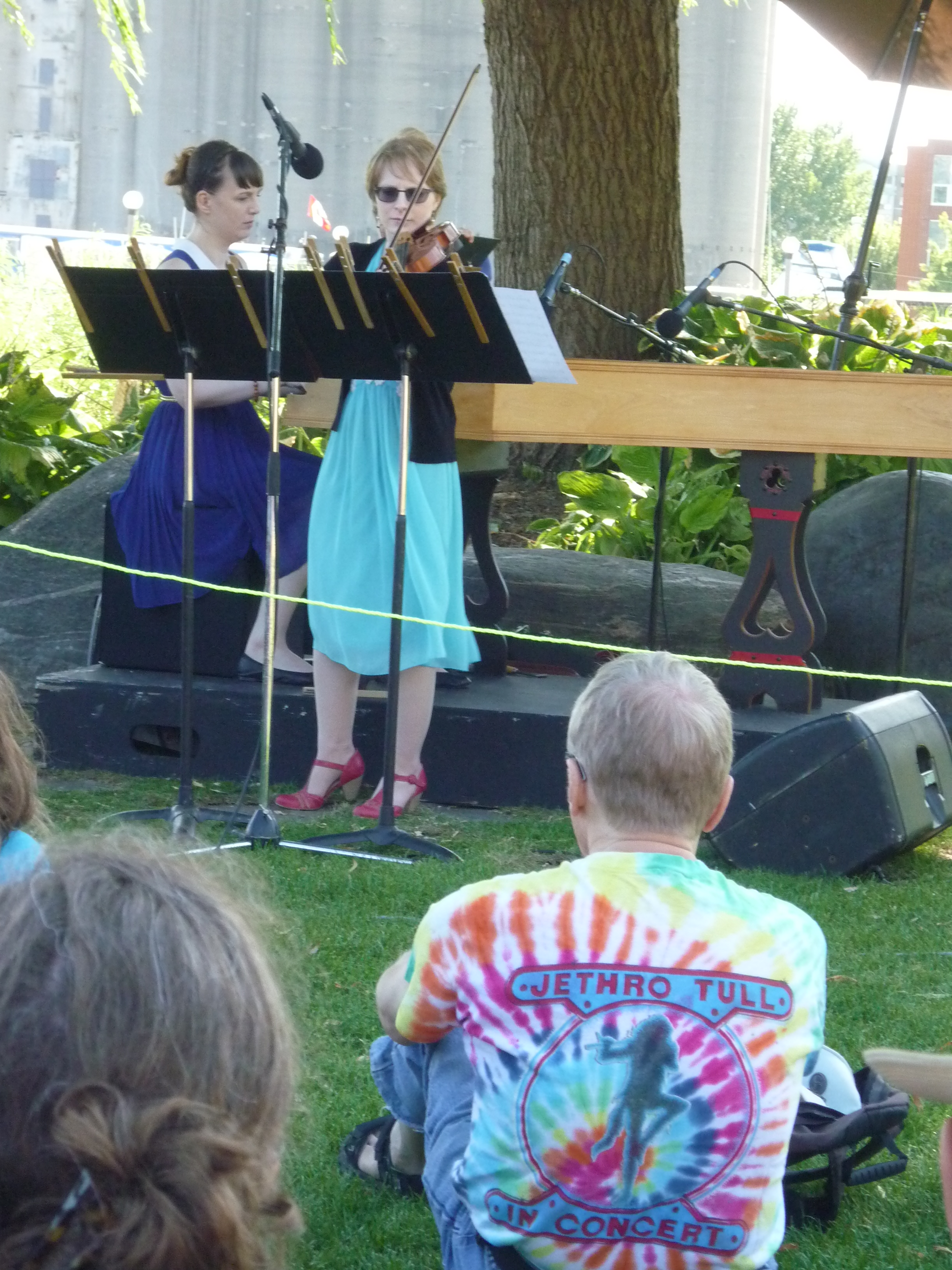
Les Amusements de la Chambre. Photo courtesy Margaret Christl.
 Robin Engelman
JOHN CAGE GOES AS SLOW AS POSSIBLE in HALBERSTADT, GERMANY.
St. Burchardi Church. Halberstadt. photo, R.E.
The drive to Quedlinburg had been long and tiring, much of it on the autobahn at night and in rain. As our hotel loomed beyond the car’s windshield wipers, we decided to reduce our travels by one destination. However, after visiting this medieval city in Germany, a World Cultural Heritage site, we changed our minds and drove back towards the city of Halberstadt. Besides a collection of 18,000 stuffed birds and being known as the town where canned sausage was invented in 1896, Halberstadt had also spent years behind the Iron Curtain, thus missing much of the achievements and benefits of its West German compatriots.
Neither stuffed birds or canned sausage had brought us to Halberstadt. Michael Praetorius (1571-1621) had proclaimed Halberstadt the city where in 1361 an organ with the first modern 12 note keyboard in Europe was built and played. Harry Partch (1901-74) declared this a “Fateful day” as that keyboard is considered the beginning of modern music. Halberstadt’s St. Burchardi church is also the home of the John Cage project (1912-92 ) ORGAN2 As Slow As Possible (ASLSP).
ASLSP was written in 1985 as the required piano work for a Maryland State contemporary music competition. In 1987 the German composer and organist Gerd Zacher (b. 1929-), asked Cage to make a version for organ which Cage named ORGAN2/ASLSP. During a discussion of Cage’s music in 1993, a German musicologist made an offhand comment about an organ being capable of sustaining tones indefinitely. From that comment came the idea for an ORGAN2/ASLSP project. A committee, a board of directors and a fund were established and the Halberstadt’s city fathers donated St. Burchardi’s Church as a home for the project.
As we approached the entrance to St. Burchardi, I was free of preconceptions. We walked through the front door into a ruin. After political secularization, St. Burchardi’s was used as a pig sty. Today, rubble removed, and a new roof and floor of gravel, St. Burchardi casts a spell. It evokes an archaic temple neither removed from, nor a part of this world. Through pane-less windows, light revealed scarred timber beans, dusty walls and a general impression of the building’s original shape, created 1,000 years ago. We were spellbound by the sound of two soft notes hanging in space. It was magic.
The ORGAN2ASLSP time span of 639 years was determined by subtracting the invention date of the 12 note keyboard from the millennium year 2000. Various difficulties, however, delayed the project opening by one year.
Just beyond the entrance of St. Burchardi, photo R.E.
Lest readers think I have an inordinate love of Cage’s music, I do discriminate. I prefer the music he wrote between 1933 and 1952, the dates encompassing his incomparable works for percussion -the core repertoire of modern percussion ensembles, the works for Prepared Piano and his 4′ 33″ the work he declared unto death to be his best.
Photo by E.E.
The Cage Projekt has not been without its critics. Zacher for instance said Cage never intended such a lengthy performance. The most recent sound changes to ORGAN2/ASLAP, occurred on 5 July 2012. The next will occur on 5 October 2013. All score changes take place on the 5th day of the month in honour of Cage’s birthday. Organ pipes are added and or sbtracted to realize note changes and small bags of sand are hung on appropriate keyes to keep the tones audible. The organ will gradually be built as the work progresses. A generator buried under replicas of the original church organ bellows, sends a constant source of air to the organ pipes located across the trancept.
Replica of original bellows with ASLSP organ in the distance. photo, Rainer Sennewald
1,000 Euros will allow a donor to have a message inscribed on a metal plaque which will be mounted below a year of their choice if available. The church guardian, a Polish man who came to Halberstadt some years ago and found himself unemployed, vetted a number of job advertisements and chose the ORGAN2/ASLAP job because “it sounded interesting”. He is a delightful individual who loves the project under his care and has an understanding of Cage and his music that took me back a few paces. He knew the contents of the books for sale and was happy to answer questions. He said there were line ups on the weekends and a rather steady, but smaller flow on weekdays. When a change of notes takes place, St. Burchardi is packed.
Tourists are its congregation and as its organist, Cage plays a concert for the ages.
Donor plaques, Halberstadt, photo R.E.
Posted by robinengelman on November 3, 2012 in Articles, Commentaries & Critiques, Contemporary Music
Tags: Cage, Halberstadt, John Cage, ORGAN2/ASLSP