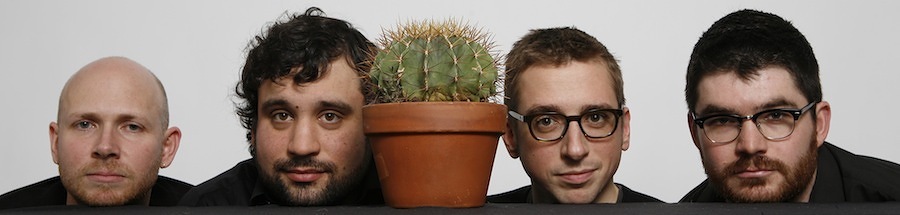
 Jason Treuting Adam Sliwinski Eric Beach Josh Quillen
So Percussion members with cactus will perform at Koerner Hall, Glenn Gould School of Music, Toronto, Friday night, 2 March, 2012.
Program:
Credo in US (1942) John CAGE
Needles (2010) SŌ PERCUSSION / MATMOS
Imaginary Landscape #1 (1939) John CAGE
Use (2009) Cenk ERGÜN
“Bottles” from Ghostbuster Cook: The Origin of the Riddler (2011) Dan DEACON
18’12”, a simultaneous performance of Cage works
-Inlets (Improvisation II) (1977) John CAGE
-0’00” (4’33” No.2) (1962)
-Duet for Cymbal (1960)
-45’ for a speaker (1954)
24 x 24 (w/ special guests) (2011) SŌ PERCUSSION
Third Construction (1941) John CAGE
Unfortunately, I won’t be attending. Just about the time they go on, I’ll be in the throes of a Morphine drip as I recover from a hip replacement operation just ten blocks from their venue. I’ve been on Morphine drips before and I can guarantee I’ll not be thinking of So Percussion or the Cactus below left I loaned them for their concert.

Nexus played Cage’s work for cacti in Amsterdam during a festival many years ago. At the end of the piece and before the applause began, someone in the audience cried out, “Bull Shit!”. Our next work was “Third Construction” and as we moved to our places, I replied, “Cactus Shit”. The morning newspaper review headlined Cactus Shit. Everything else was in Dutch, but we were made to understand the review was favorable. ‘Twas well it was, as we had spent an entire afternoon the day before hand picking cacti that would accommodate our strip, adhesive mikes – think Band Aids. The sounds were wonderful.
 L. to R. John Cage, Paeder Mercier and R.E. after a ROARATORIO performance in Toronto, ca, 1979.
My wife and I have a small collection of cacti and looking at them everyday, I am reminded of Phil Nimmons, Canada’s iconic band leader, composer, arranger, clarinetist and frequent guest artist with Nexus who gave most of them to us. I also think of Cage and some of the experiences I shared with him over the years. During Prof. Robert O’Driscoll’s Celtic Consciousness Festival, I had the great pleasure of meeting Irish Harp player Grainne Yeats, who married Michael Yeats, a son of Irish poet William Butler Yeats (1865-1939). Together we played nine performances of W. B. Yeats’ play Cuhulain. The performances were rather strange, but Grainne and I hit it off and she proffered fascinating insights into her father-in-law’s work. Grainne was a marvelous harpist who thought we were playing far too much, but our director kept asking for more music. He was sure the play would fail and thought continuous music would save the play and him.
During the Celtic Festival, John Cage arrived with a band of Irish musicians for performances of his delightful ROARATORIO and Irish Circus. The drummers were Paeder Mercier and his son Mel. Paeder came to a Nexus rehearsal with Cage as we were learning a work written for us by Bruce Mather, Clos du Vougeot. Mather’s music requires exquisite and continuous balance among parts and after we had finished Paeder said, “It’s like being a bridesmaid”. I loved this insightful comment and we became friends. He sold me an extra Bodhrán and gave me some preliminary lessons.
This was heady stuff for me because at the time Paeder was the Bodhrán player for the very popular Irish band The Chieftains. And what a Bodhrán player he was – loose as a Goose and always in the pocket! He made those Irish tunes roll. There was a tune on one of the Chieftains recordings whose beat I couldn’t figure out so I wrote Paeder an inquiry. He wrote back saying, “That’s my secret beat. I’ll show it to you when you come to Ireland.” Nexus did go to Liverpool and Paeder crossed the Irish Sea from Dublin to meet me. When he registered at the hotel there was a message waiting for him saying his brother had just died. Paeder went back to Ireland and I never learned his secret beat. Sadly, a few years later Paeder was himself dead.
 Robin Engelman
JOHN CAGE GOES AS SLOW AS POSSIBLE in HALBERSTADT, GERMANY.
St. Burchardi Church. Halberstadt. photo, R.E.
The drive to Quedlinburg had been long and tiring, much of it on the autobahn at night and in rain. As our hotel loomed beyond the car’s windshield wipers, we decided to reduce our travels by one destination. However, after visiting this medieval city in Germany, a World Cultural Heritage site, we changed our minds and drove back towards the city of Halberstadt. Besides a collection of 18,000 stuffed birds and being known as the town where canned sausage was invented in 1896, Halberstadt had also spent years behind the Iron Curtain, thus missing much of the achievements and benefits of its West German compatriots.
Neither stuffed birds or canned sausage had brought us to Halberstadt. Michael Praetorius (1571-1621) had proclaimed Halberstadt the city where in 1361 an organ with the first modern 12 note keyboard in Europe was built and played. Harry Partch (1901-74) declared this a “Fateful day” as that keyboard is considered the beginning of modern music. Halberstadt’s St. Burchardi church is also the home of the John Cage project (1912-92 ) ORGAN2 As Slow As Possible (ASLSP).
ASLSP was written in 1985 as the required piano work for a Maryland State contemporary music competition. In 1987 the German composer and organist Gerd Zacher (b. 1929-), asked Cage to make a version for organ which Cage named ORGAN2/ASLSP. During a discussion of Cage’s music in 1993, a German musicologist made an offhand comment about an organ being capable of sustaining tones indefinitely. From that comment came the idea for an ORGAN2/ASLSP project. A committee, a board of directors and a fund were established and the Halberstadt’s city fathers donated St. Burchardi’s Church as a home for the project.
As we approached the entrance to St. Burchardi, I was free of preconceptions. We walked through the front door into a ruin. After political secularization, St. Burchardi’s was used as a pig sty. Today, rubble removed, and a new roof and floor of gravel, St. Burchardi casts a spell. It evokes an archaic temple neither removed from, nor a part of this world. Through pane-less windows, light revealed scarred timber beans, dusty walls and a general impression of the building’s original shape, created 1,000 years ago. We were spellbound by the sound of two soft notes hanging in space. It was magic.
The ORGAN2ASLSP time span of 639 years was determined by subtracting the invention date of the 12 note keyboard from the millennium year 2000. Various difficulties, however, delayed the project opening by one year.
Just beyond the entrance of St. Burchardi, photo R.E.
Lest readers think I have an inordinate love of Cage’s music, I do discriminate. I prefer the music he wrote between 1933 and 1952, the dates encompassing his incomparable works for percussion -the core repertoire of modern percussion ensembles, the works for Prepared Piano and his 4′ 33″ the work he declared unto death to be his best.
Photo by E.E.
The Cage Projekt has not been without its critics. Zacher for instance said Cage never intended such a lengthy performance. The most recent sound changes to ORGAN2/ASLAP, occurred on 5 July 2012. The next will occur on 5 October 2013. All score changes take place on the 5th day of the month in honour of Cage’s birthday. Organ pipes are added and or sbtracted to realize note changes and small bags of sand are hung on appropriate keyes to keep the tones audible. The organ will gradually be built as the work progresses. A generator buried under replicas of the original church organ bellows, sends a constant source of air to the organ pipes located across the trancept.
Replica of original bellows with ASLSP organ in the distance. photo, Rainer Sennewald
1,000 Euros will allow a donor to have a message inscribed on a metal plaque which will be mounted below a year of their choice if available. The church guardian, a Polish man who came to Halberstadt some years ago and found himself unemployed, vetted a number of job advertisements and chose the ORGAN2/ASLAP job because “it sounded interesting”. He is a delightful individual who loves the project under his care and has an understanding of Cage and his music that took me back a few paces. He knew the contents of the books for sale and was happy to answer questions. He said there were line ups on the weekends and a rather steady, but smaller flow on weekdays. When a change of notes takes place, St. Burchardi is packed.
Tourists are its congregation and as its organist, Cage plays a concert for the ages.
Donor plaques, Halberstadt, photo R.E.
Posted by robinengelman on November 3, 2012 in Articles, Commentaries & Critiques, Contemporary Music
Tags: Cage, Halberstadt, John Cage, ORGAN2/ASLSP